Popular Car Shipping Routes
These are some of our most popular car shipping routes since 2004. Door-to-door car transport with no surprises, no hidden fees, and three options to ship your vehicle anywhere on your schedule.
★ 4.6/5 Google Reviews | BBB Accredited A+ | FMCSA Licensed (MC #479342) | USDOT #1240502 | No upfront payment required | 20+ years shipping vehicles
Our Most Popular Car Shipping Routes
Every vehicle shipment route is available at three service levels:
Standard, Expedited, & Rush Options
Choose the one that fits your timeline and budget. All three include full door-to-door route service and carrier insurance.

Popular California Routes
Estimated door-to-door cost to ship a car from California, by service tier.

| Route | Distance | Standard | Expedited | Rush | Transit | Best Season |
|---|---|---|---|---|---|---|
| California to Florida | ~2,500 mi | $1,880 | $2,285 | $2,520 | 5–6 days | Apr–May |
| California to Texas | ~1,440 mi | $1,170 | $1,380 | $1,570 | 3–4 days | Mar–Apr |
| California to New York | ~2,790 mi | $2,075 | $2,540 | $2,780 | 6–7 days | May–Jun |
| California to Illinois | ~2,015 mi | $1,550 | $1,865 | $2,075 | 5–6 days | May–Jun |
| California to Ohio | ~2,250 mi | $1,710 | $2,065 | $2,290 | 5–6 days | Sep–Oct |
| California to Michigan | ~2,290 mi | $1,740 | $2,100 | $2,330 | 5–6 days | Jun–Jul |
| California to New Jersey | ~2,770 mi | $2,060 | $2,525 | $2,760 | 6–7 days | May–Jun |
| California to North Carolina | ~2,430 mi | $1,830 | $2,220 | $2,450 | 5–6 days | Sep–Oct |
| California to Virginia | ~2,670 mi | $1,995 | $2,435 | $2,675 | 6–7 days | Apr–May |
| California to Georgia | ~2,175 mi | $1,660 | $2,000 | $2,225 | 5–6 days | Feb–Mar |
| California to Arizona | ~370 mi | $485 | $565 | $650 | 1–2 days | Apr–May |
| California to Colorado | ~1,015 mi | $890 | $1,040 | $1,195 | 3–4 days | May–Jun |
Popular Florida Routes
Estimated door-to-door cost to ship a car from Florida, by service tier.
| Route | Distance | Standard | Expedited | Rush | Transit | Best Season |
|---|---|---|---|---|---|---|
| Florida to California | ~2,500 mi | $1,880 | $2,285 | $2,520 | 5–6 days | Sep–Oct |
| Florida to Texas | ~1,100 mi | $940 | $1,105 | $1,260 | 3–4 days | Mar–Apr |
| Florida to New York | ~1,075 mi | $925 | $1,085 | $1,240 | 3–4 days | May–Jun |
| Florida to Illinois | ~1,180 mi | $995 | $1,175 | $1,335 | 3–4 days | May–Jun |
| Florida to Ohio | ~915 mi | $820 | $960 | $1,100 | 2–3 days | Sep–Oct |
| Florida to Michigan | ~1,185 mi | $1,000 | $1,175 | $1,340 | 3–4 days | Jun–Jul |
| Florida to New Jersey | ~1,065 mi | $920 | $1,080 | $1,235 | 3–4 days | May–Jun |
| Florida to North Carolina | ~525 mi | $565 | $660 | $755 | 2–3 days | Sep–Oct |
| Florida to Virginia | ~810 mi | $750 | $880 | $1,005 | 2–3 days | Apr–May |
| Florida to Georgia | ~440 mi | $515 | $600 | $690 | 1–2 days | Feb–Mar |
| Florida to Arizona | ~2,070 mi | $1,590 | $1,910 | $2,130 | 5–6 days | Apr–May |
| Florida to Colorado | ~1,720 mi | $1,355 | $1,610 | $1,815 | 4–5 days | May–Jun |
Popular Texas Routes
Estimated door-to-door cost to ship a car from Texas, by service tier.
| Route | Distance | Standard | Expedited | Rush | Transit | Best Season |
|---|---|---|---|---|---|---|
| Texas to California | ~1,440 mi | $1,170 | $1,380 | $1,570 | 3–4 days | Sep–Oct |
| Texas to Florida | ~1,100 mi | $940 | $1,105 | $1,260 | 3–4 days | Apr–May |
| Texas to New York | ~1,550 mi | $1,240 | $1,470 | $1,660 | 4–5 days | May–Jun |
| Texas to Illinois | ~925 mi | $830 | $965 | $1,110 | 2–3 days | May–Jun |
| Texas to Ohio | ~1,055 mi | $915 | $1,070 | $1,225 | 3–4 days | Sep–Oct |
| Texas to Michigan | ~1,160 mi | $980 | $1,155 | $1,315 | 3–4 days | Jun–Jul |
| Texas to New Jersey | ~1,540 mi | $1,235 | $1,460 | $1,655 | 4–5 days | May–Jun |
| Texas to North Carolina | ~1,030 mi | $900 | $1,050 | $1,205 | 3–4 days | Sep–Oct |
| Texas to Virginia | ~1,320 mi | $1,090 | $1,285 | $1,460 | 3–4 days | Apr–May |
| Texas to Georgia | ~780 mi | $735 | $855 | $985 | 2–3 days | Feb–Mar |
| Texas to Arizona | ~1,065 mi | $920 | $1,080 | $1,235 | 3–4 days | Apr–May |
| Texas to Colorado | ~795 mi | $740 | $865 | $990 | 2–3 days | May–Jun |
Estimates are based on open transport; enclosed runs roughly 50% more. Standard is the most economical tier, Expedited is our most popular, and Rush prioritizes your vehicle on the dispatch board. Your exact rate depends on vehicle size, transport type and timing — run the instant calculator for a live price.
The Company That Invented Instant Auto Transport Pricing
Direct Express Auto Transport pioneered online instant pricing for the auto transport industry in 2004. Before we built the first car shipping cost calculator, getting a quote from a broker meant phone calls, callbacks, and waiting — sometimes days. We changed that. Today you know your exact cost in 30 seconds, before committing to anything. No phone tag, no hassle. Just a real number, instantly.
Three Service Tiers for Every Nationwide Route Shipment
Every shipment on every route is available at three service tiers so you can match your budget to your timeline. Standard delivers at the best available rate — ideal when your schedule has a few days of flexibility. Expedited moves your vehicle to the front of the dispatch queue for faster pickup. Rush gets your car picked up as fast as humanly possible — for moves where every day counts. All three tiers include full door-to-door service and carrier insurance.
What customers say about shipping a car nationwide with Direct Express Auto Transport
And their carrier Speedstar did an exceptional job.. everyone was
Courteous and the driver was extremely competent. They transported or car in 30 hrs from TX to MA. I would definitely use them again.
What Affects Your Price
Distance & route
Long hauls cost less per mile; carriers favor major corridors like I-10, I-80 and I-95.
Vehicle size & weight
Trucks, SUVs and vans take more space and fuel than sedans.
Open vs. enclosed
Open transport is the standard; enclosed runs about 50% more for high-value cars.
Season & timing
Demand spikes during snowbird and summer moving season — see the seasonality notes below.
Vehicle condition
Running vehicles load easily; non-running units need a winch and cost more.
Service tier
Standard, Expedited or Rush — you choose how quickly a carrier is assigned.

Seasonality: When to Ship
Auto transport is seasonal nationwide. Snowbird season drives heavy southbound demand into Florida, Arizona and Texas in late fall, followed by a northbound surge in early spring — both push prices up on those lanes. Summer, roughly June through August, is the busiest period everywhere as families and college students relocate.
The best value usually lands in the shoulder seasons — late spring and early fall — when carrier supply is high and demand cools. The Best Season column in the tables above reflects the general sweet spot for each lane. Whatever the season, booking within about two weeks of your ship date gets you the most accurate, current rate, since pricing moves with the market.
How Car Shipping Works
1. Get your instant quote
Enter pickup, delivery and vehicle details for transparent pricing in seconds — no personal info required.
2. Choose your tier
Pick Standard, Expedited or Rush based on whether budget or speed matters most. See how it works to get you the best bang for the buck.
3. We assign a vetted carrier
We match your vehicle with an insured, top-rated hauler already running your route. No payment is due until this point.
4. Door-to-door delivery
Your carrier coordinates pickup and delivery as close to your doors as safely possible.

Other Popular Car Shipping Routes
The same lanes in the reverse direction — shipping into our California, Florida and Texas hubs.
Routes to California
| From (State) | To | Distance | Transit |
|---|---|---|---|
| Florida | California | ~2,500 mi | 5–6 days |
| Texas | California | ~1,440 mi | 3–4 days |
| New York | California | ~2,790 mi | 6–7 days |
| Illinois | California | ~2,015 mi | 5–6 days |
| Ohio | California | ~2,250 mi | 5–6 days |
| Michigan | California | ~2,290 mi | 5–6 days |
| New Jersey | California | ~2,770 mi | 6–7 days |
| North Carolina | California | ~2,430 mi | 5–6 days |
| Virginia | California | ~2,670 mi | 6–7 days |
| Georgia | California | ~2,175 mi | 5–6 days |
| Arizona | California | ~370 mi | 1–2 days |
| Colorado | California | ~1,015 mi | 3–4 days |
Routes to Florida
| From (State) | To | Distance | Transit |
|---|---|---|---|
| California | Florida | ~2,500 mi | 5–6 days |
| Texas | Florida | ~1,100 mi | 3–4 days |
| New York | Florida | ~1,075 mi | 3–4 days |
| Illinois | Florida | ~1,180 mi | 3–4 days |
| Ohio | Florida | ~915 mi | 2–3 days |
| Michigan | Florida | ~1,185 mi | 3–4 days |
| New Jersey | Florida | ~1,065 mi | 3–4 days |
| North Carolina | Florida | ~525 mi | 2–3 days |
| Virginia | Florida | ~810 mi | 2–3 days |
| Georgia | Florida | ~440 mi | 1–2 days |
| Arizona | Florida | ~2,070 mi | 5–6 days |
| Colorado | Florida | ~1,720 mi | 4–5 days |
Routes to Texas
| From (State) | To | Distance | Transit |
|---|---|---|---|
| California | Texas | ~1,440 mi | 3–4 days |
| Florida | Texas | ~1,100 mi | 3–4 days |
| New York | Texas | ~1,550 mi | 4–5 days |
| Illinois | Texas | ~925 mi | 2–3 days |
| Ohio | Texas | ~1,055 mi | 3–4 days |
| Michigan | Texas | ~1,160 mi | 3–4 days |
| New Jersey | Texas | ~1,540 mi | 4–5 days |
| North Carolina | Texas | ~1,030 mi | 3–4 days |
| Virginia | Texas | ~1,320 mi | 3–4 days |
| Georgia | Texas | ~780 mi | 2–3 days |
| Arizona | Texas | ~1,065 mi | 3–4 days |
| Colorado | Texas | ~795 mi | 2–3 days |
Preparing Your Vehicle for Shipment
Wash & document
Clean the exterior and photograph all sides so the condition is clear on the Bill of Lading.
Remove items & toll tags
Take out personal belongings and remove E-ZPass/toll transponders. Carriers allow up to ~100 lbs in the trunk.
Quarter tank of gas
Keep the tank around 1/4 full — enough to load and unload without adding weight.
Disable the alarm & leave a key
Switch off the car alarm and provide a key so the driver can reposition the vehicle.
Check it rolls, brakes & steers
Confirm it’s operable, or flag a non-running vehicle in advance so the right equipment is sent.
Note existing damage
Record any scratches or dents with the driver at both pickup and delivery.
Open vs. Enclosed Car Transport: Which Should You Choose?
Most of the popular routes in the tables above run along major interstate corridors — I-95, I-10, I-35, I-70, and I-80 — that are heavily trafficked and carrier-friendly. Both open and enclosed transport are available on these high-volume lanes; the right choice comes down to your vehicle’s value and the season.
Open Transport Recommended for Most
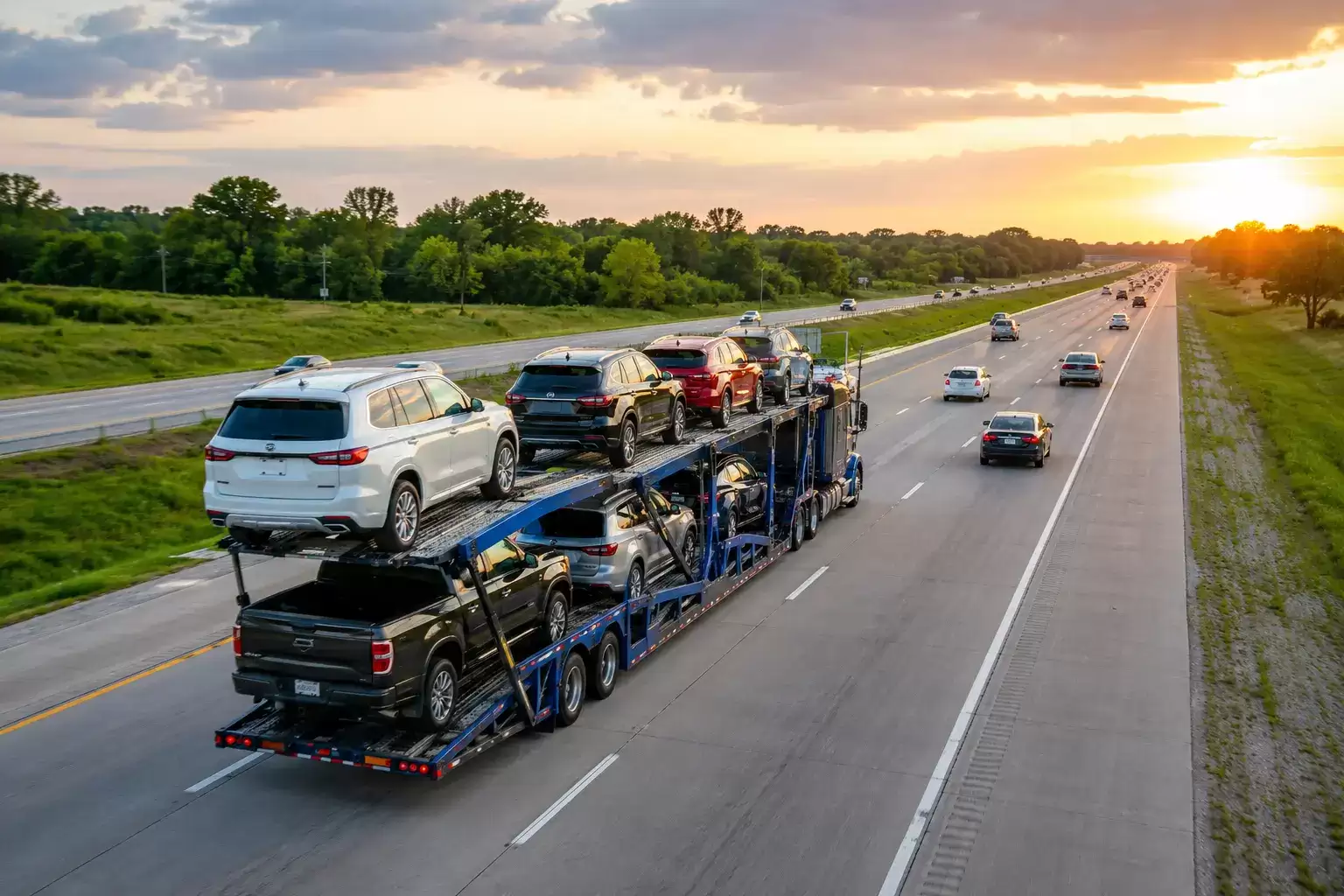
- Carries 7–10 vehicles on an open-air trailer
- Most cost-effective option — the same method used to deliver new cars to dealerships
- Well-suited for standard sedans, trucks, SUVs, and minivans
- The high-volume routes shown above see heavy open-carrier traffic — great availability and competitive rates
- Your vehicle will be exposed to road dust, light weather, and the elements — normal for this transport type
Enclosed Transport
- Vehicle travels inside a fully covered trailer — fully protected from road debris and weather
- Typically costs 40–60% more than open transport
- Ideal for: luxury vehicles, classic or collector cars, sports cars with low ground clearance, and custom paint or wrap
- Worth considering for high-value vehicles on long winter routes through the Midwest and Northeast (Nov–Mar)
- Fewer enclosed carriers operate than open carriers; book earlier to ensure availability
Our honest recommendation: If you’re shipping a daily driver or a vehicle worth under $60,000, open transport is the right call on virtually every popular route — these corridors are heavily trafficked by experienced carriers, so availability and pricing are excellent. If you’re shipping a classic Mustang, a Porsche, or a vehicle with sentimental value you can’t put a price on, pay the premium for enclosed. The protection is worth it.
FAQs About Popular Shipping Routes
What are the most popular car shipping routes in the U.S.?
Some of the busiest lanes run between major hubs like California, Florida and Texas and states across the Northeast, Midwest and Southwest — for example California to New York, Florida to Texas and Texas to Illinois. High-volume corridors like these tend to have more carriers competing, which usually means faster pickup and more competitive pricing.
How much does it cost to ship a car cross-country?
A coast-to-coast move such as California to New York typically runs in the low-to-mid four figures on our Standard tier, with Expedited and Rush adding a premium for faster carrier assignment. Exact pricing depends on distance, vehicle size, open vs. enclosed transport and timing — the instant calculator returns a live quote in seconds.
Does the direction of a route change the price?
Sometimes, yes. Rates on the same lane can differ by direction depending on carrier supply and seasonal demand — northbound and southbound snowbird routes are the classic example. That is why a quote reflects the specific origin and destination, not just the mileage.
How long does shipping take on a long-distance route?
Plan on roughly one day of transit for every 500 miles once your vehicle is loaded. A regional move takes 1–3 days, while a cross-country route generally takes 5–7 days depending on distance, weather and the carrier's schedule.
Why do prices on the same route change throughout the year?
Auto transport is seasonal. Demand spikes during snowbird season — late fall southbound and early spring northbound — and through the summer moving months, which raises prices on the affected lanes. The shoulder seasons of late spring and early fall usually offer the best value.
What is the difference between Standard, Expedited and Rush on a route?
Standard is our most economical rate and works best with a flexible pickup window. Expedited — our most popular tier — speeds up carrier assignment for a modest premium, and Rush puts your vehicle at the top of the dispatch board for urgent, deadline-driven moves.
Are snowbird routes to Florida and Arizona more expensive?
They can be during peak season. Heavy southbound demand in late fall and a northbound surge in early spring tighten carrier availability on these lanes and push prices up. Booking a few weeks ahead, or shipping in the off-peak shoulder season, helps keep costs down.
Do shorter routes cost more per mile than cross-country routes?
Yes. Long hauls spread a carrier's fixed costs over more miles, so the cost per mile is lower than on short regional routes even though the total price is higher. That is why a 2,500-mile move is nowhere near 25 times the price of a 100-mile one.
Can I ship to or from any city on these routes, or only the major metros?
Both. The tables highlight state-to-state lanes, but we provide door-to-door service to virtually any city or town along them, picking up and delivering as close to your address as a carrier can safely reach.
Do I have to pay upfront, and how accurate are these route estimates?
No upfront payment is required to book — you pay once a carrier is assigned, with the balance typically due on delivery. The figures in the tables are estimates for open transport; for an exact, current price on your route, run the instant calculator.