Florida to Colorado Car Shipping
The original instant car shipping calculator — trusted since 2004. Door-to-door Florida to Colorado transport with no surprises, no hidden fees, and three options to ship your vehicle on your schedule.
★ 4.6/5 Google Reviews | BBB Accredited A+ | FMCSA Licensed (MC #479342) | USDOT #1240502 | No upfront payment required | 20+ years shipping vehicles


Florida to Colorado Car Shipping Rates by City
Every Florida to Colorado vehicle shipment is available at three service levels:
Standard, Expedited, & Rush Options
Choose the one that fits your timeline and budget. All three include full door-to-door service and carrier insurance.
The Company That Invented Instant Auto Transport Pricing
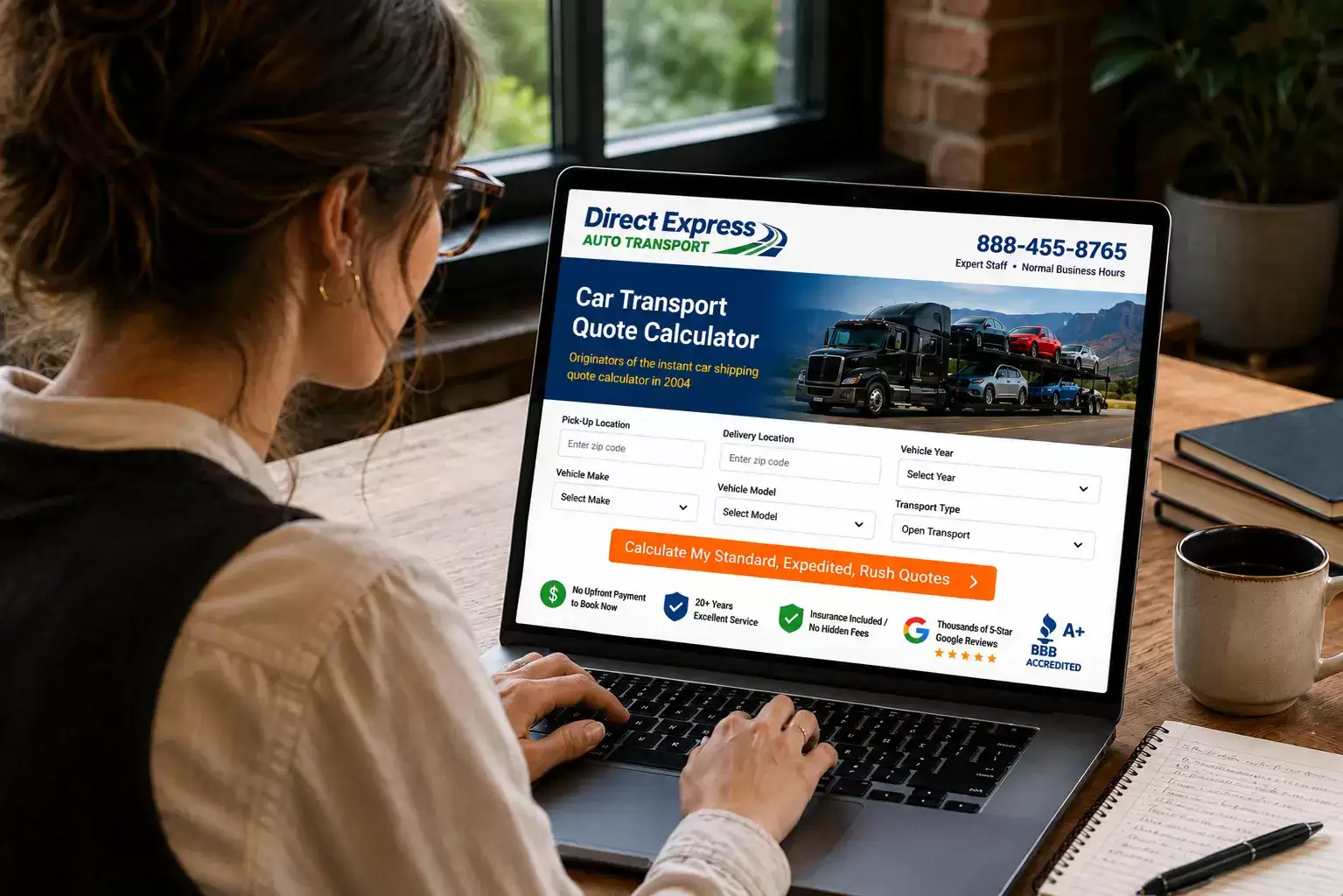
Direct Express Auto Transport pioneered online instant pricing for the auto transport industry in 2004. Before we built the first car shipping cost calculator, getting a quote from a broker meant phone calls, callbacks, and waiting — sometimes days. We changed that. Today you know your exact cost in 30 seconds, before committing to anything. No phone tag, no hassle. Just a real number, instantly.
Three Service Tiers for Every Florida to Colorado Shipment
Every shipment on this Florida to Colorado route is available at three service tiers so you can match your budget to your timeline. Standard delivers at the best available rate — ideal when your schedule has a few days of flexibility. Expedited moves your vehicle to the front of the dispatch queue for faster pickup. Rush gets your car picked up as fast as humanly possible — for moves where every day counts. All three tiers include full door-to-door service and carrier insurance.
What customers say about shipping a car from Florida to Colorado with Direct Express Auto Transport


Seasonal Pricing Guide: Florida to Colorado
Florida to Colorado spans two peaks: ski-season arrivals in fall (October–November) and military PCS in summer (June–July). August–September is the best value window, sitting between the post-PCS lull and the October ski-season surge.


Who Ships a Car from Florida to Colorado — and Why
Florida to Colorado is a corridor defined by altitude, lifestyle, and the military. The two states represent near-opposite geography — Florida is the flattest state in the continental US, averaging 6 feet above sea level; Colorado has more peaks above 14,000 feet than any other state. The people making this move are overwhelmingly making a deliberate lifestyle trade: ocean and warmth for mountains and seasons.
Military PCS: MacDill AFB / Patrick SFB → Fort Carson / Peterson SFB / Schriever SFB
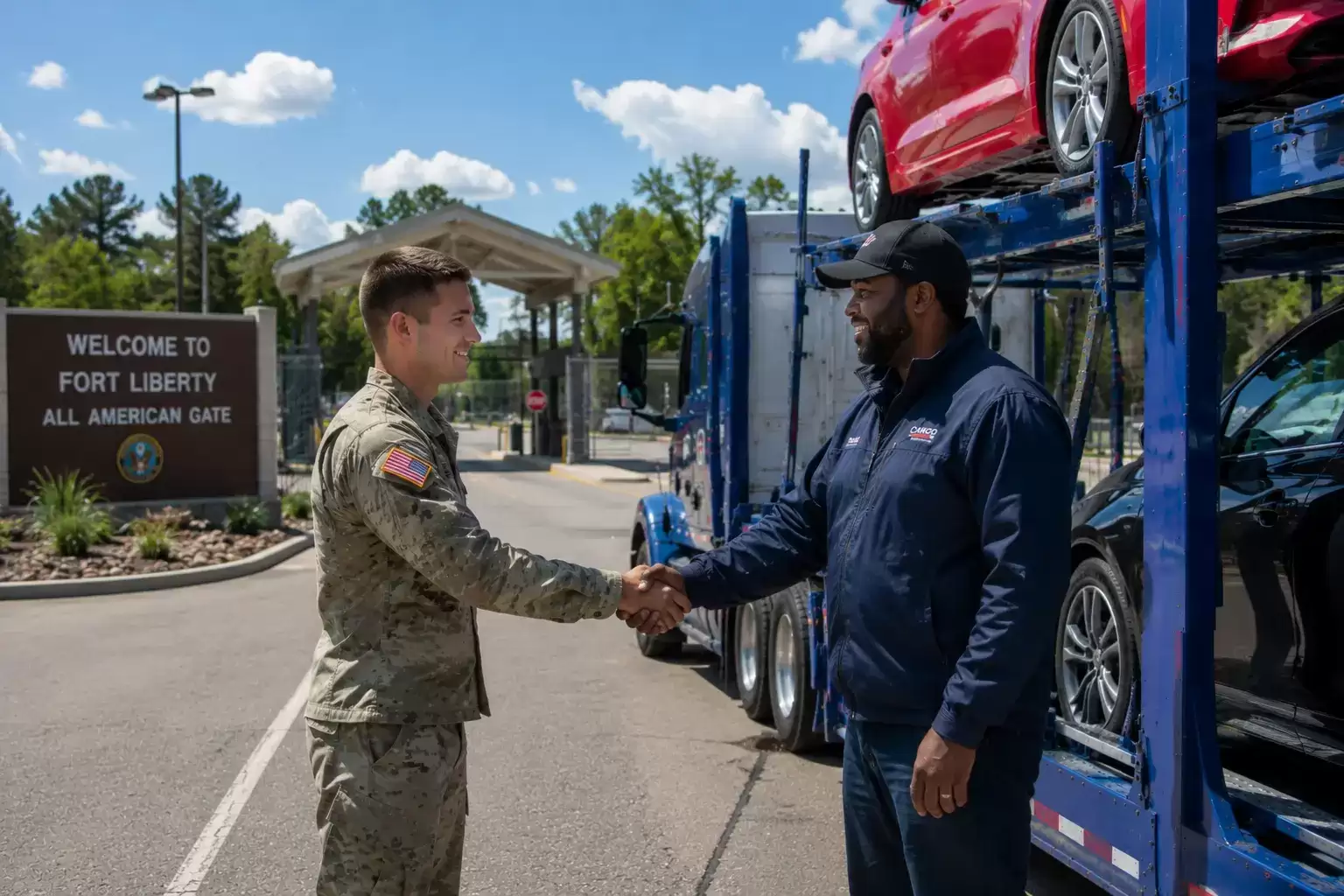
Military PCS is the corridor’s largest single-month demand driver and its most time-critical segment. Colorado Springs is one of the most military-dense cities in the United States — it hosts Fort Carson (Army), Peterson Space Force Base (USSPACECOM headquarters), Schriever Space Force Base (military satellite operations), Cheyenne Mountain Space Force Station (NORAD/NORTHCOM), and the Air Force Academy. Aurora hosts Buckley Space Force Base.
Patrick SFB and Schriever SFB: Secondary Florida PCS Routes
Patrick Space Force Base in Melbourne generates PCS orders to Schriever SFB (the Space Force’s satellite operations hub) and to the Air Force Academy in Colorado Springs — the Melbourne → Englewood and Melbourne → Castle Rock pairings in the Other Cities table capture this corridor. NAS Jacksonville and NAS Pensacola generate orders to Fort Carson and Buckley.
Technology-Sector Corporate Relocation: Florida Tech Professionals Moving to Denver
Technology-sector corporate relocation is the corridor’s fastest-growing segment. Denver’s technology ecosystem has expanded dramatically since 2015 and now rivals Austin and Salt Lake City as a second-tier tech hub. Key employers drawing Florida professionals: Google’s Boulder and Denver offices, Amazon Web Services (several Colorado facilities), Palantir Technologies (Denver headquarters), Ball Aerospace and Lockheed Martin Space (both in Broomfield/Westminster corridor), Raytheon Intelligence and Space (Aurora), and a large and growing cybersecurity cluster around the Colorado Springs military corridor.
Orlando to Fort Collins: Central Florida Tech Corridor Pricing
The Orlando → Fort Collins pairing at $1,350 serves the Central Florida tech and aerospace professional moving to CSU’s university town and its growing private sector ecosystem. Fort Collins has emerged as a significant technology cluster in its own right, anchored by Colorado State University research programs and fed by professionals leaving Florida’s defense and simulation industry for Colorado’s aerospace and defense corridor. St.
CU Boulder, Colorado State, and University of Denver Students from Florida
University moves generate one of the corridor’s most predictable annual demand spikes. The University of Colorado Boulder (36,000+ enrollment) is the largest draw — it is ranked among the top 30 public universities in the country and has a significant out-of-state enrollment from Florida.
University of Denver and Private University Routes from Florida
The University of Denver, a private research university in Denver proper, draws Florida students in law, business, and international studies. The Fort Lauderdale → Boulder pairing at $1,475 and the Port St. Lucie → Broomfield pairing at $1,475 capture the South Florida student market for the Boulder metro corridor.
Ski Resort Seasonal Employees and Colorado Mountain Community Residents
Ski resort seasonal employees and mountain community residents are a distinctive FL→CO demand segment without a close parallel on other corridors. Colorado’s ski industry employs approximately 60,000–70,000 workers seasonally at its major resorts — Vail, Aspen/Snowmass, Breckenridge, Steamboat Springs, Copper Mountain, Winter Park, Telluride, and others. A meaningful portion of these workers come from Florida, drawn by the industry’s reliance on hospitality workers with warm-weather service experience.
What Makes the Florida–Colorado Auto Shipping Run Different
Two Corridors, Not One: The Southern and Central Routes
Unlike Florida to Arizona (almost entirely I-10) or Florida to Georgia (almost entirely I-75), Florida to Colorado does not have a single dominant carrier routing. Carriers use two primary approaches depending on their origin point in Florida, their Colorado destination, and traffic conditions. The southern route follows I-10 west from Tallahassee or Pensacola through Louisiana and Texas, then I-25 north from San Antonio or Albuquerque through Santa Fe, Raton Pass, Trinidad, Pueblo, and Colorado Springs to Denver. This routing is optimal for Panhandle Florida origins (Tallahassee, Pensacola) and for Colorado Springs and Pueblo deliveries —
Central I-75/I-20/I-35/I-70 Corridor for South Florida and Atlanta Origins
The central route follows I-75 north through Florida and Georgia toward Atlanta, then I-20 west through Birmingham and Dallas, then I-35 north through Oklahoma City, then I-70 west into Denver. This routing is better for South Florida origins and Denver metro deliveries. Tampa-area shipments can go either way depending on the carrier’s current load and destination cluster.
Tallahassee → Pueblo: Why It’s the Table’s Cheapest Pair by a Large Margin
Tallahassee, FL to Pueblo, CO at 1,500 miles and $1,050 Standard is the cheapest FL→CO pair on this table — and the margin is significant. Tallahassee is the Florida origin closest to the western I-10 corridor (sitting in the Panhandle, it is already 350 miles west of Miami before the carrier even starts heading toward Colorado). Pueblo is Colorado’s southernmost major city, sitting at the junction of I-25 and US-50 approximately 100 miles south of Denver, and it is the first major Colorado city a carrier reaches when approaching from the New Mexico border via I-25 northbound.
Geographic Efficiency: Panhandle to I-25 Southern Approach Rationale
The 1,500-mile routing from Tallahassee to Pueblo via I-10 west and I-25 north is essentially a straight shot — no Florida peninsula approach mileage, no Colorado mountains, just the southern plains corridor. At $1,050 Standard, the Tallahassee → Pueblo rate represents one of the lower per-mile costs on any FL→CO pairing and makes this table’s cheapest run approximately $400 less expensive than the most expensive.
Jacksonville → Aurora: The Table’s Military-Optimal Pairing
Jacksonville to Aurora at 1,690 miles and $1,175 Standard is the second-cheapest pair and one of the most strategically significant for military PCS. Jacksonville is home to Naval Air Station Jacksonville — one of the Navy’s largest and most active East Coast installations, home to patrol and anti-submarine aviation. Aurora is home to Buckley Space Force Base — a Space Force and Air National Guard installation housing the 460th Space Wing, which operates missile warning satellites and provides critical intelligence for US strategic command. The NAS Jacksonville to Buckley SFB pipeline is a well-established military PCS corridor.
Military Significance: NAS Jacksonville to Buckley Space Force Base
Jacksonville’s geographic position — at the very northern tip of the Florida peninsula on I-10 westbound — gives it the shortest approach distance to Colorado of any Atlantic Coast FL city. The 1,690-mile Jacksonville → Aurora haul via I-10 and I-70 (or I-25) is completed at $1,175 Standard — the best rate of any Jacksonville-area shipment to the Denver metro.
The I-70 Mountain Corridor: What Carriers Actually Face
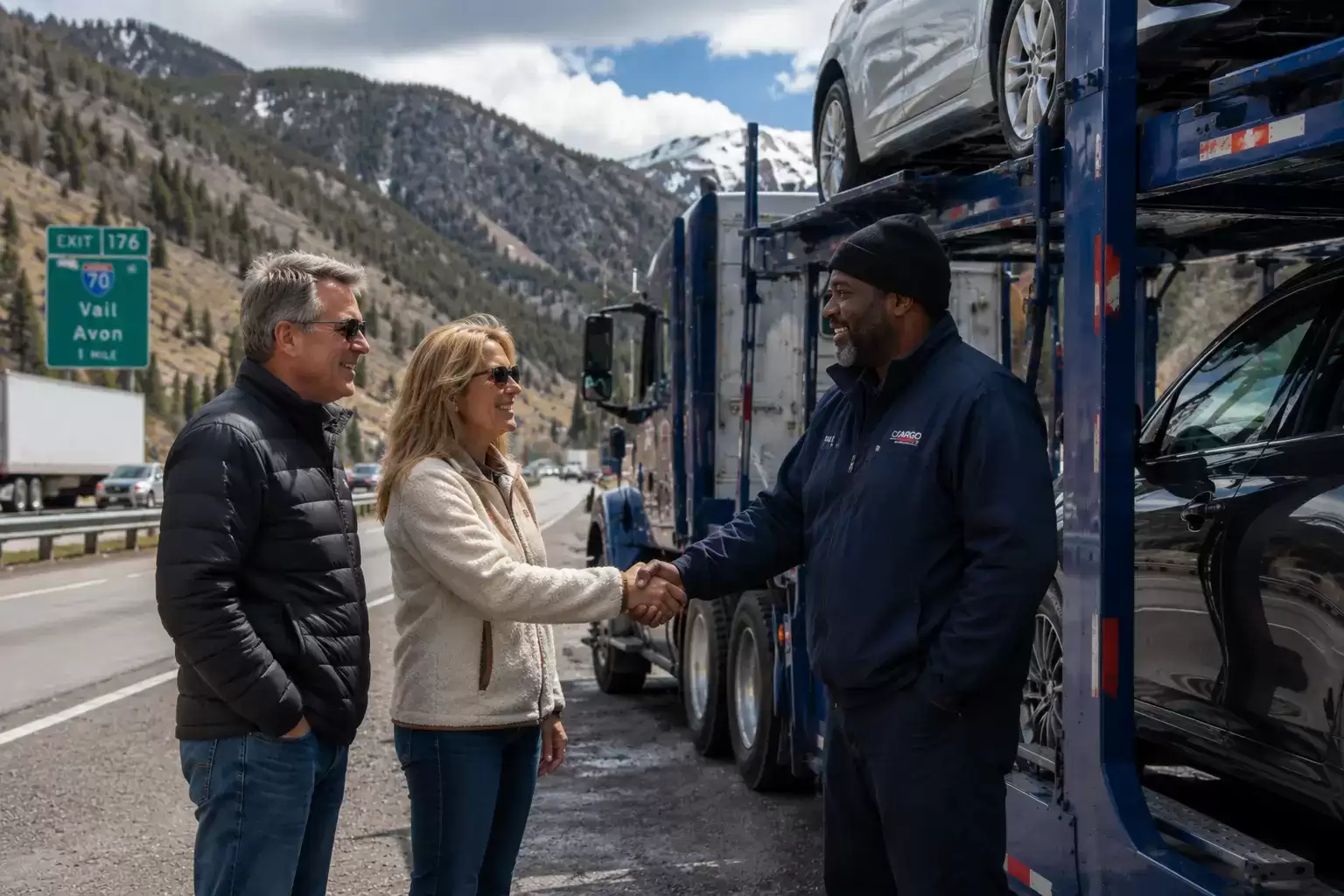
For Denver metro deliveries, many FL→CO carriers exit I-70 near Denver and approach from the east (from Kansas), which presents no elevation complications — Denver sits at 5,280 feet but the eastern approach from Kansas is gradual. However, some routing choices and virtually all deliveries to mountain communities (Vail, Aspen, Steamboat Springs, Breckenridge, and Durango) require carriers to either traverse the I-70 mountain corridor west of Denver or take alternate US highway routes into the mountains. The I-70 mountain corridor from Denver to Vail Pass (10,662 feet) is one of the most challenging freight routes in the United States —
Mountain Community Delivery: Vail, Aspen, Steamboat, and Durango Routing
Colorado Department of Transportation (CDOT) operates real-time I-70 mountain corridor alerts at cotrip.org — this is the resource your carrier coordinator watches for mountain deliveries. For Vail deliveries, carriers exit I-70 at the Vail exits directly — Vail sits alongside I-70. For Aspen, carriers must travel CO-82 from Glenwood Springs, a mountain highway with its own steep grades unsuitable for 75-foot multi-car haulers.
South Florida to the Front Range: The Long End of the Table
Miami, Fort Lauderdale, Hialeah, Hollywood, Pembroke Pines, West Palm Beach, and Coral Springs all fall in the $1,450–$1,475 Standard range for Denver metro area deliveries. The Florida Turnpike from Miami to Jacksonville adds approximately 350 miles before the carrier begins the cross-country run — South Florida origins effectively start the clock 5–6 hours after the carrier leaves the pickup address. The $400 premium South Florida pays over Tallahassee → Pueblo ($1,050) reflects this: roughly 600 additional miles of Florida and Texas driving on the southern approach.
Hurricane Season Impact on South Florida Departure Timing
At $1,450–$1,475 for a 2,080–2,110 mile run, South Florida to Denver metro pricing represents approximately $0.70/mile Standard — competitive for a long-haul shipment requiring Florida Turnpike approach plus the full Colorado delivery. The Fort Lauderdale → Boulder pairing at $1,475 and the Hialeah → Thornton pairing at $1,475 are the table’s most expensive, reflecting both the South Florida approach mileage and the northern Front Range delivery distances (Boulder is north of Denver, Thornton is Denver’s northern suburban metro).
Colorado Springs: The Military Hub That Shapes This Corridor
Colorado Springs deserves specific attention because its military concentration is unusually dense and its proximity to multiple Florida installations creates the corridor’s highest-volume military PCS market. Fort Carson — home of the 4th Infantry Division and the 10th Special Forces Group — is the Army’s primary Mountain West installation, generating both inbound PCS from Florida Army and joint-force personnel and outbound PCS to Florida. Peterson Space Force Base co-located with Colorado Springs Airport houses USSPACECOM and NORAD/NORTHCOM. Schriever Space Force Base 10 miles east on US-24 operates the military’s GPS and satellite constellation.
Military Significance: Fort Carson / MacDill AFB and NORAD Pairings
Cheyenne Mountain Space Force Station in the mountain itself houses the NORAD combat operations center. Together these installations make Colorado Springs one of the top five US destinations for military PCS moves by volume. The Tampa → Colorado Springs pairing at $1,275 is the table’s primary MacDill AFB corridor.
Other Florida to Colorado Cities We Serve
Direct Express ships vehicles between hundreds of city pairs on this route. Below is a broader look at additional Florida origins and Colorado destinations we regularly serve.

Hub Cities Along the Florida–Colorado Car Shipping Corridor
Florida to Colorado uses two primary routing approaches — the southern corridor via I-10 and I-25, and the central corridor via I-75/I-20 and I-70 — depending on the origin and destination city pair. Most deliveries to Colorado Springs and Pueblo use the southern I-25 approach; most Denver metro deliveries use whichever routing the carrier finds most efficient given their current load cluster.
Florida Origin Zones
Mid-Corridor Relay Points
Colorado Delivery Zones
Open vs. Enclosed Car Transport on the Florida–Colorado Route
Open transport is the correct choice for the vast majority of FL→CO shipments, including military PCS, corporate relocation, university moves, and ski-season worker vehicles. However, Colorado is the one corridor in this series where winter weather at the delivery end genuinely warrants discussing enclosed transport for certain vehicles and certain delivery points.
Open Transport Recommended for Most
- Standard open-air carrier — the correct choice for virtually all FL→CO shipments to Front Range cities (Denver metro, Colorado Springs, Fort Collins, Pueblo)
- Military PCS to Fort Carson, Buckley SFB, Peterson SFB, Schriever SFB, Air Force Academy: entirely open transport market
- Denver metro and Colorado Springs deliveries year-round: open carriers navigate Front Range winter conditions without operational complications. Your vehicle arrives covered in road salt and sand from the highway — wash it promptly, but it arrives undamaged
- University moves to Boulder and Fort Collins: open transport, book in July for August arrival
- Ski resort workers heading to Vail (I-70 adjacent delivery) or Front Range staging points: open transport
Enclosed Transport
- Vehicle travels in a fully enclosed, weatherproof trailer for the entire run
- Typically 40–60% more expensive than open transport
- Classic and collector cars being delivered to Colorado mountain communities (Aspen, Vail, Telluride) for summer storage or events: the primary enclosed FL→CO use case
- High-value exotics (Ferrari, Lamborghini, McLaren, Porsche 911 GT-series) being shipped from South Florida to Aspen or Vail for summer: the secondary use case. Aspen’s summer social calendar and Vail’s summer arts and music programming draw South Florida’s luxury vehicle community
- Aspen delivery specifically: the CO-82 approach from Glenwood Springs requires a specialized carrier for standard-length open haulers — enclosed carriers that can navigate the mountain highway approach are often the practical choice regardless of weather
- Winter delivery of any vehicle to Vail or Steamboat Springs in January–February during a heavy snow year: enclosed transport eliminates all weather exposure on the mountain approach
Our honest recommendation: Open transport for all Front Range deliveries and military PCS year-round. Enclosed for collector cars and exotics moving between South Florida’s luxury market and Colorado mountain destinations (particularly Aspen and Vail), and for Aspen deliveries year-round due to the CO-82 mountain road approach.
Door-to-Door Car Shipping: What to Expect in Florida and Colorado
Pickup in Florida
South Florida and the Gold Coast
Florida pickup for Colorado-bound shipments follows the same regional patterns as all Florida northbound transport. South Florida (Miami metro, Fort Lauderdale, Hialeah, Hollywood, Pembroke Pines, Coral Springs, Boca Raton, Miramar, West Palm Beach, Port St. Lucie, Fort Pierce) routes via Florida Turnpike or I-95 northbound to the I-75 or I-20 westbound corridor. Urban Miami high-rise or beachfront pickup may require nearby commercial staging for large haulers — your coordinator manages this routinely.
Tampa Bay, Orlando, and North Florida
Tampa Bay and Gulf Coast (Tampa, St. Petersburg, Clearwater, Sarasota, Bradenton, Fort Myers, Cape Coral, Naples) access I-75 northbound with excellent carrier coverage. Central Florida (Orlando, Kissimmee, Lakeland, Melbourne, Deltona) routes via I-4 east to I-75 or I-95. Northeast Florida (Jacksonville, Palm Coast, Daytona Beach, Ocala) is the most efficient FL pickup zone for the central I-70 corridor. Panhandle (Tallahassee, Gainesville, Pensacola) routes via I-10 westbound. Monitor NOAA tropical forecasts for South and Southwest Florida pickup during hurricane season (June 1–November 30).
Delivery in Colorado
Denver Metro and Colorado Springs
Colorado Front Range delivery (Denver metro, Aurora, Lakewood, Thornton, Westminster, Centennial, Highlands Ranch, Arvada, Broomfield, Northglenn) is excellent year-round via I-25, I-70, and the metro beltway. Winter delivery (November–March) brings road salt and sand accumulation — wash promptly after delivery and ensure covered parking for overnight temperatures. Colorado Springs (Fort Carson, Peterson SFB, Schriever SFB, Air Force Academy) has excellent carrier access via I-25; Fort Carson on-base delivery follows established PCS protocols. Boulder: US-36 from Denver; off-campus staging required for large haulers.
Mountain Communities and Western Slope
Fort Collins and Loveland sit on I-25 north of Denver with outstanding carrier coverage; CSU Fort Collins has off-campus staging available. Mountain communities require advance planning: Vail is directly on I-70 with good summer and fall access; Steamboat Springs (US-40 from I-70) and Aspen (CO-82 from Glenwood Springs) require weather-contingency scheduling October–April. Aspen is not accessible for 75-foot multi-car haulers — specialized carrier arrangements required year-round; discuss with your coordinator before booking. Grand Junction: I-70 direct with excellent open-carrier access. Durango: I-25 south to US-160 west, no extreme elevation complications.
Colorado Vehicle Registration for Florida Arrivals
Colorado requires registration within 90 days of establishing residency. Visit a Colorado DMV office with your out-of-state title, proof of Colorado insurance, and proof of Colorado address; a VIN inspection is required; emissions testing applies in Denver and Boulder Front Range counties. Cancel your Florida registration once your Colorado plates arrive.
Preparing Your Vehicle
Before Florida pickup: remove all personal items, disable car alarms, remove SunPass transponders, and leave no more than a quarter tank of fuel. Photograph your vehicle from all angles with date-stamped images. Colorado delivery: expect road salt and sand on the exterior from the highway approach — wash promptly. If delivering to mountain communities in winter, ensure tires are rated for winter conditions (Colorado enforces traction laws October 1–May 31 on certain mountain highways). Inspect carefully before signing the Bill of Lading.
Florida & Colorado Auto Transport Resources
Florida Helpful Government Links
- Florida Department of Highway Safety and Motor Vehicles (FLHSMV) — Florida’s vehicle title and registration oversight agency. Cancel your Florida registration when establishing Colorado residency.
- FLHSMV — Vehicle Title and Registration — Florida title transfer process and registration cancellation for vehicles transferring to Colorado.
- FLHSMV — Florida Driver License — Surrender your Florida driver’s license when obtaining a Colorado license after establishing Colorado residency.
- FLHSMV — Military Provisions — Provisions for active duty military departing Florida installations (MacDill AFB, Patrick SFB, NAS Jacksonville, NAS Pensacola, Eglin AFB) on PCS orders to Colorado.
Colorado Helpful Government Links
- Colorado Division of Motor Vehicles (Colorado DMV) — Colorado’s vehicle title and registration agency. New Colorado residents from Florida must register their vehicle within 90 days of establishing Colorado residency.
- Colorado DMV — Vehicle Registration — Registration requirements, fees, and Specific Ownership Tax (SOT) information for Florida vehicles transferring to Colorado.
- Colorado DMV — VIN Inspection Requirements — All out-of-state vehicles registering in Colorado for the first time require a VIN inspection. Find authorized inspection locations near your Colorado address.
- Colorado Emissions Testing Program — Emissions inspection requirements for vehicles in Front Range counties (Denver Metro, Boulder, Fort Collins, Greeley, Colorado Springs metro areas). Required for vehicles 7–25 years old at first Colorado registration in covered counties.
- Colorado DMV — Driver License — New Colorado residents must obtain a Colorado driver’s license within 30 days of establishing residency. Your Florida license must be surrendered.
- Colorado DMV — Military Provisions — Registration and licensing provisions for active duty military on PCS orders to Fort Carson, Buckley SFB, Peterson SFB, Schriever SFB, and the Air Force Academy arriving from Florida.
- CDOT COtrip — Colorado I-70 Mountain Corridor Alerts — Real-time road conditions, closures, and chain requirement alerts for the I-70 mountain corridor (Eisenhower Tunnel, Vail Pass). Relevant for mountain community deliveries November–April.
Federal Auto Transport Resources
- FMCSA — Verify a Carrier’s License (SAFER System) — Verify that any auto transport company is federally licensed and insured before booking.
- FMCSA — Protect Your Move — Federal consumer guidance on hiring vehicle shippers and your rights on a cross-country move.