California to Arizona Car Shipping
The original instant car shipping calculator — trusted since 2004. Door-to-door California to Arizona transport with no surprises, no hidden fees, and three options to ship your vehicle on your schedule.
★ 4.6/5 Google Reviews | BBB Accredited A+ | FMCSA Licensed (MC #479342) | USDOT #1240502 | No upfront payment required | 20+ years shipping vehicles


California to Arizona Car Shipping Rates by City
Every California to Arizona vehicle shipment is available at three service levels:
Standard, Expedited, & Rush Options
Choose the one that fits your timeline and budget. All three include full door-to-door service and carrier insurance.
The Company That Invented Instant Auto Transport Pricing
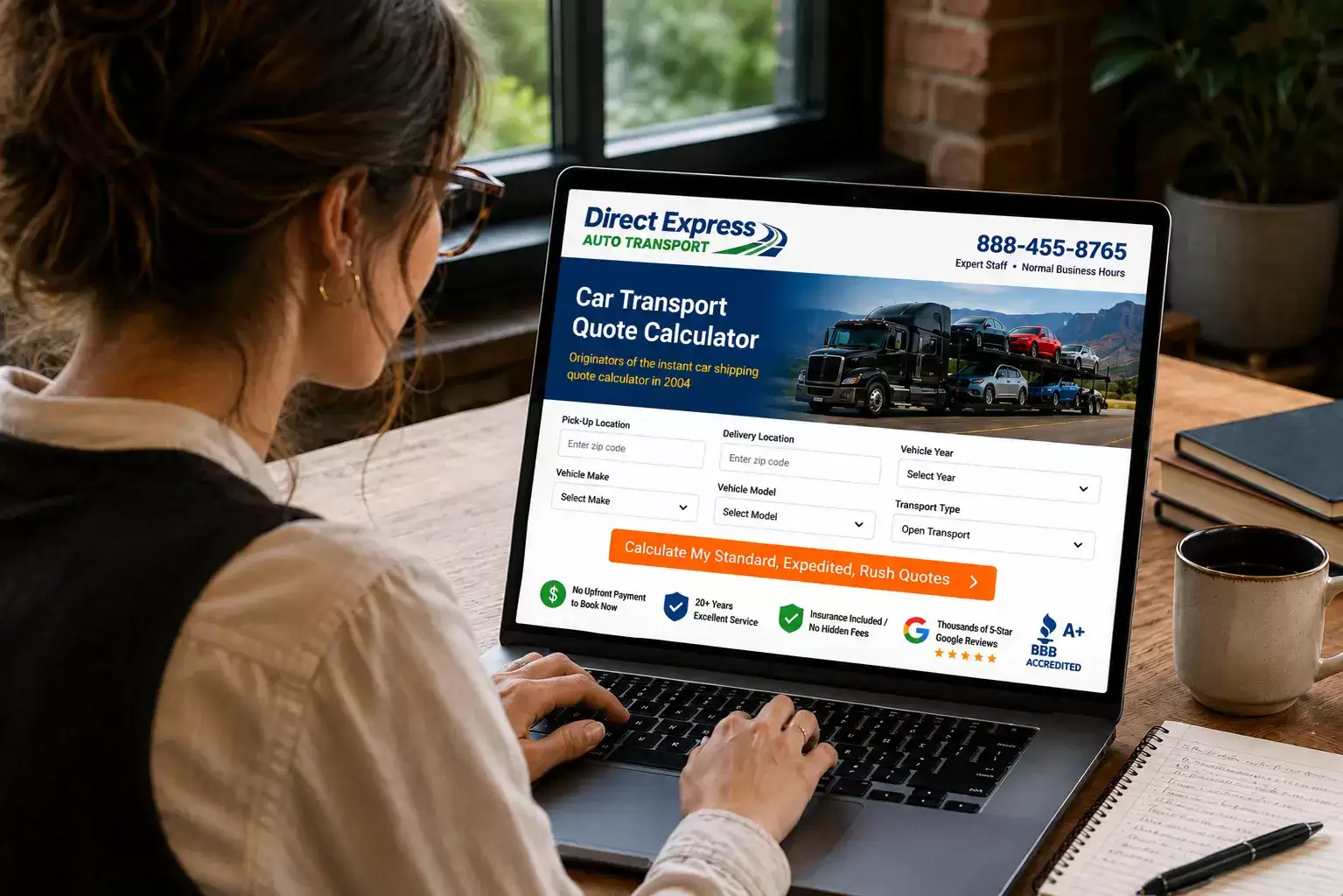
Direct Express Auto Transport pioneered online instant pricing for the auto transport industry in 2004. Before we built the first car shipping cost calculator, getting a quote from a broker meant phone calls, callbacks, and waiting — sometimes days. We changed that. Today you know your exact cost in 30 seconds, before committing to anything. No phone tag, no hassle. Just a real number, instantly.
Three Service Tiers for Every California to Arizona Shipment
Every shipment on this California to Arizona route is available at three service tiers so you can match your budget to your timeline. Standard delivers at the best available rate — ideal when your schedule has a few days of flexibility. Expedited moves your vehicle to the front of the dispatch queue for faster pickup. Rush gets your car picked up as fast as humanly possible — for moves where every day counts. All three tiers include full door-to-door service and carrier insurance.
What customers say about shipping a car from California to Arizona with Direct Express Auto Transport


Seasonal Pricing Guide: California to Arizona
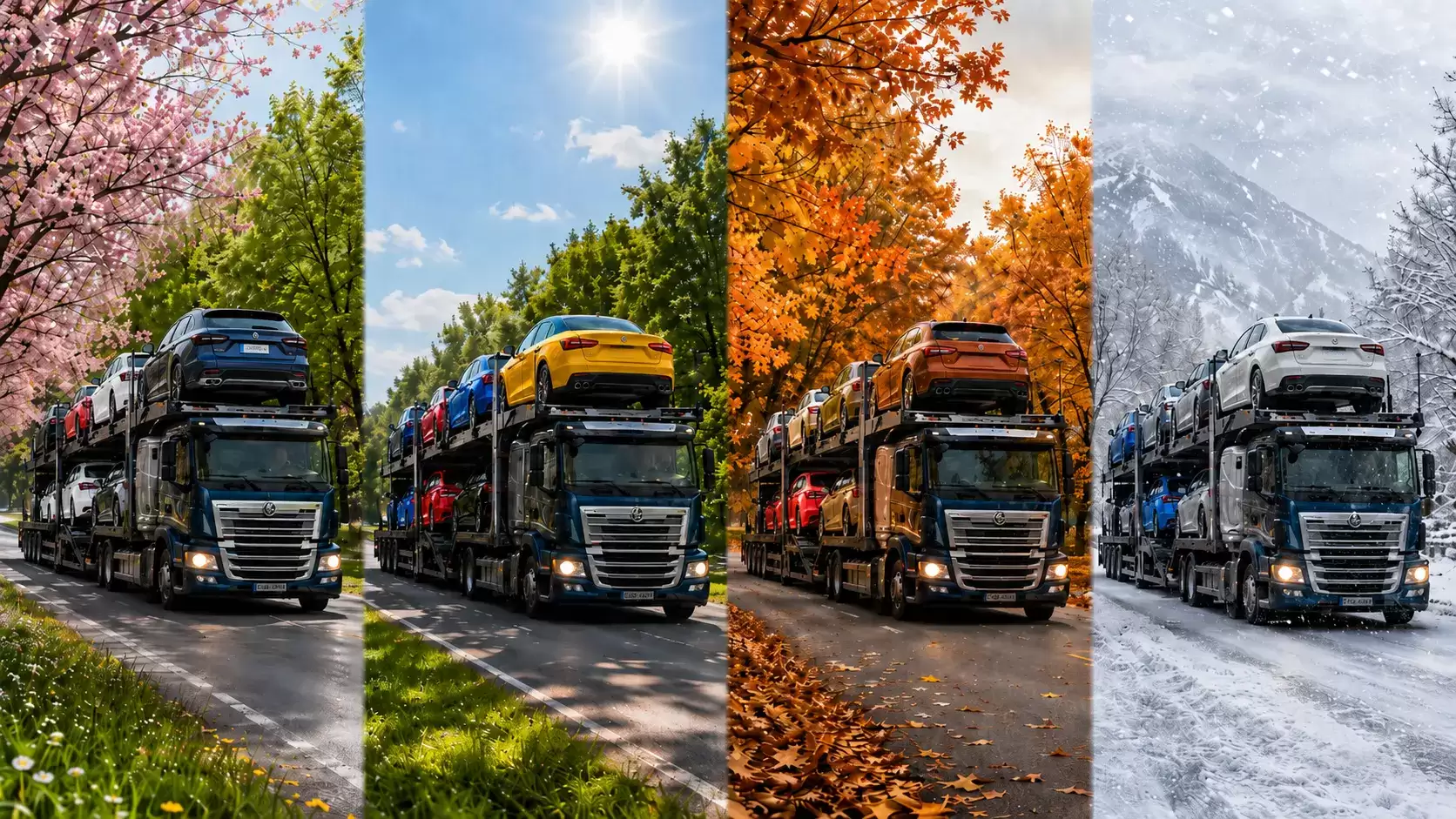
California-to-Arizona is one of the busiest short-haul auto transport corridors in the country, and its seasonal demand pattern is unlike any other route we handle. The snowbird cycle — California retirees and seasonal residents moving their vehicles east to Phoenix, Scottsdale, Chandler, and Mesa for the winter — drives pronounced demand spikes that don’t exist on longer interstate lanes. At the same time, Arizona’s summer heat creates a counter-seasonal period in June through August where California-bound traffic is extremely strong but Arizona-inbound traffic is light. Knowing this calendar can save hundreds of dollars on an already-affordable corridor.
Who Ships a Car from California to Arizona — and Why
California-to-Arizona is the country’s highest-volume short-haul auto transport corridor. The two states share 350 miles of border, an economy increasingly intertwined through technology, real estate, and retirement migration, and the strongest snowbird demand pattern of any two-state route we handle. The reasons for the move are as varied as the people making them.
California Snowbirds Wintering in Arizona: The Corridor’s Defining Seasonal Wave
Snowbird retirees are the dominant seasonal driver. California’s cost of living — property taxes, state income tax, housing costs — has pushed a steady stream of California retirees toward Arizona for decades. Phoenix, Scottsdale, Chandler, Mesa, Gilbert, and the East Valley have built entire communities designed around the California retiree market. Many of these households maintain California residences and Arizona winter residences simultaneously, shipping their vehicle east in November or December and returning it west in April. This cycle repeats annually and creates the most predictable demand spike of any corridor we service: the November-through-February snowbird window is as close to clockwork as the auto transport industry gets.
Permanent Relocation: California Remote Workers Moving to Arizona for Affordability
Permanent relocation for cost of living has accelerated significantly since 2020. California remote workers, freed from the requirement to live within commuting distance of Bay Area or Los Angeles offices, discovered that Arizona offered comparable sunshine, similar climate, and dramatically lower housing costs. Phoenix metro housing prices — even after significant appreciation — remain well below comparable California markets. A San Jose software engineer whose salary travels with them to Phoenix can reduce their housing cost by 40–60% while maintaining their California income. The Maricopa County market has been the fastest-growing major county in the United States for multiple years, and a meaningful portion of that growth is California inbound. These permanent relocation shippers typically move their vehicle once and don’t return.
Military PCS: Camp Pendleton / Travis AFB → Luke AFB and Arizona Installations
Military PCS transfers generate consistent year-round demand. Luke Air Force Base in Glendale is one of the Air Force’s most important advanced fighter training installations — the F-35 pilot training mission brings personnel from California bases including Edwards AFB, Vandenberg Space Force Base, and Naval Air Station Lemoore. Davis-Monthan Air Force Base in Tucson — home to the 355th Wing and AMARG (the Air Force’s aircraft storage facility, colloquially known as the Boneyard) — generates regular transfers from California installations. Fort Huachuca near Sierra Vista, the Army’s intelligence and cyber training center, receives California-based Army personnel. Marine Corps Air Station Yuma generates Marine transfers to and from California. These four Arizona military installations collectively receive California-origin PCS orders throughout the year with a pronounced summer peak.
California Students at Arizona State, U of A, and Grand Canyon University
Arizona State University, University of Arizona, and Grand Canyon University attract tens of thousands of California students annually. May and August are the highest-volume student move months — May for summer departure and late August for fall arrival. The ASU student body alone has a very large California contingent, and a meaningful percentage ship their vehicles rather than drive them. Families with multiple vehicles frequently ship one while a family member drives the other on move-in weekend.
California Technology Professionals Moving to Arizona’s Semiconductor Corridor
Arizona’s technology industry growth has created a direct California talent pipeline. Intel’s Chandler campus and the TSMC semiconductor fabs under construction in the Phoenix North area represent massive employment demand that the local talent market cannot fill alone. These facilities draw experienced semiconductor, engineering, and technology workers from California’s own semiconductor corridor. Technology workers relocating from Silicon Valley, San Jose, and Sacramento to the Phoenix metro are a growing segment of this corridor’s demand.
What Makes the California–Arizona Auto Shipping Run Different
The Routes: I-10 East and I-8 East
California-to-Arizona carriers use two primary corridors depending on origin city. Southern California origins — Los Angeles, Long Beach, Orange County, and the Inland Empire — load onto I-10 east from the Los Angeles basin. I-10 passes through Pomona, Ontario, Riverside, Banning, and the Cajon Pass area before dropping into the low desert through Indio and Blythe, crossing the Colorado River into Arizona and continuing to Phoenix. This is the primary route for most of the volume on this corridor — roughly 370 miles from downtown LA to central Phoenix on a well-traveled, flat-to-mildly-hilly carrier run.
San Diego Origins: I-8 East and Northern California: I-5 South to I-10
San Diego origins use I-8 east through the Imperial Valley to Tucson, then north on I-10 to Phoenix. Northern California origins — the Bay Area, Sacramento, Fresno — typically use I-5 south to I-10E, or CA-99 south to I-10, adding 300–400 miles versus a Los Angeles origin.
The Cajon Pass and Desert Heat
The Cajon Pass (elevation ~4,200 feet) is the natural gateway from the Los Angeles basin into the Inland Empire and the beginning of the I-10 desert crossing. It is carrier-friendly year-round — unlike mountain crossings in other states, the Cajon Pass rarely closes for weather. The Mojave Desert section of I-10 east of Indio is operationally fine for carrier transit. In summer, carriers crossing the Mojave manage desert heat with normal operating procedures — this is not a significant operational challenge on this corridor.
Summer Heat Protocol: Arizona Desert Staging and Vehicle Preparation
June through September, I-10 east through the Sonoran and Colorado Deserts reaches sustained ambient temperatures exceeding 110°F. Standard heat protocol applies: quarter-tank fuel limit, no personal items or electronics, no pressurized containers left in the vehicle. The protocol is non-negotiable for open carrier transport.
Inland Empire to Phoenix: The Shortest Leg on the Corridor
San Bernardino, Riverside, and Fontana sit closest to the Arizona border of any California metro areas. San Bernardino to Glendale, Arizona is approximately 280 miles — one of the shortest significant auto transport runs in the western United States. The Inland Empire to Phoenix metro is a straightforward I-10 desert crossing that dispatches and delivers quickly. Rates from this zone are the lowest on this corridor as a result, and carrier availability is consistent given the volume of commercial and freight traffic on this stretch of I-10.
San Bernardino and Riverside: Direct I-10E Access to Arizona Border
San Bernardino and Riverside sit at the base of the Cajon Pass — once a carrier clears the pass and reaches the I-10 interchange at Fontana, the Arizona border at Blythe is approximately 170 miles east. Inland Empire origins minimize approach mileage versus downtown Los Angeles pickups.
Other California to Arizona Cities We Serve
Direct Express ships vehicles between hundreds of city pairs on this route. Below is a broader look at additional California origins and Arizona destinations we regularly serve.
Hub Cities Along the California–Arizona Car Shipping Corridor
California-to-Arizona is a short, high-volume desert corridor. Southern California anchors the origin zone; Phoenix and Tucson anchor the Arizona delivery zone. Most shipments move directly, without relay stops, on a single-driver I-10 or I-8 run.
Major Origin Hubs in California
I-10 and I-8 Desert Corridor
Major Arizona Delivery Points
Phoenix: The Highest-Density Auto Delivery Zone in the Southwest: The Phoenix metro — covering Phoenix, Scottsdale, Chandler, Mesa, Gilbert, Glendale, Tempe, Peoria, Surprise, Goodyear, and Avondale — is the single largest Arizona delivery zone and one of the largest single auto transport delivery markets in the western United States. The combination of snowbird seasonal demand, military PCS traffic from Luke AFB, technology sector growth, and the highest population growth rate of any major U.S. county makes the Phoenix metro a disproportionately high-frequency California-to-Arizona delivery destination. Carrier routes for this zone converge on the I-10 / Loop 101 / Loop 202 freeway system, providing excellent access to nearly every residential address in the metro area.
Open vs. Enclosed Car Transport on the California–Arizona Route
The California-to-Arizona corridor is one of the cleanest weather and terrain profiles in the country. Southern California to Arizona is a desert crossing with no mountain snow, no ice, and no meaningful precipitation risk. Northern California origins route through the Central Valley or over lower passes before reaching the same desert I-10 corridor. The result: open transport is nearly universally appropriate on this lane, and the enclosed premium is best reserved for vehicles that genuinely warrant it.
Open Transport Recommended for Most
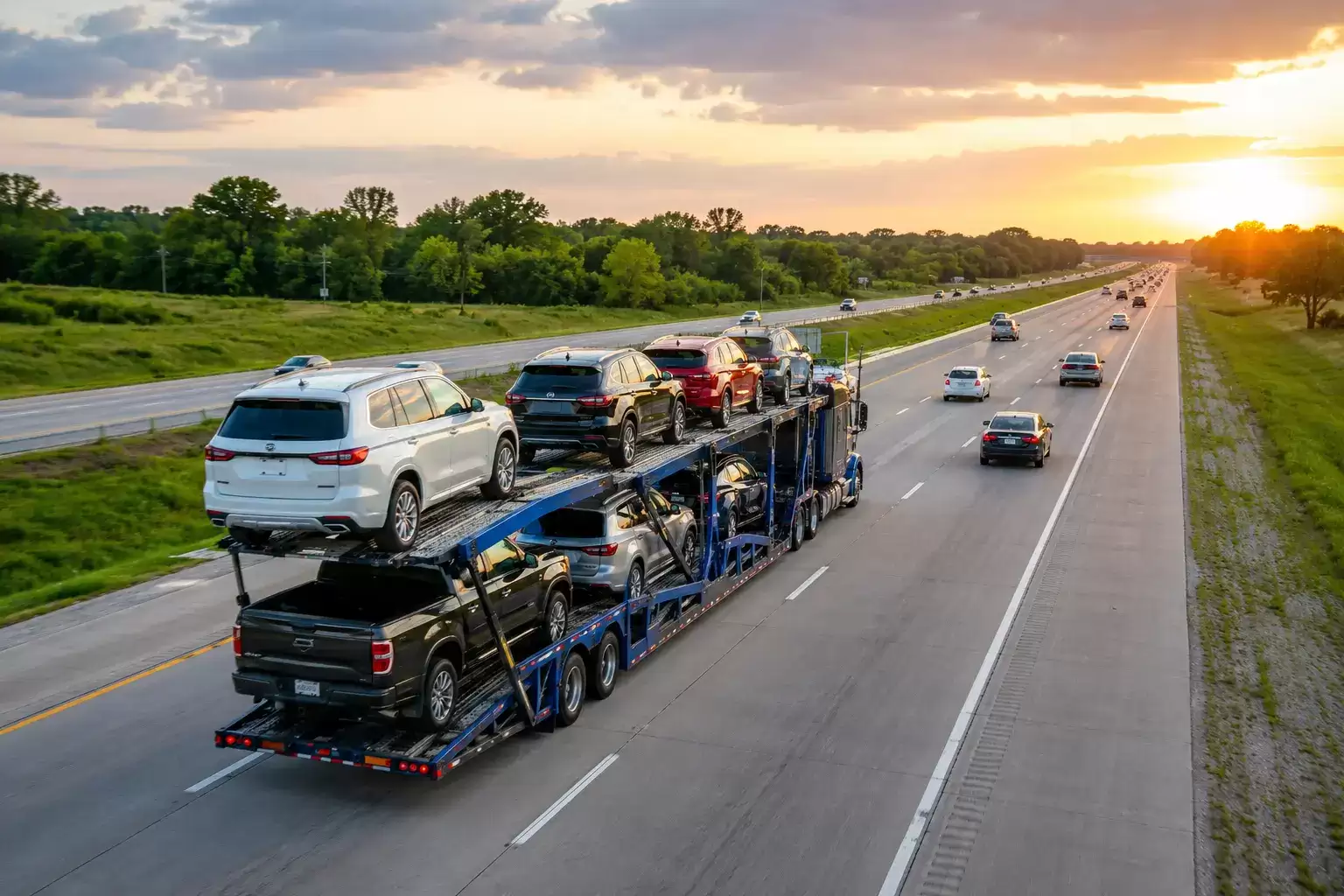
- Open-air trailer carrying 7–10 vehicles — the industry standard for virtually all everyday vehicle shipments on this lane
- Most cost-effective option on an already affordable short-haul corridor; carrier availability from Southern California to Phoenix metro is among the strongest in the country
- Well-suited for daily drivers, commuter vehicles, SUVs, trucks, minivans, and any vehicle under approximately $60,000
- No weather, mountain, or road-surface concerns on the I-10 desert corridor at any time of year
- Road film and light dust after the desert crossing is normal and washes off completely at your Arizona destination
Enclosed Transport
- Vehicle travels in a fully enclosed, weatherproof trailer from California to Arizona
- Typically 40–60% more expensive than open transport
- Recommended for luxury vehicles, exotics, collector cars, show-quality finishes, and any vehicle over approximately $75,000
- Scottsdale’s collector car market — Barrett-Jackson and other major auctions are held in Scottsdale — generates enclosed transport demand for high-value vehicles being delivered to or from Scottsdale for auction purposes
- Lake Havasu City and Bullhead City, both popular vacation home markets for Californians, have above-average boat-trailer and specialty-vehicle enclosed demand
- Book 1–2 weeks ahead — fewer enclosed carriers on this lane than open
Our honest recommendation: Open transport for the everyday vehicle — this corridor has strong carrier availability, reliable weather, and a straightforward desert route. Enclosed for luxury vehicles, exotics, and Barrett-Jackson-bound collector cars.
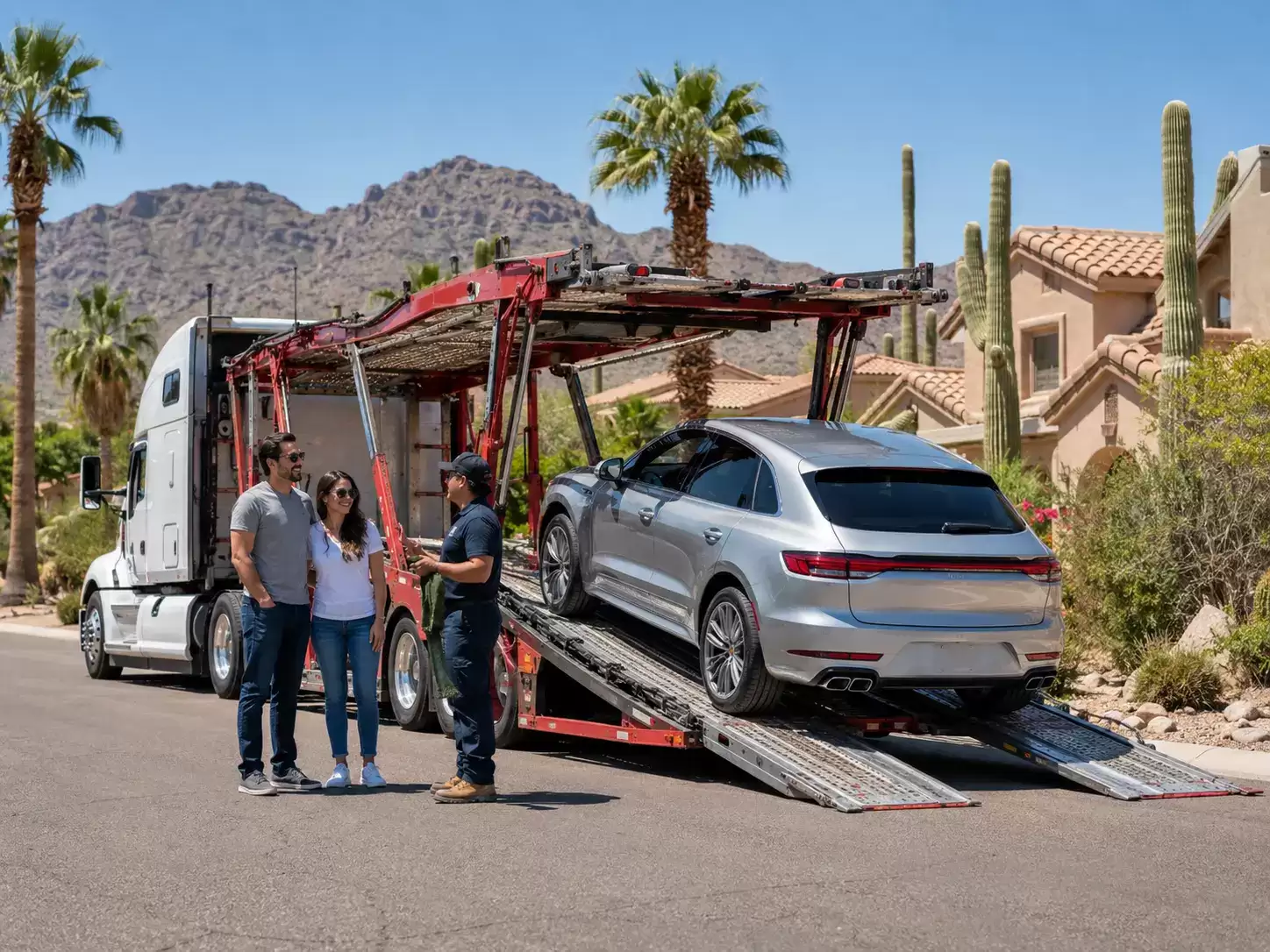
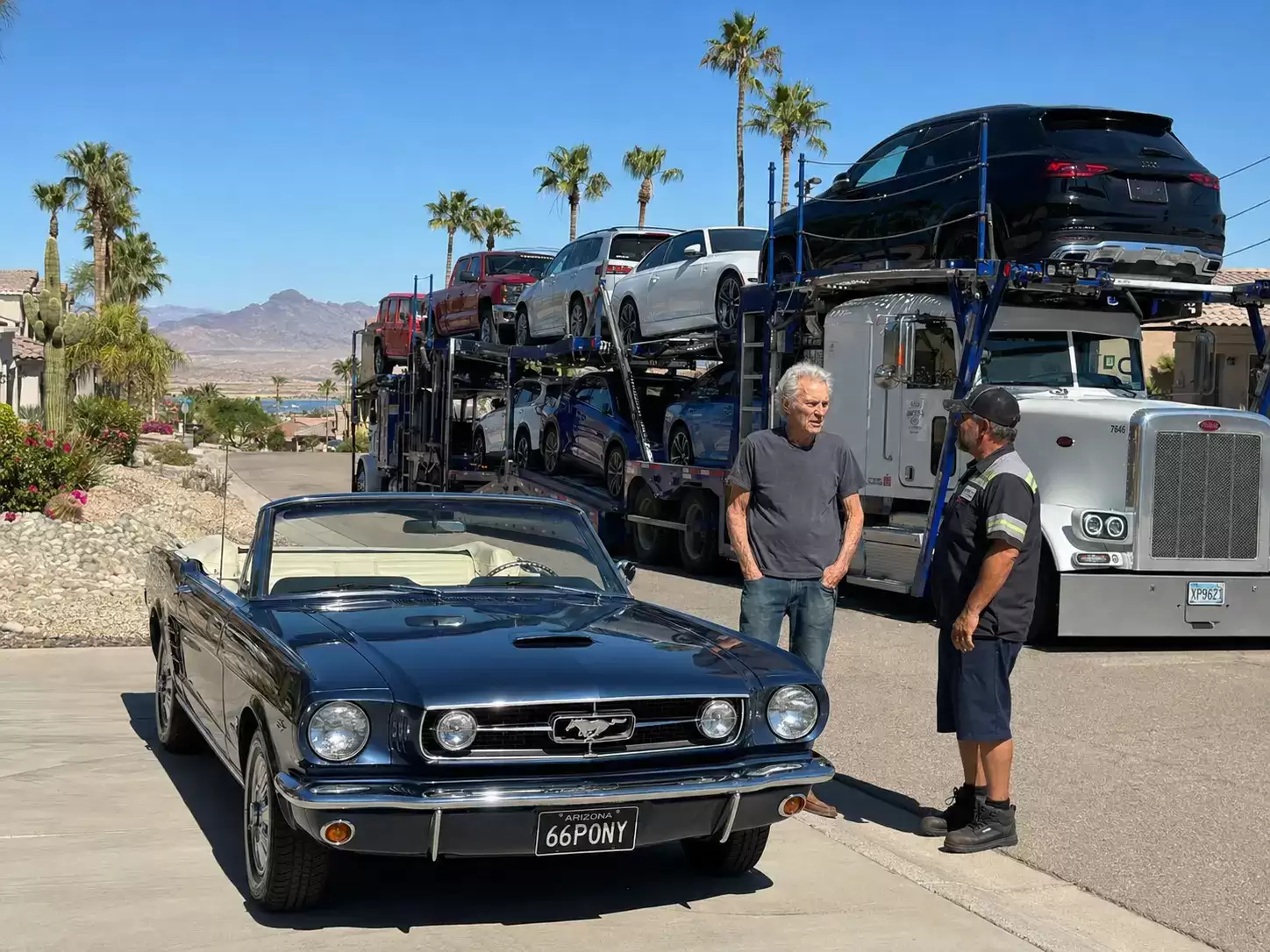
Door-to-Door Car Shipping: What to Expect in California and Arizona
Pickup in California
Southern California: Los Angeles, San Diego, and Orange County
Standard door-to-door pickup throughout Southern California. Los Angeles basin: standard residential throughout; very dense downtown LA, Koreatown, Hollywood, and Westlake high-rise addresses require carrier staging on a nearby wide commercial street — confirm your address at booking. San Diego and Chula Vista: excellent carrier access, standard residential throughout. Orange County (Anaheim, Irvine, Santa Ana, Fullerton): standard residential, no staging concerns. Southern California is the highest carrier-density pickup zone in the country — strong dispatch availability in all service tiers. No heat protocol at coastal SoCal origins in any season.
Inland Empire and Central Valley
Standard door-to-door pickup throughout the Inland Empire and Central Valley. Riverside, San Bernardino, Fontana, and Ontario: excellent suburban carrier access via I-10 and I-15; the Inland Empire is one of the densest carrier staging zones in the country. Summer heat protocol: Inland Empire origins (June–September) reach 105–115°F — enclosed transport recommended for exotic and luxury vehicles staged at IE pickup locations during peak summer. Fresno, Bakersfield, Modesto, and Stockton: standard residential throughout; same summer heat protocol applies for exotics June through September.
Bay Area and Sacramento
Standard door-to-door pickup throughout the Bay Area and Sacramento. San Jose, Oakland, Fremont, Vallejo, and Concord: standard residential access. San Francisco: carrier staging required for steep-grade neighborhood pickups (Pacific Heights, Russian Hill, Nob Hill, Bernal Heights) — confirm your specific address at booking. Sacramento: standard residential throughout. No heat protocol at coastal Bay Area origins in any season. Bay Area origins carry a pricing premium due to departure distance and carrier positioning relative to Southern California staging hubs.
Delivery in Arizona
Phoenix Metro: Scottsdale, Mesa, Chandler, Tempe, Glendale, and Surrounding Cities
Standard door-to-door delivery throughout the Phoenix metro. Phoenix, Scottsdale, Mesa, Chandler, Gilbert, Tempe, Glendale, Peoria, Surprise, Avondale, and Goodyear: standard residential throughout, accessible on the Loop 101, Loop 202, and Loop 303 freeway grid. Most residential and commercial addresses in the Phoenix metro are accessible to multi-car haulers without staging complications. No weather concerns at Phoenix delivery in any season.
Southern Arizona: Tucson, Sierra Vista, and Yuma
Standard door-to-door delivery throughout Southern Arizona. Tucson: standard residential throughout, I-10 access; no staging concerns. Sierra Vista and Fort Huachuca (Army): confirm on-base vehicle access and gate authorization at booking for military PCS deliveries. Yuma: standard residential, I-8 access. Allow additional transit lead time for Yuma and Sierra Vista relative to Tucson and Phoenix.
Northern and Western Arizona: Flagstaff, Prescott, Sedona, and Lake Havasu City
Standard door-to-door delivery throughout Northern and Western Arizona. Flagstaff: standard residential, I-40/I-17 access — add 1–2 day winter buffer (November–March) for snow and ice at 7,000 ft elevation. Prescott and Prescott Valley: standard residential, US-89 access. Sedona: standard residential; some narrow canyon approaches — confirm your delivery address at booking. Lake Havasu City and Bullhead City: standard residential, I-40 and US-95 access. Allow additional transit lead time for Northern Arizona markets relative to Phoenix metro.
Arizona Vehicle Registration for New Residents
Arizona requires registration within 15 days of establishing residency. Visit an Arizona MVD office with your out-of-state title, proof of Arizona insurance, and proof of Arizona address; an emissions inspection is required in Maricopa and Pima counties. Cancel your California registration once your Arizona plates arrive.
Preparing Your Vehicle
Before pickup: remove all personal items from the interior, leave no more than a quarter tank of fuel, disable your car alarm, and remove any exterior accessories. Photograph your vehicle thoroughly from all angles with date-stamped images before the carrier arrives. At delivery in Arizona, inspect your vehicle carefully before signing the Bill of Lading — note any concerns before signing. Your signature without notation constitutes acceptance of the vehicle’s condition.
California & Arizona Auto Transport Resources
California Helpful Government Links
- California Department of Motor Vehicles (CA DMV) — Primary agency for California vehicle titles and registration. If you are permanently relocating to Arizona, notify the CA DMV, return your California plates, and obtain your title for Arizona registration.
- CA DMV — Transferring a California Title Out of State — Guidance on completing your California title release when registering a California vehicle in Arizona. Complete the title process before your vehicle is picked up for transport.
- CA DMV — Vehicle Registration Fees — Review your California registration status and confirm any outstanding fees before your move.
Arizona Helpful Government Links
- Arizona Motor Vehicle Division (AZ MVD) — Primary agency for Arizona vehicle titles, registration, and driver’s licenses. New Arizona residents must register their out-of-state vehicle promptly after establishing Arizona residency.
- AZ MVD — Vehicle Registration — Register your California vehicle in Arizona. Maricopa County and Pima County require emissions testing. Bring your California title, proof of Arizona insurance, and valid ID.
- AZ MVD — Registration Fees and Vehicle License Tax — Arizona assesses a Vehicle License Tax (VLT) based on vehicle value in lieu of property tax. Review current fee schedules before budgeting your registration cost.
Federal Auto Transport Resources
- FMCSA — Verify a Carrier’s License (SAFER System) — Verify that any auto transport company you consider is federally licensed and insured before booking.
- FMCSA — Protect Your Move — Federal consumer guidance about hiring vehicle shippers, including red flags for broker scams and your rights as a shipper.