Arizona to Florida Car Shipping
The original instant car shipping calculator — trusted since 2004. Door-to-door Arizona to Florida transport with no surprises, no hidden fees, and three options to ship your vehicle on your schedule.
★ 4.6/5 Google Reviews | BBB Accredited A+ | FMCSA Licensed (MC #479342) | USDOT #1240502 | No upfront payment required | 20+ years shipping vehicles


Arizona to Florida Car Shipping Rates by City
Every Arizona to Florida vehicle shipment is available at three service levels:
Standard, Expedited, & Rush Options
Choose the one that fits your timeline and budget. All three include full door-to-door service and carrier insurance.

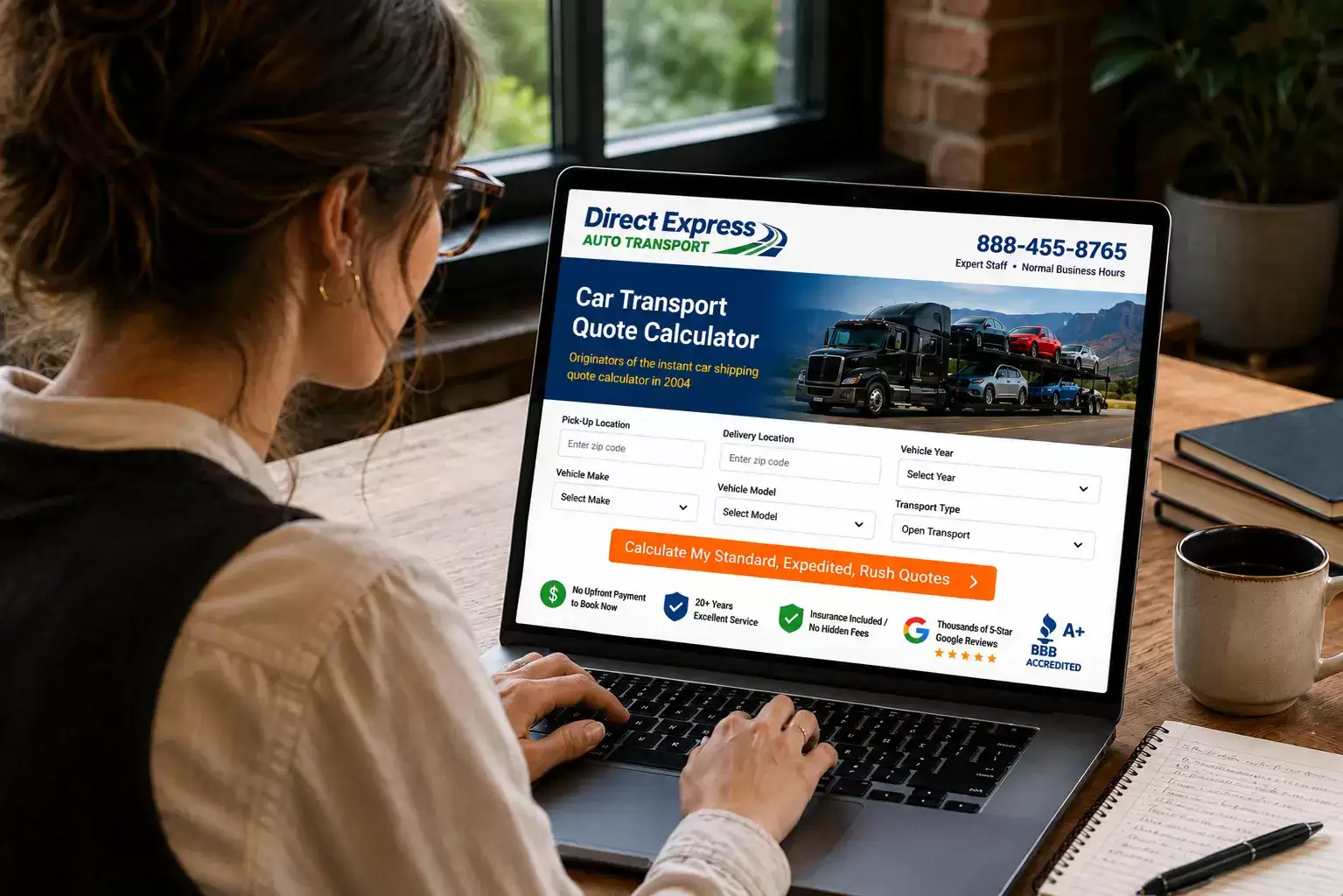
The Company That Invented Instant Auto Transport Pricing
Direct Express Auto Transport pioneered online instant pricing for the auto transport industry in 2004. Before we built the first car shipping cost calculator, getting a quote from a broker meant phone calls, callbacks, and waiting — sometimes days. We changed that. Today you know your exact cost in 30 seconds, before committing to anything. No phone tag, no hassle. Just a real number, instantly.
Three Service Tiers for Every Arizona to Florida Shipment
Every shipment on this Arizona to Florida route is available at three service tiers so you can match your budget to your timeline. Standard delivers at the best available rate — ideal when your schedule has a few days of flexibility. Expedited moves your vehicle to the front of the dispatch queue for faster pickup. Rush gets your car picked up as fast as humanly possible — for moves where every day counts. All three tiers include full door-to-door service and carrier insurance.
What customers say about shipping a car from Arizona to Florida with Direct Express Auto Transport


Seasonal Pricing Guide: Arizona to Florida
Arizona to Florida runs counter to the dominant FL→AZ retirement flow, driven by eastbound military PCS, snowbird vehicle returns in spring, and permanent Arizona-to-Florida moves. Spring (March–May) is peak as snowbirds return east; fall is the best value window.


Who Ships a Car from Arizona to Florida — and Why
Arizona to Florida is a smaller-volume corridor than its FL→AZ counterpart — more Floridians relocate to Arizona than the reverse — but it generates consistent year-round auto transport demand from four specific segments: snowbird vehicle returns, military PCS outbound from Arizona installations, permanent Arizona-to-Florida relocations, and Florida-bound corporate transfers. The shared I-10 corridor that defines FL→AZ works identically in reverse, which means carrier availability is excellent in both directions and the operational profile is identical to the eastbound run.
Florida Snowbirds Returning Arizona-Wintered Vehicles Home
The snowbird vehicle return market is the AZ→FL corridor’s most concentrated seasonal demand driver. Florida residents who winter in Arizona — particularly the Scottsdale, Phoenix North, and Tucson communities popular with Florida retirees — frequently ship one vehicle to Arizona for the season in October and November, then ship it back to Florida in March and April. This creates a reliable two-directional annual market: FL→AZ in fall, AZ→FL in spring. The Scottsdale → St.
Tampa Bay and Fort Lauderdale Return Routes: March–April Booking Urgency
Petersburg pairing ($1,475), the Chandler → Fort Lauderdale pairing ($1,600), and the Phoenix → Tampa pairing ($1,450) are the corridor’s primary snowbird vehicle return routes — Tampa Bay and the West Palm Beach/Fort Lauderdale corridor are the major Florida origin markets for Arizona winter residents. Snowbird vehicle shippers should book AZ→FL returns as early in March as possible — the spring return window is compressed into 4–6 weeks and carrier demand peaks sharply from late March through mid-April.
Military PCS: Luke AFB / Davis-Monthan / Fort Huachuca → Florida Installations
Military PCS outbound from Arizona to Florida is the corridor’s most time-critical segment. Luke AFB (Glendale) generates PCS orders to MacDill AFB (Tampa), Patrick Space Force Base (Melbourne), NAS Jacksonville, and Pensacola NAS. Davis-Monthan (Tucson) transfers personnel to Eglin AFB and Tyndall AFB. The Tucson → Jacksonville pairing ($1,350 Standard) and Glendale → Tallahassee ($1,275 Standard) are the primary military routes. Book immediately on receipt of orders.
MCAS Yuma and Yuma Proving Ground Routes to MacDill and NAS Jacksonville
MCAS Yuma and Yuma Proving Ground add westernmost Arizona PCS volume to the Florida pipeline. The Glendale → Tallahassee pairing at $1,275 Standard is the corridor’s lowest-cost military route, serving Luke AFB personnel heading to Eglin and Tyndall. PCS shippers from all Arizona installations should book immediately on receipt of orders and use Expedited or Rush when report dates fall within 10 days.
Permanent Arizona-to-Florida Relocation: Sun Belt to Sun Belt
Permanent Arizona-to-Florida relocation is the year-round base demand layer on this corridor. Arizona residents move to Florida for proximity to East Coast cities, family reunion moves, professional transfers to Miami’s finance and tech sector, and retirement-community options beyond Arizona’s own Sun Belt market. The corridor serves households relocating across Sun Belt states, not just snowbirds reversing direction.
East Valley and West Valley Movers to Miami, Orlando, and Fort Myers
The Gilbert → Hialeah pairing ($1,600) and Avondale → Hollywood pairing ($1,600) capture the East Valley and West Valley permanent mover to South Florida. Mesa → Orlando ($1,500) serves the Arizona tech worker moving to Central Florida’s defense simulation, aerospace, and technology corridor. Tempe → Fort Myers ($1,500) — ASU professionals and graduates relocating to Southwest Florida — is a smaller but consistent market driven by Fort Myers and Naples’ expanding high-net-worth residential market.
Barrett-Jackson Auction Vehicles: Scottsdale to Florida Collectors
Barrett-Jackson’s Scottsdale auction in January draws Florida’s major collector car communities — West Palm Beach, Naples, Miami Beach, and Boca Raton — who ship auction wins to Florida in late January and early February. Enclosed transport is standard for these collector vehicles. The Scottsdale → Miami Beach pairing handles the premium South Florida collector market; Scottsdale → Naples serves the Gulf Coast collector community.
What Makes the Arizona–Florida Auto Shipping Run Different
The I-10 Corridor Eastbound: Identical Infrastructure, Opposite Direction
Arizona to Florida runs the I-10 corridor in reverse — same highway, same mileage, opposite direction. Every AZ→FL carrier departs Arizona on I-10 eastbound at Tucson or Phoenix, crosses New Mexico, traverses Texas east to west (approximately 900 miles — the Texas crossing is the same dominant factor it is in the FL→AZ direction), passes through Louisiana and Mississippi, and arrives in Florida via I-10 at Pensacola or Jacksonville.
Geographic Efficiency: No Routing Alternatives on I-10E
This single-corridor structure makes AZ→FL one of the most operationally predictable cross-country routes in the U.S. No significant elevation challenges exist between Arizona and Florida on I-10 — the highest point is El Paso at approximately 3,800 feet. The carrier you book has almost certainly run this corridor dozens of times.
Glendale → Tallahassee: The Table’s Cheapest Pair Explained
Glendale, AZ to Tallahassee, FL at 1,820 miles and $1,275 Standard is the cheapest pair on this table — and also one of the most relevant military PCS routes. Glendale is home to Luke Air Force Base, the world’s largest F-35 training installation. Tallahassee is not only Florida’s capital but its nearest major city to the Florida Panhandle installations — Eglin AFB (approximately 175 miles west of Tallahassee on I-10), Tyndall AFB (60 miles south of Tallahassee via US-319), and the broader Panhandle military cluster.
Geographic Efficiency: Florida Panhandle Access from West Valley Origins
The geographic explanation for the low rate is straightforward: the Florida Panhandle is where I-10 enters Florida — carriers traveling eastbound from Arizona are already at Tallahassee before making any further Florida penetration. There is no extended Florida approach mileage, and no southward peninsula driving required.
Flagstaff → Miami: Why It’s the Table’s Most Expensive Pair
Flagstaff, AZ to Miami, FL at 2,430 miles and $1,650 Standard is the most expensive pair on this table for compounding reasons. Flagstaff sits at 6,909 feet elevation in northern Arizona — it is not directly on I-10, requiring the carrier to descend I-17 approximately 145 miles south from Flagstaff to reach Phoenix before joining I-10 eastbound. This 145-mile I-17 approach adds distance and routing complexity.
Stacked Penalties: I-17 Mountain Descent and South Florida Peninsula Extension
Stacked at both ends — high-elevation Arizona departure requiring a mountain descent and Florida’s southernmost delivery point — the Flagstaff → Miami pairing is the corridor’s maximum-distance, maximum-complexity run. The per-mile economics are $0.68/mile Standard — competitive for a cross-country haul of this complexity.
The Phoenix Metro’s Departure Advantage
Phoenix’s suburban grid gives it one of the best carrier departure profiles of any major city in the western United States. Unlike Los Angeles (congested freeways, complex suburban routing), San Francisco (bridge tolls, congested approaches), or Seattle (maritime geography and mountains), the Phoenix metro is a flat, grid-based, freeway-dense city where every suburb has direct arterial access to I-10. From Glendale, Peoria, and Surprise in the West Valley, carriers access I-10 eastbound within 10–20 minutes.
West Valley and East Valley Access: I-10E Departure from Every Suburb
From Glendale, Peoria, and Surprise in the West Valley, carriers access I-10 eastbound within 10–20 minutes. From Chandler, Mesa, Gilbert, and Tempe, US-60 or Loop 202 connects to I-10 in approximately 2 hours. Phoenix area origins are consistently well-covered for AZ→FL loads.
Yuma → Clearwater: The Southwest Corner to the Gulf Coast
Yuma, AZ to Clearwater, FL at 2,060 miles and $1,450 Standard is geographically interesting: Yuma sits at Arizona’s extreme southwest corner, closer to San Diego (190 miles west) than to Phoenix (185 miles north), and is reached from Phoenix by taking I-8 southwest approximately 180 miles. A carrier departing Yuma eastbound joins I-8 to Tucson, then I-10 northeast to Phoenix, then I-10 east all the way to Clearwater (via Jacksonville, I-75 south, and the Suncoast Parkway).
MCAS Yuma PCS Traffic: MacDill AFB and Central Florida Assignments
Yuma’s primary demand driver for AZ→FL is MCAS Yuma and Yuma Proving Ground PCS moves to Tampa Bay and Central Florida installations — MacDill AFB in particular, which shares the F-18 and tactical aircraft training mission set that aligns with MCAS Yuma’s pipeline.
Casa Grande → Cape Coral: The Center-to-Southwest-Coast Pairing
Casa Grande sits at I-10’s intersection with I-8 between Tucson and Phoenix — it is the geographic midpoint of Arizona’s most traveled auto transport corridor. Cape Coral on Florida’s Southwest Coast is one of Florida’s fastest-growing cities, located south of Fort Myers on the Caloosahatchee River. The 2,100-mile Casa Grande → Cape Coral run requires the carrier to travel I-10 east to I-75 south from Lake City, continuing south through Gainesville and Ocala to Fort Myers and Cape Coral.
Southwest Florida Snowbird Traffic: Lee County and Casa Grande Season-End Shipping
At $1,475 Standard, Casa Grande → Cape Coral represents competitive pricing for the Southwest Florida coastal market — popular with Arizona snowbirds who own second properties in Lee County and ship their vehicle east at season’s end. The I-75 south approach adds roughly 100 miles past Jacksonville.

Other Arizona to Florida Cities We Serve
Direct Express ships vehicles between hundreds of city pairs on this route. Below is a broader look at additional Arizona origins and Florida destinations we regularly serve.
Hub Cities Along the Arizona–Florida Car Shipping Corridor
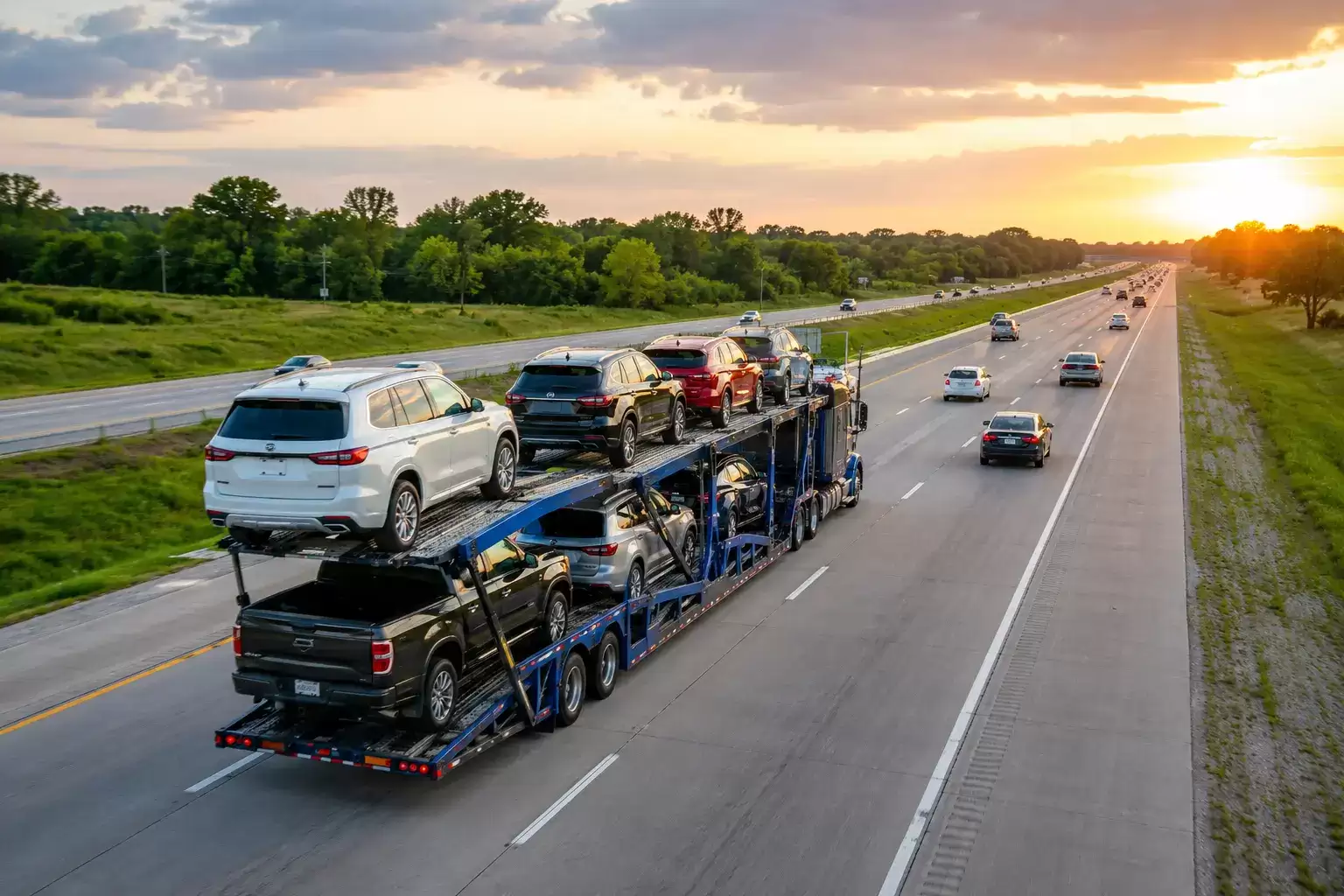
Arizona to Florida is the eastbound I-10 corridor — mirror-image of the FL→AZ westbound run. Every Arizona departure zone feeds I-10 eastbound, crosses New Mexico, traverses Texas from El Paso east to the Louisiana border (approximately 900 miles), continues through the Gulf Coast states, and delivers to Florida via Jacksonville or the Panhandle.
Arizona Departure Zones
I-10 Cross-Country Relay Points (Eastbound)
Florida Delivery Zones
Open vs. Enclosed Car Transport on the Arizona–Florida Route
Open transport is the correct choice for the vast majority of AZ→FL shipments. The I-10 corridor eastbound is one of the most heavily traveled cross-country auto transport lanes in the country — open carrier availability from Arizona to Florida is consistent and reliable year-round. The route presents no elevation hazards between Phoenix and Florida (the highest point is El Paso at approximately 3,800 feet), no severe weather risk zones for the vehicle in transit, and no road conditions that would argue for enclosed transport on a standard automobile.
Open Transport Recommended for Most
- Standard open-air carrier — the correct choice for virtually all AZ→FL shipments including military PCS, snowbird vehicle returns, corporate relocation, and permanent moves
- I-10 eastbound is among the country’s most carrier-dense cross-country corridors — AZ→FL open transport availability is consistently strong
- Arizona summer heat is not an issue for vehicles on open carriers departing Arizona — the vehicle travels through the Sonoran and Chihuahuan deserts in 4–6 hours and then enters more moderate temperatures in New Mexico and Texas
- Military PCS from Luke AFB, Davis-Monthan AFB, Fort Huachuca, MCAS Yuma, Yuma Proving Ground: entirely open transport market
- Snowbird vehicle returns: open transport throughout the March–April spring return season
Enclosed Transport
- Vehicle travels in a fully enclosed, weatherproof trailer coast to coast
- Typically 40–60% more expensive than open transport
- Barrett-Jackson Scottsdale auction purchases: the primary enclosed transport segment on this corridor. Collector car buyers from South Florida, Palm Beach, and Naples shipping Barrett-Jackson purchases home after the January Scottsdale auction should use enclosed transport for pre-1975 vehicles and any high-value collectibles
- Scottsdale / Paradise Valley luxury vehicle market (Ferrari, Lamborghini, McLaren, high-value Porsche) shipping to equivalent South Florida markets: Naples, Palm Beach, Miami Beach, Coral Gables
- Flagstaff winter departures (November–February): if shipping a weather-sensitive vehicle from Flagstaff in heavy winter conditions at elevation, enclosed transport provides additional protection for the mountain departure portion of the trip
Our honest recommendation: Open transport for all standard vehicles and military PCS. Enclosed for collector car auction purchases from Barrett-Jackson Scottsdale being delivered to Florida and for high-value exotics moving between Arizona’s and Florida’s luxury automotive markets.


Door-to-Door Car Shipping: What to Expect in Arizona and Florida
Pickup in Arizona
Phoenix and Scottsdale Metro
Arizona pickup is operationally smooth across Phoenix metro. Flat grid and freeway density allow 75-foot multi-car haulers to reach virtually every residential neighborhood without staging. West Valley (Glendale, Luke AFB area, Peoria, Surprise, Avondale, Goodyear, Buckeye, Litchfield Park): direct I-10, 10–20 minutes to the eastbound on-ramp. East Valley (Mesa, Chandler, Gilbert, Tempe, Scottsdale, Queen Creek, San Tan Valley): US-60 or Loop 202 to I-10. Tucson metro: I-10 direct, Davis-Monthan AFB established PCS staging. Sierra Vista / Fort Huachuca: 90 miles southeast of Tucson via AZ-90, carriers stage in Sierra Vista.
Tucson and Smaller Arizona Markets
Prescott: I-17 north from Phoenix via Prescott Junction (Cordes Lakes), then AZ-69 — manageable haul route, some older residential streets require nearby staging. Flagstaff: I-17 north, 145 miles at 6,909 feet — winter pickup (November–February) requires weather-contingency scheduling for snow and ice. Yuma: flat grid city, easy carrier access from I-8. Arizona summer pickup: plan handoff before 9am in July and August when possible — triple-digit heat is routine for carriers, but is a significant consideration for the person doing the inspection and handoff.
Delivery in Florida
South Florida and the Gold Coast
Florida delivery follows AZ→FL regional patterns. Jacksonville and NE Florida: first major delivery zone carriers reach via I-10 — excellent carrier access. Florida Panhandle (Pensacola, Tallahassee): directly on I-10, fastest delivery zones, including the Glendale → Tallahassee pairing at $1,275. Central Florida (Orlando, Kissimmee, Lakeland, Melbourne, Deltona): I-75 south or I-4 east, excellent coverage. Tampa Bay (Tampa, St. Petersburg, Clearwater) and Gulf Coast (Sarasota, Bradenton): I-75 to I-275, strong carrier density. Southwest Florida (Fort Myers, Cape Coral, Naples): I-75 south to Exit 131 and US-41, accessible without routing complications.
Tampa Bay, Orlando, and North Florida
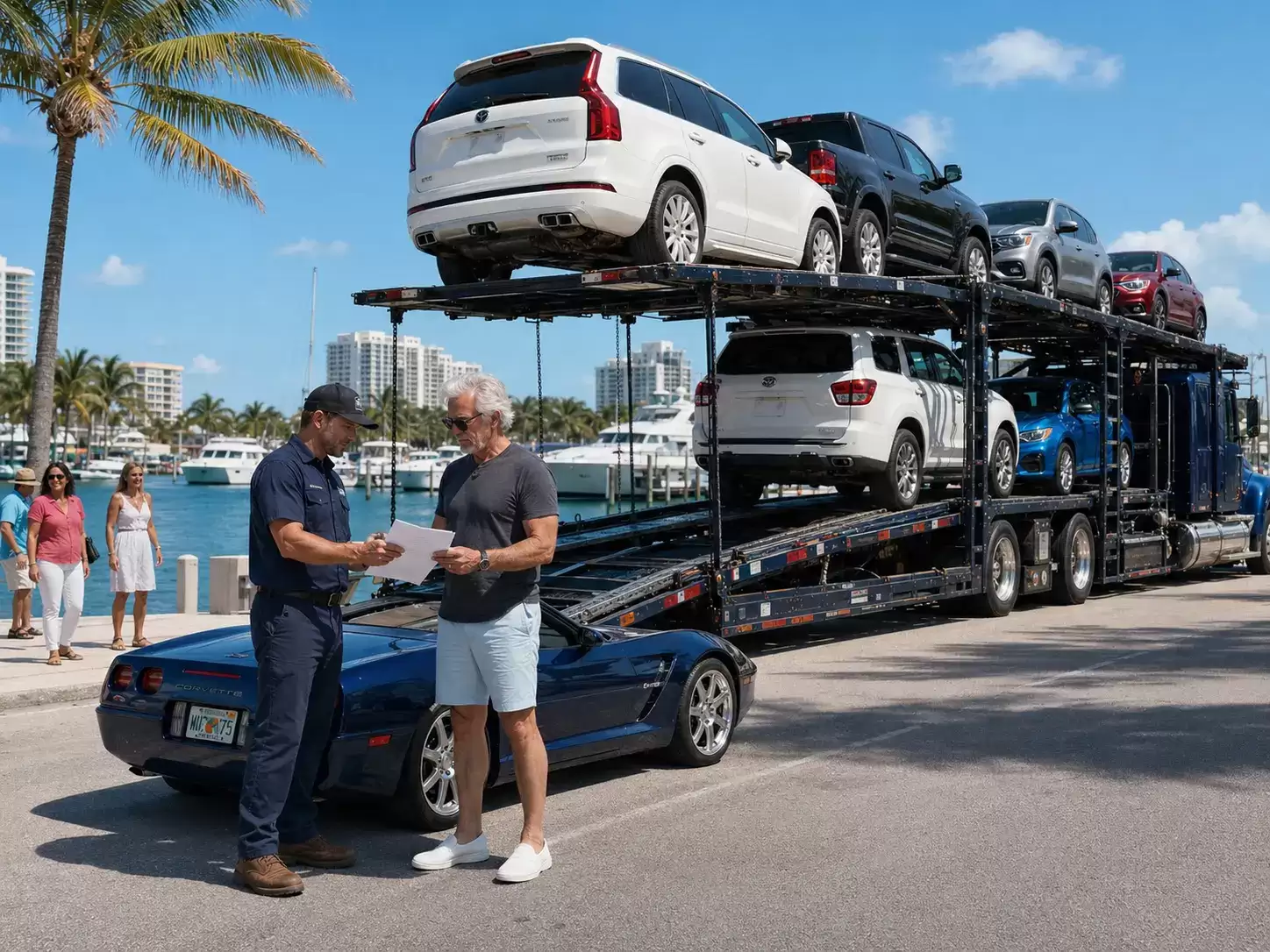
South Florida (Miami metro, Fort Lauderdale, Hollywood, Pembroke Pines, Coral Springs, Boca Raton, West Palm Beach, Port St. Lucie): Florida Turnpike or I-95 south from Jacksonville, approximately 350 Florida miles after entering the state. Urban Miami and Fort Lauderdale high-rise delivery: carriers may require nearby commercial staging; your coordinator handles this routinely. Hurricane season (June 1–November 30): NOAA monitoring applies for South and Southwest FL deliveries in August–October. Carriers hold staging during active storm events and deliver when safe — rarely extending delivery by more than a day or two.
Florida Vehicle Registration for Arizona Arrivals
Florida requires registration within 10 days of establishing residency. Visit your county tax collector’s office with your out-of-state title, proof of Florida insurance, and proof of Florida address; no smog check or VIN inspection is required. Cancel your Arizona registration once your Florida plates arrive.
Preparing Your Vehicle
Before Arizona pickup: remove all personal items from the passenger compartment, disable car alarms, remove any toll transponders (Arizona FasTrack or Electronic Toll Collection transponders), and leave no more than a quarter tank of fuel. Photograph your vehicle from all angles with date-stamped images before the carrier arrives. If departing in Arizona summer, plan your inspection time for the morning hours when possible. Florida delivery: inspect your vehicle carefully before signing the Bill of Lading. Note any new damage with the carrier before signing — your signature without noted exceptions constitutes acceptance. Florida summer delivery: your vehicle will be warm on arrival from transit; wait a few minutes before detailed inspection in the shade.
Arizona & Florida Auto Transport Resources
Arizona Helpful Government Links
- Arizona Motor Vehicle Division (Arizona MVD) — Arizona’s vehicle title and registration agency. Cancel your Arizona vehicle registration when establishing Florida residency. Arizona MVD is not called the DMV — it is the Motor Vehicle Division under ADOT.
- ServiceArizona.com — Arizona MVD Online Portal — Online vehicle registration cancellation and title release for Arizona residents departing for Florida.
- Arizona MVD — Title Transfer and Release of Interest — Releasing the Arizona title for transfer to Florida when establishing new residency. Lienholder releases required if vehicle is financed.
- Arizona MVD — Military Provisions — Provisions for active duty military departing Arizona installations (Luke AFB, Davis-Monthan AFB, Fort Huachuca, MCAS Yuma, Yuma Proving Ground) on PCS orders to Florida.
Florida Helpful Government Links
- Florida Department of Highway Safety and Motor Vehicles (FLHSMV) — Florida’s vehicle title and registration oversight agency. New Florida residents from Arizona must establish Florida title and registration within 10 days of becoming a resident.
- FLHSMV — Vehicle Title and Registration — Florida title transfer from Arizona title, registration fees, and license plate issuance. Note: Florida vehicle registration transactions are processed at your county Tax Collector’s office, not directly at an FLHSMV office.
- FLHSMV — Florida Driver License — New Florida residents from Arizona must obtain a Florida driver’s license within 30 days of establishing residency. Your Arizona driver’s license must be surrendered.
- FLHSMV — Military Provisions — Registration and licensing provisions for active duty military personnel on PCS orders to Florida installations (MacDill AFB, Patrick SFB, NAS Jacksonville, NAS Pensacola, Eglin AFB) arriving from Arizona.
Federal Auto Transport Resources
- FMCSA — Verify a Carrier’s License (SAFER System) — Verify that any auto transport company is federally licensed and insured before booking a cross-country shipment.
- FMCSA — Protect Your Move — Federal consumer guidance on hiring vehicle shippers and your rights on a cross-country move.