Florida to Arizona Car Shipping
The original instant car shipping calculator — trusted since 2004. Door-to-door Florida to Arizona transport with no surprises, no hidden fees, and three options to ship your vehicle on your schedule.
★ 4.6/5 Google Reviews | BBB Accredited A+ | FMCSA Licensed (MC #479342) | USDOT #1240502 | No upfront payment required | 20+ years shipping vehicles


Florida to Arizona Car Shipping Rates by City
Every Florida to Arizona vehicle shipment is available at three service levels:
Standard, Expedited, & Rush Options
Choose the one that fits your timeline and budget. All three include full door-to-door service and carrier insurance.

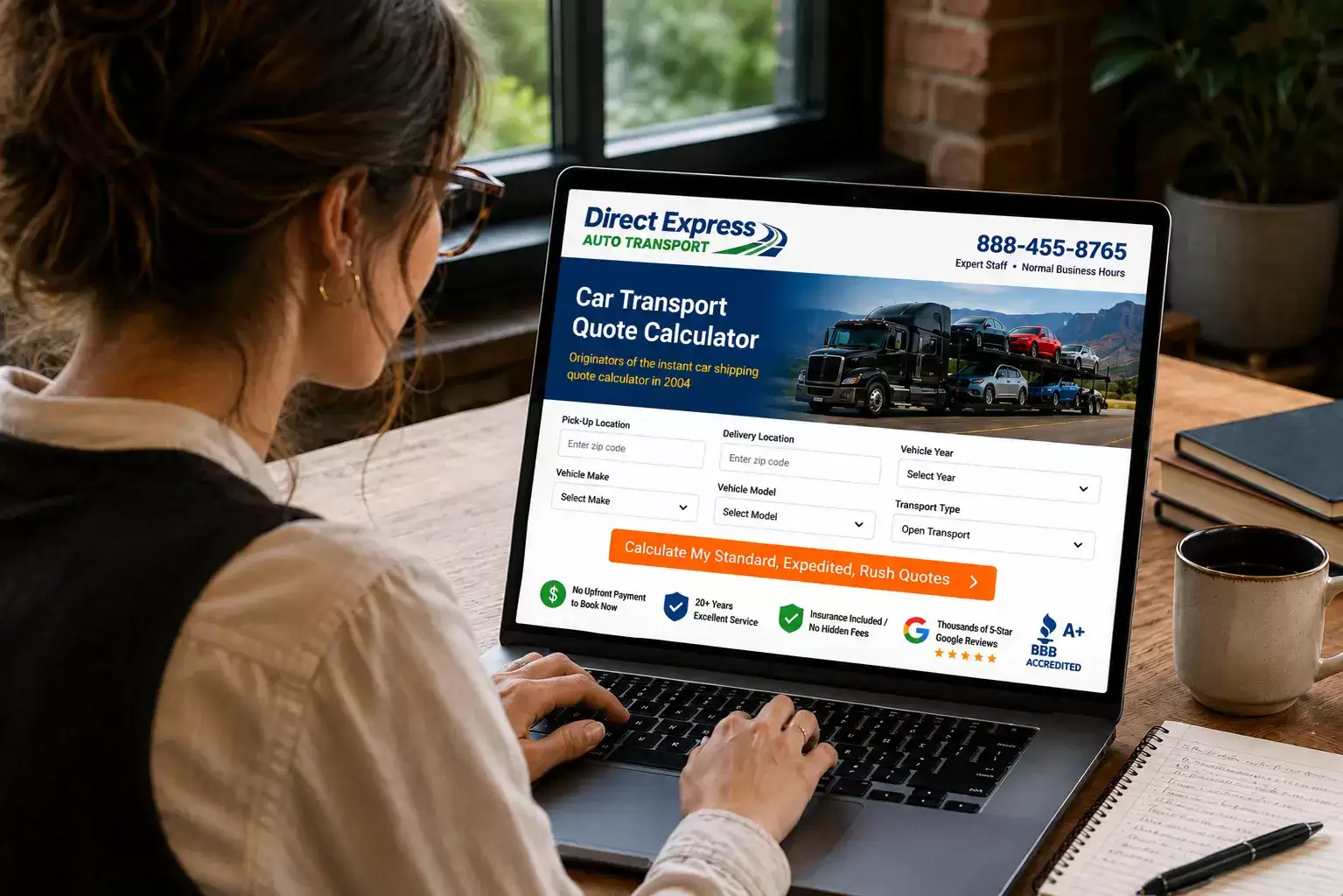
The Company That Invented Instant Auto Transport Pricing
Direct Express Auto Transport pioneered online instant pricing for the auto transport industry in 2004. Before we built the first car shipping cost calculator, getting a quote from a broker meant phone calls, callbacks, and waiting — sometimes days. We changed that. Today you know your exact cost in 30 seconds, before committing to anything. No phone tag, no hassle. Just a real number, instantly.
Three Service Tiers for Every Florida to Arizona Shipment
Every shipment on this Florida to Arizona route is available at three service tiers so you can match your budget to your timeline. Standard delivers at the best available rate — ideal when your schedule has a few days of flexibility. Expedited moves your vehicle to the front of the dispatch queue for faster pickup. Rush gets your car picked up as fast as humanly possible — for moves where every day counts. All three tiers include full door-to-door service and carrier insurance.
What customers say about shipping a car from Florida to Arizona with Direct Express Auto Transport


Seasonal Pricing Guide: Florida to Arizona
Florida to Arizona runs year-round on I-10W, driven by military PCS and permanent westbound relocations rather than classic snowbird demand. The summer PCS peak (June–July) is the dominant seasonal force; mid-to-late summer after PCS volumes wind down is the best value window.


Who Ships a Car from Florida to Arizona — and Why
Florida to Arizona is a long-haul Sun Belt corridor without a single dominant driver — instead it runs on a combination of military PCS, Phoenix tech sector growth, retirement equity migration, and university enrollment. The I-10 corridor connects both states directly, giving carriers reliable lane coverage. Demand is distributed across four distinct segments that each have distinct seasonality.
Military PCS: MacDill AFB / NAS Jacksonville → Luke AFB / Davis-Monthan
Military PCS is the corridor’s most time-sensitive segment and its largest single-month demand driver. The I-10 corridor connects Florida’s installations directly to Arizona’s receiving bases. MacDill AFB (Tampa), NAS Jacksonville, NAS Pensacola, and Eglin AFB/Hurlburt Field generate most Florida departures. Receiving installations are Luke AFB (Glendale), Davis-Monthan AFB (Tucson), and Fort Huachuca (Sierra Vista).
Luke AFB, Davis-Monthan, and Fort Huachuca: Florida Installation Receiving Routes
Luke AFB in Glendale is the world’s largest F-35 training base and receives personnel from MacDill and Eglin with predictable frequency. Davis-Monthan AFB in Tucson (355th Wing, AMARG) and Fort Huachuca (Army intelligence, Sierra Vista) fill out the receiving installation picture. The Jacksonville → Luke and Tampa → Davis-Monthan lanes carry the highest military PCS volume. June–August and January–March are peak military shipping months for this corridor.
Technology-Sector Corporate Relocation: Florida Tech Professionals Moving to Phoenix
Technology-sector corporate relocation is the corridor’s fastest-growing demand segment. Phoenix’s semiconductor and technology industry — anchored by TSMC’s $40B fabrication complex in north Phoenix, Intel in Chandler, and a dense Scottsdale tech corridor — recruits aggressively from Florida’s Tampa Bay and Miami tech markets. Florida tech professionals accepting Arizona offers ship vehicles rather than drive the 2,400-mile route.
Scottsdale Tech Corridor and Tempe ASU Ecosystem: South Florida Relocation Routes
The Fort Lauderdale → Scottsdale ($1,625) and Pembroke Pines → Avondale ($1,625) pairings capture the South Florida tech professional to West Phoenix tech corridor moves. Tempe — home to Arizona State University, Carvana, Axon, and GoDaddy — generates demand from the Cape Coral → Tempe pairing ($1,550). The broader Orlando → Chandler route ($1,500) covers Central Florida tech and aerospace professionals moving to Arizona’s East Valley semiconductor and aerospace cluster.
Sun Belt Retirement Migration: Florida Homeowners Moving to Arizona
Permanent Sun Belt retirement migration from Florida to Arizona is a growing and often counterintuitive flow. Florida has long been the country’s premier retirement destination, but significant numbers of long-time Florida residents — particularly those who arrived from the Northeast and Midwest decades ago — choose Arizona for their retirement years specifically because it offers what Florida once did: affordable housing, no state income tax, warm weather, and space.
Phoenix Metro and Prescott Retirement Markets for Florida Equity-Exit Moves
Florida homeowners who sold during the market’s peak appreciation now carry significant equity and frequently target the Phoenix metro or Prescott/Sedona area for retirement. Arizona offers lower property costs, dry heat that many retirees prefer over Florida humidity, and strong medical infrastructure in the Phoenix metro. The Jacksonville → Scottsdale and Miami → Phoenix pairings carry the most retirement migration volume.
Florida University Students Shipping Cars to Arizona State, U of A, and NAU
Florida students relocating to Arizona State University (Tempe), University of Arizona (Tucson), Grand Canyon University (Phoenix), or Northern Arizona University (Flagstaff) ship vehicles at the start and end of academic years. Miami, Tampa, and Orlando feeder markets generate the most consistent volume. Florida parents shipping vehicles to college students — and students shipping cars home after graduation — create reliable August and May demand peaks.
What Makes the Florida–Arizona Auto Shipping Run Different
The I-10 Corridor: America’s Southern Cross-Country Highway
Florida to Arizona is almost entirely an I-10 story. Interstate 10 is the southernmost transcontinental US interstate, running 2,460 miles from Jacksonville, Florida to Santa Monica, California. Every FL→AZ shipment travels west on I-10 from its Florida pickup point, crossing the Florida Panhandle (Tallahassee, Pensacola), Alabama (Mobile), Mississippi, Louisiana (New Orleans, Baton Rouge), Texas (Houston, San Antonio, El Paso — the longest single-state I-10 stretch at approximately 900 miles), New Mexico (Las Cruces), and then into Arizona at Lordsburg, continuing through Tucson and on to Phoenix.
Texas Transit Time: I-10 Crossing and Overnight Logistics
This single-corridor structure means FL→AZ transit is straightforward and predictable — there is no carrier routing ambiguity, no mountain pass closures to navigate (the highest point on I-10 between Florida and Arizona is the approach to El Paso at approximately 3,800 feet — well below any problematic altitude), and no significant weather-related delays except for occasional South Florida hurricane season complications at the pickup end.
Tallahassee → Casa Grande: Why It’s the Cheapest Pair by a Wide Margin
Tallahassee, FL to Casa Grande, AZ at 1,750 miles and $1,225 Standard is the cheapest pair on this table for two compounding reasons. First, Tallahassee is the closest major Florida city to Arizona — sitting in the Florida Panhandle just east of where I-10 begins its westward run across the Gulf Coast states, it has approximately 350 miles less to cover than Miami before reaching the I-10 on-ramp. Second, Casa Grande sits between Tucson and Phoenix on I-10 at an exit that all westbound carriers pass directly through —
Geographic Efficiency: Panhandle Origin and I-10 Direct Terminus
The combination of a short Florida approach and a zero-detour Arizona delivery makes Tallahassee → Casa Grande the corridor’s most cost-efficient pair. It is also relevant to Fort Huachuca — service members stationed at Fort Huachuca near Sierra Vista (about 90 miles southeast of Casa Grande via AZ-79 south) sometimes use Tucson or Casa Grande as their delivery point before driving to the installation.
Port St. Lucie → Flagstaff: The Table’s Most Expensive Pair
Port St. Lucie → Flagstaff at 2,470 miles and $1,675 Standard is the table’s most expensive pair for stacked reasons. Port St. Lucie sits on Florida’s Treasure Coast — not as far south as Miami but still requiring roughly 200 miles of I-95 northbound to reach Jacksonville before joining I-10 westbound. Flagstaff sits at 6,909 feet in northern Arizona — it is the highest-altitude city on this table and requires carriers to leave I-10 at the Phoenix area and take I-17 north approximately 145 miles uphill to Flagstaff (or approach from I-40 westbound).
I-17 Northern Approach: Flagstaff Elevation and Routing Complexity
The elevation approach adds both distance and routing complexity. Flagstaff in January and February — when snowbirds traveling to Phoenix or Sedona might also book moves — can see actual snow and ice conditions at elevation, which adds operational consideration for carriers. At $1,675, the Port St. Lucie → Flagstaff Standard rate reflects approximately $0.68/mile —
South Florida to Phoenix: Why 2,360 Miles Doesn’t Feel Like It
Miami, Fort Lauderdale, Hialeah, Hollywood, and Pembroke Pines are all approximately 2,355–2,390 miles from Phoenix and the West Valley communities (Avondale, Goodyear, Surprise). Many South Florida residents are surprised by how far Arizona is — the common perception of “both Sun Belt states” masks the geographical reality that Miami is approximately as far from Phoenix as it is from Chicago, and closer to New York City than to the Grand Canyon.
I-10 Cross-Country Distance: South Florida True Mileage Reality
This is a true cross-country shipment. At $1,600–$1,625 Standard, it is priced accordingly — these rates reflect a 7–10 day carrier engagement covering approximately 2,370 miles of road. The per-mile rate for South Florida to Phoenix ($0.68/mile) is competitive for a cross-country haul and considerably cheaper than shipping by any other method.
The Texas Factor: Why FL→AZ Takes Longer Than FL→NC
Florida to North Carolina (approximately 700–950 miles) can be delivered in 2–3 days. Florida to Arizona (1,750–2,470 miles) takes 7–10 days — not just because of the additional mileage, but specifically because of Texas. The I-10 crossing of Texas is approximately 900 miles from the Louisiana border to El Paso — a distance greater than the entire Florida-to-North-Carolina route. Crossing Texas alone is a full day of driving for a carrier.
I-10 Texas Crossing: 900-Mile Transit Factor for FL→AZ Timing
Carriers on this corridor typically overnight in Texas (Houston or San Antonio area) before continuing to El Paso and into Arizona. Plan your booking window with the 7–10 day transit prominently in mind — on a cross-country shipment, booking too close to a firm move-in date creates unnecessary pressure.
Yuma: The Table’s Geographic Outlier
Yuma, AZ appears in the Sarasota → Yuma pairing at 2,100 miles and $1,475. Yuma occupies a unique geographic position: it sits at Arizona’s extreme southwest corner, at the junction of I-8 and US-95, closer to San Diego (190 miles west) and to California’s Imperial Valley than to Phoenix (185 miles north). To reach Yuma from Florida on I-10, carriers continue west through Phoenix then take I-8 southwest for approximately 180 miles.
Military Significance: MCAS Yuma and Yuma Proving Ground PCS Demand
The Sarasota → Yuma distance of 2,100 miles is shorter than Miami → Phoenix (2,360 miles) despite being further west, because Sarasota is on Florida’s central Gulf Coast (shorter approach to I-10 via I-75) while Yuma is reached via a southwestern detour from the Phoenix junction. Yuma’s primary demand driver is Marine Corps Air Station Yuma —

Other Florida to Arizona Cities We Serve
Direct Express ships vehicles between hundreds of city pairs on this route. Below is a broader look at additional Florida origins and Arizona destinations we regularly serve.
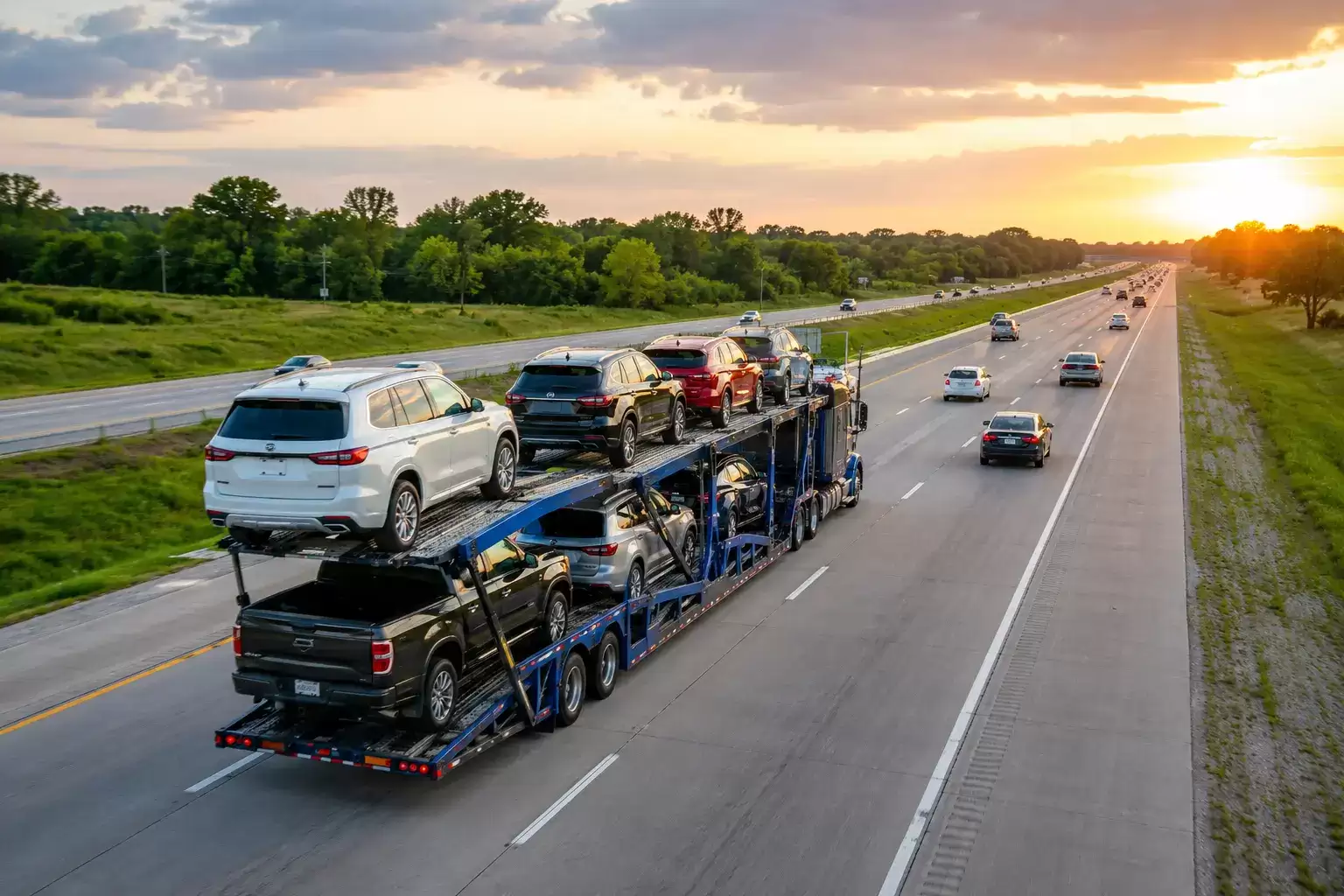

Hub Cities Along the Florida–Arizona Car Shipping Corridor
Florida to Arizona is an I-10 corridor — the most straightforward cross-country auto transport routing in the United States. Every pickup point in Florida feeds into I-10 westbound at Jacksonville or approaches via I-75/Florida Turnpike to join I-10 at the Panhandle. Every delivery point in Arizona is reached from I-10 eastbound approaching from the New Mexico border.
Florida Origin Zones
I-10 Cross-Country Relay Points
Arizona Delivery Zones
Open vs. Enclosed Car Transport on the Florida–Arizona Route
Open transport is the right choice for the overwhelming majority of FL→AZ shipments. The I-10 corridor is one of the most carrier-dense cross-country routes in the United States — open transport availability from Florida to Arizona is consistent year-round. The desert crossing involves no hazardous mountain passes, no significant weather risk for the vehicle (carriers manage summer heat routinely), and no road conditions that would argue for enclosed transport on a standard vehicle.
Open Transport Recommended for Most
- Standard open-air carrier — the correct choice for virtually all FL→AZ shipments including military PCS, corporate relocation, retirement moves, and student vehicles
- I-10 is the country’s most heavily traveled southern cross-country freight corridor — FL→AZ open carrier availability is consistently outstanding
- Desert heat does not damage vehicles on open carriers in transit — this is a common misconception. Carriers cross the Mojave and Sonoran deserts daily without incident. Your vehicle will be fine.
- Military PCS to Luke AFB, Davis-Monthan AFB, Fort Huachuca, MCAS Yuma, and Yuma Proving Ground: entirely open transport market
- Summer heat in Arizona: plan to have covered parking ready upon delivery if possible, but open transport delivery is not a concern for the vehicle itself
Enclosed Transport
- Vehicle travels in a fully enclosed, weatherproof trailer coast to coast
- Typically 40–60% more expensive than open transport
- South Florida exotic and collector vehicle market (Miami Beach, Palm Beach, Fort Lauderdale waterfront) shipping high-value exotics to Scottsdale and Paradise Valley: the primary enclosed transport segment on this corridor
- Scottsdale’s auction market — Barrett-Jackson Scottsdale (January) is the world’s largest collector car auction — draws enclosed transport from Florida collector car communities in West Palm Beach, Naples, and Miami for pre-auction consignment delivery
- Classic car collectors shipping to the Scottsdale car week events (January) from Florida winter storage
- Flagstaff winter delivery (November–February): if delivering a weather-sensitive exotic to Flagstaff at elevation during snow season, enclosed transport provides additional protection
Our honest recommendation: Open transport for all standard vehicles. Enclosed for exotics and collector cars moving between South Florida’s luxury automobile market and the Scottsdale/Paradise Valley collector car and auction community — particularly around Barrett-Jackson Scottsdale in January.


Door-to-Door Car Shipping: What to Expect in Florida and Arizona
Pickup in Florida
South Florida and the Gold Coast
Florida pickup for AZ-bound cross-country shipments follows the same regional patterns as all Florida northbound and westbound transport. For South Florida (Miami, Fort Lauderdale, Hialeah, Hollywood, Pembroke Pines, Coral Springs, Boca Raton): Florida Turnpike and I-95 northbound access, good carrier density — the I-10 westbound pipeline originates from this zone via the Jacksonville funnel. Urban South Florida pickup (Miami high-rises, Fort Lauderdale waterfront): carriers may require nearby commercial staging for 75-foot multi-car haulers; your coordinator handles this routinely.
Tampa Bay, Orlando, and North Florida
Tampa Bay, Sarasota, and Gulf Coast: I-75 north to I-10, excellent carrier access. Northeast Florida (Jacksonville): literally the eastern terminus of I-10 — the most efficient pickup zone for I-10 westbound loads. Florida Panhandle (Tallahassee, Pensacola, Gainesville): directly on I-10 or a short connector away, making this the fastest-to-dispatch FL zone for AZ-bound shipments. Hurricane season (June 1–November 30): monitor NOAA tropical forecasts for South and Southwest FL pickup logistics August through October. For all FL pickup zones: no cold-weather, mountainous, or other operational complications year-round.
Delivery in Arizona
Phoenix and Scottsdale Metro
Phoenix metro delivery is excellent — one of the most accessible large-city delivery zones in the western United States. Unlike Los Angeles or San Francisco, Phoenix’s grid-based suburban layout provides direct hauler access to virtually every residential address, with minimal staging requirements. Luke AFB (West Valley) and nearby communities (Glendale, Peoria, Surprise, Litchfield Park, Goodyear, Avondale): all accessible via I-10 west / Loop 101 network, established PCS staging protocols. East Valley (Mesa, Chandler, Gilbert, Tempe, Scottsdale, Queen Creek, San Tan Valley): I-10 / US-60 / Loop 202 access, excellent delivery conditions. Tucson and Southeast Arizona: I-10 direct, exceptional carrier access. Davis-Monthan AFB delivery has established on-base staging.
Tucson and Smaller Arizona Markets
Sierra Vista / Fort Huachuca: approximately 90 miles southeast of Tucson via AZ-90 — carriers typically deliver to Tucson-area staging and complete the final leg, or deliver door-to-door for residential addresses in Sierra Vista. Flagstaff: I-17 north from Phoenix, 145 miles; winter months (November–February) can see snow and ice at 6,909 feet elevation — winter tire conditions for delivery vehicles should be verified for January and February Flagstaff deliveries. Yuma: I-8 southwest from Phoenix, approximately 180 miles; excellent conditions year-round in one of the country’s driest and sunniest cities. Bullhead City / Laughlin: AZ-95 from I-40; accessible with standard hauler equipment. Prescott / Prescott Valley: I-17 north to Prescott Junction (Cordes Lakes exit), then AZ-69 — manageable haul access, though some residential streets in older Prescott neighborhoods require nearby staging.
Arizona Vehicle Registration for Florida Arrivals
Arizona requires registration within 15 days of establishing residency. Visit an Arizona MVD office with your out-of-state title, proof of Arizona insurance, and proof of Arizona address; an emissions inspection is required in Maricopa and Pima counties. Cancel your Florida registration once your Arizona plates arrive.
Preparing Your Vehicle
Before Florida pickup: remove all personal items from the passenger compartment, remove SunPass transponders, disable car alarms, and leave no more than a quarter tank of fuel. Photograph your vehicle from all angles with date-stamped images before the carrier arrives. Arizona delivery: the desert sun is intense — if your vehicle is being delivered to the Phoenix metro in summer, have a garage or covered parking spot ready if possible. Inspect carefully before signing the Bill of Lading. Note any new damage before signing — your signature without noted exceptions constitutes acceptance.
Florida & Arizona Auto Transport Resources
Florida Helpful Government Links
- Florida Department of Highway Safety and Motor Vehicles (FLHSMV) — Florida’s vehicle title and registration agency. Cancel your Florida registration when establishing Arizona residency.
- FLHSMV — Vehicle Title and Registration — Title transfers, registration cancellation, and duplicate titles for Florida vehicles transferring to Arizona.
- FLHSMV — Florida Driver License — Surrender your Florida driver’s license when establishing Arizona residency.
- FLHSMV — Military Provisions — Provisions for active duty military departing Florida installations (MacDill AFB, Patrick SFB, NAS Jacksonville, NAS Pensacola, Eglin AFB) on PCS orders to Arizona.
Arizona Helpful Government Links
- Arizona Motor Vehicle Division (Arizona MVD) — Arizona’s vehicle title and registration agency. New Arizona residents must register their Florida-titled vehicle within 15 days of establishing AZ residency. Arizona MVD is not called the DMV — it is the Motor Vehicle Division, part of ADOT.
- ServiceArizona.com — Arizona MVD Online Portal — Online vehicle registration, title transfers, and MVD services for Arizona residents arriving from Florida.
- Arizona MVD — Office Locations and Appointments — Schedule your VIN inspection and title transfer appointment at your nearest MVD office in the Phoenix metro, Tucson, or elsewhere in Arizona.
- Arizona DEQ — Vehicle Emissions Testing Program — Emissions testing requirements for newly registered vehicles in Maricopa County (Phoenix metro) and Pima County (Tucson). Required at first Arizona registration for eligible vehicles.
- Arizona MVD — Vehicle License Tax (VLT) Information — Arizona’s annual vehicle property tax equivalent, calculated on 60% of MSRP at $2.89 per $100 assessed value. Required at first registration and annually. Florida arrivals: budget for this in addition to registration fees.
- Arizona MVD — Military Exemptions — Registration and licensing provisions for active duty military personnel on PCS orders to Luke AFB, Davis-Monthan AFB, Fort Huachuca, MCAS Yuma, and Yuma Proving Ground arriving from Florida installations.
Federal Auto Transport Resources
- FMCSA — Verify a Carrier’s License (SAFER System) — Verify that any auto transport company you consider is federally licensed and insured before booking a cross-country shipment.
- FMCSA — Protect Your Move — Federal consumer guidance on hiring vehicle shippers and your rights as a shipper on a cross-country move.