Texas to New York Car Shipping
The original instant car shipping calculator — trusted since 2004. Door-to-door Texas to New York transport with no surprises, no hidden fees, and three options to ship your vehicle on your schedule.
★ 4.6/5 Google Reviews | BBB Accredited A+ | FMCSA Licensed (MC #479342) | USDOT #1240502 | No upfront payment required | 20+ years shipping vehicles


Texas to New York Car Shipping Rates by City
Every Texas to New York vehicle shipment is available at three service levels:
Standard, Expedited, & Rush Options
Choose the one that fits your timeline and budget. All three include full door-to-door service and carrier insurance.
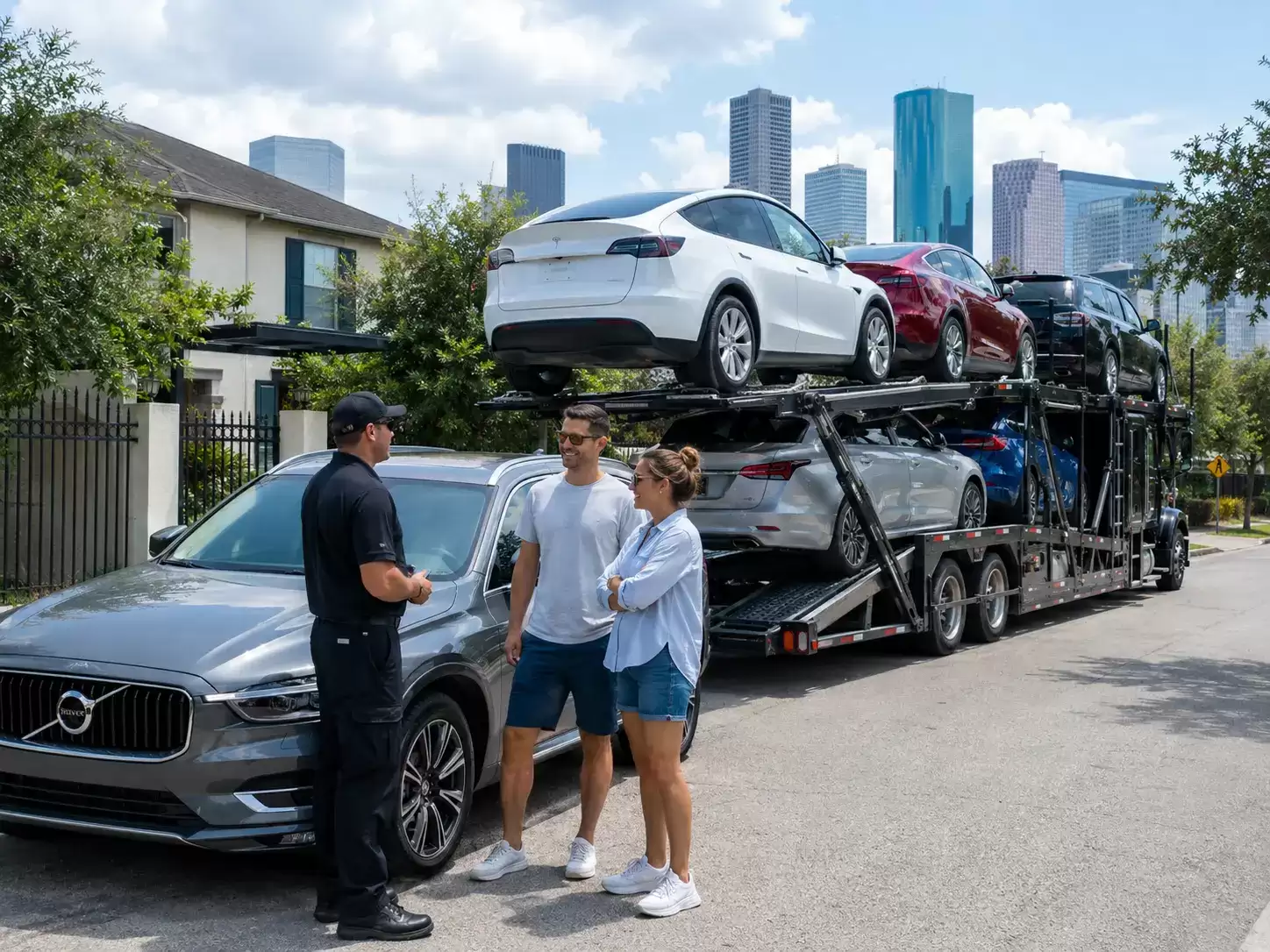
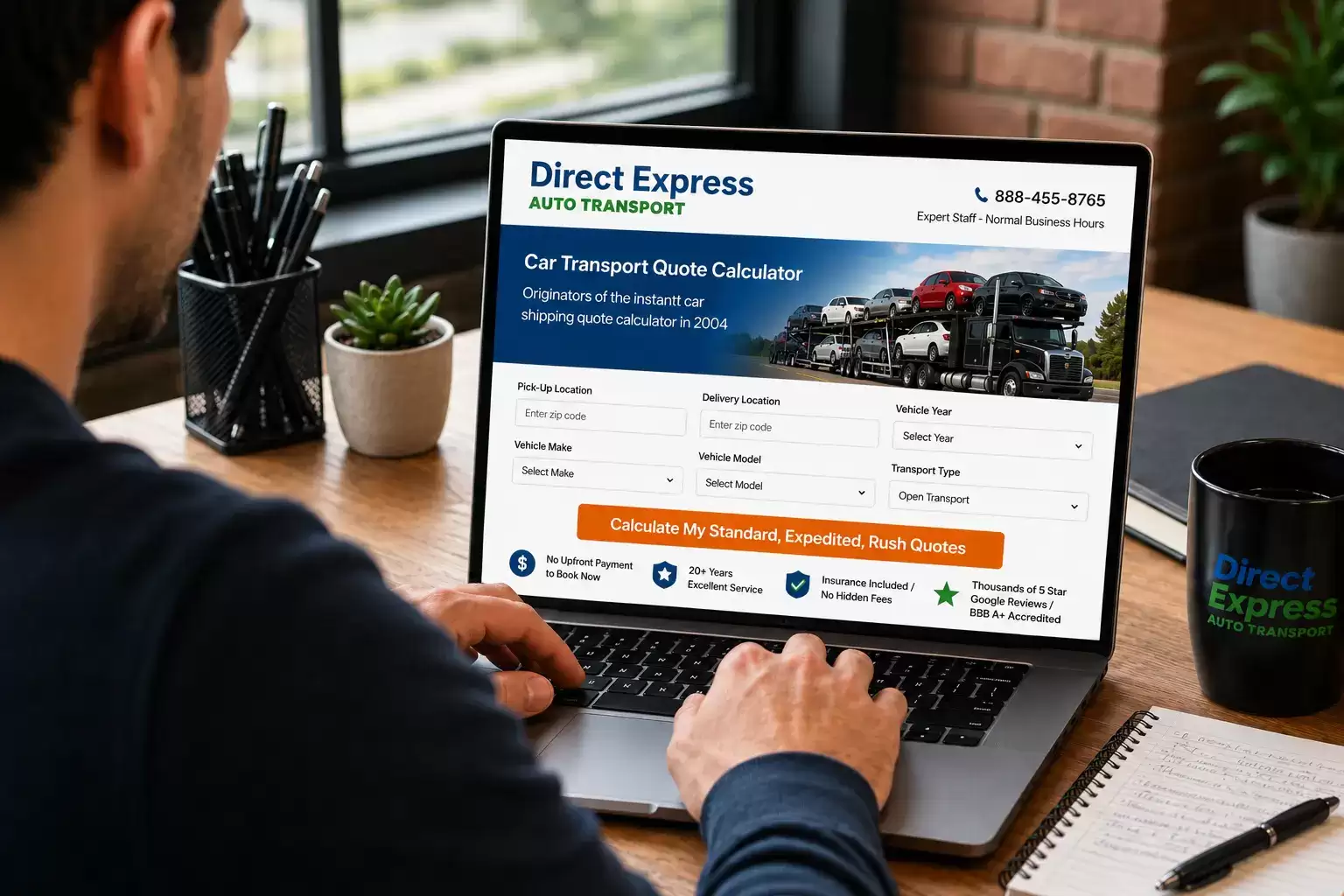
The Company That Invented Instant Auto Transport Pricing
Direct Express Auto Transport pioneered online instant pricing for the auto transport industry in 2004. Before we built the first car shipping cost calculator, getting a quote from a broker meant phone calls, callbacks, and waiting — sometimes days. We changed that. Today you know your exact cost in 30 seconds, before committing to anything. No phone tag, no hassle. Just a real number, instantly.
Three Service Tiers for Every Texas to New York Shipment
Every shipment on this Texas to New York route is available at three service tiers so you can match your budget to your timeline. Standard delivers at the best available rate — ideal when your schedule has a few days of flexibility. Expedited moves your vehicle to the front of the dispatch queue for faster pickup. Rush gets your car picked up as fast as humanly possible — for moves where every day counts. All three tiers include full door-to-door service and carrier insurance.
What customers say about shipping a car from Texas to New York with Direct Express Auto Transport


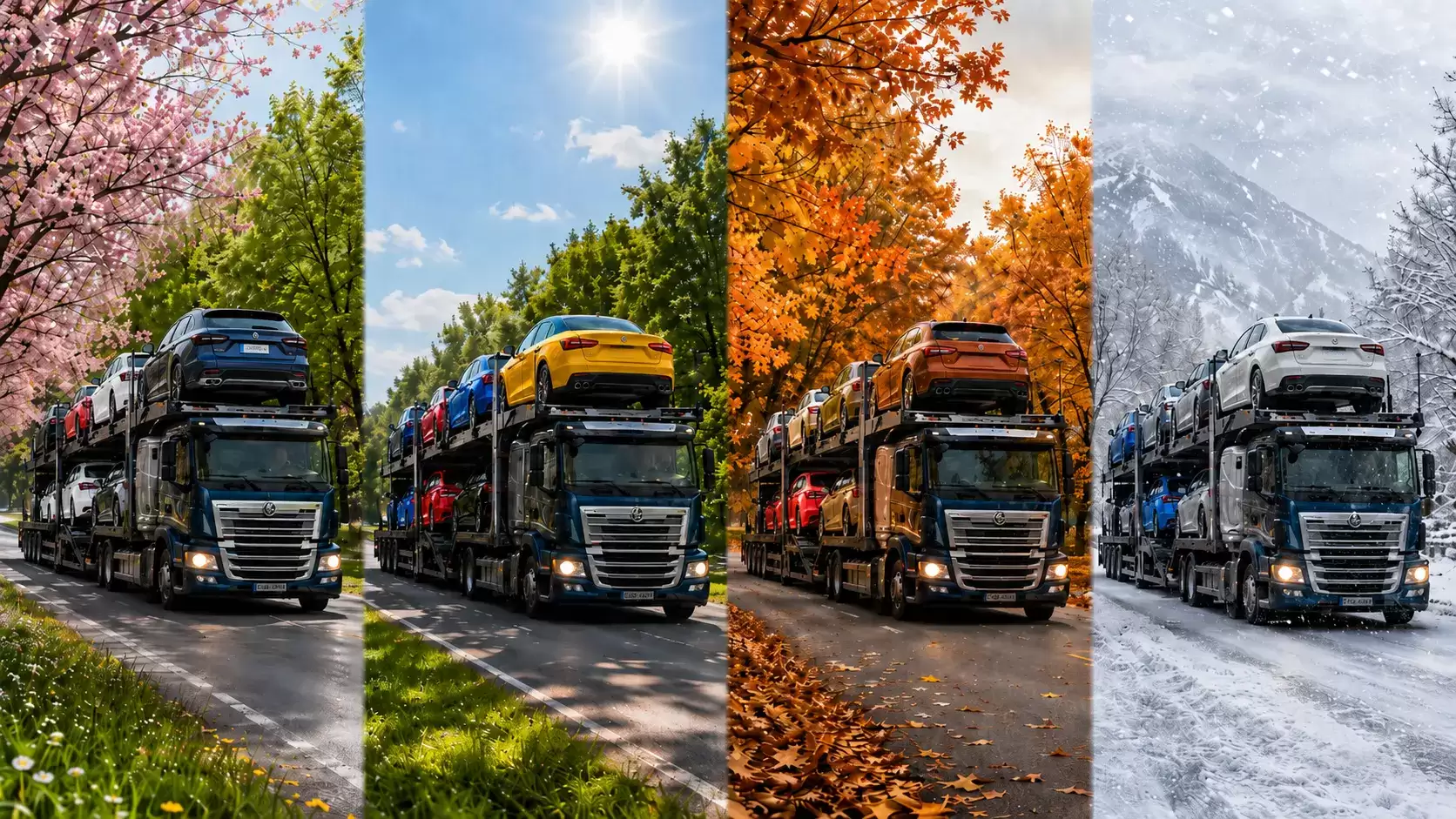
Seasonal Pricing Guide: Texas to New York
Texas to New York peaks in summer with PCS orders, corporate cycles, and university move-in. January through March is the best value window when northbound demand is at its seasonal low.
Who Ships a Car from Texas to New York — and Why
Texas to New York is one of the highest-volume state-to-state auto transport corridors in the country — a consequence of two states that represent the largest and third-largest US economies, two of the country’s four largest cities, and one of the Army’s largest installations feeding directly into one of the Army’s most active deployment posts. The corridor operates at high volume year-round, with a customer base spanning every major demographic and industry segment.
Military PCS: Fort Cavazos and Joint Base San Antonio → New York
Military PCS is the corridor’s most time-critical and most concentrated demand driver. Fort Cavazos in Killeen — home of the 1st Cavalry Division, the 13th Expeditionary Sustainment Command, and III Armored Corps — generates consistent outbound PCS orders to Fort Hamilton in Brooklyn, Fort Drum near Watertown (home of the 10th Mountain Division), and West Point Military Academy.
JBSA Air Force and Army Medical Command: PCS Orders to Fort Drum and Northeast Installations
JBSA — Lackland AFB, Randolph AFB, and Fort Sam Houston — generates Air Force and Army Medical Command orders to Fort Drum and other Northeast installations. The Killeen → Levittown pairing captures the Fort Cavazos–to–Long Island corridor for soldiers assigned to Fort Hamilton and West Point.
Texas University Graduates Moving to New York City
Texas university graduates moving to New York City represent one of the corridor’s most predictable annual segments. New York City’s financial services, media, technology, legal, and consulting industries draw a significant annual cohort from Texas’s major universities. Rice University in Houston produces a concentrated annual cohort of NYC-bound finance graduates each spring. UT Austin places graduates into Goldman Sachs, McKinsey, JPMorgan Chase, Google New York, and major New York law firms each May.
UT Austin, Texas A&M, SMU, and TCU Graduates Entering NYC Finance, Consulting, and Media
Texas A&M’s business and engineering programs place graduates into Manhattan consulting and commodities firms. SMU, TCU, and Baylor all place graduates into New York finance and consulting roles. The Austin → Yonkers pairing at $1,225 and Houston → New York City at $1,150 are the primary university graduate routes. July is the critical booking month for moves with June–July New York start dates.
Houston Energy Sector Professionals
Houston energy-sector professionals transitioning to New York financial roles form a distinctive and high-value segment. Houston is the center of the global energy industry; New York City is the center of global capital markets for energy financing — commodity trading, energy private equity, energy investment banking, and LNG shipping finance all have significant New York operations.
Houston Petroleum Engineers and Energy Finance: Commodity Trading Desks and Private Equity in NYC
A consistent stream of Houston petroleum engineers, geologists, and energy finance professionals crosses to Manhattan for roles at commodity trading firms, private equity energy funds, and investment banks. This segment moves year-round, is relatively price-insensitive (corporate relocation packages typically cover auto transport), and strongly prefers Expedited. The Houston → New York City pairing at $1,150 Standard is the primary route for this segment.
Southeast Texas Petrochemical Corridor
Southeast Texas’s petrochemical and refining corridor — the Golden Triangle of Beaumont, Port Arthur, and Orange — generates a distinct TX→NY shipping segment tied to the refining industry’s rotational workforce. The Port Arthur refinery complex is one of the largest refining concentrations in the world. Refining engineers, project managers, and specialized maintenance professionals frequently rotate between the Golden Triangle and facilities in the New York–New Jersey area.
Beaumont, Port Arthur, and Orange: Golden Triangle Refinery Rotational Workers to New York
The Beaumont → Binghamton pairing at $1,050 Standard is the table’s cheapest pair — Beaumont’s eastern position on I-10 makes it the closest major Texas city to New York and the most efficiently routed Texas origin on this corridor.
South Texas Border City Residents
Texas border city residents moving to New York City’s large Latino communities represent one of the corridor’s most distinctive geographic segments. New York City’s Puerto Rican, Dominican, Mexican, and Central American communities — centered in the South Bronx, East Harlem, Washington Heights, Bushwick, and Jackson Heights — have deep ties to Texas’s border cities. Laredo, Corpus Christi, and the Rio Grande Valley have large Mexican-American populations with family networks extending to NYC’s Latino communities.
Laredo, McAllen, and El Paso Residents Moving to NYC Latino Communities in the Bronx and Queens
The Laredo → Niagara Falls pairing at $1,375 is the table’s most expensive — Laredo sits on the southern Texas border well south of the main I-10 corridor, and Niagara Falls requires the full crossing of New York east to west on I-90. The Brownsville → Freeport and McAllen → Valley Stream pairings in the Other Cities table capture the deep South Texas to Long Island migration corridor.
What Makes the Texas–New York Auto Shipping Run Different
Your Texas Origin Shapes the Price More Than Almost Anywhere Else
Even within a single state, origin geography matters significantly on this corridor — and Texas is large enough that the difference between a Beaumont origin and a Laredo origin is nearly 500 miles before the carrier even crosses into Louisiana. Beaumont, sitting on I-10 just 28 miles from the Texas-Louisiana border, is the closest major Texas city to the east coast of any city on this table. A carrier departing Beaumont immediately enters the I-10 mainline toward New Orleans with minimal Texas approach mileage — this is why Beaumont → Binghamton at $1,050 is the table’s cheapest pair.
Laredo vs. Beaumont: The $325 Price Spread and Why Only East/Central/South Texas Origins Appear on This Table
Contrast that with Laredo, which sits at the Texas-Mexico border well south of San Antonio, requiring carriers to travel 150 miles north on I-35 before the eastbound run even begins. Laredo → Niagara Falls at $1,375 is the table’s most expensive pair, combining a deep-south Texas origin with one of New York’s farthest western destinations.
The Main Corridor: I-10/I-20 East to Atlanta, Then I-85/I-95 North
The primary TX→NY carrier routing follows a two-segment path. Segment one: I-10 east from Houston and East Texas cities through Beaumont, Lake Charles, New Orleans, and into Mississippi and Alabama — or I-20 east from Dallas-Fort Worth through Shreveport and into Alabama — merging toward Atlanta, Georgia. Atlanta is the corridor’s definitive mid-route relay hub: the I-75/I-85/I-20 junction at Atlanta is one of the densest carrier interchange points in the country, and virtually all east-coast-bound Texas loads pass through it or near it.
Segment Two: I-85 Northeast Through Charlotte to I-95, Then Upstate NY via I-81 and I-90
Segment two: I-85 northeast from Atlanta through Charlotte and Richmond, then I-95 north through Washington DC, Baltimore, Philadelphia, and Newark to the New York metro. For upstate New York deliveries, carriers exit the I-95/I-287 interchange in New Jersey and take I-78 or I-80 west to I-81 north through Pennsylvania into upstate New York. Buffalo and Rochester use I-90 (NYS Thruway) west from Albany; Fort Drum uses I-81 north past Syracuse.
Beaumont → Binghamton: The Table’s Cheapest Pair
Beaumont to Binghamton at 1,480 miles and $1,050 Standard is the corridor’s cheapest pair by a meaningful margin — and both ends earn it. Beaumont sits at the far eastern edge of Texas on I-10, approximately 85 miles east of Houston and 28 miles from the Louisiana border. It is the closest major Texas city to the southeast coast, and carriers departing Beaumont are effectively already beginning the cross-country run before they leave Texas.
I-81 North Through Scranton to Binghamton: The Most Direct Approach Without Entering NYC Metro
Carriers routing from Beaumont to Binghamton via I-10 east and I-81 north can reach the New York border without traveling through the New York City metro at all — the I-81 corridor from Scranton, PA directly into Binghamton is the most direct approach from the south. At $1,050 Standard for a 1,480-mile run, Beaumont to Binghamton represents the corridor’s best per-mile value.
Laredo → Niagara Falls: The Most Expensive Pair
Laredo to Niagara Falls at 1,960 miles and $1,375 Standard is the table’s most expensive pair, and the geography explains why. Laredo sits at the far southern end of Texas on the Mexico border, directly south of San Antonio via I-35. Unlike cities on I-10 east (Beaumont, Houston) that can head immediately toward New Orleans, a Laredo carrier must travel approximately 150 miles north to San Antonio before the eastbound run even begins.
Laredo’s Auto Transport Demand: CBP and Logistics Personnel PCS Moves on the Border Corridor
Laredo’s own auto transport demand is significant: the city processes the largest volume of US-Mexico cross-border cargo of any land port, and logistics professionals, federal agents, and CBP officers rotating to and from Laredo regularly use auto transport for interstate personal vehicle moves.
Dallas → Buffalo: Why the DFW Flagship City Pairs with Western NY
Dallas to Buffalo at 1,840 miles and $1,300 Standard is the most expensive DFW pairing on the table — and it earns its price because Buffalo is in western New York, requiring carriers to cross the full state. Dallas, the westernmost DFW city, pairs with Buffalo because the I-20 east to I-90 west routing from Dallas through Atlanta then north and west to Buffalo adds the most distance of any DFW pairing in the table.
Houston to NYC Cheaper Than Dallas to Buffalo: How Routing Geometry Creates Counterintuitive Pricing
Houston → New York City at $1,150 is cheaper than Dallas → Buffalo at $1,300 despite Houston being farther from New York City than Dallas — because the NYC approach from Houston via I-10/I-95 is more direct than the Buffalo approach from Dallas via I-20/I-90, which requires traveling east to New York and then west again to reach Buffalo.
New York City Delivery: The Country’s Most Complex Auto Transport Destination
Delivering a vehicle to New York City requires specific attention to logistics that apply to no other major destination in the country. Standard multi-car haulers (75–80 feet, 80,000 lbs loaded) cannot legally or practically operate on most Manhattan streets, many Brooklyn side streets, or in dense urban Queens and Bronx neighborhoods. Delivery is made to the nearest commercially accessible staging point — typically a parking facility near a major arterial interchange in the Bronx or Queens, or a commercial lot in Jersey City or Newark for Brooklyn and Staten Island deliveries.
Westchester and Long Island: Standard Door-to-Door vs. NYC Metro Staging Protocol
Yonkers, Mount Vernon, New Rochelle, White Plains, and most Westchester County addresses generally receive standard door-to-door delivery. Most Long Island addresses (Hempstead, Levittown, Hicksville) are serviceable via I-495 LIE with standard door-to-door protocols. Confirm your NYC staging arrangement before your carrier departs Texas so you are prepared to meet the carrier or authorize a local agent at the staging location.
Other Texas to New York Cities We Serve
Direct Express ships vehicles between hundreds of city pairs on this route. Below is a broader look at additional Texas origins and New York destinations we regularly serve.
Hub Cities Along the Texas–New York Car Shipping Corridor
Texas to New York follows a primary southeastern corridor — I-10 or I-20 east through the Deep South to Atlanta, then I-85/I-95 north to the New York metro — with a secondary Appalachian corridor using I-81 north for upstate New York deliveries. Atlanta is the definitive mid-route relay hub for the entire southern tier of the US heading northeast.
Texas Origin Zones
Mid-Corridor Relay Points
New York Delivery Zones
Open vs. Enclosed Car Transport on the Texas–New York Route
Open transport handles the overwhelming majority of TX→NY shipments — military PCS, corporate relocation, university moves, and standard personal vehicles all ship open. The Texas–New York corridor is notable for one of the higher enclosed-transport markets in the country: New York City’s luxury and collector car community, fed by Texas dealerships and private auction sales, generates consistent demand for white-glove enclosed service.
Open Transport Recommended for Most
- Standard open-air carrier — the correct choice for virtually all TX→NY military PCS, corporate relocation, university moves, and daily driver shipments
- Military PCS from Fort Cavazos and Joint Base San Antonio: entirely open transport market; standard military personal vehicle ships open without exception
- Texas university graduates moving to New York City: open transport, standard sedan or crossover, book in May–July for June–August NYC arrival
- Houston energy-sector professionals moving to Manhattan: open transport; your Ford F-150 or Toyota Tundra ships open from Houston to New York without issue
- All DFW metroplex, Houston, East Texas, Austin, and San Antonio origins: excellent open carrier availability year-round
- New York delivery year-round: open transport is standard; your vehicle arrives with typical highway grime from the haul — wash on arrival
Enclosed Transport
- Vehicle travels in a fully enclosed, weatherproof trailer for the entire run
- Typically 40–60% more expensive than open transport
- Texas dealership to New York collector: the primary TX→NY enclosed use case — Barrett-Jackson Houston and Mecum Dallas auction acquisitions being shipped to New York and New Jersey collectors require white-glove enclosed service
- Dallas-area exotic dealer inventory shipping to Manhattan or Hamptons clients: McLaren Houston, Ferrari dealerships in Dallas, Lamborghini Austin — these moves ship enclosed to New York’s most discerning buyers
- Pre-war classics, muscle cars, and concours-condition vehicles moving from Texas private collections to New York car shows or private buyers: enclosed
- High-value vehicles being delivered to NYC in winter: I-95 northbound through New Jersey applies road salt heavily in winter — enclosed eliminates highway salt spray exposure for vehicles with exotic finishes
Our honest recommendation: Open transport for all military PCS, university moves, corporate relocations, and standard daily drivers regardless of Texas origin or New York destination. Enclosed for collector cars, exotic dealer inventory, and auction-purchased vehicles moving between Texas’s dealer and auction market and New York’s luxury collector community.
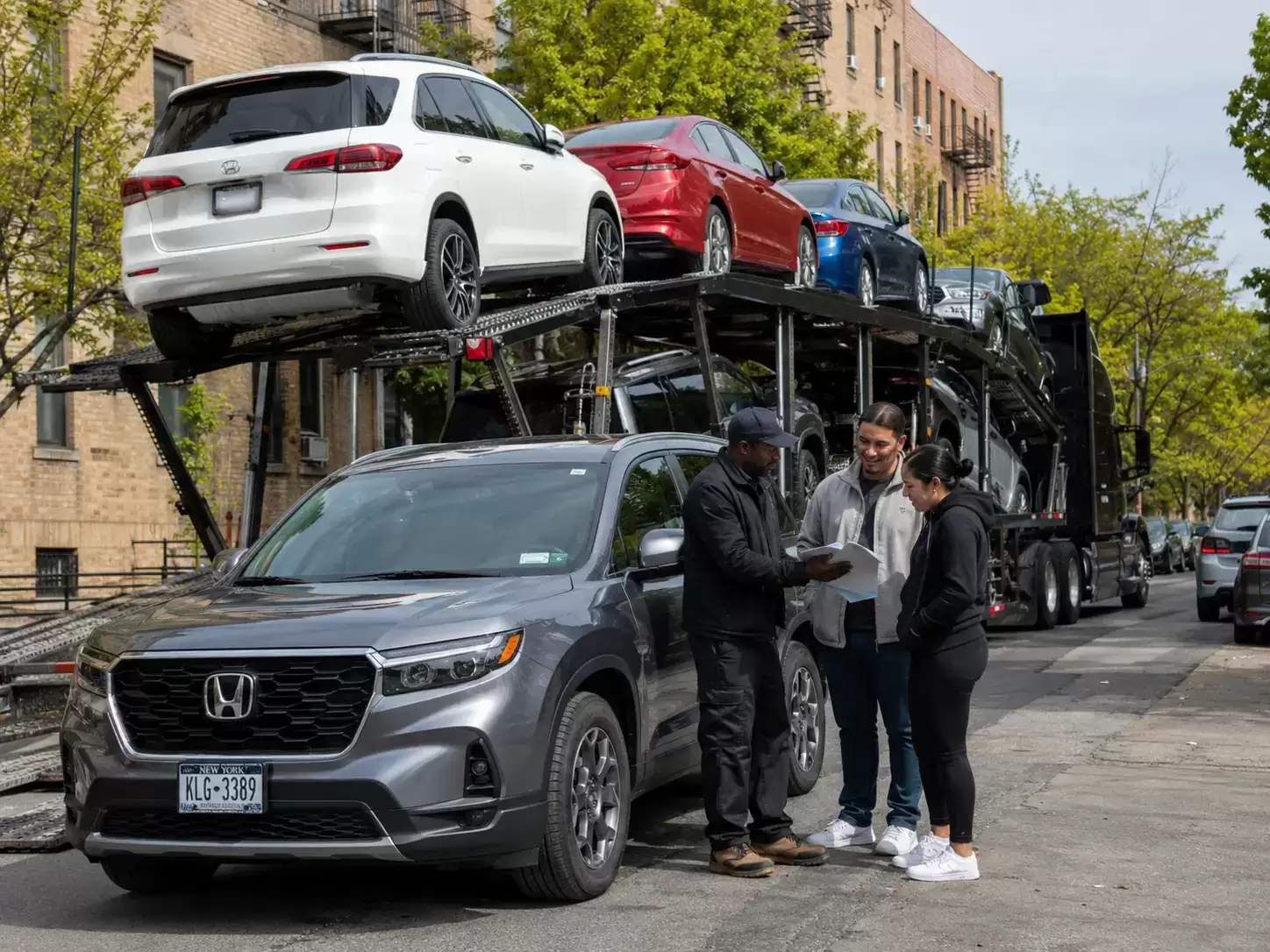
Door-to-Door Car Shipping: What to Expect in Texas and New York
Pickup in Texas
Greater Houston Metro and Southeast Texas
Greater Houston metro — Houston, Pasadena, Sugar Land, Conroe — uses the I-10 and I-45 corridor with the highest carrier density on the Gulf Coast. Houston’s energy industry creates high carrier traffic on I-10 eastbound. High-rise or gated community pickup in the Galleria, River Oaks, or Medical Center areas uses standard commercial staging protocol — your coordinator manages routinely.
Southeast Texas / Golden Triangle — Beaumont and Port Arthur — sit directly on the I-10 corridor. Carriers departing Beaumont cross into Louisiana in under 30 minutes. This is the most efficiently positioned Texas zone for east-coast-bound runs, with excellent pickup logistics year-round.
East Texas and Dallas–Fort Worth
East Texas cities — Tyler, Longview, Lufkin, Texarkana — offer straightforward access. Tyler and Longview access I-20 east directly. Lufkin uses US-59 north to I-20 or east to I-10. Texarkana sits at the Texas-Arkansas border on I-30, making it one of the most directly situated Texas cities for Northeast-bound runs.
Dallas–Fort Worth Metroplex — Dallas, Fort Worth, Arlington, Irving, Plano, Garland, Frisco, McKinney, Lewisville, Denton, Carrollton — has the highest carrier density in Texas with direct I-20 and I-30 eastbound access. Excellent pickup logistics year-round.
Central Texas
Austin uses I-35 and I-10 access with solid carrier coverage. Waco sits on I-35 with standard access. Killeen and Temple use I-35 south to Austin/San Antonio or I-35 north to DFW — Fort Cavazos PCS pickup follows established carrier protocols; confirm with your coordinator. College Station uses TX-6 north to I-35 or east to Houston; serviceable. San Antonio has I-10 and I-35 access with solid coverage.
South Texas and Border Cities
Corpus Christi, Laredo, Brownsville, McAllen, and Harlingen all require carriers to travel north before reaching the main I-10 corridor — Corpus Christi uses I-37 north, Laredo uses I-35 north. This approach mileage is reflected in pricing for South Texas origins.
Texas summer heat (June–September): all Texas regions reach 95–110°F in summer. Remove all personal items, medications, and heat-sensitive electronics before carrier loading.
Delivery in New York
New York City Metro
New York City metro delivery is the country’s most operationally complex auto transport destination and requires specific planning. Large multi-car haulers (75–80 feet) cannot operate on most Manhattan streets — delivery uses the nearest accessible commercial staging point (Bronx near I-87/I-95, Queens near the LIE, or Jersey City/Newark for Brooklyn and Staten Island). Confirm staging protocol with your coordinator before the carrier departs Texas.
Yonkers, Mount Vernon, New Rochelle, and White Plains (Westchester) receive standard door-to-door delivery for most addresses. Long Island — Hempstead, Valley Stream, Hicksville, Levittown, Freeport — uses I-495 LIE access with standard delivery to most addresses.
Hudson Valley and Capital Region
Hudson Valley cities — Poughkeepsie, Newburgh, Kingston, Middletown — use I-87 north with standard door-to-door delivery. Capital Region cities — Albany, Schenectady, Troy, Saratoga Springs, Glens Falls — use I-87/I-90 access with excellent year-round delivery conditions.
Southern Tier and Central New York
Southern Tier cities — Binghamton, Elmira, Cortland, Ithaca — use I-81/I-88 and Route 17. Cornell and Ithaca College staging applies for campus deliveries. Central NY — Syracuse, Rome, Utica, Watertown — uses I-81 north. Fort Drum near Watertown uses established on-base delivery protocols for military PCS recipients; confirm with your coordinator at booking.
Western New York
Buffalo, Rochester, Niagara Falls, and Jamestown use I-90 (NYS Thruway) west. This zone receives heavy lake-effect snow from November through March — plan winter arrival logistics and covered parking at destination. Watertown (Fort Drum) also receives serious northern New York snowfall; plan weather-contingency buffer days for winter deliveries.
New York Vehicle Registration for Texas Arrivals
New York requires registration within 30 days of establishing residency. Visit a New York DMV office with your out-of-state title, proof of New York insurance, and proof of New York address; no emissions inspection is required for most out-of-state vehicles. Cancel your Texas registration once your New York plates arrive.
Preparing Your Vehicle
Before Texas pickup: remove all personal items from the passenger compartment, disable car alarms, remove EZ Tag or TxTag toll transponders, and leave no more than a quarter tank of fuel. In summer heat, remove anything that can melt, warp, or combust. Photograph your vehicle from all angles with date-stamped images before pickup. New York City delivery: bring photo ID and your delivery confirmation number when meeting the carrier at the staging location. Inspect carefully before signing the Bill of Lading. Western and Central NY delivery in winter: confirm your destination address has appropriate winter parking and that you have winter-capable tires if delivering to the lake-effect snow zone (Buffalo, Rochester, Watertown).
Texas & New York Auto Transport Resources
Texas Helpful Government Links
- Texas Department of Motor Vehicles (TxDMV) — Texas vehicle title and registration agency. Cancel your Texas registration and obtain title documentation when establishing New York residency.
- TxDMV — Buying or Selling a Vehicle — Texas title transfer process and registration cancellation for vehicles departing to New York.
- TxDMV — Military Provisions — Provisions for active duty military departing Texas installations (Fort Cavazos, Joint Base San Antonio) on PCS orders to New York.
- Texas DPS — Driver License — Surrender your Texas driver’s license when obtaining a New York license after establishing New York residency.
New York Helpful Government Links
- New York State Department of Motor Vehicles (NYS DMV) — New York’s vehicle title and registration agency. New residents from Texas must register their vehicle within 30 days of establishing New York residency.
- NYS DMV — Register a Vehicle from Out of State — Registration requirements, fees, and documentation for Texas vehicles transferring to New York.
- NYS DMV — Vehicle Inspection Program — Annual safety and emissions inspection requirements for all New York-registered vehicles, including those arriving from Texas.
- NYS DMV — Driver License — New New York residents must obtain a New York driver’s license within 30 days of establishing residency. Your Texas license must be surrendered.
- NYS DMV — Military Personnel Registration — Non-resident military exemptions for active duty service members on PCS orders to Fort Drum, Fort Hamilton, West Point, and Stewart ANGB arriving from Texas installations.
Federal Auto Transport Resources
- FMCSA — Verify a Carrier’s License (SAFER System) — Verify that any auto transport company is federally licensed and insured before booking.
- FMCSA — Protect Your Move — Federal consumer guidance on hiring vehicle shippers and your rights on a cross-country move.