California to Colorado Car Shipping
The original instant car shipping calculator — trusted since 2004. Door-to-door California to Colorado transport with no surprises, no hidden fees, and three options to ship your vehicle on your schedule.
★ 4.6/5 Google Reviews | BBB Accredited A+ | FMCSA Licensed (MC #479342) | USDOT #1240502 | No upfront payment required | 20+ years shipping vehicles


California to Colorado Car Shipping Rates by City
Every California to Colorado vehicle shipment is available at three service levels:
Standard, Expedited, & Rush Options
Choose the one that fits your timeline and budget. All three include full door-to-door service and carrier insurance.
The Company That Invented Instant Auto Transport Pricing
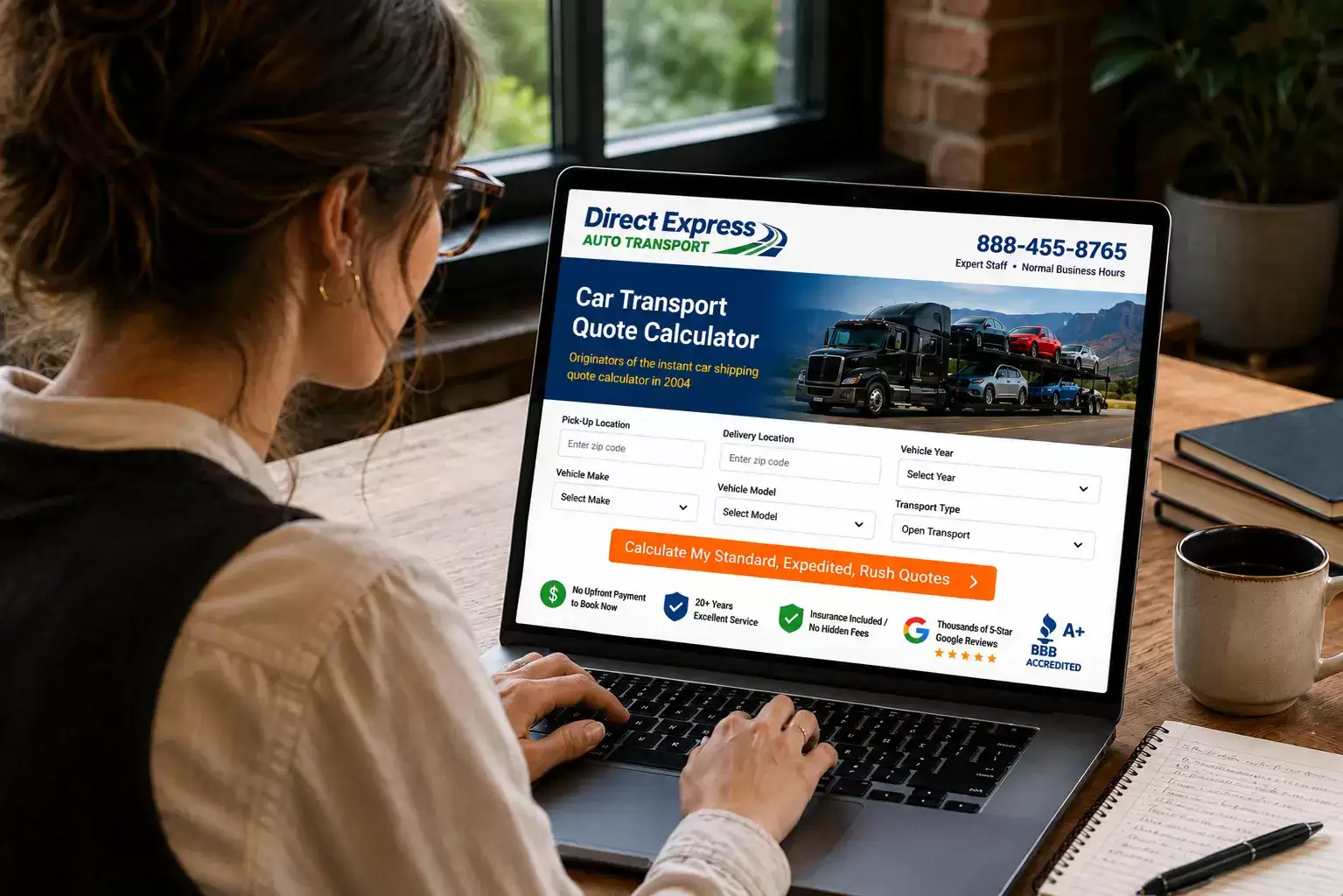
Direct Express Auto Transport pioneered online instant pricing for the auto transport industry in 2004. Before we built the first car shipping cost calculator, getting a quote from a broker meant phone calls, callbacks, and waiting — sometimes days. We changed that. Today you know your exact cost in 30 seconds, before committing to anything. No phone tag, no hassle. Just a real number, instantly.
Three Service Tiers for Every California to Colorado Shipment
Every shipment on this California to Colorado route is available at three service tiers so you can match your budget to your timeline. Standard delivers at the best available rate — ideal when your schedule has a few days of flexibility. Expedited moves your vehicle to the front of the dispatch queue for faster pickup. Rush gets your car picked up as fast as humanly possible — for moves where every day counts. All three tiers include full door-to-door service and carrier insurance.
What customers say about shipping a car from California to Colorado with Direct Express Auto Transport


Seasonal Pricing Guide: California to Colorado
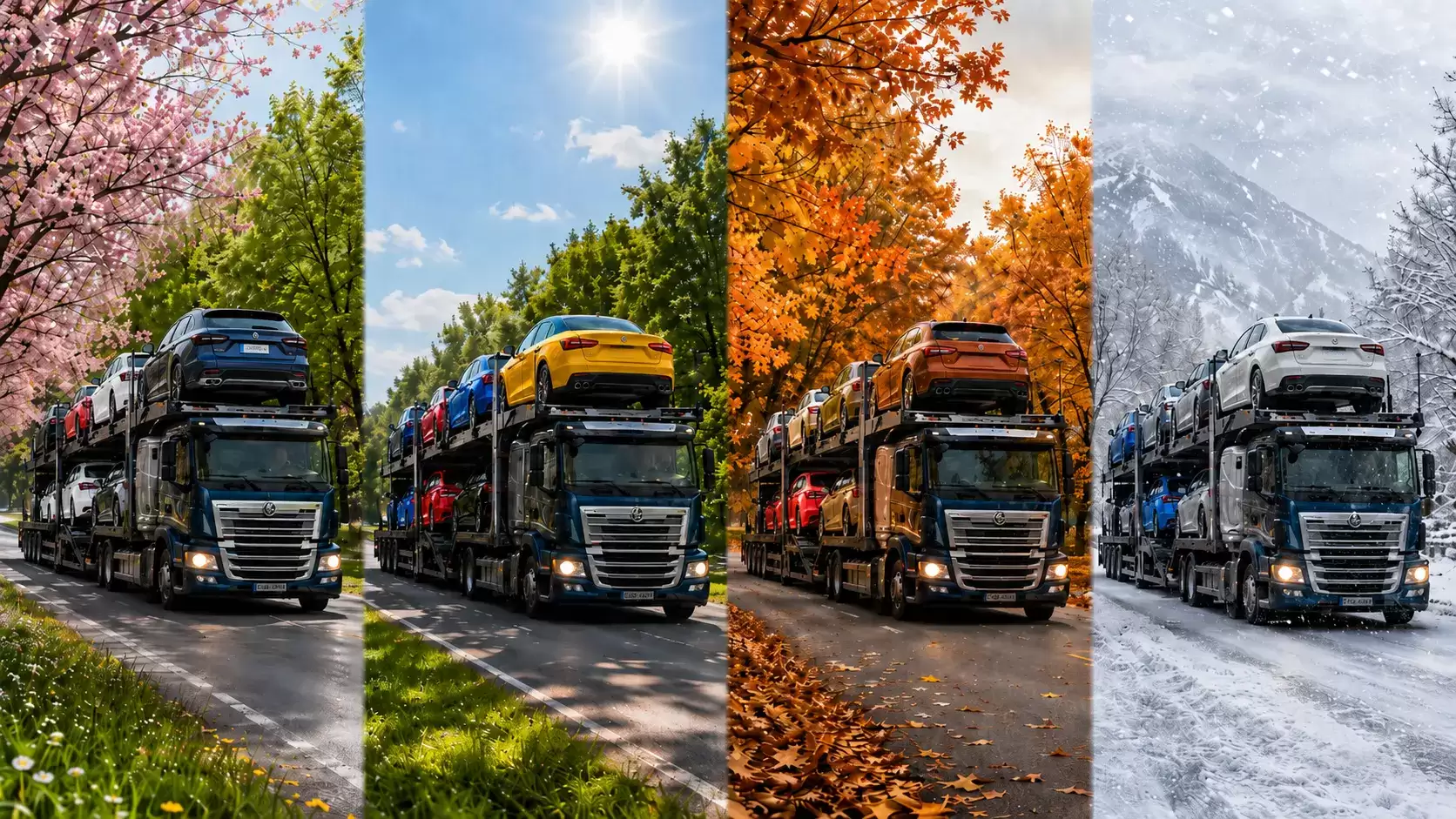
California-to-Colorado is one of the most seasonally variable mid-distance corridors in the country. The route crosses mountain terrain that creates genuine winter transit challenges — I-70 through the Eisenhower Tunnel and Vail Pass regularly closes or restricts chains between November and April — and the demand calendar is shaped by a combination of lifestyle migration, military PCS cycles, university moves, and Colorado’s ski economy. Understanding the seasonal pattern before you book can save money and prevent delays.
Who Ships a Car from California to Colorado — and Why
California-to-Colorado is a corridor driven by lifestyle, outdoor culture, cost of living, military service, and a technology industry that has turned the Denver-Boulder corridor into one of the country’s fastest-growing professional relocation destinations. The people on this route are typically younger professionals, outdoor-oriented families, and military personnel making moves that are simultaneously practical and deeply intentional.
Lifestyle Migration: California Professionals Moving to Colorado’s Outdoor Culture
Lifestyle migration is the dominant long-term structural driver. California professionals — engineers, technology workers, finance professionals, and creatives — have been relocating to Colorado in increasing numbers for a decade. The draw is consistent: Denver’s downtown, its outdoor access, its housing costs relative to the Bay Area and Los Angeles, and its quality of life metrics attract California households who have decided that a Pacific coastline they visit twice a year doesn’t justify the cost of living they pay year-round.
Boulder draws California technology and academic professionals toward the university environment and outdoor culture that Boulder’s Front Range position provides. Fort Collins draws families and outdoor recreation enthusiasts who want a college town with immediate mountain access. These moves are largely permanent and skew toward couples and families shipping their vehicles as part of a complete household relocation — they are not driving, and they are moving one to three vehicles simultaneously.
Military PCS: Camp Pendleton / Fort Irwin / Travis AFB → Fort Carson and Colorado
Military PCS transfers are among the most concentrated and predictable demand drivers on this corridor. Colorado Springs alone hosts five major military installations: Fort Carson (Army), Peterson Space Force Base, Schriever Space Force Base, Buckley Space Force Base in Aurora, and the United States Air Force Academy. Fort Carson receives Army personnel from California installations including Fort Irwin (National Training Center), Camp Pendleton, and Joint Base Lewis-McChord Pacific transfers routing through California. The Air Force Academy generates cadet-related vehicle moves and faculty transfers from California Air Force installations. Buckley Space Force Base, located in Aurora east of Denver, receives California-based Space Force and intelligence personnel. Colorado’s military installation density is the highest of any Rocky Mountain state, and the CA-to-CO military corridor is active year-round with a pronounced summer PCS peak.
California Technology Professionals Relocating to Denver’s Tech Corridor
Colorado’s technology industry — concentrated in Denver, Boulder, and the Denver Tech Center (Centennial/Greenwood Village) — has built a deep talent pipeline from California’s Bay Area and Los Angeles technology sectors. Colorado was an early beneficiary of the post-pandemic remote work redistribution: Bay Area engineers accepting Denver offers, San Francisco startup employees joining Boulder-based companies, and Los Angeles technology professionals pursuing Denver’s lower-density urban environment. Intel, Google, Amazon, Twitter (pre-acquisition), and dozens of mid-sized technology companies have Denver or Boulder offices that regularly hire California professionals. These workers are often making their first long-distance vehicle shipment and value the certainty of an instant quote over the unpredictability of negotiating with carriers directly.
California Students at CU Boulder, Colorado State, and Colorado College
University moves between California and Colorado are significant and seasonal. The University of Colorado Boulder, Colorado State University in Fort Collins, the University of Denver, and UC Colorado Springs collectively enroll large numbers of California students. CU Boulder in particular has a high California enrollment concentration — the university’s reputation in outdoor recreation, environmental science, and technology programs draws California students who ship their vehicles rather than drive across the Nevada desert and Utah for a one-semester or one-year move. May and August are the peak university shipping months in both directions.
Door-to-Door Car Shipping: What to Expect in California and Colorado
Pickup in California
Southern California: Los Angeles, San Diego, and Orange County
Standard door-to-door pickup throughout Southern California. Los Angeles basin: standard residential throughout; very dense downtown LA, Koreatown, Hollywood, and Westlake high-rise addresses require carrier staging on a nearby wide commercial street — confirm your address at booking. San Diego and Chula Vista: excellent carrier access, standard residential throughout. Orange County (Anaheim, Irvine, Santa Ana, Fullerton): standard residential, no staging concerns. Southern California is the highest carrier-density pickup zone in the country — strong dispatch availability in all service tiers. No heat protocol at coastal SoCal origins in any season.
Inland Empire and Central Valley
Standard door-to-door pickup throughout the Inland Empire and Central Valley. Riverside, San Bernardino, Fontana, and Ontario: excellent suburban carrier access via I-10 and I-15; the Inland Empire is one of the densest carrier staging zones in the country. Summer heat protocol: Inland Empire origins (June–September) reach 105–115°F — enclosed transport recommended for exotic and luxury vehicles staged at IE pickup locations during peak summer. Fresno, Bakersfield, Modesto, and Stockton: standard residential throughout; same summer heat protocol applies for exotics June through September.
Bay Area and Sacramento
Standard door-to-door pickup throughout the Bay Area and Sacramento. San Jose, Oakland, Fremont, Vallejo, and Concord: standard residential access. San Francisco: carrier staging required for steep-grade neighborhood pickups (Pacific Heights, Russian Hill, Nob Hill, Bernal Heights) — confirm your specific address at booking. Sacramento: standard residential throughout. No heat protocol at coastal Bay Area origins in any season. Bay Area origins carry a pricing premium due to departure distance and carrier positioning relative to Southern California staging hubs.
Delivery in Colorado
Denver Metro: Aurora, Lakewood, Arvada, Westminster, and Surrounding Cities
Standard door-to-door delivery throughout the Denver metro. Denver proper, Aurora, Lakewood, Arvada, Westminster, Thornton, Englewood, and Centennial: standard residential throughout, accessible on Denver’s I-25, I-70, E-470, and C-470 freeway grid. Most residential and commercial addresses are accessible to multi-car haulers without staging complications. Denver winter protocol (November–March): carriers operate through typical Front Range winter conditions, but heavy snowstorms cause 1–2 day delivery delays — budget a buffer for January and February deliveries. No heat concerns at Denver delivery in summer.
Colorado Springs and Military Installations
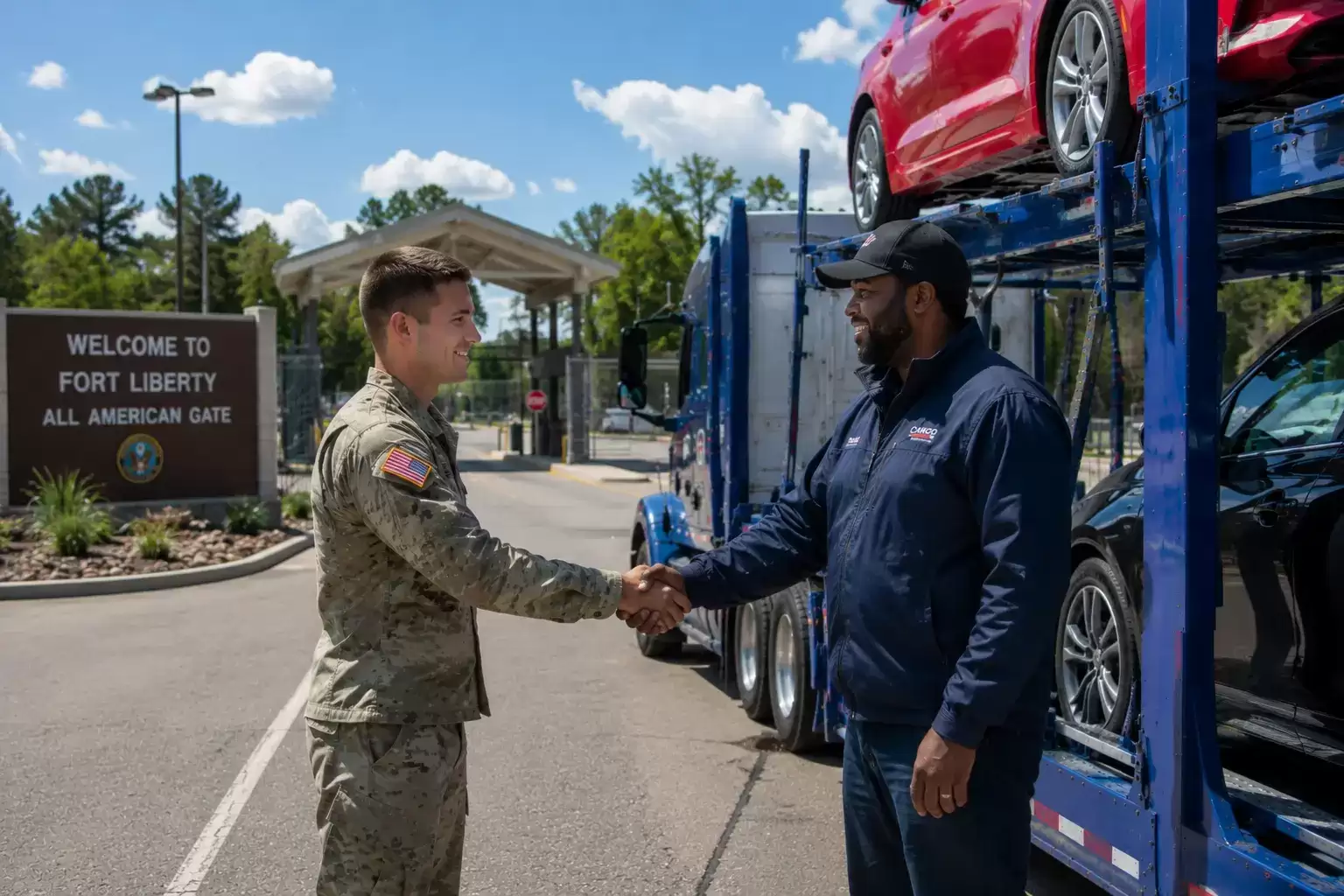
Standard door-to-door delivery throughout Colorado Springs and the military corridor. Colorado Springs: standard residential throughout, I-25 access. Fort Carson (Army) and USAFA (Air Force Academy): confirm on-base vehicle access and gate authorization at booking for military PCS deliveries. Peterson SFB and Schriever SFB: confirm on-base access at booking. Colorado Springs winter protocol: add 1–2 day buffer November through March for snow and ice on residential streets. Pueblo: standard residential, I-25 access.
Mountain Communities and Northern Colorado
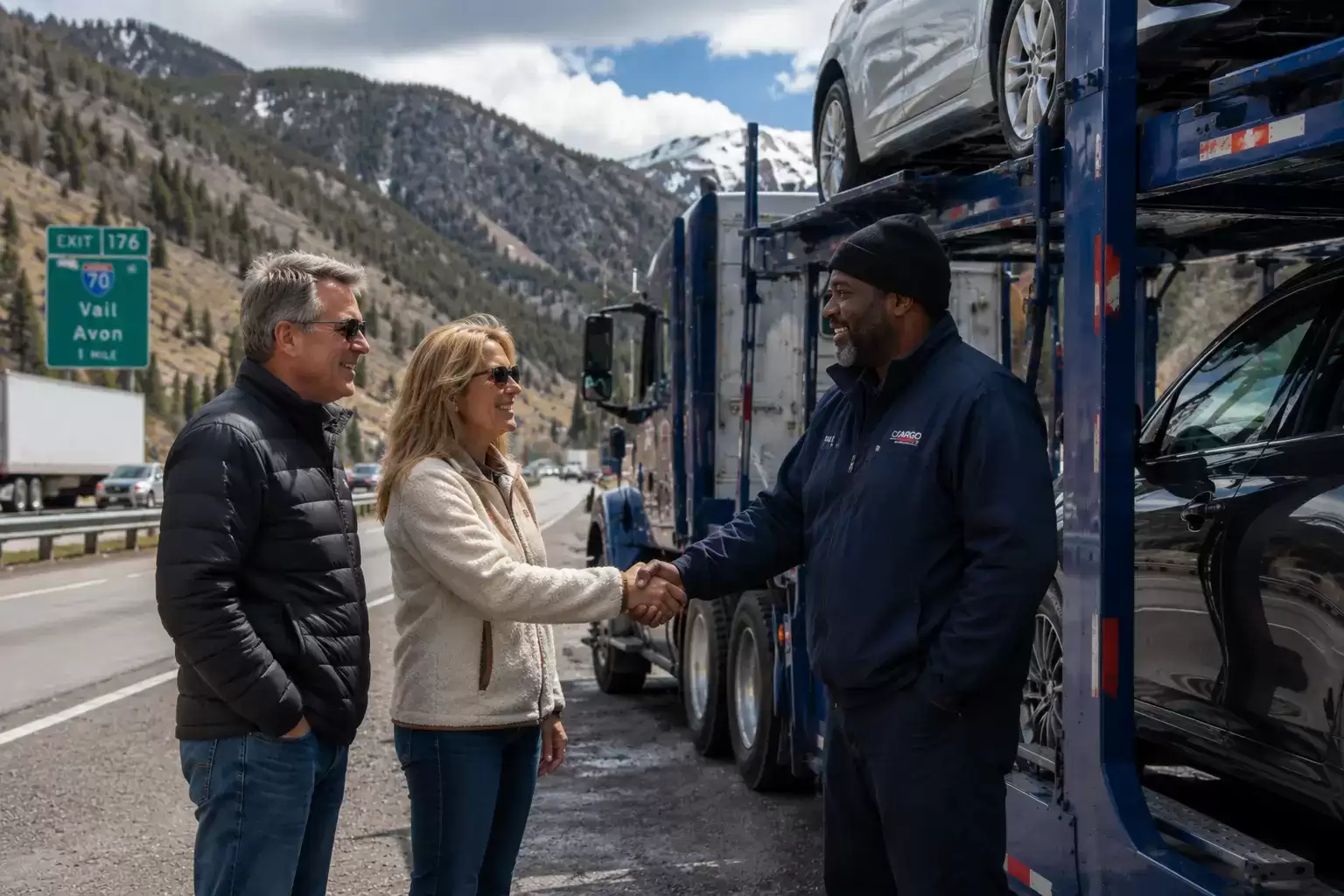
Standard door-to-door delivery throughout mountain communities and Northern Colorado. Boulder: standard residential, US-36 access. Fort Collins and Greeley: standard residential, I-25 access. Mountain resort communities (Vail, Breckenridge, Aspen, Steamboat Springs): narrow mountain road access — confirm your delivery address at booking; some very remote driveways require staging at a nearby accessible point. Grand Junction and the Western Slope: standard residential, I-70 access. Mountain winter protocol: significant snow and ice November through April — add 2–3 day delivery buffer for mountain community destinations during winter.
Colorado Vehicle Registration for New Residents
Colorado requires registration within 90 days of establishing residency. Visit a Colorado DMV office with your out-of-state title, proof of Colorado insurance, and proof of Colorado address; a VIN inspection is required; emissions testing applies in Denver and Boulder Front Range counties. Cancel your California registration once your Colorado plates arrive.
Preparing Your Vehicle
Before pickup: remove all personal items from the interior, leave no more than a quarter tank of fuel, disable your car alarm, and remove any exterior accessories. Photograph your vehicle thoroughly from all angles with date-stamped images before the carrier arrives. At delivery in Colorado, inspect your vehicle carefully before signing the Bill of Lading — note any concerns before signing. Your signature without notation constitutes acceptance of the vehicle’s condition.
Other California to Colorado Cities We Serve
Direct Express ships vehicles between hundreds of city pairs on this route. Below is a broader look at additional California origins and Colorado destinations we regularly serve.
Hub Cities Along the California–Colorado Car Shipping Corridor
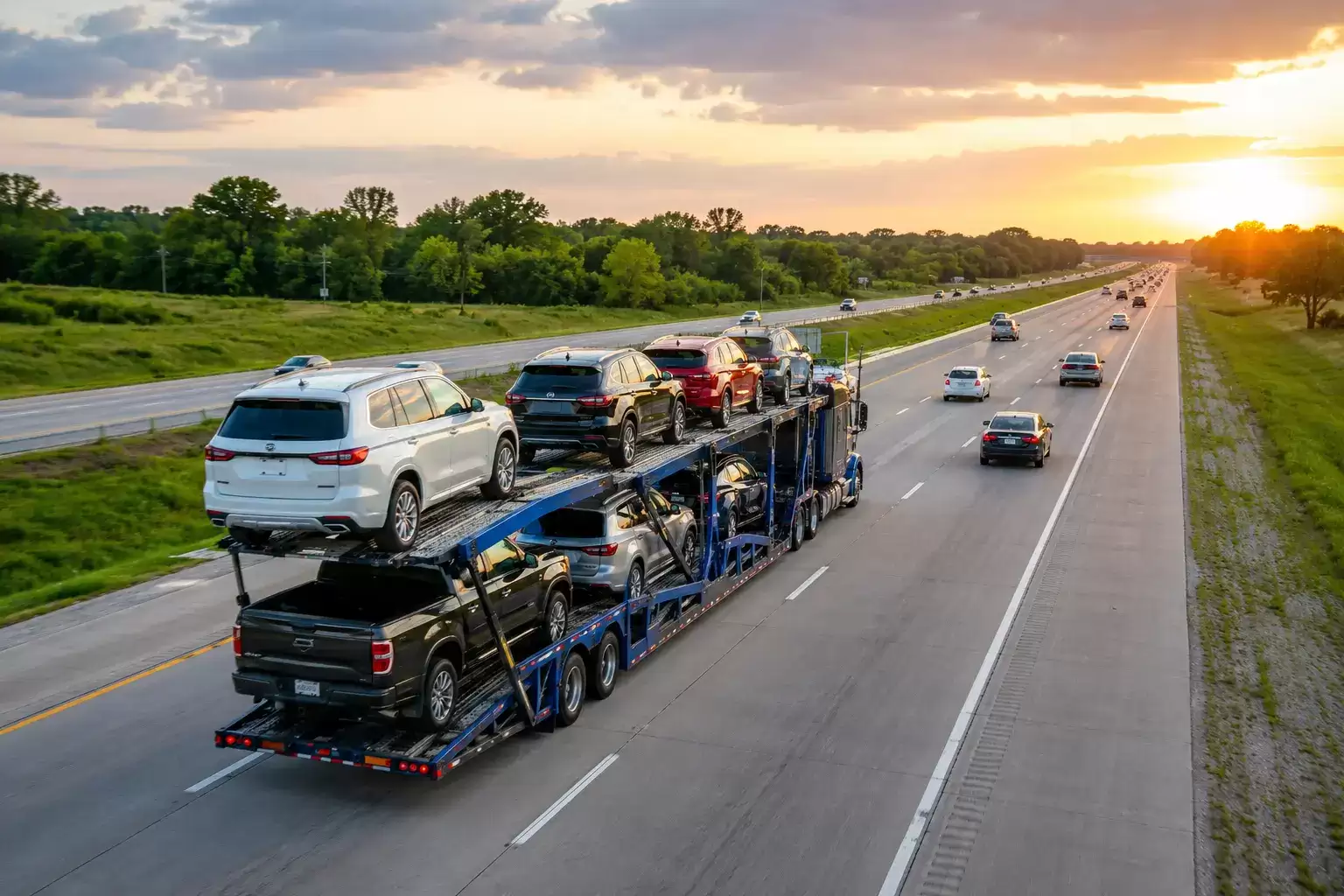
The California-to-Colorado run crosses four states on the I-15/I-70 corridor before delivering into the Denver metro or Colorado Springs. Southern California anchors the origin zone; the Denver metro and Front Range anchor the Colorado delivery zone.
Major Origin Hubs in California
I-15 / I-70 Corridor Waypoints
Major Colorado Delivery Points
Denver’s Front Range: The Delivery Zone That Matters: The Denver-Boulder-Fort Collins Front Range corridor — from Pueblo in the south to Fort Collins in the north — is the delivery zone for approximately 90% of California-to-Colorado auto transport volume. This corridor follows the base of the Rocky Mountains along I-25, and its density, military installations, and university presence make it the operational focus of every carrier running the I-70 Colorado corridor. Most suburban Denver addresses (Aurora, Lakewood, Westminster, Arvada, Thornton, Broomfield, Centennial, Parker, Highlands Ranch, Castle Rock, Longmont, Englewood, Littleton) are reachable on I-25 and the Denver metro freeway system. Grand Junction, on the western slope, is a delivery point approximately 245 miles west of Denver on I-70 and notably shorter from California — carriers serving Grand Junction may not continue east over the mountain passes at all.
Open vs. Enclosed Car Transport on the California–Colorado Route
The California-to-Colorado run crosses two mountain systems — the Sierra Nevada or Spring Mountains depending on routing, and the Colorado Rockies via I-70. Both crossings are well-maintained Interstate routes handled routinely by open carriers. The vast majority of California-to-Colorado shipments travel open, and the mountain terrain is not a reason to upgrade to enclosed transport.
Open Transport Recommended for Most
- Open-air trailer carrying 7–10 vehicles — the standard for virtually all everyday vehicle shipments on this corridor year-round
- Mountain passes (Eisenhower Tunnel, Vail Pass) are navigated routinely by open carriers in all seasons; open transport is operationally appropriate even in winter on this route
- The Inland Empire to Denver run is one of the most carrier-active mid-distance runs in the western United States — strong carrier availability keeps open transport pricing competitive
- Road grime and mountain dust after the Rocky Mountain crossing wash off completely upon delivery
- Well-suited for daily drivers, commuter vehicles, SUVs, trucks, pickup trucks (popular in Colorado), and any vehicle under approximately $60,000
Enclosed Transport
- Vehicle travels in a fully enclosed, weatherproof trailer from California to Colorado
- Typically 40–60% more expensive than open transport
- Recommended for luxury vehicles, exotics, collector cars, show-quality finishes, and any vehicle over approximately $75,000
- Boulder and Denver have high concentrations of European luxury vehicles; California households relocating with high-value vehicles commonly choose enclosed for documented condition delivery at their new Colorado home
- Colorado’s mountain weather creates genuine debris and moisture exposure on winter open carrier runs — owners of show-quality vehicles or pristine paintwork often choose enclosed regardless of corridor
- Book 2–3 weeks ahead — fewer enclosed carriers on this corridor than I-10 or I-80 lanes
Our honest recommendation: Open transport for the everyday vehicle — carriers handle the Colorado mountain crossings year-round without issue. Enclosed for luxury vehicles, exotics, and show-quality finishes that warrant the premium, particularly for winter shipments where road spray from mountain passes is a genuine exposure factor.
Door-to-Door Car Shipping: What to Expect in California and Colorado
Pickup in California
California pickup is uncomplicated year-round throughout the state. Southern California — Los Angeles, the Inland Empire, San Diego, and Orange County — is the most carrier-dense pickup zone in the country and the primary origin zone for CA-to-CO shipments. Most residential and commercial addresses are accessible to large haulers. Your carrier contacts you 24–48 hours before pickup to confirm a window. Northern California pickup (the Bay Area, Sacramento, Fresno, Modesto) is equally uncomplicated; your carrier routes east toward the Colorado corridor after pickup. Dense urban addresses in San Francisco may require a nearby meet point for large multi-car haulers.
Delivery in Colorado
Denver metro delivery is operationally smooth year-round. The city’s grid-based suburban freeway system (I-25, I-70, E-470, C-470, US-36) provides carrier access to virtually every residential address in the metro area. Your carrier contacts you 24–48 hours before delivery to confirm a window. Colorado Springs delivery uses I-25 south from Denver and the city’s eastern arterial grid; most addresses are accessible. Boulder and Fort Collins deliveries use US-36 and I-25 north respectively; most addresses reachable. Mountain-area deliveries (Vail, Aspen, Breckenridge, Steamboat Springs) involve significant elevation and road complexity — confirm access details at booking. Winter delivery in any Colorado mountain community requires coordination with your carrier about road conditions.
Colorado Vehicle Registration for New Residents
New Colorado residents must register their out-of-state vehicle within 90 days of establishing Colorado residency. Colorado emissions testing is required for vehicles registered in the Denver metropolitan area (Adams, Arapahoe, Boulder, Broomfield, Denver, Douglas, and Jefferson counties) and in the Northern Front Range area (Larimer and Weld counties, which include Fort Collins and Greeley). Bring your out-of-state title, proof of Colorado insurance, and a completed emissions test (if in a testing county) when you register. Colorado title fees and registration fees are assessed at registration. Consult the Colorado Division of Motor Vehicles for current fee schedules.
Preparing Your Vehicle
Before pickup: remove all personal items from the interior, leave no more than a quarter tank of fuel, disable your car alarm, and remove any exterior accessories. Photograph your vehicle thoroughly from all angles with date-stamped images before the carrier arrives. At delivery in Colorado, inspect your vehicle carefully before signing the Bill of Lading — note any concerns before signing. Your signature without notation constitutes acceptance of the vehicle’s condition.
California & Colorado Auto Transport Resources
California Helpful Government Links
- California Department of Motor Vehicles (CA DMV) — Primary agency for California vehicle titles and registration. If permanently relocating to Colorado, notify the CA DMV, return your California plates, and obtain your title for Colorado registration.
- CA DMV — Transferring a California Title Out of State — Complete your California title release before your vehicle is picked up for transport to Colorado.
- CA DMV — Vehicle Registration Fees — Confirm your California registration status and any outstanding fees before your move.
Colorado Helpful Government Links
- Colorado Division of Motor Vehicles (CO DMV) — Primary agency for Colorado vehicle titles and registration. New Colorado residents must register their out-of-state vehicle within 90 days of establishing Colorado residency.
- CO DMV — Title and Registration — Transfer your California title and obtain Colorado plates. Emissions testing is required for vehicles registered in the Denver metro and Northern Front Range counties before registration.
- CO DMV — Fees, Taxes, and Surcharges — Colorado’s vehicle registration fees include a specific ownership tax based on vehicle value. Estimate your cost before your vehicle arrives.
- CDOT — I-70 Mountain Corridor Travel Alerts — Real-time road conditions, chain laws, and closure information for the Eisenhower Tunnel and Vail Pass sections of I-70. Useful reference if your vehicle is in transit during winter weather.
Federal Auto Transport Resources
- FMCSA — Verify a Carrier’s License (SAFER System) — Verify that any auto transport company you consider is federally licensed and insured before booking.
- FMCSA — Protect Your Move — Federal consumer guidance about hiring vehicle shippers, including red flags for broker scams and your rights as a shipper.