Texas to Ohio Car Shipping
The original instant car shipping calculator — trusted since 2004. Door-to-door Texas to Ohio transport with no surprises, no hidden fees, and three options to ship your vehicle on your schedule.
★ 4.6/5 Google Reviews | BBB Accredited A+ | FMCSA Licensed (MC #479342) | USDOT #1240502 | No upfront payment required | 20+ years shipping vehicles


Texas to Ohio Car Shipping Rates by City
Every Texas to Ohio vehicle shipment is available at three service levels:
Standard, Expedited, & Rush Options
Choose the one that fits your timeline and budget. All three include full door-to-door service and carrier insurance.
The Company That Invented Instant Auto Transport Pricing
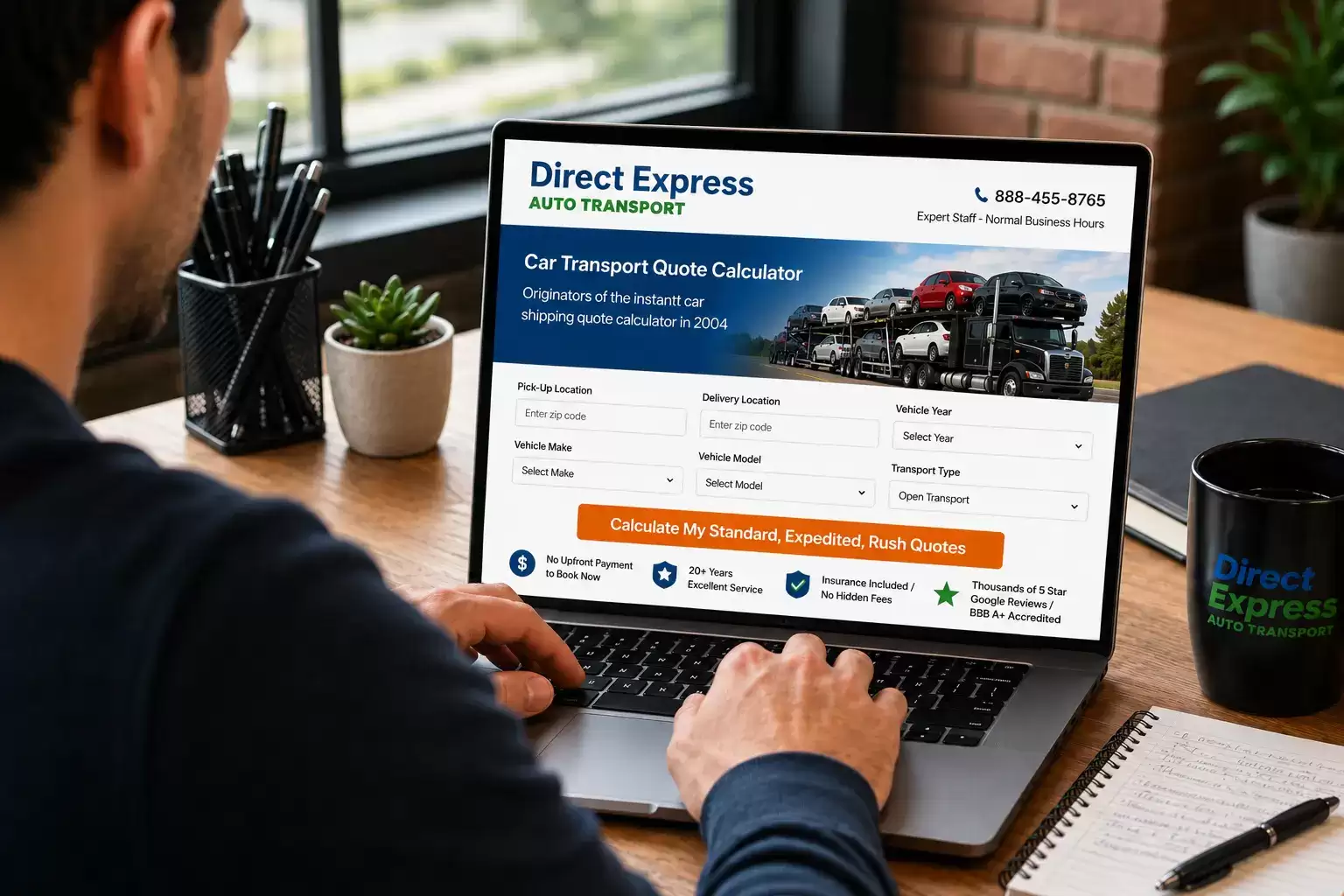
Direct Express Auto Transport pioneered online instant pricing for the auto transport industry in 2004. Before we built the first car shipping cost calculator, getting a quote from a broker meant phone calls, callbacks, and waiting — sometimes days. We changed that. Today you know your exact cost in 30 seconds, before committing to anything. No phone tag, no hassle. Just a real number, instantly.
Three Service Tiers for Every Texas to Ohio Shipment
Every shipment on this Texas to Ohio route is available at three service tiers so you can match your budget to your timeline. Standard delivers at the best available rate — ideal when your schedule has a few days of flexibility. Expedited moves your vehicle to the front of the dispatch queue for faster pickup. Rush gets your car picked up as fast as humanly possible — for moves where every day counts. All three tiers include full door-to-door service and carrier insurance.
What customers say about shipping a car from Texas to Ohio with Direct Express Auto Transport


Seasonal Pricing Guide: Texas to Ohio
Pricing on this route moves with the calendar. Knowing when to ship and when to wait a few weeks can save you real money. Here’s what to expect throughout the year.

Who Ships a Car from Texas to Ohio — and Why
The Texas-to-Ohio corridor runs year-round for consistent reasons. Military PCS orders, employment relocations, and university admissions drive the majority of shipments — and understanding the mix explains why this route stays active in every season.
Military PCS: Texas Installations to Wright-Patterson AFB and Ohio Bases
Texas hosts more active-duty military than any other state — Fort Cavazos (Killeen), Fort Bliss (El Paso), Joint Base San Antonio, Dyess AFB (Abilene), and Sheppard AFB (Wichita Falls) collectively generate continuous PCS orders northeast. Wright-Patterson Air Force Base in Dayton is one of the Air Force’s largest installations and a primary Ohio destination for Texas-based airmen and officers. Military PCS orders move on hard dates — Expedited is standard practice for most military Texas-to-Ohio shipments.
Fort Cavazos to Wright-Patterson: The Primary Military Pair on This Route
Fort Cavazos (Killeen) to Wright-Patterson (Dayton) is the most frequently traveled military pair on this corridor. I-35 north to I-44 to I-70 east runs almost directly between Killeen and Dayton at approximately 1,200 miles. JBSA (San Antonio) to Wright-Patterson follows a similar path at roughly 1,300 miles. Confirm on-base delivery protocol and sponsor address at booking for on-post Wright-Patterson housing; PCS orders and gate authorization speed the process considerably.
Ohio Employers Drawing Texas Professionals
Ohio’s manufacturing, aerospace, and healthcare sectors attract career relocations from Texas year-round. Columbus’s growing professional economy — insurance, finance, and technology — draws talent from Austin and Dallas. Cleveland Clinic and University Hospitals recruit specialized healthcare professionals from Houston’s Texas Medical Center and San Antonio’s JBSA-adjacent healthcare sector. Dayton’s aerospace contractor ecosystem and Cincinnati’s corporate headquarters base generate additional year-round professional relocation demand on this corridor.
Texas Students Enrolled at Ohio State and Ohio’s Universities
Ohio State University in Columbus, the University of Cincinnati, the University of Akron, Bowling Green, and Ohio University collectively draw Texas students who arrive for fall semester in August and return home in May. These students ship their car from a Texas family address to an Ohio campus address, avoiding a 1,200-mile solo drive. August and late May are the primary academic-cycle shipping windows on this route.
Ohioans Returning Home After Texas Career Stints
Ohioans who spent years working in Texas’s oil and gas, finance, or technology sectors and are returning home make up a consistent segment. These are typically professional households with a vehicle acquired during the Texas years, a firm return date, and a preference for Standard service at the best available rate. The Ohio-returnee segment runs steady year-round, with a mild concentration in late summer as families complete Texas assignments before the school year starts.
What Makes the Texas–Ohio Auto Shipping Run Different
The I-35 / I-44 / I-70 Corridor
The Texas-to-Ohio route is a well-worn carrier corridor. Most carriers head north out of Dallas or Fort Worth on I-35 through Oklahoma City, pick up I-44 through Tulsa and Joplin, then transition to I-70 at St. Louis and ride it straight into Columbus. Some loads from Houston route slightly east through Little Rock or Memphis before merging north through Nashville and into Cincinnati. Either way, these are major interstate highways with heavy carrier traffic — which means better availability and more competitive pricing than off-corridor routes.
Why El Paso Costs More
If you’re shipping from El Paso, expect to pay $200–$300 more than shipping from Dallas or Houston. El Paso sits at the far western tip of Texas — it’s closer to Phoenix than to Dallas. Carriers routing from El Paso must either backtrack east across Texas to reach the main I-35 corridor or take a longer western arc. Either way, the effective distance to Ohio is closer to 1,600 miles rather than 1,100. Budget accordingly.
The Directional Pricing Asymmetry: Texas to Ohio vs. Ohio to Texas
Here’s something most companies won’t tell you: this route is typically cheaper heading from Texas to Ohio than the reverse. Why? Texas is one of the highest-volume outbound auto transport states in the country. Carriers flowing north and northeast out of Texas have plenty of loads — they fill their trailers easily and can price competitively. Ohio-to-Texas is a longer run in the less-dominant direction, and carriers sometimes have to reposition to fill loads, which drives the price up. If you’re coordinating a two-vehicle household move in both directions, ship the Texas car first — you’ll likely get a better rate.
Texas’s Size Works Against You (or For You)
Texas is enormous. The distance from Beaumont (southeast corner) to El Paso (far west) is greater than the distance from El Paso to Los Angeles. For auto transport, your Texas city matters a lot. Dallas and Fort Worth ship like a dream on this route — they sit almost perfectly on the I-35 carrier corridor heading north. Houston adds about 150 miles but is still a major hub. San Antonio is well-served. Smaller markets like Midland, Lubbock, or Amarillo will require more lead time and may see a slight premium as carriers route out to pick up your vehicle.
Dallas vs. El Paso vs. Beaumont: How Your Texas City Changes the Route Distance
Dallas–Fort Worth to Columbus is roughly 1,100 miles via I-35 north to I-44 to I-70 — the tightest routing on this corridor and a carrier favorite. Houston adds about 150 miles but is a major hub with strong outbound volume; it transits I-45 north to Dallas before joining the same corridor. Beaumont and southeast Texas route through Houston, adding modest cost. El Paso is the outlier: at roughly 1,600 effective miles — nearly 500 more than Dallas — it prices like a different route entirely.
Other Texas to Ohio Cities We Serve
Direct Express ships vehicles between hundreds of city pairs on this route. Below is a broader look at additional Texas origins and Ohio destinations we regularly serve.

Hub Cities Along the Texas–Ohio Car Shipping Corridor
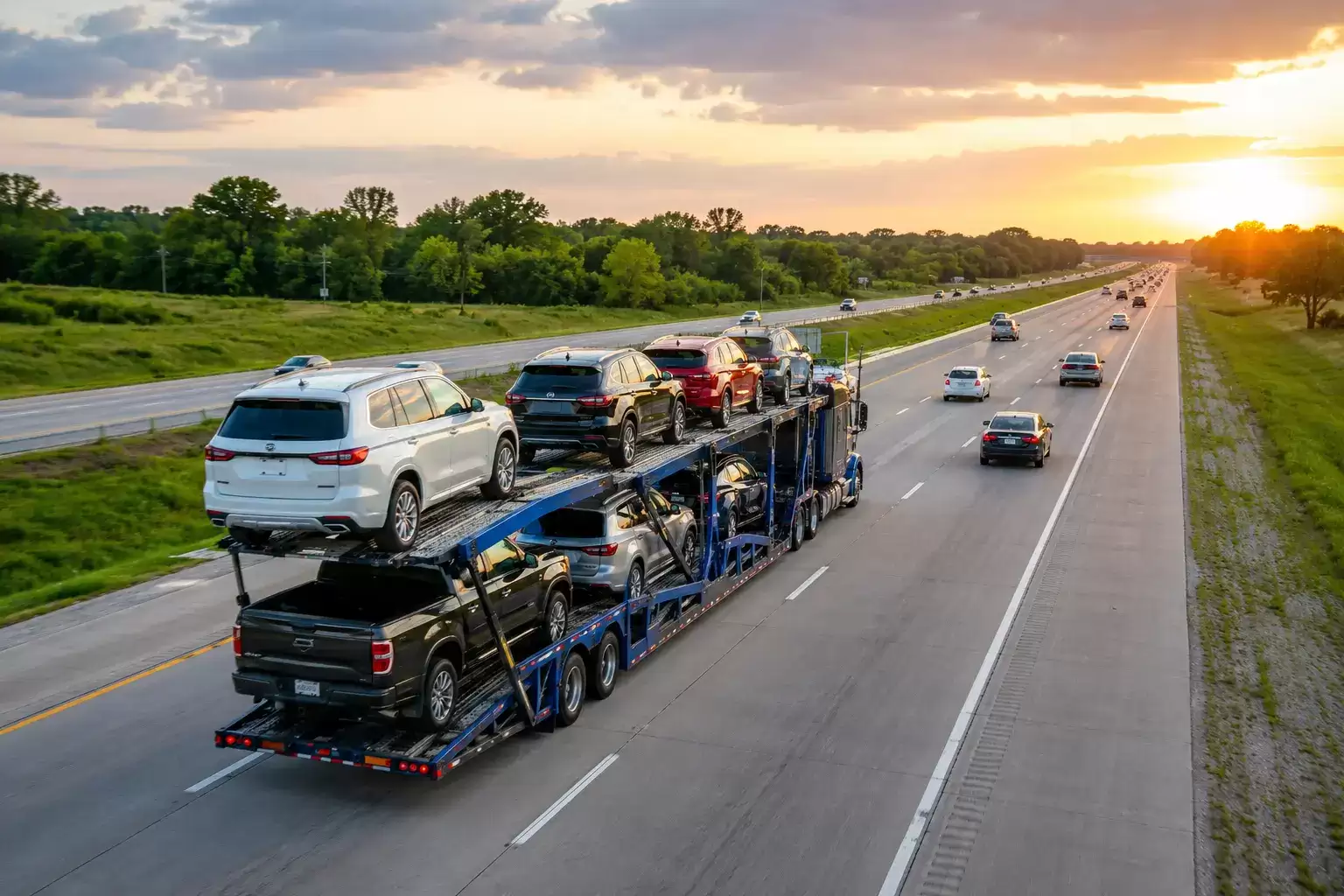
Auto transport carriers don’t drive in a straight line. They follow load corridors where freight volume keeps trailers full. On the Texas-to-Ohio run, your vehicle will typically pass through several logistics hubs before final delivery. Knowing this explains why a car picked up Monday in Houston might arrive Saturday in Cleveland. It’s not sitting still, it’s moving through a network.
Major Origin Hubs in Texas
Midpoint Corridor Cities
Major Ohio Delivery Points
Routing Insight: Columbus is the easiest Ohio city for carriers on this route because it sits directly on I-70 and serves as a natural endpoint. Cleveland adds roughly 150 miles northeast and requires carriers to exit the main corridor up I-71 or I-77. Toledo sits at the northwest corner of Ohio, easily accessible from the Indiana/Michigan carrier lanes. If you have flexibility on your delivery city, Columbus typically dispatches fastest and most affordably.
Open vs. Enclosed Car Transport on the Texas-Ohio Route
The Texas-to-Ohio route crosses the Southern Plains and the Midwest — terrain that’s generally carrier-friendly but has weather considerations worth knowing.
Open Transport Recommended for Most
- Carries 7–10 vehicles on an open-air trailer
- Most cost-effective option — same method used to deliver new cars to dealerships
- Well-suited for standard sedans, trucks, SUVs, minivans
- The I-35/I-70 corridor has heavy open-carrier traffic — great availability and competitive rates
- Your vehicle will be exposed to road dust, light weather, and the elements — normal for this transport type
Enclosed Transport
- Vehicle travels inside a fully covered trailer — fully protected from road debris and weather
- Typically costs 40–60% more than open transport
- Ideal for: luxury vehicles, classic or collector cars, sports cars with low ground clearance, custom paint or wrap
- Ohio winter months (Nov–Mar) — enclosed is worth considering for high-value vehicles crossing the Midwest
- Fewer enclosed carriers on this route vs. open; book earlier to ensure availability
Our honest recommendation: If you’re shipping a daily driver or a vehicle worth under $60,000, open transport is the right call on this route. The I-35/I-70 corridor is heavily trafficked by experienced carriers. If you’re shipping a classic Mustang, a Porsche, or a vehicle with sentimental value you can’t put a price on — pay the premium for enclosed. The protection is worth it.

Door-to-Door Car Shipping: What to Expect in Texas and Ohio
Pickup in Texas
Major Texas Metros: Houston, DFW, San Antonio, and Austin
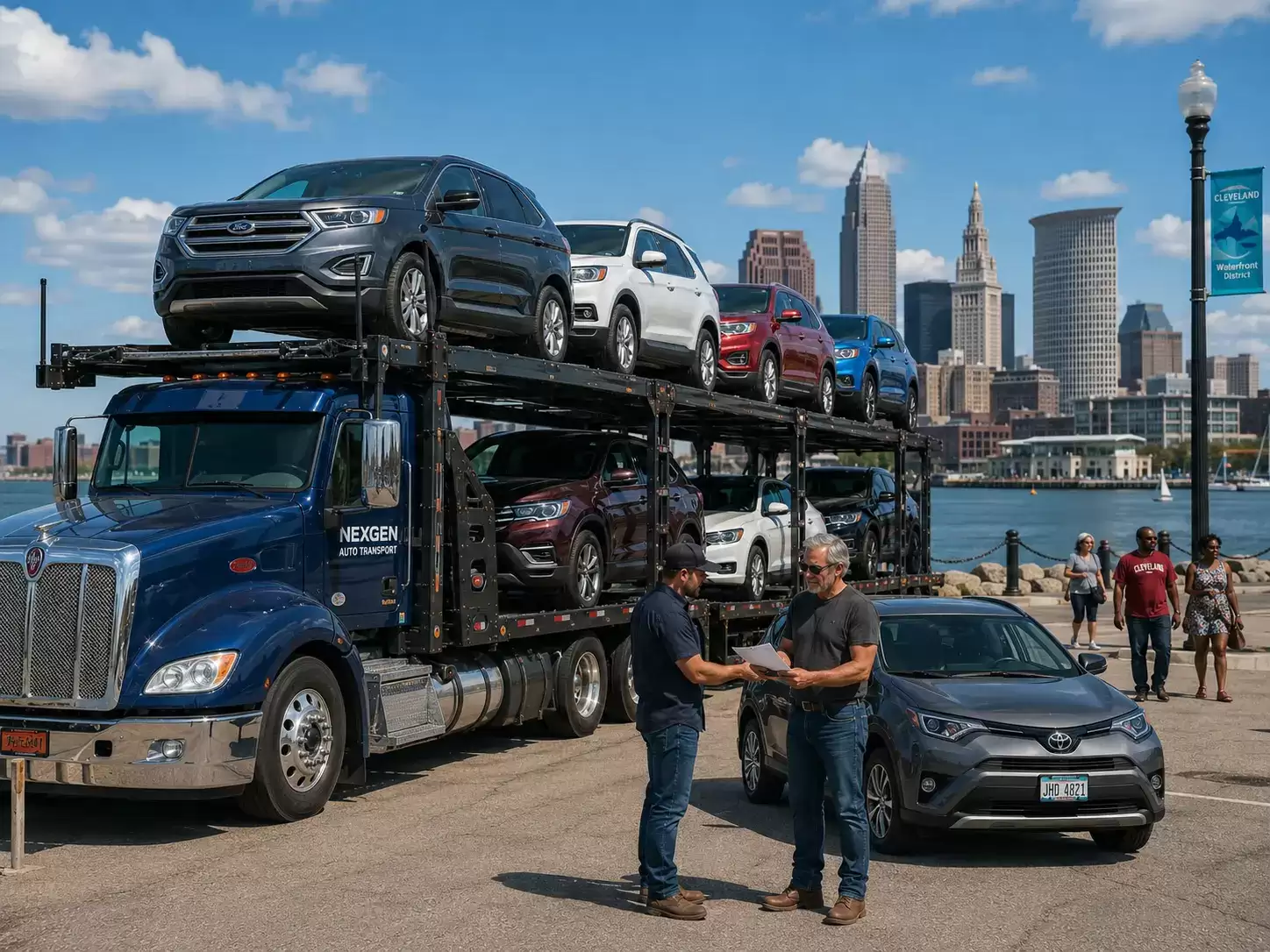
Texas cities are built for large vehicles — wide roads, suburban sprawl, and commercial corridors everywhere. Door-to-door pickup is straightforward in Houston, Dallas, San Antonio, and Austin. Carriers come directly to your driveway, apartment complex parking area, or a nearby street. The exception: dense urban addresses in downtown Houston or central Dallas where large carriers have limited access — your carrier will coordinate a nearby staging point, typically a large parking lot within a mile.
East Texas and Smaller Markets
East Texas origins — Tyler, Longview, Beaumont, Nacogdoches, and Texarkana — are standard door-to-door, with carriers routing through Dallas or Houston before joining the I-35/I-44 northbound corridor. Smaller Central Texas markets (Wichita Falls, Temple, Killeen off-post addresses) are regularly serviced; plan for 1–2 additional days of lead time compared to DFW or Houston. Remote addresses in rural ZIP codes may require the carrier to coordinate a nearby commercial staging area.
Delivery in Ohio
Major Ohio Metros: Columbus, Cleveland, and Cincinnati
Columbus is the easiest Ohio delivery point on this corridor — sprawling, modern, with wide roads throughout the metro. Cincinnati is similarly accessible, with I-71 and I-75 providing direct carrier access to neighborhoods throughout Hamilton County. Cleveland’s older inner-ring neighborhoods occasionally require carriers to arrange an outer-suburb staging point; suburban Cleveland (Parma, Strongsville, Westlake, Mentor) is straightforward. All three metros are consistently served from the I-35/I-44/I-70 corridor with reliable year-round carrier availability.
Dayton, Akron, Toledo, and Northeast Ohio
Standard door-to-door delivery throughout Dayton, Akron, Toledo, and Northeast Ohio. Dayton: standard residential, I-75 and I-70 access; Wright-Patterson AFB (Fairborn) on-post deliveries require confirmed base access credentials and sponsor address at booking. Akron and Canton: standard residential, I-76 and I-77 access — carriers approach from Columbus, adding 1 transit day. Youngstown: standard residential, I-80 access. Toledo: standard residential, I-80/I-90 and I-75 access. Northeast Ohio’s Lake Erie snow belt: add a 1–2 day delivery buffer for heavy lake-effect events January through March.
Ohio Vehicle Registration for Texas Arrivals
Ohio requires vehicle registration within 30 days of establishing residency. Visit a County Clerk of Courts office to title your vehicle and a County Auditor or Deputy Registrar to register it; bring your out-of-state title, proof of Ohio insurance, and proof of Ohio address. A VIN inspection is required. Cancel your Texas registration once your Ohio plates arrive.
Preparing Your Vehicle
Before pickup, remove any personal items from the interior (carrier insurance does not cover personal property), leave no more than a quarter tank of fuel, disable your alarm, and remove any exterior accessories like bike racks or custom antenna attachments. Take dated photos of the vehicle from all angles — this protects you at both ends of the shipment. At delivery, inspect carefully before signing the Bill of Lading.
Texas & Ohio Auto Transport Resources
Texas Helpful Government Links
- Texas Department of Motor Vehicles (TxDMV) — The primary state agency overseeing vehicle titling and registration in Texas. If you are selling your vehicle or transferring ownership before shipping, this is the starting point for title release and lien documentation.
- TxDMV — Buying or Selling a Vehicle in Texas — Covers title transfer requirements, odometer disclosures, and how to properly release a Texas title when a vehicle is being sold or relocated out of state.
- Texas Department of Public Safety — Vehicle Inspection Program — Texas requires an annual vehicle inspection. If your vehicle is due for renewal before or during your move, this resource explains inspection requirements, station locations, and what happens to your registration timeline when leaving the state.
Ohio Helpful Government Links
- Ohio Bureau of Motor Vehicles (Ohio BMV) — The central resource for registering and titling a vehicle after it arrives in Ohio. New residents must register their vehicle within 30 days of establishing residency.
- Ohio BMV — New to Ohio Vehicle Registration — Step-by-step guidance for transferring an out-of-state title and obtaining Ohio plates. Covers required documents including proof of identity, proof of residency, and an out-of-state title or MCO.
- Ohio EPA — Motor Vehicle Inspection & Maintenance Program — Ohio requires emissions testing in certain counties, primarily in the northeast and central regions. Vehicles shipped into Ohio for first-time registration in an E-Check county must pass an emissions test before plates are issued.
Federal Auto Transport Resources
- FMCSA — Verify a Carrier’s License (SAFER System) — The Federal Motor Carrier Safety Administration’s carrier lookup tool. Verify that any auto transport company you consider is federally licensed and insured before booking.
- FMCSA — Protect Your Move — Federal consumer guidance about hiring vehicle shippers, including scam warnings and shipper rights. Useful for anyone shipping a car for the first time on the Texas-to-Ohio route.