North Carolina to California Car Shipping
The original instant car shipping calculator — trusted since 2004. Door-to-door North Carolina to California transport with no surprises, no hidden fees, and three options to ship your vehicle on your schedule.
★ 4.6/5 Google Reviews | BBB Accredited A+ | FMCSA Licensed (MC #479342) | USDOT #1240502 | No upfront payment required | 20+ years shipping vehicles


North Carolina to California Car Shipping Rates by City
Every North Carolina to California vehicle shipment is available at three service levels:
Standard, Expedited, & Rush Options
Choose the one that fits your timeline and budget. All three include full door-to-door service and carrier insurance.
The Company That Invented Instant Auto Transport Pricing
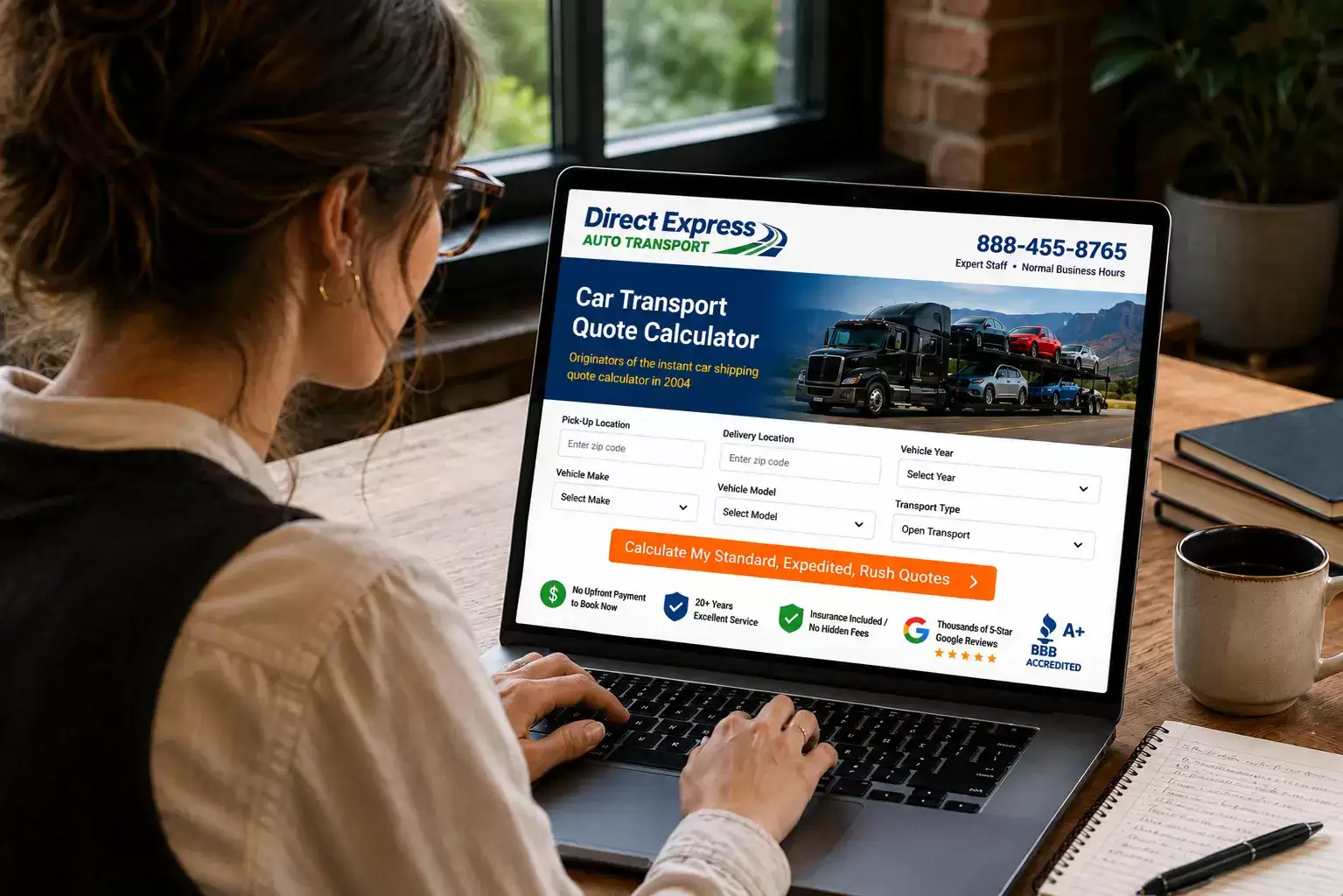
Direct Express Auto Transport pioneered online instant pricing for the auto transport industry in 2004. Before we built the first car shipping cost calculator, getting a quote from a broker meant phone calls, callbacks, and waiting — sometimes days. We changed that. Today you know your exact cost in 30 seconds, before committing to anything. No phone tag, no hassle. Just a real number, instantly.
Three Service Tiers for Every North Carolina to California Shipment
Every shipment on this North Carolina to California route is available at three service tiers so you can match your budget to your timeline. Standard delivers at the best available rate — ideal when your schedule has a few days of flexibility. Expedited moves your vehicle to the front of the dispatch queue for faster pickup. Rush gets your car picked up as fast as humanly possible — for moves where every day counts. All three tiers include full door-to-door service and carrier insurance.
What customers say about shipping a car from North Carolina to California with Direct Express Auto Transport


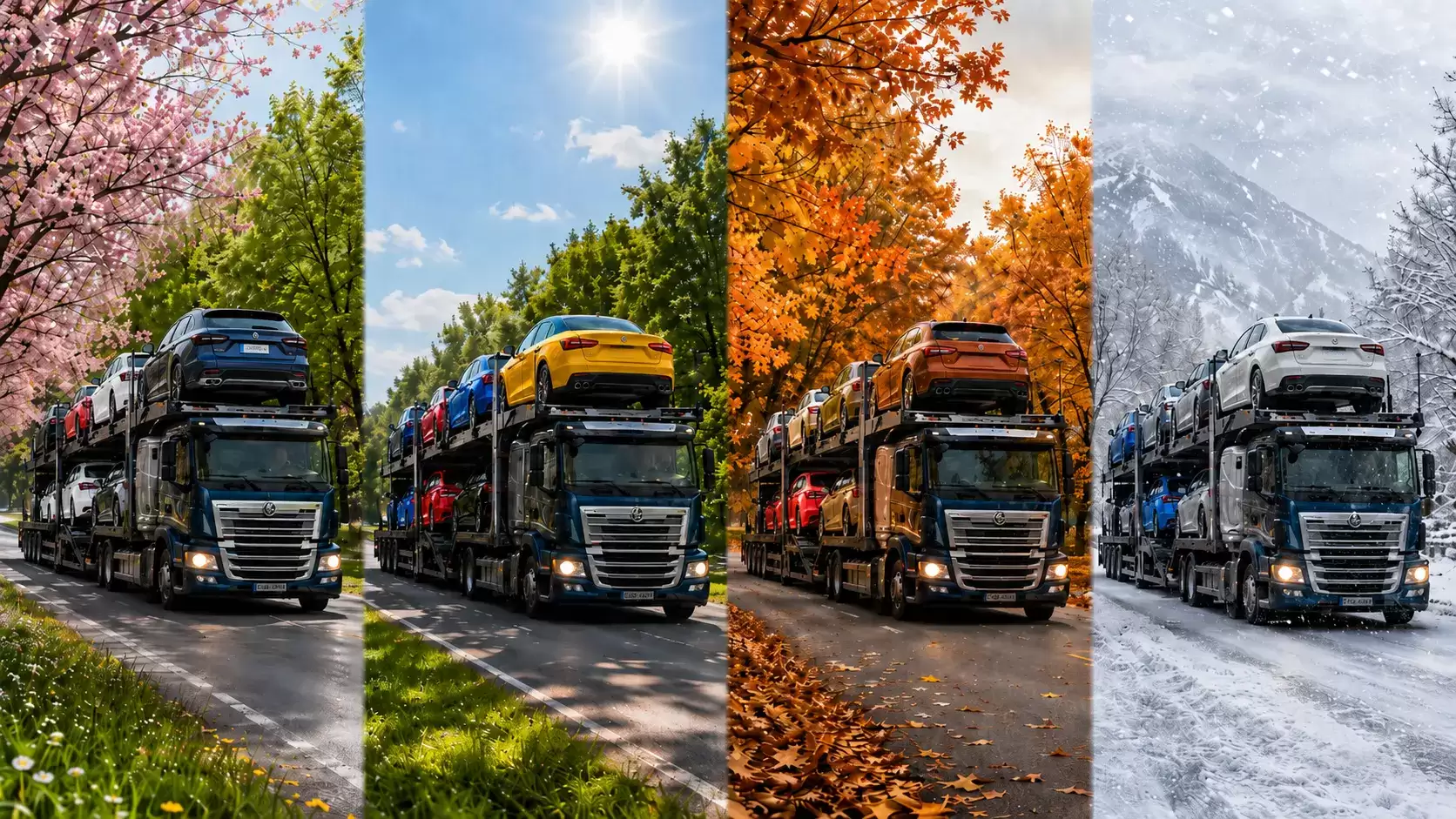
Seasonal Pricing Guide: North Carolina to California
North Carolina to California is the westbound leg of one of the country’s fastest-growing bicoastal corridors. The motivations span career opportunity, military service, climate, and the gravitational pull of California’s entertainment and technology industries. Seasonal pricing on this lane tracks the national demand calendar closely, with a meaningful summer spike driven by military PCS orders out of Fort Liberty and Camp Lejeune — and a fall sweet spot that rewards shippers with flexibility.
Who Ships a Car from North Carolina to California — and Why
North Carolina-to-California is a corridor defined by diverging ambitions. North Carolina sends its engineers, scientists, military personnel, entertainers, and graduates westward along I-40 toward a California that still represents, for many of them, the gravitational center of the industry they want to enter — technology, entertainment, biotechnology, or the United States military’s vast California installation network.
Military PCS: Fort Liberty / Camp Lejeune → Camp Pendleton and California Installations
Military transfers are the most structurally consistent, highest-volume driver on this westbound lane. Fort Liberty generates thousands of PCS orders to Fort Irwin, Camp Pendleton, and Vandenberg Space Force Base annually. Camp Lejeune and MCAS Cherry Point add Marine Corps transfers to Camp Pendleton and MCAS Miramar. The summer PCS surge from these two installations makes the NC-to-CA lane one of the most militarily-driven auto transport corridors in the country. Book Expedited with maximum lead time once orders arrive.
Research Triangle Technology Professionals Moving to California’s Tech Industry
The Research Triangle generates a consistent technology-to-California flow. North Carolina’s pharmaceutical and biotech corridor — centered on Research Triangle Park — employs thousands of scientists who move to California’s competing biotech centers in San Francisco’s Mission Bay and San Diego’s Torrey Pines. Durham and Chapel Hill professionals accepting Bay Area positions, Cary software engineers taking San Jose offers, and Raleigh product managers moving to Los Angeles all ship their vehicles west on I-40.
North Carolina Entertainment Industry Professionals Moving to Los Angeles
North Carolina’s entertainment industry pipeline feeds the California flow steadily. The state has genuine film and television production infrastructure — major studios have operated in Wilmington and Charlotte for decades — and talent developed there frequently moves to Los Angeles to pursue careers at the industry’s center. Musicians from Asheville, Charlotte, and the Triangle move west with their instruments and their cars. This creative westbound flow is smaller than the military and technology segments but remains year-round and consistent.
What Makes the North Carolina–California Auto Shipping Run Different
I-40 Westbound: From Wilmington to Barstow on One Interstate
The North Carolina-to-California corridor runs the full length of Interstate 40 in reverse — from its eastern terminus in Wilmington, NC westward through Asheville, Knoxville, Nashville, Little Rock, Oklahoma City, Amarillo, Albuquerque, and Flagstaff before reaching Barstow, California and the Los Angeles basin. No other state-pair route in this collection can be driven on a single interstate from origin to destination. Charlotte, the most common NC origin city, connects to I-40 westbound via I-85 southwest to Spartanburg, SC, then I-26 to I-40 at Asheville — or alternately via I-85 south to Atlanta and I-20/I-40 west.
Charlotte and Triangle Origins: I-85/I-26 or I-85/I-40 Connection to the Main Corridor
The Triangle (Raleigh, Durham, Cary, Chapel Hill) and eastern NC cities like Fayetteville, Jacksonville, and Wilmington pick up I-40 westbound directly from the eastern NC segment of the highway. Once on I-40 heading west, carriers follow a consistent, well-maintained, all-weather route the rest of the way to California.
The Asheville Mountain Departure
Whether originating from Charlotte, Asheville, or the Triangle, every NC-to-California shipment passes through the Pigeon River Gorge on I-40 between Asheville and Knoxville, Tennessee — the mountain crossing that marks the boundary between the Appalachians and the open Midwest plateau. This segment climbs to approximately 3,000 feet elevation and can see ice, snow, and occasional closures in January and February. Carriers monitor conditions and hold loads at Asheville or Knoxville staging points during significant weather events rather than risk the gorge.
Pigeon River Gorge: January-February Mountain Hold Protocol and Transit Buffer
Transit-time estimates for January and February pickups from NC build in a 1-day buffer for mountain weather. The other nine months of the year, this crossing is straightforward and uncomplicated.
NorCal Delivery Premium — Applies to Bay Area and Sacramento Destinations
Southern California — Los Angeles, San Diego, and the Inland Empire — is the natural western terminus of the I-40 run. Northern California delivery (San Francisco, Oakland, San Jose, Sacramento) requires the carrier to continue north on I-5 or I-580 after crossing the desert — adding 400+ miles and typically 1–2 transit days. The $175–$255 NorCal delivery premium from any North Carolina origin reflects this routing extension.
Eastern vs. Western NC Pickup Timing
North Carolina’s east-west span is approximately 500 miles — wider than many states. This matters for pickup timing. Charlotte and Asheville in the western part of the state are 700+ miles closer to California than Wilmington or Jacksonville on the eastern coast. Pickup from western NC cities (Charlotte, Concord, Gastonia, Huntersville, Asheville) connects directly to the westbound I-40 corridor. Pickup from eastern NC cities (Wilmington, Jacksonville, Fayetteville) runs 2–3 hours west on I-40 before joining the main cross-country corridor near Greensboro and Durham.
Eastern NC Cities: Half-Day Additional Transit for Wilmington, Jacksonville, and Fayetteville
This adds approximately half a transit day for eastern NC origins compared to equivalent Charlotte-area pickups, reflected in the distance and transit columns of the pricing table.
Other North Carolina to California Cities We Serve
Direct Express ships vehicles between hundreds of city pairs on this route. Below is a broader look at additional North Carolina origins and California destinations we regularly serve.
Hub Cities Along the North Carolina–California Car Shipping Corridor
The North Carolina-to-California run follows Interstate 40 westbound from its Tar Heel State origins all the way to the Pacific coast. Charlotte and Raleigh anchor the eastern origin zones; Los Angeles and the SoCal basin anchor the California delivery zone. The route passes through some of the most operationally significant highway junctions in the country on its way west.
Major Origin Hubs in North Carolina
I-40 Corridor Cities
Major California Delivery Points
Oklahoma City: The Midway Junction: At approximately 1,300 miles from Charlotte and 1,200 miles from Los Angeles, Oklahoma City sits at almost the exact midpoint of the I-40 corridor between North Carolina and California. It is a major carrier staging, relay, and load-exchange city — long-haul drivers approaching their hours-of-service limits frequently hand off loads to fresh drivers here. Oklahoma City’s position at the convergence of I-40 (east-west) and I-35 (north-south) makes it the most operationally important interior city on this corridor, even though it is not a pickup or delivery point. Think of it as the engine room of the I-40 run.
Open vs. Enclosed Car Transport on the North Carolina–California Route
The North Carolina-to-California haul spans 2,500–2,900 miles on one of the country’s most consistently carrier-traveled interstates. Both the North Carolina pickup end and the California delivery end are generally benign for vehicle transport. The only weather variable unique to NC pickups is the Asheville mountain crossing in winter, which is a transit-time consideration rather than a surface protection issue for most vehicles.
Open Transport Recommended for Most
- Open-air trailer carrying 7–10 vehicles — the industry standard for virtually all everyday vehicle shipments on this lane
- Most cost-effective option; the I-40 corridor is one of the best-served long-haul routes in the country for open carrier availability
- Well-suited for daily drivers, commuter vehicles, SUVs, trucks, minivans, and any vehicle under approximately $60,000
- North Carolina pickup is uncomplicated year-round for most of the state; California delivery is uncomplicated year-round without exception
- Road film after 2,500+ miles on I-40 is normal — a standard wash upon California delivery addresses it
Enclosed Transport
- Vehicle travels in a fully enclosed, weatherproof trailer from North Carolina to California
- Typically 40–60% more expensive than open transport
- Recommended for luxury vehicles, exotics, collector cars, show-quality finishes, and any vehicle over approximately $75,000
- Relevant for Asheville and western NC mountain-area pickups in winter: enclosed transport protects during mountain weather if the Pigeon River Gorge crossing involves ice or precipitation
- North Carolina classic and vintage vehicles heading to the California collector market benefit from enclosed transport — arriving in documented, pristine condition matters when the buyer is paying for NC provenance
- Book 2–3 weeks ahead — fewer enclosed carriers on this lane than open
Our honest recommendation: Open transport for the everyday vehicle — I-40 is an excellent corridor and open carrier service runs efficiently from all NC pickup zones. Enclosed for collector cars, luxury vehicles, or western NC winter pickups where the mountain crossing in precipitation is a concern.
North Carolina–California Open or Enclosed Transport Estimate
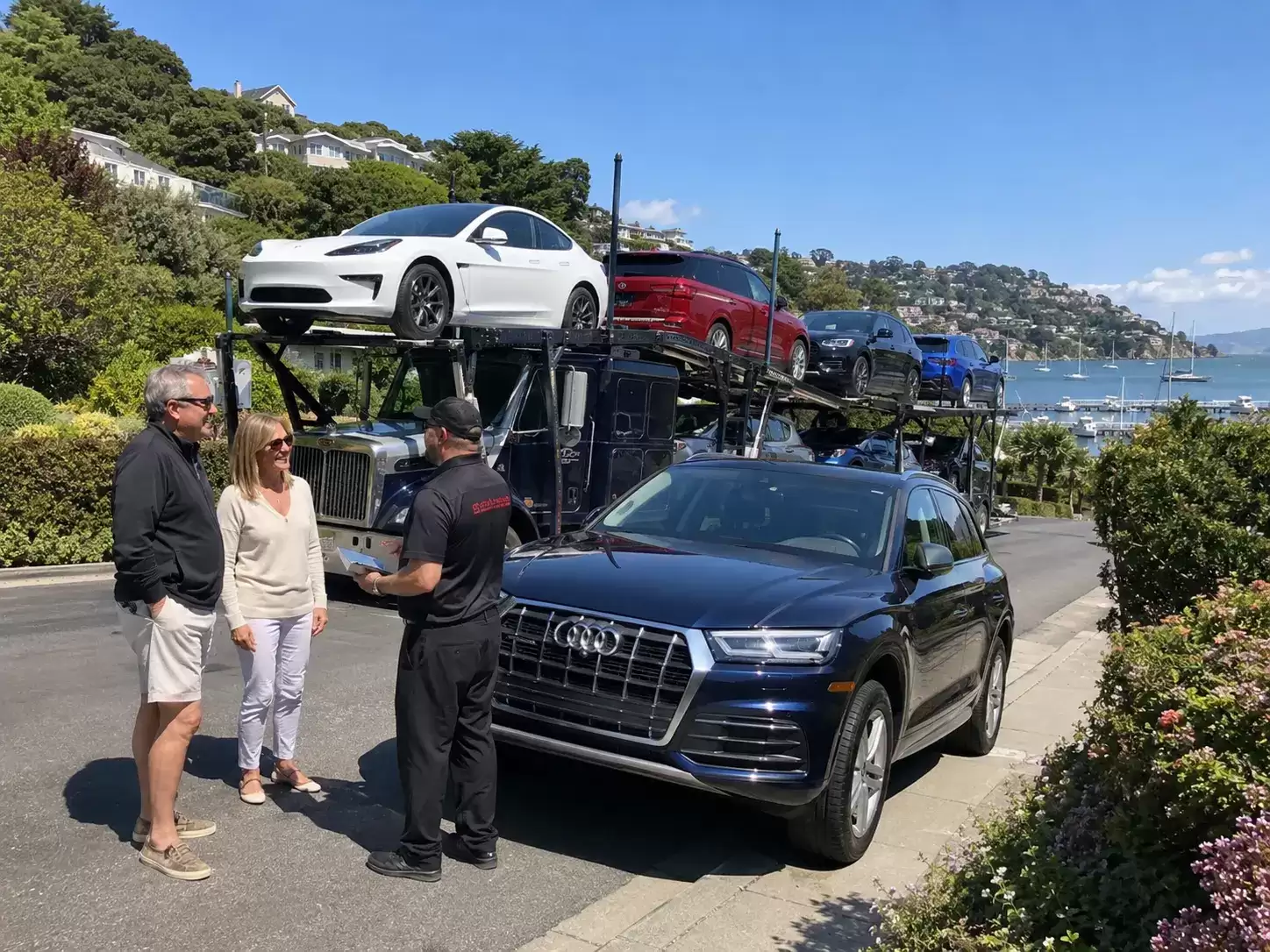
Door-to-Door Car Shipping: What to Expect in North Carolina and California
Pickup in North Carolina
Charlotte Metro and the Piedmont
Standard door-to-door pickup throughout Charlotte and the Piedmont. Charlotte: standard residential throughout; very dense uptown Charlotte and South End addresses require carrier staging on a nearby wide street — confirm at booking. Charlotte suburbs (Concord, Kannapolis, Gastonia, Huntersville, Mooresville, Matthews, Monroe): standard residential, no staging concerns. Piedmont Triad (Greensboro, Winston-Salem, High Point): standard residential throughout. Charlotte’s I-77, I-85, and I-485 freeway network generates strong carrier staging — Charlotte is North Carolina’s dominant outbound carrier hub.
Research Triangle and Central North Carolina
Standard door-to-door pickup throughout the Research Triangle and Central NC. Raleigh: standard residential throughout; dense downtown Raleigh addresses require nearby staging — confirm at booking. Durham and Chapel Hill (Duke/UNC corridor): standard residential, no staging concerns. Cary, Apex, Morrisville, and Research Triangle Park: standard residential throughout. Fayetteville and Fort Liberty (Army, formerly Fort Bragg): standard residential; confirm on-base vehicle access and gate authorization at booking for military PCS pickups. Fort Liberty is one of the Army’s largest installations — high PCS volume on this corridor.
Eastern NC, Coastal Markets, and Western Mountains
Standard door-to-door pickup throughout Eastern NC, coastal markets, and Western NC. Jacksonville and Camp Lejeune (Marine Corps): standard residential; confirm on-base vehicle access at booking for military PCS pickups. Wilmington: standard residential, I-40 and US-17 access. Asheville and Western NC mountains: standard residential; some mountain community addresses require staging nearby — confirm at booking. Rocky Mount, Goldsboro, Greenville, and New Bern: standard residential. Outer Banks: confirm accessibility at booking. Allow additional dispatch lead time for Eastern NC markets relative to Charlotte and the Triangle.
Delivery in California
Southern California: Los Angeles, San Diego, and Orange County
Standard door-to-door delivery throughout Southern California. Los Angeles basin: standard residential delivery throughout; very dense downtown LA, Koreatown, Hollywood, and Westlake addresses require carrier staging on a nearby wide commercial street — confirm your delivery address at booking. San Diego and Chula Vista: excellent carrier access, standard residential. Orange County (Anaheim, Irvine, Santa Ana, Fullerton): standard residential, no staging concerns. No heat protocol at coastal SoCal delivery destinations in any season.
Inland Empire and Central Valley
Standard door-to-door delivery throughout the Inland Empire and Central Valley. Riverside, San Bernardino, Fontana, and Ontario: excellent suburban carrier access; the Inland Empire is one of the most active inbound carrier zones in California. Summer heat note at delivery: IE and Central Valley destinations reach 105–115°F June–September — for exotic or luxury vehicles sensitive to heat, enclosed transport keeps the vehicle sealed during transit to these destinations. Fresno, Bakersfield, Modesto, and Stockton: standard residential throughout.
Bay Area and Sacramento
Standard door-to-door delivery throughout the Bay Area and Sacramento. San Jose, Oakland, Fremont, Vallejo, and Concord: standard residential access. San Francisco: carrier staging required for steep-grade neighborhood deliveries (Pacific Heights, Russian Hill, Nob Hill) — confirm your delivery address at booking. Sacramento: standard residential throughout. No heat protocol at coastal Bay Area delivery in any season. Bay Area delivery carries a pricing premium due to distance from most origins and carrier positioning requirements in the metro.
Preparing Your Vehicle
Before pickup: remove all personal items from the interior, leave no more than a quarter tank of fuel, disable your car alarm, and remove any exterior accessories. Photograph your vehicle thoroughly from all angles with date-stamped images before the carrier arrives. At delivery in California, inspect your vehicle carefully before signing the Bill of Lading — note any concerns before signing. Your signature without notation constitutes acceptance of the vehicle’s condition.
North Carolina & California Auto Transport Resources
North Carolina Helpful Government Links
- North Carolina Division of Motor Vehicles (NC DMV) — Primary agency for NC vehicle titles and registration. When moving permanently to California, obtain your NC title before shipping — California requires it to complete registration. New California residents must register within 20 days of establishing residency.
- NC DMV — Vehicle Title Transfers — Guidance on releasing your North Carolina title for out-of-state transfer. Complete the title release before your vehicle is picked up for transport to California.
- NC DMV — Vehicle Inspections — If maintaining a North Carolina address, NC requires annual safety inspections. Emissions testing applies in select metro counties. Keeping your inspection current before shipping avoids any compliance issues.
California Helpful Government Links
- California Department of Motor Vehicles (CA DMV) — Primary agency for California vehicle titles and registration. New California residents must register their out-of-state vehicle within 20 days of establishing residency in the state.
- CA DMV — Registering an Out-of-State Vehicle — Step-by-step guidance for transferring your North Carolina title and obtaining California registration and plates. California requires a smog inspection before registration for most vehicles.
- CA DMV — Vehicle Registration Fees — California registration fees are calculated on vehicle value. Estimate your cost before your vehicle arrives at your California address.
Federal Auto Transport Resources
- FMCSA — Verify a Carrier’s License (SAFER System) — Verify that any auto transport company you consider is federally licensed and insured before booking.
- FMCSA — Protect Your Move — Federal consumer guidance about hiring vehicle shippers, including red flags for broker scams and your rights as a shipper.