
Car Shipping To or From Missouri
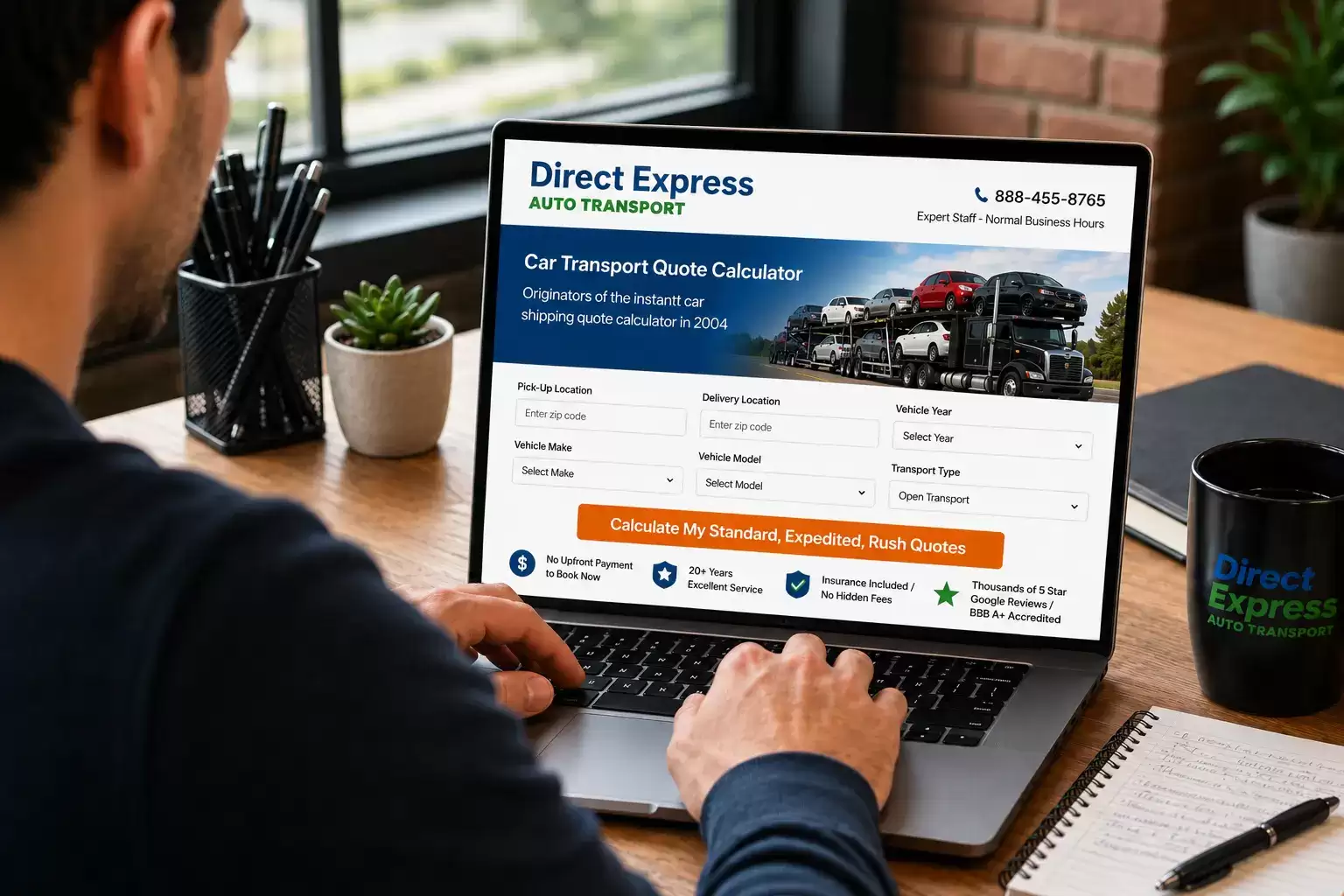
Need to ship a car to or from Missouri? Direct Express Auto Transport has been the Show-Me State’s most trusted auto transport broker since 2004 — with a 4.6-star average across thousands of verified Google reviews, no upfront payment required, and a real-time quote available in 30 seconds.
★ 4.6/5 Google Reviews | BBB Accredited A+ | FMCSA Licensed (MC #479342) | USDOT #1240502 | No upfront payment required | 20+ years shipping vehicles


Missouri car shipping costs vary based on your route, the time of year, vehicle size, and the service tier you choose. Use our instant calculator above for a real-time quote — or see the route-by-route pricing tables below for a fast ballpark. Most standard sedan shipments to or from Missouri range from $550 on short regional hauls to neighboring states to $1,200+ on cross-country routes to California or Washington State. Our Expedited and Rush pricing tiers hasten the process to create an even more satisfying experience.
What customers say about shipping a car to or from Missouri with Direct Express Auto Transport


The interstate corridors that move Missouri vehicles
Five primary highway arteries define Missouri’s auto transport network:
I-70 (The Kansas City–St. Louis backbone): The dominant east-west corridor, connecting Kansas City westward to Denver and Los Angeles, and St. Louis eastward to Indianapolis, Columbus, Pittsburgh, and New York. I-70 is arguably the most important single auto transport corridor in the United States: it crosses the entire continent and runs directly through Missouri’s two largest cities. Carrier frequency on I-70 within Missouri is among the highest in the Midwest, with multiple daily departures in both directions.
I-44 (Southwest corridor): Runs southwest from St. Louis through Rolla, Springfield, and Joplin to Tulsa and Oklahoma City, connecting to I-40 for the Dallas/Fort Worth and Amarillo/Albuquerque/Los Angeles routes. I-44 is the primary artery for Missouri vehicles moving to and from Texas, Oklahoma, and the Southwest. The Joplin interchange with I-49 also provides access to Arkansas, Louisiana, and the Gulf Coast.
I-55 (South corridor): Runs south from St. Louis through Cape Girardeau and into Tennessee, Memphis, and ultimately New Orleans. It is the primary route for vehicles moving between Missouri and the Mississippi Delta, Gulf Coast, and Southeast. Cape Girardeau benefits from consistent carrier presence as a natural I-55 waypoint between St. Louis and Memphis.
I-29 / I-35 (Kansas City north-south corridors): I-29 runs north from Kansas City to Omaha, Sioux City, and Fargo, giving Kansas City strong access to the upper Midwest. I-35 runs northeast to Des Moines and Minneapolis, and southwest toward Wichita, Oklahoma City, and Dallas. Together, these two interstates make Kansas City the dominant carrier hub for the central north-south corridor.
I-49 (Southwest Missouri corridor): The newest major interstate in Missouri, running southwest from Joplin toward Fort Smith, Arkansas, and connecting to the I-40 corridor for broader Southwest access. It is an emerging carrier route for Missouri-to-Arkansas and Missouri-to-Louisiana shipments, supplementing I-55 for southeastern destinations.
Vehicles shipping to or from Kansas City, St. Louis, or Columbia benefit from the highest carrier frequency in the state. If you are shipping to a secondary market such as Springfield, Joplin, Cape Girardeau, or a rural county seat, expect slightly longer pickup windows due to the required detour from primary carrier trunk routes.
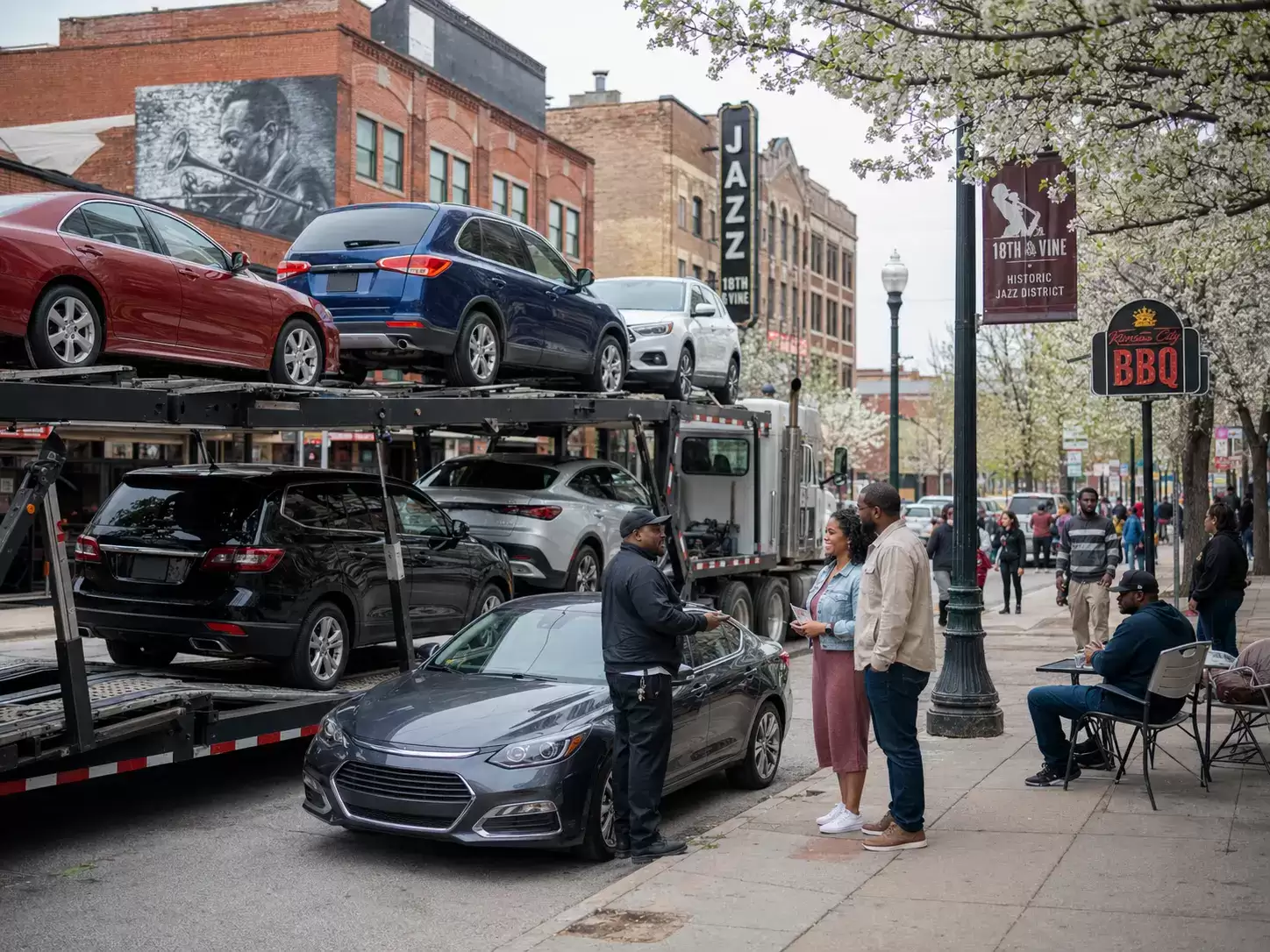

Missouri as a carrier crossroads: what eight-state geography means for your shipment
Missouri’s position as a border-rich through-state creates carrier dynamics that benefit shippers in ways that are not always obvious at first glance:
Constant bidirectional freight: Because I-70 runs coast to coast and passes directly through Kansas City and St. Louis, carriers running transcontinental routes are always present in Missouri. A carrier delivering to Los Angeles and deadheading back east will pick up a Missouri load eagerly. A carrier running Florida to Chicago will pass through St. Louis regardless. This structural freight overlap means Missouri rarely experiences the one-way availability gaps that affect states with less interstate coverage.
The St. Louis hub effect: St. Louis sits at the intersection of I-70 (east-west), I-44 (southwest), and I-55 (south), making it one of the most important carrier interchange points in the country. Carriers running any of these three corridors converge in St. Louis, creating a pickup window that is consistently shorter than you would expect for a mid-sized metro. If you are shipping from the St. Louis area, you are effectively shipping from one of the best-served inland markets in the United States.
The Kansas City hub effect: Kansas City sits at the I-70/I-35/I-29 convergence, making it the dominant carrier hub for the central north-south corridor. Carriers running Minnesota to Texas, Iowa to Oklahoma, or the Pacific Northwest to the Gulf Coast all pass through Kansas City. Combined with its east-west I-70 access, Kansas City generates carrier availability that rivals Chicago-area markets on most routes.
Secondary market considerations: Springfield, Joplin, Rolla, and rural Missouri communities sit off the primary trunk corridors. Carriers will serve these markets as deliberate detours, which means pickup windows are longer and Expedited tier is more important for time-sensitive shipments. The Ozark geography also means some rural areas require careful staging coordination — contact our team if your pickup or delivery address has steep terrain access challenges.
Missouri’s major auto carrier hubs and what they mean for you
Not all Missouri cities are equal from a logistics standpoint. Here is how the major hubs rank in terms of carrier availability:
St. Louis / I-70/I-44/I-55 Interchange: The highest carrier density in the state. The convergence of three major interstates in St. Louis makes it one of the premier carrier hubs in the entire Midwest. Daily departures run to virtually every major U.S. city. The I-270 beltway gives carrier trucks excellent access to all St. Louis suburbs without downtown traffic. Pickup windows here are among the shortest in the Midwest, comparable to Chicago and Indianapolis on most routes.
Kansas City / I-70/I-35/I-29 Convergence: Missouri’s western hub and the dominant carrier interchange for the central north-south corridor. Kansas City benefits from both east-west I-70 traffic and the constant north-south flow on I-29 and I-35. The Kansas City metro straddles the Missouri/Kansas state line, and carriers serving both sides of the metro treat it as a single unified market. Pickup windows are very competitive, particularly for southbound routes to Texas and northbound routes to the upper Midwest.
Columbia / I-70 Midpoint: Missouri’s geographic midpoint on I-70 and home of the University of Missouri (~30,000 students). Carriers running between Kansas City and St. Louis pass through Columbia continuously, giving it carrier access disproportionate to its size. University move seasons in August and May bring additional carriers specifically into the Columbia market. Standard tier works well here outside of university peak periods.
Springfield / I-44 Corridor: Southwest Missouri’s primary hub and the largest city on the I-44 corridor. Missouri State University (~25,000 students) generates consistent annual move demand. I-44 connects Springfield to St. Louis to the northeast and Joplin to the southwest. While off the primary east-west I-70 trunk, Springfield’s size and university demand give it reasonable carrier availability. Expedited tier recommended for tight timelines.
Joplin / I-44/I-49 Gateway: Southwest Missouri’s gateway city and the junction of I-44 and I-49. Carriers running toward Oklahoma, Arkansas, and Texas pass through Joplin, giving it consistent southbound carrier traffic. It is the best-served market in the southwest corner of the state, though its distance from the Kansas City and St. Louis hubs means northbound pickup windows are longer.
Cape Girardeau / I-55 Southern Missouri: The primary hub for southeast Missouri and the dominant market between St. Louis and Memphis on I-55. Carriers running the Mississippi corridor stop in Cape Girardeau routinely. Southeast Missouri State University (~11,000 students) provides a consistent local demand base.
St. Joseph / I-29 Northwest: The northwestern hub, sitting on I-29 north of Kansas City. Carriers running Kansas City to Omaha or Sioux City pass through St. Joseph, giving it reasonable northbound availability. Primarily served from the Kansas City hub for southbound and east-west routes.
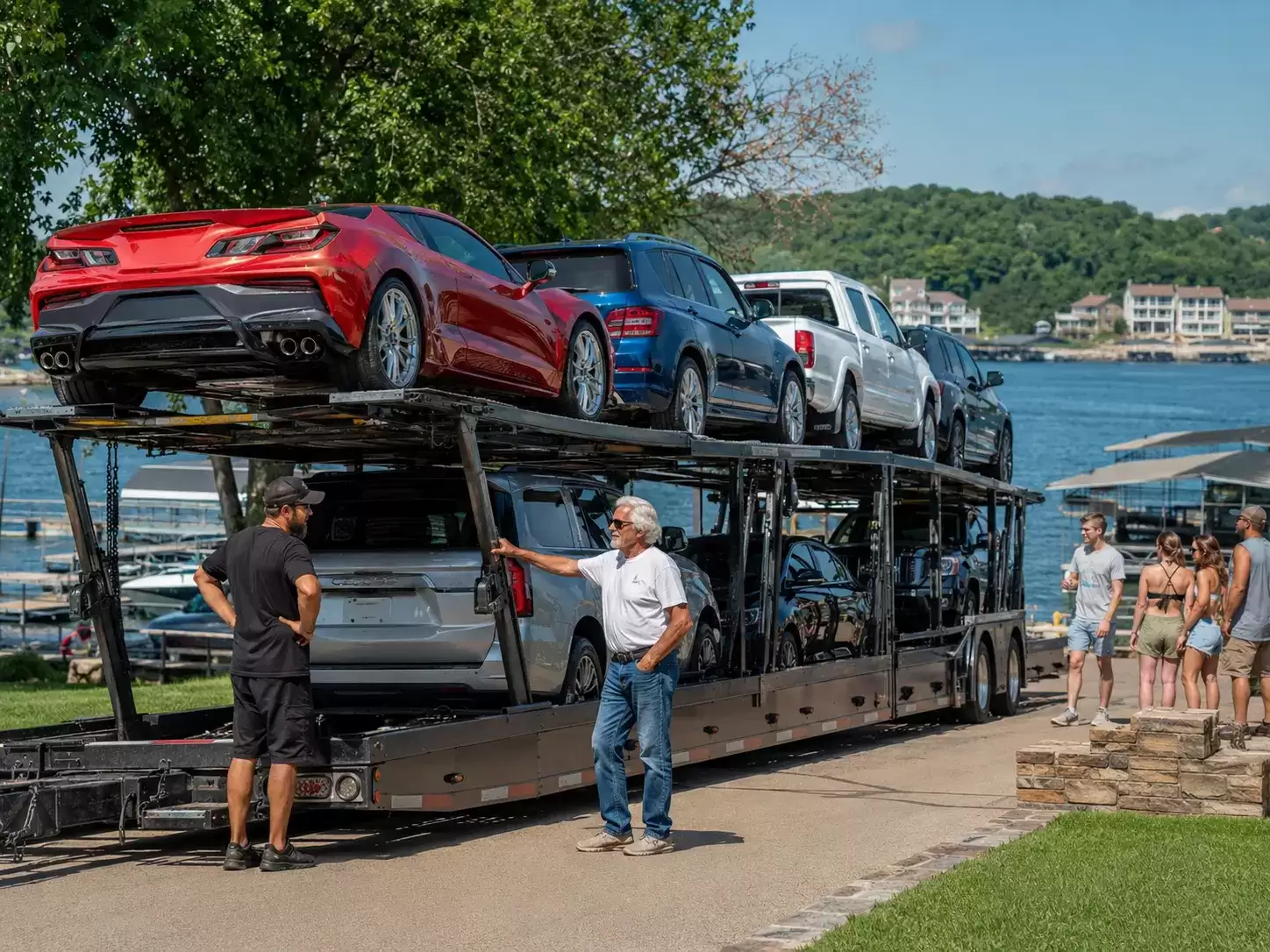
Missouri car shipping cost estimates: major routes
The tables below show estimated pricing for the most commonly requested Missouri auto transport routes, based on real-time market data for a standard operable sedan via open carrier. All prices reflect current market conditions for Standard, Expedited, and Rush tiers. Your actual quote may vary based on vehicle size, exact pickup/delivery zip codes, and seasonal demand. Use our instant calculator for a real-time rate.
Popular Routes To Missouri
Swipe to view full table →
| From | To | Distance (mi) | Estimated Days | Standard | Expedited | Rush |
|---|---|---|---|---|---|---|
| Florida | Missouri | 1,200 | 5–7 days | $1,000 | $1,200 | $1,400 |
| New York | Missouri | 1,200 | 5–7 days | $975 | $1,170 | $1,365 |
| California | Missouri | 1,900 | 6–9 days | $1,150 | $1,380 | $1,610 |
| Texas | Missouri | 800 | 3–5 days | $800 | $960 | $1,120 |
| Washington State | Missouri | 2,000 | 7–10 days | $1,200 | $1,440 | $1,680 |
| Colorado | Missouri | 850 | 3–5 days | $800 | $960 | $1,120 |
| Georgia | Missouri | 850 | 3–5 days | $800 | $960 | $1,120 |
| North Carolina | Missouri | 1,000 | 4–6 days | $850 | $1,020 | $1,190 |
| Michigan | Missouri | 650 | 3–5 days | $750 | $900 | $1,050 |
| Arizona | Missouri | 1,600 | 5–8 days | $1,050 | $1,260 | $1,470 |
Popular Routes From Missouri
Swipe to view full table →
| From | To | Distance (mi) | Estimated Days | Standard | Expedited | Rush |
|---|---|---|---|---|---|---|
| Missouri | Florida | 1,200 | 5–8 days | $1,000 | $1,200 | $1,400 |
| Missouri | California | 1,900 | 7–10 days | $1,150 | $1,380 | $1,610 |
| Missouri | New York | 1,200 | 5–7 days | $975 | $1,170 | $1,365 |
| Missouri | Texas | 800 | 3–6 days | $800 | $960 | $1,120 |
| Missouri | Washington State | 2,000 | 8–11 days | $1,200 | $1,440 | $1,680 |
| Missouri | Georgia | 850 | 3–5 days | $800 | $960 | $1,120 |
| Missouri | Colorado | 850 | 3–5 days | $800 | $960 | $1,120 |
| Missouri | Michigan | 650 | 3–5 days | $750 | $900 | $1,050 |
| Missouri | Illinois | 300 | 2–4 days | $550 | $660 | $770 |
| Missouri | Indiana | 500 | 2–4 days | $650 | $780 | $910 |
Why cross-country vehicle shipping from Missouri often costs less per mile than short regional hauls
Missouri shippers sometimes notice that shipping a car to California costs only modestly more than shipping to Georgia, even though California is more than twice as far. The explanation is carrier economics. A carrier running a Kansas City-to-Los Angeles transcontinental route is already committed to crossing Missouri; an additional stop at the Kansas City origin adds minimal cost to a load they were already running. The fixed costs — driver time, fuel, insurance, overhead — are spread across 1,900 miles rather than 850. On a short haul to Atlanta, by contrast, the carrier makes a deliberate trip of 850 miles with the same fixed cost structure compressed into fewer miles. The result is that the per-mile rate on short hauls is almost always higher than on long hauls, even though the total dollar amount is lower. This is why Missouri-to-California or Missouri-to-Washington shipments often feel like surprisingly good value compared to what shippers expect from the distance.

Missouri vehicle shipping seasonal guide

Missouri auto shipping service tiers
| Tier | How It Works | Pickup Window | Best For | Price vs. Standard |
|---|---|---|---|---|
| Standard | Listed at market rate; carrier assigned when available | 3–7 business days | Flexible schedules; off-peak season; I-70 and I-55 corridor pickups | Base rate |
| Expedited (most popular) |
Listed above market rate; attracts carriers faster through the load board | 1–3 business days | Most Missouri shippers; secondary markets; military PCS; university move seasons | +20% |
| Rush | Top of market; maximum carrier priority; first available driver assigned | Same or next business day | Hard deadlines; peak summer demand; last-minute corporate relocations | +40% |
The Missouri-specific tier recommendation
For most Missouri shippers using Kansas City or St. Louis as their origin or destination, Standard tier performs well during the off-peak period of October through April. The carrier density on I-70 and the broader interstate network is high enough that Standard listings in the primary hubs are assigned within a reasonable window. If your move falls between May and September — or if you are shipping to or from a secondary market such as Springfield, Joplin, Cape Girardeau, Rolla, or rural Missouri — Expedited tier is the correct choice. Secondary markets require a carrier to deviate from the primary corridor, and a Standard listing in those areas during summer peak can sit longer than most shippers find acceptable. Rush tier is reserved for hard-deadline situations: military orders with a firm report-by date, corporate relocations where housing is already committed, or a closing date that cannot move. If your timeline has even two or three days of flexibility, Expedited delivers fast pickup at a meaningfully lower cost than Rush.


How to ship a car to or from Missouri: 4 steps
Step 1: Get your instant quote. Use our Missouri car shipping calculator above. Enter your pickup zip code, delivery zip code, vehicle year, make, and model. Your real-time quote appears in 30 seconds, with Standard, Expedited, and Rush pricing shown side by side. No phone call required.
Step 2: Book your order — no upfront payment. Select your tier and confirm your pickup window. We do not charge your card until a carrier is assigned and confirmed. Your card is only authorized when your driver is locked in and ready to pick up your vehicle.
Step 3: Carrier pickup and inspection. Your assigned carrier contacts you directly to confirm pickup timing. At pickup, the driver completes a Bill of Lading inspection report documenting your vehicle’s pre-transport condition on all panels. Review it carefully before signing — this document is your protection record at delivery.
Step 4: Delivery and final inspection. Your driver will contact you before arrival to coordinate delivery. At delivery, inspect your vehicle against the Bill of Lading before signing off. Payment to the carrier (cash or certified funds) is due at delivery. If you note any new damage, document it on the Bill of Lading before the driver departs — this is the required first step for any carrier insurance claim.
University and college vehicle transport in Missouri
Missouri’s universities collectively enroll more than 150,000 students, creating two major annual vehicle shipping waves: fall move-in (August) and spring move-out (May). If your shipment window overlaps with a university move period — particularly around Columbia, Springfield, or St. Louis — book three to four weeks ahead and select Expedited tier.
| University | Location | Approx. Enrollment |
|---|---|---|
| University of Missouri (Mizzou) | Columbia | ~30,000 |
| Missouri State University | Springfield | ~25,000 |
| University of Missouri–Kansas City | Kansas City | ~17,000 |
| Washington University in St. Louis | St. Louis | ~15,000 |
| Saint Louis University | St. Louis | ~13,000 |
| Southeast Missouri State University | Cape Girardeau | ~11,000 |
| Missouri University of Science and Technology | Rolla | ~8,000 |
| Truman State University | Kirksville | ~6,000 |
| Missouri Southern State University | Joplin | ~4,500 |
| Missouri Western State University | St. Joseph | ~4,000 |

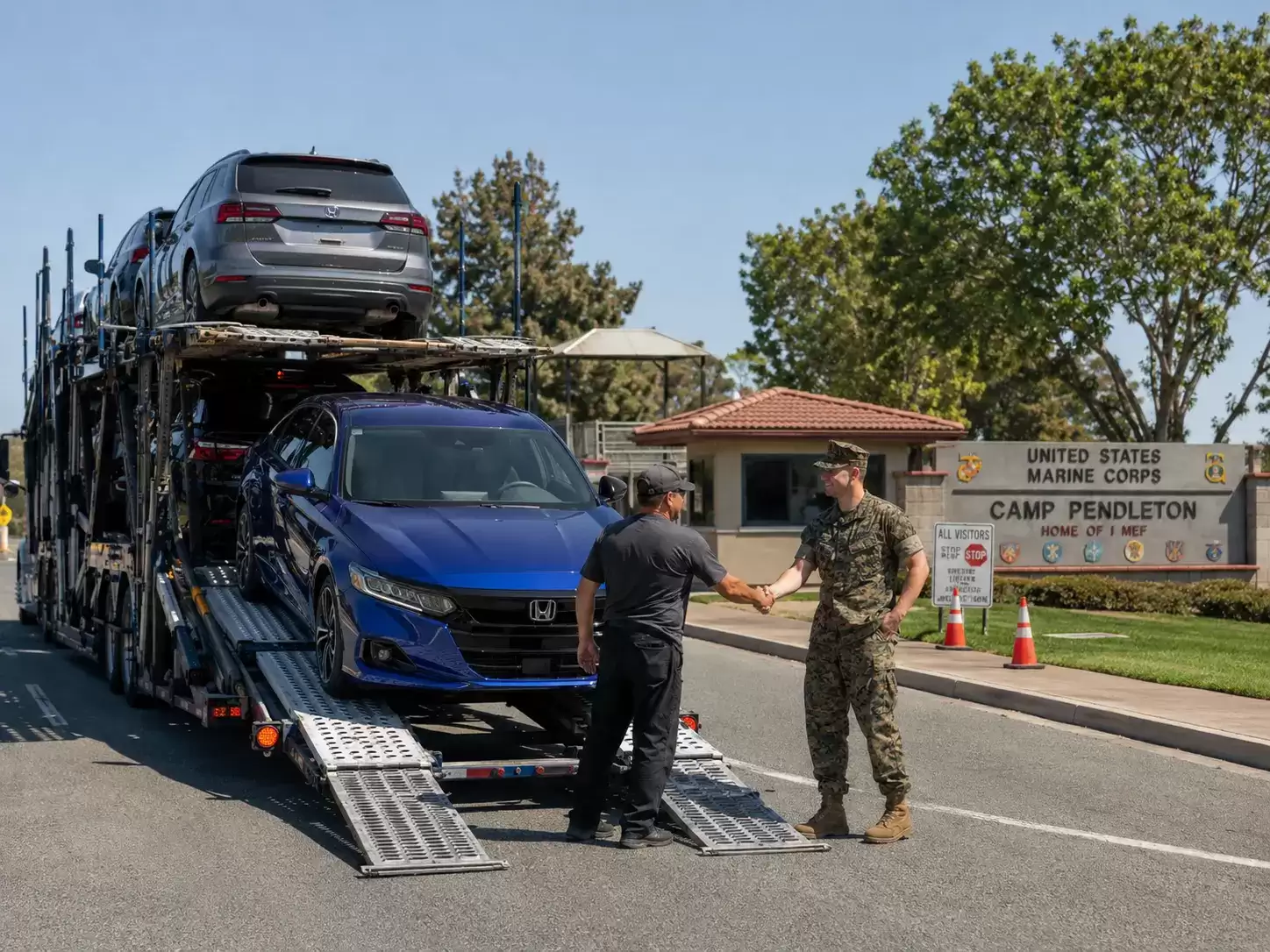
Military base car hauling in Missouri
Missouri’s military installations generate significant PCS shipping demand, particularly during the spring and summer PCS season. Military shippers receive the same transparent, no-upfront-payment process as all Direct Express customers, and our team is experienced in coordinating with military report-by dates and deployment schedules.
Fort Leonard Wood — Pulaski County
One of the Army’s largest training installations and the home of the Army Engineer School, Military Police School, and Chemical School. Fort Leonard Wood generates among the highest PCS shipping volumes of any installation in the continental United States. Its location in the Missouri Ozarks, off the primary I-44 corridor near Waynesville, means Expedited tier is strongly recommended for personnel relocating to or from the installation — especially during the May through August PCS peak when carrier competition for secondary market pickups is highest.
Whiteman Air Force Base — Knob Noster
Home of the 509th Bomb Wing and the B-2 Spirit stealth bomber, Whiteman AFB sits in west-central Missouri between Kansas City and Columbia on US-50. Personnel relocating to or from Whiteman benefit from reasonable access to both the Kansas City and Columbia carrier hubs. Standard tier works well here during off-peak periods; Expedited recommended for summer PCS moves.
Missouri National Guard installations statewide
Missouri maintains armories and training facilities throughout the state, including facilities in Kansas City, St. Louis, Springfield, Jefferson City, and Joplin. Personnel mobilized from Guard facilities are served through their nearest primary carrier hub on the Missouri interstate grid.
Cities we serve in Missouri
We provide auto transport pickup and delivery throughout Missouri. Cities on or near major carrier corridors have the shortest pickup windows and most competitive rates. Secondary markets further from the interstate grid may require Expedited tier for time-sensitive shipments.
Kansas City Metro / I-70/I-35/I-29
Kansas City — Missouri’s western hub and the I-70/I-35/I-29 convergence point; among the highest carrier density in the state with daily departures in all directions. Independence — Eastern Kansas City suburb on I-70 with direct access to the transcontinental corridor. Lee’s Summit — Southern Kansas City suburb; US-50 and I-470 access connecting to the broader KC metro carrier network. Overland Park — Major Kansas City suburb (Kansas side) accessed through the unified KC metro carrier market. St. Joseph — Northwestern hub 55 miles north of Kansas City on I-29; served from the KC hub with I-29 access north toward Omaha.
St. Louis Metro / I-70/I-44/I-55
St. Louis — Missouri’s eastern hub at the convergence of I-70, I-44, and I-55; one of the premier carrier hubs in the Midwest with daily departures to virtually every major U.S. city. Clayton — St. Louis County seat and corporate center; served directly from the St. Louis hub. Chesterfield — Western St. Louis suburb on I-64 with strong carrier access from the I-270 beltway. O’Fallon — Fast-growing St. Charles County suburb on I-70 west of St. Louis; served from the St. Louis hub with excellent interstate access. Florissant — Northern St. Louis County suburb; I-270 access connecting to both I-70 and I-55 carrier trunk routes.
I-70 Central Corridor
Columbia — Home of the University of Missouri; I-70 midpoint between Kansas City and St. Louis with carrier access in both directions and strong university-driven demand in August and May. Jefferson City — State capital on the Missouri River; US-54 access to I-70 at Columbia; served from both KC and St. Louis hubs with reasonable pickup windows. Sedalia — US-50 corridor between Kansas City and Jefferson City; served from the Kansas City hub as a deliberate waypoint on central Missouri runs.
I-44 Southwest Corridor
Springfield — Southwest Missouri’s primary hub and home of Missouri State University; I-44 access northeast to St. Louis and southwest to Joplin with reasonable carrier availability for a secondary market. Joplin — I-44/I-49 gateway at the Oklahoma border; consistent southbound carrier traffic from carriers heading toward Tulsa, Oklahoma City, and Texas. Rolla — I-44 midpoint between St. Louis and Springfield and home of Missouri S&T; served as a carrier waypoint on the St. Louis-to-Springfield run.
I-55 Southeast Corridor
Cape Girardeau — Southeast Missouri’s primary hub on I-55; carriers running the Mississippi corridor between St. Louis and Memphis stop here routinely, giving it competitive pickup windows for a secondary market. Poplar Bluff — South-central Missouri hub on US-60; served from the Cape Girardeau and Springfield carrier networks for southbound and cross-state shipments. Sikeston — I-55/US-60 junction in the Missouri Bootheel; served from the Cape Girardeau hub with reasonable southbound access toward Memphis.
I-29 Northwestern Missouri
Maryville — Northwest Missouri State University home; US-136 access connecting to I-29 toward St. Joseph and Kansas City; served from the St. Joseph hub for Kansas City-bound carrier routes. Kirksville — Truman State University home in northeastern Missouri; US-63 access south toward Columbia; reached via the Columbia hub for most long-distance routes.
Missouri government resources for vehicle shipping
- Missouri Department of Revenue — Motor Vehicle Bureau — Official source for Missouri vehicle registration, title transfer, and out-of-state title requirements when your shipped vehicle arrives in Missouri.
- Missouri Attorney General — Consumer Protection — File a complaint or research a mover’s complaint history with Missouri’s consumer protection office.
- FMCSA SAFER System — Look up any auto transport carrier’s federal operating authority, insurance status, and safety record before booking.
- FMCSA Protect Your Move — Federal consumer guidance on avoiding auto transport fraud and understanding your rights as a shipper.
- Missouri Department of Transportation (MoDOT) — Current road conditions, construction updates, and travel advisories that may affect carrier transit times on Missouri interstates.

Popular long-distance Missouri car transport routes
Missouri to Florida: Car Shipping
Missouri-to-Florida is one of the state’s most traveled long-distance corridors, driven by consistent snowbird demand and year-round relocation traffic between the Midwest and the Sunshine State. The I-55 south route from St. Louis through Memphis and Birmingham, and the I-44/I-65 route from Kansas City through Nashville, both feed directly into Florida-bound carrier lanes. Transit is typically 5–8 days. Expedited tier recommended for October and November snowbird departures when southbound trailer space is at its most competitive.
Missouri to Georgia: Auto Transport
Missouri-to-Georgia routes run primarily via I-55 south to Memphis and then I-22 or I-20 east toward Atlanta, or via I-65 through Nashville and south to Birmingham and Atlanta. The Atlanta metro generates consistent relocation demand that keeps this corridor well-served. Transit is typically 3–5 days. Standard tier is reliable outside of peak summer demand windows.
Missouri to North Carolina: Vehicle Shipping
Missouri-to-North Carolina shipments run I-70 east through Indianapolis and Columbus, then south via I-77 or I-81 toward Charlotte and the Research Triangle. The strong corporate relocation demand in the Raleigh-Durham-Chapel Hill market and the Charlotte metro keeps this route well-served. Transit is typically 4–6 days.
Missouri to Ohio: Vehicle Transport
I-70 east from both Kansas City and St. Louis connects directly to the Ohio market at Indianapolis, with direct continuing access to Dayton, Columbus, and Cleveland. The I-70 corridor is one of the highest-frequency carrier lanes in the country, and Ohio-bound shipments from Missouri benefit from near-daily carrier departures in both directions. Transit is typically 3–5 days.
Missouri to Michigan: Auto Shipping
Missouri-to-Michigan routes run I-70 east to Indianapolis and then north via I-69 to Fort Wayne and Detroit, or continue via I-94 toward Grand Rapids and Lansing. Automotive industry freight between Missouri and Michigan keeps this corridor well-supplied with carriers throughout the year. Transit is typically 3–5 days.
Missouri to Illinois: Car Hauling
Missouri and Illinois share the Mississippi River border, and the St. Louis metro straddles the state line. Illinois-bound shipments from St. Louis are among the shortest interstate routes in the state. Chicago is reachable via I-55 north or I-70 east to Indianapolis and then I-65 north. The constant cross-river freight flow keeps this corridor stocked with carriers in both directions. Transit is typically 1–4 days depending on destination.
Missouri to Texas: Vehicle Relocation
I-44 southwest from St. Louis through Joplin to Tulsa and Oklahoma City, then I-35 south to Dallas/Fort Worth, is the primary Missouri-to-Texas route. Houston continues south on I-45; San Antonio via I-35 south. The Texas relocation market is one of the most active in the country, and carriers run I-44 and I-35 constantly in both directions. Transit is typically 3–6 days.
Missouri to Colorado: Vehicle Hauling
I-70 west from both Kansas City and St. Louis runs directly to Denver and the Colorado Front Range — it is one of the most direct transcontinental routes available from Missouri. Transit is typically 3–5 days. Mountain pass conditions on I-70 west of Denver can affect winter transit; build in a one-to-two-day buffer for November through March shipments.
Missouri to California: Car Transport
Missouri-to-California is one of the premier transcontinental auto transport routes in the country. I-70 west from Kansas City runs to Denver, then through Utah to Las Vegas and the California border. Alternatively, I-44 southwest to Oklahoma City connects to I-40 for the southern California route through Albuquerque and Flagstaff. Both routes are heavily traveled by carriers. Transit is typically 6–10 days.
Missouri to Washington State: Auto Shipping
Missouri-to-Seattle and Washington State shipments run I-70 west to Denver, then north via I-15 and I-90 through Idaho and into the Pacific Northwest. Transit is typically 8–12 days. Expedited tier recommended for Washington State deliveries due to the distance and the lower carrier frequency on the final Pacific Northwest leg compared to California-bound routes.
Missouri to New York: Auto Transport
I-70 east from Missouri runs through Indianapolis, Columbus, and the Pennsylvania Turnpike into the New York metro. This is one of the highest-frequency transcontinental corridors in the country, with near-daily carrier departures from both Kansas City and St. Louis. Transit is typically 4–7 days. Standard tier performs well on this route outside of summer peak season.
Missouri to Indiana: Vehicle Shipping
Missouri and Indiana are directly connected by I-70, making this one of the most straightforward Midwest interstate routes available. Indianapolis is 500 miles east of Kansas City and 240 miles east of St. Louis. Carriers running between the two states are extremely common on I-70 throughout the year. Transit is typically 2–4 days, and Standard tier works reliably on this corridor year-round outside of peak summer demand.

Nearby states for Missouri auto transport
Illinois: Car Shipping
Illinois borders Missouri to the east along the Mississippi River. St. Louis and East St. Louis are effectively a single carrier market. Chicago is reachable via I-55 or I-70/I-65 north. The constant cross-river freight flow and the Chicago carrier hub make Illinois one of Missouri’s most reliably served neighboring markets.
Kansas: Auto Transport
Kansas borders Missouri to the west, with Kansas City straddling the state line. Wichita is reachable via I-35 south, and the remainder of Kansas is well-served from the Kansas City hub. I-70 also runs west through Topeka and Salina for shipments to western Kansas and beyond.
Iowa: Vehicle Shipping
Iowa borders Missouri to the north. Des Moines is accessible via I-35 north from Kansas City. I-61 and US-61 connect the St. Louis area to Iowa’s southeastern communities. Iowa-bound shipments from Missouri benefit from strong I-35 carrier traffic running the Kansas City-to-Minneapolis corridor.
Arkansas: Vehicle Transport
Arkansas borders Missouri to the south. I-55 south from St. Louis runs directly into Arkansas toward Little Rock and Memphis. I-49 south from Joplin runs through Fayetteville and Fort Smith. Arkansas-bound shipments from Missouri are straightforward and well-served by carriers running the Midwest-to-Gulf corridor.
Tennessee: Auto Shipping
Tennessee is reachable from Missouri via I-55 south through Memphis or via I-65 south through Nashville. Memphis sits at the Missouri-to-Tennessee carrier junction and is served daily from St. Louis. Nashville-bound shipments from Missouri can also route through Louisville on I-65.
Oklahoma: Car Hauling
Oklahoma borders Missouri to the southwest via I-44 through Joplin and Tulsa, or via I-35 south from Kansas City to Oklahoma City. The I-44/I-35 corridor is a heavily traveled carrier lane with consistent bidirectional freight. Oklahoma City and Tulsa are both well-served from Missouri’s primary hubs.

Ready to ship your car to or from Missouri?
Join hundreds of thousands of customers — Snowbirds, military families, tech relocators, students, and families moving across the country — who have trusted Direct Express Auto Transport with their Missouri vehicle shipments since 2004. Get your instant, no-obligation quote now. It takes 30 seconds, and there is no upfront payment required to hold your spot.
Instant quote — real-time pricing in under 5 seconds
No upfront payment — your card is charged only when a carrier is assigned
No risk to get a quote and book your order
BBB Accredited A+ since 2004
FMCSA licensed and fully bonded
4.6 stars across thousands of verified Google reviews