
California Car Shipping Services
Need to ship a car to or from California? Get a real-time, transparent price in 30 seconds — no phone calls, no risk, no upfront payment. Direct Express Auto Transport has been the Golden State’s most trusted auto transport broker since 2004, with a 4.6-star average across thousands of verified Google reviews.
★ 4.6/5 Google Reviews | BBB Accredited A+ | FMCSA Licensed (MC #479342) | USDOT #1240502 | No upfront payment required | 20+ years shipping vehicles


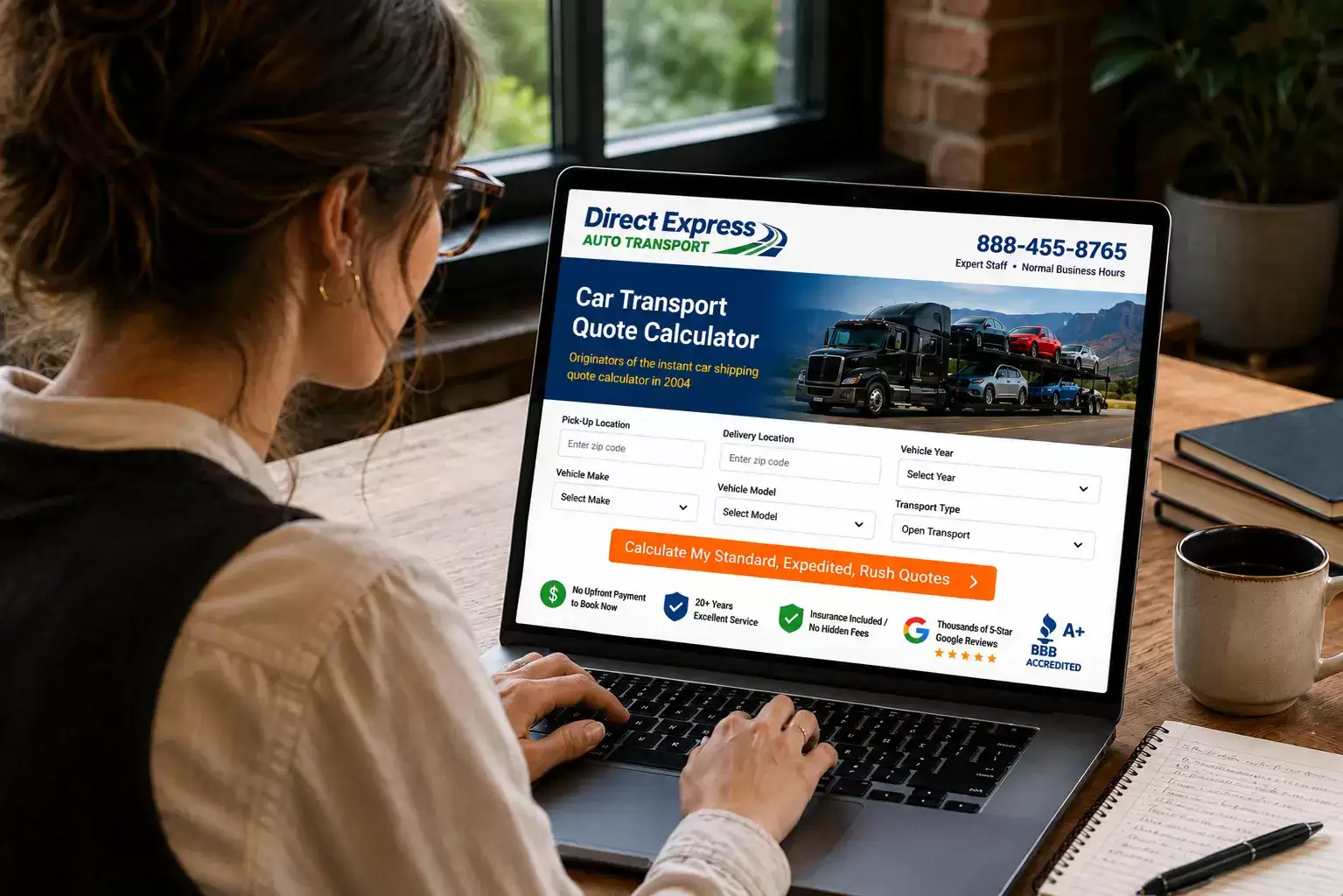
California car shipping costs vary based on your route, the time of year, vehicle size, and the service tier you choose. Use our instant calculator above for a real-time quote — or see the route-by-route pricing tables below for a fast ballpark. Most standard sedan shipments to or from California range from $345 on short Southwest hauls to $1,800+ on cross-country routes to New York or Florida. Our Expedited and Rush pricing tiers hasten the process to create an even more satisfying experience.
What customers say about shipping a car to or from California with Direct Express Auto Transport


The interstate corridors that move California vehicles
Four primary highway arteries define California’s auto transport network:
I-5 (Pacific Coast corridor): The dominant route for vehicles moving between California and the Pacific Northwest — Oregon, Washington, and British Columbia. It is also the primary north-south spine within California, linking San Diego, Los Angeles, the Central Valley, and Sacramento. Carriers run it daily in both directions. The I-5 corridor is one of the highest-volume domestic transport lanes on the West Coast.
I-10 (Southern Transcontinental corridor): The primary artery for shipments between California and the South and Southeast — Phoenix, Tucson, El Paso, San Antonio, Houston, New Orleans, and ultimately Florida. It enters California at the Arizona border near Blythe and terminates in downtown Los Angeles. For cross-country routes, I-10 is the workhorse of California auto transport.
I-80 (Northern Transcontinental corridor): Connects the Bay Area and Sacramento eastward through Reno, Salt Lake City, Denver, Omaha, Chicago, and on to New York. It is the primary corridor for vehicle shipping between Northern California and the entire northern tier of the United States. Carriers running I-80 cross the Sierra Nevada through Donner Pass, which can slow winter transit during major snow events.
I-15 (Desert Southwest corridor): Connects San Diego and the greater Los Angeles area northeast through the Cajon Pass to Las Vegas, Salt Lake City, and ultimately Montana. It is the primary carrier route for California-to-Nevada and California-to-Utah shipments and carries significant northbound California Exodus traffic to the Interior West.
Vehicles shipping to or from Los Angeles, San Diego, the Bay Area, or Sacramento benefit from the highest carrier frequency in the state — multiple daily departures on each corridor. If you are shipping to a Central Valley destination, the High Desert, or a North Coast community, expect slightly longer pickup windows due to the deviation from primary carrier trunk routes.
California as a terminus: what it means for your vehicle shipment
California’s geography creates a carrier dynamic that directly affects pricing and availability. Unlike a through-state where carriers can cross in multiple directions and pick up return freight at either end, California is the western terminus of every major transcontinental interstate. Every carrier that delivers a vehicle to California must find a load to take back east — or run empty. This has two important implications for shippers:
Bidirectional demand year-round: Because carriers need outbound loads as badly as inbound loads, both directions — INTO California and OUT OF California — have strong carrier interest year-round. This is why California rarely suffers the one-way availability problems that plague purely inbound or purely outbound states during off-peak periods. The California Exodus of residents relocating to Texas, Nevada, Arizona, and Colorado provides a structural outbound freight base that keeps return-trip carriers competitive.
Cross-country rates that beat regional rates per mile: On a 2,800-mile New York to California shipment, carriers are running a full transcontinental route and can optimize their trailer mix carefully. This drives the per-mile rate DOWN on long routes. On a shorter 400-mile regional route — say, Los Angeles to Las Vegas — the per-mile rate is actually higher because the carrier cannot spread fixed costs across as many miles. This is counterintuitive but explains why shipping a car from California to Florida often costs less per mile than shipping it to Nevada.
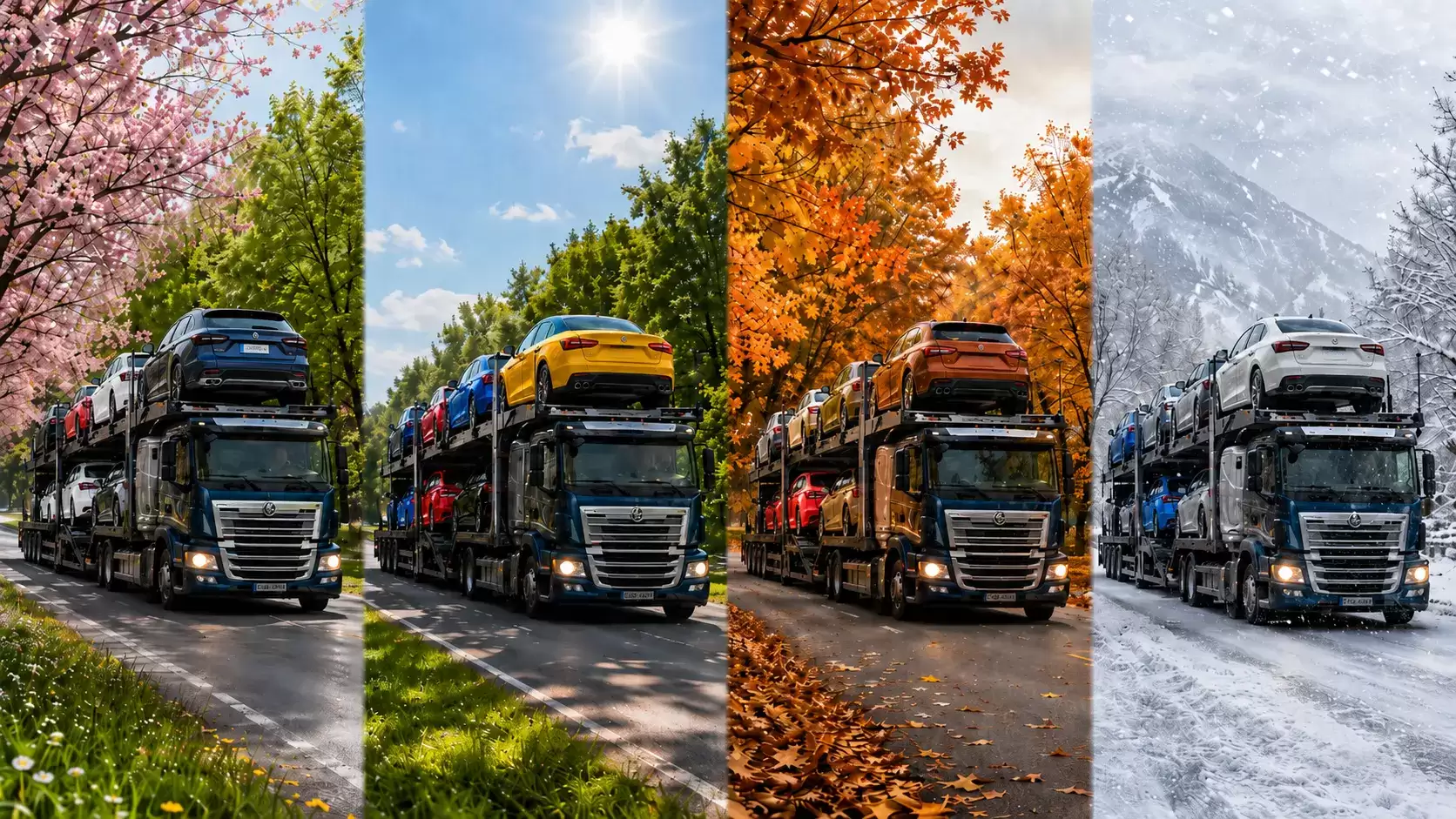
Southern California (Oct–Apr): High inbound demand as Pacific Northwest Snowbirds flood into San Diego and the greater Los Angeles area for winter. Carriers fill trailers heading south quickly. Pricing firms and pickup windows depend heavily on your chosen tier.
Northbound out of California (Nov–Mar): Carriers who have just delivered southbound loads seek return freight eagerly. This creates favorable conditions — and often competitive rates — for vehicles shipping out of California during peak inbound season. January and February are typically the best months of the year for outbound California shipments.
Summer (May–Sep): Military PCS season and university moves drive both directions into peak simultaneously. Rates are highest in summer — unlike Florida, where summer is the bargain window. California’s peak is June through August when relocation demand saturates carrier capacity statewide.
California’s major auto carrier hubs and what they mean for you
Not all California cities are equal from a logistics standpoint. Here is how the major hubs rank in terms of carrier availability:
Los Angeles / Long Beach / Orange County: Highest carrier density in the state — and in the country. Daily departures to virtually every major U.S. city. The I-10, I-5, I-15, and I-405 corridors converging in the LA metro make it the single most active origin and destination city for domestic auto transport anywhere in the United States. Pickup windows here are shorter than the national average even at Standard tier during non-peak months.
San Francisco / Bay Area / San Jose: Northern California’s dominant hub. Tech industry relocation demand, UC Berkeley and Stanford student moves, and consistent bidirectional freight on I-80 and US-101 keep carrier availability high year-round. San Francisco proper presents access challenges in residential neighborhoods; most deliveries stage at a nearby accessible point. San Jose and the South Bay are significantly more accessible for standard carrier trucks.
San Diego: California’s southernmost major hub and the military auto transport capital of the West Coast. Camp Pendleton, Naval Base San Diego, and MCAS Miramar generate consistent PCS shipping demand year-round. The I-5 and I-8 corridors give San Diego strong carrier access to both Los Angeles (northbound) and Arizona/Texas (eastbound). Second-fastest pickup windows in the state after the LA metro.
Sacramento: Northern California’s central distribution hub. Carriers on I-80 (to and from the Bay Area and Reno/Utah/Midwest) and I-5 (Pacific Coast north-south) both pass through Sacramento, giving it excellent bidirectional availability. State government workforce relocations and Travis Air Force Base PCS moves provide a consistent non-seasonal demand base.
Inland Empire (Riverside / San Bernardino): The I-10/I-15/I-215 interchange makes the Inland Empire a critical carrier staging point. Vehicles heading to Las Vegas, Phoenix, Salt Lake City, and Denver all pass through here. Despite being perceived as a secondary market, the Inland Empire actually has carrier availability close to the LA metro due to its position at the convergence of three major corridors.
Fresno / Central Valley: SR-99 and I-5 run the length of the Central Valley, and Fresno sits at the midpoint. Carriers combining Bakersfield, Fresno, and Stockton stops can run the entire valley in a single day, making Central Valley pickup windows more competitive than the cities’ relative isolation from major metros would suggest.
High Desert / Antelope Valley (Lancaster / Palmdale): Served primarily from the Los Angeles metro via SR-14 and I-15 through Victorville. Longer pickup windows than coastal California; Expedited tier recommended for time-sensitive shipments from High Desert communities.
North Coast / Redwood Region: Eureka and points north on US-101 are California’s most challenging carrier access market. Lower population density and distance from major carrier hubs mean pickup windows can extend significantly. Expedited tier is strongly recommended; contact our team for area-specific logistics.

California car shipping cost estimates: major routes
The tables below show estimated pricing for the most commonly requested California auto transport routes, based on real-time market data for a standard operable sedan via open carrier. All prices reflect current market conditions for Standard, Expedited, and Rush tiers. Your actual quote may vary based on vehicle size, exact pickup/delivery zip codes, and seasonal demand. Use our instant calculator for a real-time rate.
Popular Routes To California
Swipe to view full table →
| From | To | Distance (mi) | Estimated Days | Standard | Expedited | Rush |
|---|---|---|---|---|---|---|
| New York | California | 2,790 | 6–8 days | $1,480 | $1,775 | $2,070 |
| Florida | California | 2,750 | 6–8 days | $1,460 | $1,750 | $2,045 |
| Illinois | California | 2,020 | 5–7 days | $1,230 | $1,475 | $1,720 |
| Minnesota | California | 2,050 | 5–7 days | $1,250 | $1,500 | $1,750 |
| Michigan | California | 2,310 | 6–8 days | $1,410 | $1,690 | $1,975 |
| Ohio | California | 2,380 | 6–8 days | $1,450 | $1,740 | $2,030 |
| Washington | California | 1,140 | 3–5 days | $935 | $1,120 | $1,310 |
| Texas | California | 1,430 | 4–6 days | $1,000 | $1,200 | $1,400 |
| Colorado | California | 1,020 | 3–5 days | $835 | $1,000 | $1,170 |
| Arizona | California | 370 | 1–3 days | $530 | $635 | $740 |
Popular Routes From California
Swipe to view full table →
| From | To | Distance (mi) | Estimated Days | Standard | Expedited | Rush |
|---|---|---|---|---|---|---|
| California | New York | 2,790 | 7–9 days | $1,480 | $1,775 | $2,070 |
| California | Florida | 2,750 | 7–10 days | $1,460 | $1,750 | $2,045 |
| California | Texas | 1,430 | 4–6 days | $1,000 | $1,200 | $1,400 |
| California | Nevada | 270 | 1–2 days | $435 | $520 | $610 |
| California | Washington | 1,140 | 3–5 days | $935 | $1,120 | $1,310 |
| California | Georgia | 2,170 | 5–7 days | $1,325 | $1,590 | $1,855 |
| California | Michigan | 2,310 | 6–8 days | $1,410 | $1,690 | $1,975 |
| California | Arizona | 370 | 1–3 days | $530 | $635 | $740 |
| California | North Carolina | 2,590 | 6–8 days | $1,375 | $1,650 | $1,925 |
| California | Colorado | 1,020 | 3–5 days | $835 | $1,000 | $1,170 |
Why cross-country routes to California have a lower cost per mile
On a 2,790-mile New York to California car shipment, carriers are running an efficient transcontinental route and can combine multiple vehicles heading the same direction. On shorter regional routes like California to Nevada, the per-mile rate is actually higher. This is why a Los Angeles to Las Vegas shipment at $345 costs more per mile than a New York to Los Angeles shipment at $1,265 — distance works in the shipper’s favor on long routes.

Best time to ship a car to or from California — the complete seasonal guide
Standard, Expedited, or Rush — which tier is right for your California shipment?
Direct Express Auto Transport pioneered the three-tiered pricing model that is still for the most part unique to us. Each tier represents a different level of carrier incentive — the higher the tier, the more attractive your shipment is to carriers on the dispatch board, and the faster your vehicle gets assigned. Here is how each tier performs specifically on California routes:
Swipe to view full table →
| Tier | Best for California when… | What to expect |
|---|---|---|
| Standard | Outbound CA in Jan–Mar, flexible timeline on LA or San Diego routes, any route with a 10+ day window | Assignment in 4–8 days on major corridors. Best value when you are not in a rush and can let the market work for you. |
| Expedited (most popular) |
Inbound Snowbird season Oct–Feb, summer military PCS, any time you want certainty on a major corridor | Assignment in 1–4 days. Strongly recommended May–Sep on all California routes and Oct–Feb for inbound Southern California. |
| Rush | Hard move-in deadline during summer peak, last-minute military PCS, vehicle needed at California dealership or auction by a fixed date | Priority dispatch, often assigned within 24–48 hours. Best for urgent cross-country arrivals when Standard and Expedited windows are too long. |
The California-specific tier recommendation
On most routes, Expedited is the tier we recommend most often — and not just during peak season. California is a competitive market year-round, and even in the winter outbound window, the difference between Standard and Expedited is typically $80–$150 on a major corridor. That modest premium significantly increases how quickly carriers prioritize your load over the others waiting on the same route. Most of our repeat California customers — military families, tech relocators, and Snowbirds who ship annually — default to Expedited after their first experience.
Standard tier works well for: outbound California shipments in January through March, vehicles on major hub routes (LA to Las Vegas, San Diego to Phoenix, Sacramento to Seattle) with a 10-day or longer flexible window, and budget-conscious shippers on routes with naturally high carrier frequency.
Rush tier is the right call for: anyone with a hard delivery deadline during summer (June–August), last-minute inbound moves during the October–February Snowbird window, military PCS orders with compressed timelines, and vehicles that need to reach a California dealership, storage facility, or auction by a fixed date.


How to ship a car to or from California: 4 steps
Step 1: Get your instant California car shipping quote
Enter your pickup and delivery zip codes, your vehicle year, make, and model, whether it runs, and your preferred transport type (open or enclosed). Our calculator returns a real-time market rate in under 5 seconds. No name, phone number, or email required — you get the price first, every time.
Step 2: Choose your tier and confirm your dates
Select Standard, Expedited, or Rush based on your timeline and the seasonal guidance above. Enter your first available pickup date — you don’t need a firm date, just the earliest day the vehicle can be ready. Our dispatch team starts working immediately.
Step 3: Secure your spot — no upfront payment
Complete your booking online or by phone. Your credit card is on file but not charged until a carrier is assigned to your shipment. There is no deposit, no cancellation fee, and no obligation until assignment. Once matched, you receive the carrier’s name, phone number, and estimated pickup date by email.
Step 4: Door-to-door pickup and delivery
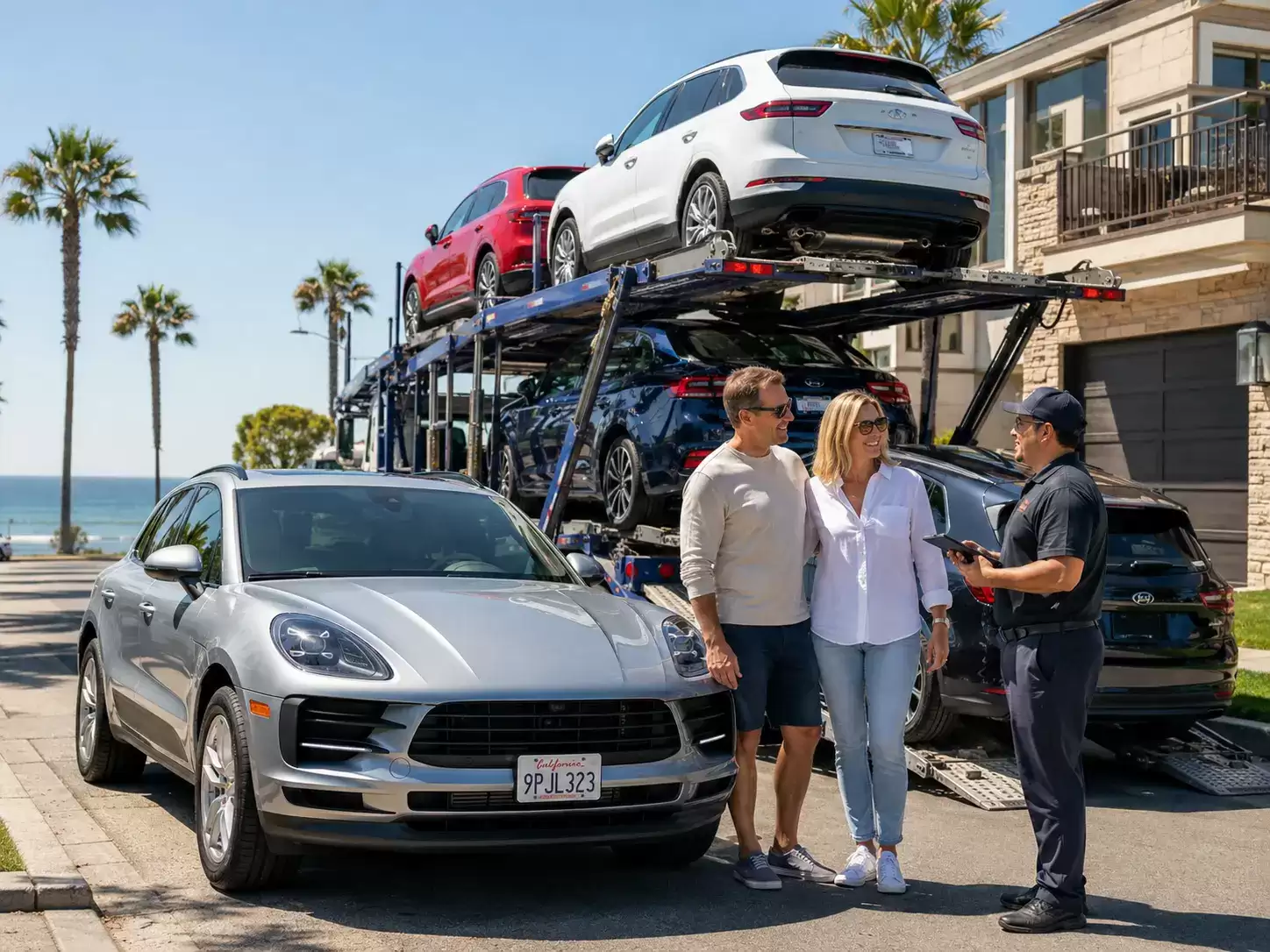
Your carrier calls your pickup contact 12–24 hours before arrival to confirm timing and the meeting location. For dense California cities — San Francisco, downtown Los Angeles, Santa Monica — the driver will coordinate a safe nearby meet point if residential streets cannot accommodate a 75-foot transporter. At delivery, inspect your vehicle thoroughly, note any issues on the Bill of Lading, and pay the carrier the balance due by cash or money order.
Shipping a Car to or From a California College or University
California is home to two of the largest public university systems in the world: the University of California (UC) and the California State University (CSU) systems, together serving nearly one million students. The sheer volume of student vehicle moves at semester starts and ends — combined with California’s draw of out-of-state students from New York, Texas, Illinois, Ohio, and beyond — makes university auto transport one of the state’s most consistent demand drivers. The universities below each have a student population of 12,000 or more and represent major auto shipping demand centers, especially in August, December, and May.
Swipe to view full table →
| University | Location | Approx. Enrollment |
|---|---|---|
| University of Southern California (USC) | Los Angeles | ~48,000 |
| UCLA | Los Angeles | ~46,000 |
| UC Berkeley | Berkeley | ~45,000 |
| UC San Diego | San Diego | ~42,000 |
| Cal State Fullerton | Fullerton | ~41,000 |
| UC Davis | Davis | ~39,000 |
| Cal State Long Beach | Long Beach | ~38,000 |
| San Diego State University | San Diego | ~37,000 |
| UC Irvine | Irvine | ~36,000 |
| San Jose State University | San Jose | ~35,000 |
| Sacramento State | Sacramento | ~31,000 |
| Fresno State | Fresno | ~26,000 |
| UC Santa Barbara | Santa Barbara | ~26,000 |
| Cal Poly San Luis Obispo | San Luis Obispo | ~22,000 |
Tips for college car shipping: Book 2 to 3 weeks ahead of move-in dates, as carrier availability tightens in late July and August across the entire state. Door-to-door delivery is available to most campus areas, though a nearby meet point may be required in dense urban campuses like USC, UCLA, and UC Berkeley where standard car-carrier trucks cannot navigate residential blocks.

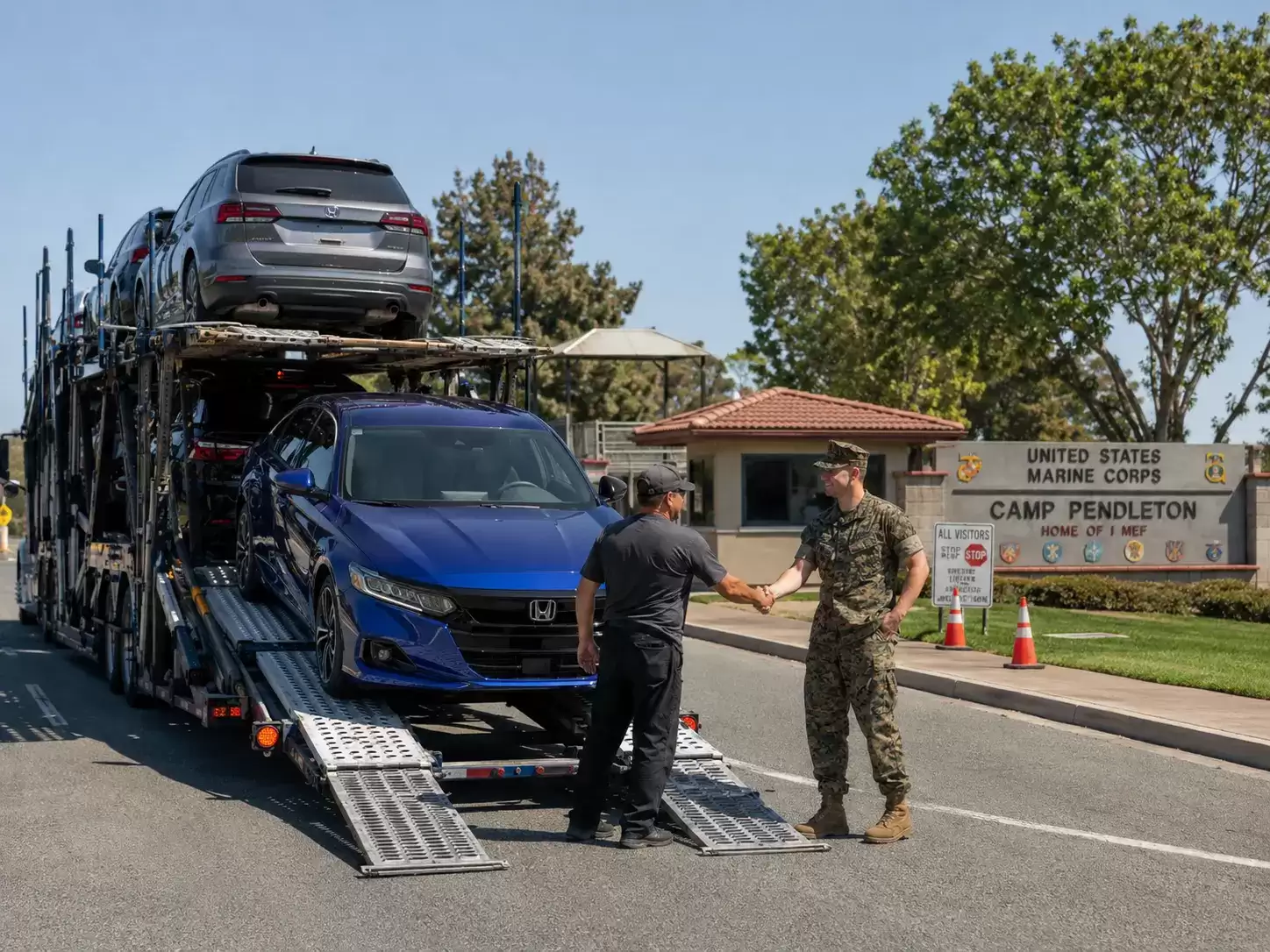
Military Car Shipping to and From California Bases
California has more active-duty military personnel than any other state. Major Marine Corps, Navy, Army, Air Force, and Space Force installations are distributed from San Diego to the Sacramento Valley, making PCS (Permanent Change of Station) vehicle shipping a constant in California auto transport demand. We ship vehicles to and from all major California military installations, including:
Camp Pendleton — Oceanside
The largest active-duty Marine Corps base on the West Coast, spanning 125,000 acres between San Diego and Orange County on I-5. Camp Pendleton is the highest-volume military auto transport location in California. Marines regularly ship vehicles to and from the East Coast, Southeast, Hawaii, Japan, and Okinawa. The base’s I-5 position ensures carrier availability in both directions daily. Book 2–3 weeks ahead during the June–August PCS peak. Rush tier is recommended for compressed PCS timelines.
Naval Base San Diego — San Diego
The largest surface fleet concentration on the Pacific Coast and the hub of Navy vehicle shipping in California. Naval Base San Diego generates consistent auto transport demand year-round, with deployment rotations creating shipping needs that fall outside the standard Army and Marine PCS calendar. Carriers serving San Diego military efficiently cover both Naval Base San Diego and Camp Pendleton on combined loads — making San Diego one of the best-served military auto transport markets in the country.
Edwards Air Force Base — Lancaster
Located in the Antelope Valley high desert north of Los Angeles, Edwards is home to the Air Force Test Center and the USAF Test Pilot School. Vehicle shipping here involves navigating the limited carrier access typical of high-desert bases. Most loads stage through Lancaster or Palmdale before the final leg to the installation. Expedited tier is recommended for tight PCS timelines at Edwards.
Travis Air Force Base — Fairfield
The largest military air terminal on the West Coast, Travis AFB sits between Sacramento and the Bay Area on I-80 — a position that gives it excellent carrier coverage in both directions. As a major airlift hub, Travis processes a high volume of personnel transfers to Hawaii, Alaska, Japan, and Guam; vehicle shipping to storage or to a family member’s address is extremely common here. The Sacramento-to-Bay Area I-80 corridor runs at high carrier frequency year-round.
March Air Reserve Base — Riverside
The Inland Empire’s primary military installation at the intersection of I-215 and I-15. March ARB generates a mix of active duty, reserve, and civilian contractor vehicle shipping needs. Carriers heading to Las Vegas, Phoenix, and Utah pass directly through the March ARB vicinity, making outbound vehicle shipping especially efficient on those corridors.
Vandenberg Space Force Base — Lompoc
Located on the Santa Barbara County coast, Vandenberg hosts the Western Range and is California’s primary military space launch facility. Its geographic isolation on US-1 and SR-246 means carrier access requires advance planning. Most carriers serving Vandenberg route through Santa Maria or Santa Barbara for load consolidation. Book 2–3 weeks ahead regardless of season.
Fort Irwin / National Training Center — Barstow
Located in the Mojave Desert north of Barstow off I-15, Fort Irwin is the Army’s primary ground combat training center. The I-15 corridor between Barstow and Las Vegas provides carrier connectivity, and loads to Fort Irwin are often combined with Las Vegas-area deliveries for efficiency. Personnel rotating through NTC face compressed timelines and benefit from Expedited or Rush tier booking.
Beale Air Force Base — Marysville
Home to the 9th Reconnaissance Wing and the U-2 program, Beale AFB sits in the Sacramento Valley approximately 40 miles north of Sacramento on SR-70. Carriers servicing the Sacramento metro can frequently accommodate Beale deliveries without significant route deviation, making this one of the more carrier-accessible remote bases in Northern California.
Naval Air Station Lemoore — Lemoore
The Navy’s primary master jet base on the West Coast, NAS Lemoore is located in Kings County in the Central Valley between Fresno and Visalia. The base houses most of the Pacific Fleet’s strike fighter aircraft. Carriers running SR-99 between Bakersfield and Fresno routinely serve Lemoore on combined loads, giving it better carrier access than its rural location would otherwise suggest.
Naval Base Ventura County — Oxnard
Located at Point Mugu in Ventura County north of Los Angeles, NBVC consolidates NAS Point Mugu and Port Hueneme into a single command. US-101 carrier access connects the base to both the Los Angeles metro and the Santa Barbara area, and military families here typically find availability comparable to the broader Southern California market.
A note for military members: Always verify whether your branch covers POV (Privately Owned Vehicle) shipment costs under your PCS orders before booking. If your move qualifies, government shipping may be arranged through your transportation office, but many service members choose a private carrier for speed, flexibility, or to ship a second vehicle.
California cities we serve
Direct Express Auto Transport provides car shipping services to and from every city in California. Our highest-volume California markets include:
Los Angeles — The nation’s #1 auto transport origin and destination city. Daily carrier departures on I-5, I-10, I-15, and I-405 to every major U.S. city. Fastest Standard pickup windows in California.
San Diego — California’s southernmost hub and military auto transport capital. Camp Pendleton and Naval Base San Diego drive consistent year-round demand. Strong carrier access east on I-8 and north on I-5.
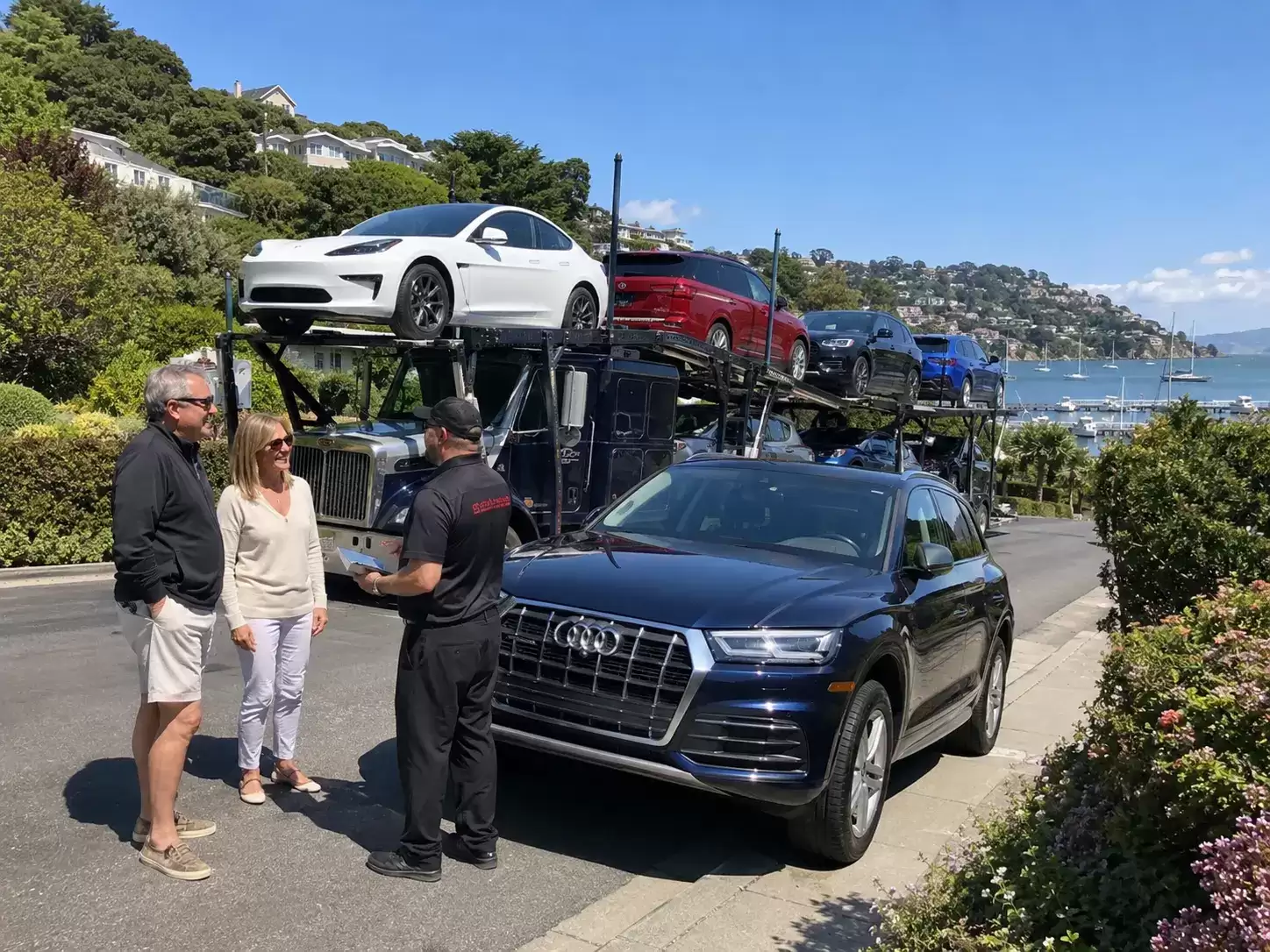
San Francisco / Bay Area — Northern California’s dominant hub. Tech industry relocation, university moves, and bidirectional I-80 freight keep availability high. SF proper requires staging at accessible meet points in most residential neighborhoods.
Sacramento — Northern California’s central distribution hub at the I-80 and I-5 crossroads. State government workforce and Travis AFB provide a consistent, non-seasonal demand base.
Oakland — East Bay hub with direct I-880 and I-580 access. Carriers serving the Bay Area circuit from the east or south routinely cover Oakland alongside San Jose and Fremont on combined dispatches.
Riverside / San Bernardino / Inland Empire — High-volume market at the I-10/I-15/I-215 convergence. Carriers heading to Las Vegas, Phoenix, and Utah pass directly through, making this one of California’s most efficiently served regional markets despite its inland position.
Fresno — Central Valley hub at the SR-99 midpoint. Carriers combining Bakersfield, Fresno, and Stockton stops can run the entire valley efficiently, giving Fresno competitive pickup windows.
Bakersfield — Southern end of the Central Valley at the I-5/SR-99 junction. Strong east-west and north-south carrier access.
Long Beach — South Bay auto transport market with proximity to the Port of Long Beach, one of the country’s top vehicle import and export terminals. I-405 and I-710 access.
Anaheim / Santa Ana / Orange County — Carriers treat Orange County and the LA metro as a continuous market. I-5 and SR-55 access. Strong year-round demand driven by tourism industry and corporate relocations.
Lancaster / Palmdale — Antelope Valley high-desert market served via SR-14 and I-15. Expedited tier recommended. Home to Edwards Air Force Base and growing aerospace industry workforce.
Chula Vista / South San Diego County — Military corridor between San Diego and the Mexican border. Routinely bundled with San Diego metro dispatches on I-5 southbound runs.
Modesto / Stockton — Northern Central Valley cities served by SR-99. Carriers combining Bay Area and Sacramento runs cover this corridor efficiently.
Redding — Northernmost significant California city on I-5. Carriers on the Pacific Coast corridor between Los Angeles and Portland pass directly through Redding, giving it strong carrier access despite its distance from major metros.
California Helpful Government Links
- California Department of Motor Vehicles (CA DMV) — The primary resource for registering and titling a vehicle after it arrives in California. Required for anyone establishing California residency or purchasing an out-of-state vehicle.
- CA DMV — Out-of-State Vehicle Registration — Covers what new California residents must do within 20 days of establishing residency, including transferring an out-of-state title and obtaining California plates.
- California Air Resources Board (CARB) — Smog Check Program — Explains California’s vehicle emissions requirements. Vehicles shipped into California for first-time registration must pass a California smog inspection before plates are issued. Diesel and pre-1996 vehicles may face additional scrutiny.
- FMCSA — Verify a Carrier’s License (SAFER System) — The Federal Motor Carrier Safety Administration’s carrier lookup tool. Verify that any auto transport company you consider is federally licensed and insured before booking.
- FMCSA — Protect Your Move — Federal consumer guidance about hiring vehicle shippers, including scam warnings and shipper rights. Useful for first-time California car shippers.

Popular Long Distance Routes From or To California
California to New York Car Shipping
The California-to-New York corridor is one of the two or three most active cross-country routes in the country at approximately 2,800 miles. Entertainment industry relocations, finance and media industry moves, and cross-country family relocations drive steady demand in both directions year-round. Transit typically runs seven to nine days. The route follows I-40 or I-80 depending on season — I-80 preferred in summer, I-40 in winter to avoid Sierra Nevada and Rocky Mountain snow. Most of our repeat New York–California customers are in the entertainment and finance industries, shipping vehicles semi-annually as they rotate between coasts.
California to Florida Auto Transport
One of the longest and most active coast-to-coast routes in the country at approximately 2,750 miles. Bidirectional snowbird traffic — California retirees wintering in Florida and Florida retirees spending summers in coastal California — layers on top of military relocations, entertainment industry moves, and lifestyle relocation demand. Standard transit runs seven to ten days via I-10 through Phoenix and El Paso. Fall and winter see peak demand in both directions simultaneously; book Expedited 2–3 weeks ahead from October through January on this corridor.
California to Texas Vehicle Shipping
The California-to-Texas corridor has become one of the most active outbound routes in the country, fueled by sustained “California Exodus” relocation to Dallas-Fort Worth, Austin, Houston, and San Antonio. At 1,400–1,700 miles depending on origin and destination, Standard transit runs five to seven days via I-10. Outbound (California to Texas) demand is near-constant; inbound (Texas to California) peaks in summer during tech hiring season. This is one of the most carrier-rich corridors in the country — Expedited availability is frequently excellent even during peak periods.
California to Illinois Car Transport
Chicago is the Midwest’s primary auto transport hub and a major destination for California vehicle shipping. At approximately 2,000 miles via I-40 or I-80 through Kansas City or Salt Lake City, Standard transit runs five to seven days. Tech and finance relocations between Silicon Valley and Chicago’s financial district drive consistent bidirectional demand. Chicago’s central logistics position means loads from California destined for the broader Midwest often route through Chicago before final delivery to Wisconsin, Michigan, Indiana, or Ohio.
California to Ohio Auto Shipping
California and Ohio share a symmetrical long-distance auto transport relationship. Ohio Snowbirds ship vehicles west to California for winter stays in San Diego, Palm Desert, and the Los Angeles area; California retirees ship vehicles east to be near family in Cleveland, Columbus, and Cincinnati. At 2,300–2,500 miles, Standard transit runs seven to nine days via I-40 and I-70. Demand is reasonably balanced year-round with a modest fall peak driven by Snowbird migration.
California to Michigan Vehicle Transport
The automotive industry heartland and California’s tech sector share a meaningful auto transport relationship driven by automaker executive and engineer relocations, Big Ten student moves, and general Midwest-to-California lifestyle migration. At approximately 2,300 miles, Standard transit runs six to eight days. Detroit, Ann Arbor, Grand Rapids, and Lansing are the primary Michigan destinations. The corridor peaks in late summer as Michigan’s OEM hiring cycle drives engineering transfers to California Bay Area offices.
California to Washington State Auto Transport
The Pacific Coast I-5 corridor between California and Washington State is one of the most active regional long-haul routes in the country. At 1,100–1,400 miles, Standard transit runs four to six days. Tech industry relocations between Silicon Valley and the Seattle tech corridor (Amazon, Microsoft, Boeing) drive consistent bidirectional demand. Pacific Northwest Snowbirds shipping vehicles south to Southern California for winter also contribute meaningful seasonal volume. This is one of the most carrier-dense corridors in the West.
California to Georgia Car Shipping
The California-to-Georgia corridor, primarily serving the Los Angeles-to-Atlanta connection, covers approximately 2,200 miles and has grown significantly as Atlanta has become a major entertainment production hub. Film and television industry relocations between the two states are a meaningful component of this corridor’s traffic. Standard transit runs six to eight days via I-10 and I-20. Military transfers between California installations and Fort Moore (formerly Fort Benning), Robins AFB, and Moody AFB also contribute consistent demand year-round.
California to Colorado Vehicle Shipping
Colorado is one of the most popular relocation destinations for Californians seeking lower housing costs and outdoor recreation. At 1,000–1,250 miles depending on origin (Los Angeles to Denver runs shorter than Sacramento to Denver via the northern I-80 route), Standard transit runs three to five days. The corridor sees a noticeable fall peak as Californians finalize moves before ski season. Denver, Colorado Springs, Fort Collins, and Boulder are the primary destinations.
California to Pennsylvania Auto Transport
Pennsylvania is a major East Coast destination for California vehicle shipments, serving the Philadelphia, Pittsburgh, and Lehigh Valley markets. At approximately 2,600 miles, Standard transit runs seven to nine days. Military transfers between California installations and Carlisle Barracks, Tobyhanna Army Depot, and the Philadelphia region add steady demand. Philadelphia’s proximity to New York means some California-to-Pennsylvania loads are dispatched on shared East Coast circuits.
California to Tennessee Car Transport
Nashville’s rise as a major entertainment and corporate hub has made the California-to-Tennessee corridor one of the more active mid-distance cross-country routes. At approximately 2,000 miles via I-40, Standard transit runs six to eight days. Entertainment industry relocations from Los Angeles to Nashville’s music and production sector are a unique demand driver on this corridor. Memphis adds volume as a logistics hub. I-40 connects California to both Tennessee cities efficiently.
California to North Carolina Vehicle Shipping
The Research Triangle, Charlotte, and the military corridor around Fort Liberty (Fayetteville) are the primary destinations on this 2,400–2,600 mile route. Standard transit runs seven to nine days via I-40. Military transfers between California installations and Camp Lejeune, Fort Liberty, Seymour Johnson AFB, and Cherry Point MCAS contribute meaningful demand. North Carolina’s tech sector growth from companies expanding east from Silicon Valley has added civilian demand to the well-established military base on this route.
California to Virginia Auto Transport
Virginia’s concentration of federal government and military employment makes it one of the most active East Coast destinations for California vehicle shipping. Pentagon employees, Defense Department contractors, and military personnel at Fort Belvoir, Quantico, Langley, and the Norfolk Naval Station represent a consistent demand base. At 2,700–2,800 miles, Standard transit runs eight to ten days. Northern Virginia’s defense tech corridor has grown significantly as a source of California-to-Virginia relocation demand.
California to Massachusetts Car Shipping
One of the higher-volume East Coast routes at approximately 3,000 miles, connecting California’s tech hubs to Boston’s university and biotech ecosystem. Standard transit runs eight to ten days via I-80 and I-90. The Boston-to-California corridor sees strong inbound demand in late summer as college and graduate students ship vehicles west for fall semester starts at UC schools. California-to-Massachusetts demand peaks in spring as Bay Area and LA professionals relocate for Boston-area academic and medical positions.
California to Minnesota Vehicle Shipping
At approximately 2,000 miles, the California-to-Minnesota corridor carries a mix of Midwest lifestyle relocation and California Snowbird reverse traffic — Minnesota retirees shipping vehicles to Palm Springs and San Diego for winter. Standard transit runs six to eight days via I-80 through Salt Lake City and I-90 through the upper Midwest. Minneapolis and Saint Paul are the primary destinations. Spring is the busiest season for northbound California-to-Minnesota vehicle shipping as Snowbirds return.

Nearby States
California to Oregon Car Shipping
The California-Oregon I-5 corridor is one of the Pacific Coast’s most active regional auto transport routes. At 600–900 miles depending on California origin, Standard transit runs two to four days. Portland and Eugene are the primary Oregon destinations. The corridor is strongly bidirectional: California residents relocating to Oregon’s lower-cost cities have been offset by Oregon and Washington Snowbirds shipping vehicles south to California’s warmer winters. I-5 through the Siskiyou Mountains can face winter delays; carriers hold at Redding or Grants Pass during significant snow events. Standard tier car transport often assigns within 2–4 days on this corridor, making it one of the better-value short-haul routes in the West.
California to Nevada Vehicle Shipping
California-to-Nevada is among the highest-volume short-haul routes in the country. Las Vegas and Reno are the primary Nevada destinations, and both see exceptional carrier availability due to the sheer volume of moves in both directions. At 270–450 miles, Standard transit runs one to two days. The I-15 Los Angeles-to-Las Vegas corridor is one of the most carrier-dense routes in the western United States; carriers pick up in the LA metro in the morning and deliver in Las Vegas the same afternoon routinely. Reno routes use I-80 east from Sacramento. This is among the most affordable and fastest domestic auto transport routes available from California.
California to Arizona Car Shipping
The California-to-Arizona corridor is driven by the constant flow of Snowbirds, retirees, and cost-of-living migrants between Southern California and the Phoenix-Scottsdale metro. At 370–500 miles from the LA metro and San Diego, Standard transit runs one to three days via I-10 through Blythe. Carrier availability is excellent in both directions year-round. Military demand from MCAS Yuma and Yuma Proving Ground adds consistent volume on the southern leg. Phoenix is one of the most carrier-rich cities in the Southwest, making Expedited and Rush availability high on this corridor throughout the year.
California to Utah Auto Transport
Utah has become one of California’s most active outbound relocation corridors as Bay Area and LA residents relocate to Salt Lake City and the Wasatch Front seeking lower housing costs. At 600–800 miles via I-15 through Las Vegas, Standard transit runs two to four days. Salt Lake City is the primary destination, with Provo, Ogden, and St. George adding volume. St. George in southern Utah is particularly popular with Southern California retirees. California-to-Utah loads frequently originate alongside California-to-Las Vegas freight, giving the corridor better carrier availability than raw mileage suggests.
California to Idaho Car Shipping
Boise’s emergence as a major relocation destination has made the California-to-Idaho corridor one of the more active regional routes of the past decade. At 750–1,000 miles via I-80 north or SR-84 through Portland, Standard transit runs three to five days. Boise is the dominant destination, with Nampa, Meridian, and Twin Falls adding volume. The corridor benefits from its connection to the well-established Portland-to-Boise carrier circuit. Pricing is competitive given the strong carrier interest driven by California outmigration to the Treasure Valley in recent years.

Major Cities From California
I-5 San Diego Corridor
San Diego Car Shipping
California’s southernmost major auto transport hub and the military vehicle shipping capital of the West Coast. Camp Pendleton and Naval Base San Diego drive year-round carrier demand that keeps San Diego among the top five auto transport cities nationally. Daily carrier departures on I-5 northbound to Los Angeles and the Bay Area, I-8 eastbound to Phoenix, and I-15 northbound to Las Vegas and Salt Lake City. The combination of military PCS demand, university shipping (UCSD and SDSU), and Pacific Northwest Snowbird inbound traffic creates one of the most consistently active markets in the country.
Chula Vista Auto Transport
South San Diego County’s largest city, immediately north of the Mexican border on I-5 and I-805. Chula Vista is routinely bundled with adjacent San Diego and National City pickups on southbound carrier dispatches, shortening assignment times and reducing per-stop costs for shippers in the South Bay corridor.
Oceanside Vehicle Shipping
Gateway to Camp Pendleton, positioned on I-5 between San Diego and Orange County. Oceanside and Carlsbad handle a high volume of Marine Corps PCS vehicle transport, and carriers frequently combine civilian Oceanside loads with military Camp Pendleton dispatches on the same northbound run.
Escondido Car Transport
North San Diego County’s inland hub on I-15. Escondido, Vista, and San Marcos in the North County inland corridor are served from I-15, with pickup windows slightly longer than coastal San Diego but well within the state average. Carriers routinely combine these inland North County cities on shared dispatch runs.
El Cajon Auto Shipping
East County San Diego on I-8. El Cajon and Santee are served via the I-8 corridor east of downtown, routinely combined with Mission Valley and downtown San Diego carriers on daily East County dispatch runs.
Los Angeles Metro / I-5 / I-405 Hub
Los Angeles Car Shipping
California’s — and the nation’s — highest-volume auto transport market. The LA metro generates more individual car shipping bookings than most entire states. Carriers dispatch continuously on I-5, I-10, I-15, I-405, and US-101 in all directions. Standard tier pickup windows in the LA metro are shorter than the national average. The entertainment industry, tech sector, military installations, and a dozen major universities create a demand profile unlike any other American city. Enclosed vehicle transport is heavily requested for the luxury and exotic automobiles common to the collector and entertainment markets.
Glendale Auto Transport
Glendale sits inside the LA freight grid north of downtown, served by I-5 and SR-134. It is routinely bundled with adjacent Burbank, North Hollywood, and Pasadena pickups on carriers covering the San Fernando Valley and I-210 foothill corridor.
Torrance Vehicle Shipping
South Bay hub served by I-405 between Los Angeles and Long Beach. Torrance is integrated into the South Bay carrier loop covering Redondo Beach, Hawthorne, and Inglewood on shared dispatches, maintaining reliable assignment windows throughout the year.
Long Beach Car Shipping
South Bay and Port of Long Beach proximity gives Long Beach exceptional carrier density for both domestic and international vehicle shipping. I-405 and I-710 access supports consistent multi-stop carrier runs through the South Bay. Enclosed transport demand for vehicles clearing the Port of Long Beach is a meaningful segment of this market.
Anaheim Auto Transport
Orange County hub on I-5 and SR-57. Anaheim, Santa Ana, and the surrounding Orange County cities are handled as a continuous market with the LA metro. Carriers on the I-5 southbound circuit from LA to San Diego routinely include Orange County pickups on the same dispatch.
Irvine Vehicle Shipping
South Orange County tech and university hub on I-405 and SR-55. Irvine benefits from carrier density on the I-5 south corridor to San Diego and the I-405 loop connecting Orange County to the LA metro. UC Irvine student moves contribute consistent inbound demand each September and January.
Huntington Beach Car Shipping
Coastal Orange County community served by I-405 and SR-1. Carriers covering the Irvine and Orange County circuit include Huntington Beach and Garden Grove stops on shared coastal dispatches.
Santa Clarita Auto Transport
Santa Clarita Valley city north of Los Angeles on I-5. Carriers transitioning between the LA metro and the Antelope Valley or the Central Valley via SR-14 and the Tejon Pass include Santa Clarita as a natural stop on northbound dispatches.
Thousand Oaks Vehicle Shipping
Ventura County gateway city on US-101 northwest of Los Angeles. Thousand Oaks and Oxnard are served by carriers on the US-101 corridor between LA and Santa Barbara, benefiting from consistent coastal Pacific freight patterns throughout the year.
I-15 Inland Empire / Desert Corridor
Riverside Auto Transport
The Inland Empire’s eastern anchor at the I-215 and SR-91 intersection. Riverside’s position at the convergence of three major carrier routes gives it auto transport availability close to the LA metro. March Air Reserve Base adds military demand that supports year-round carrier frequency. Standard pickup windows here rival those of Orange County despite the inland location.
Rancho Cucamonga Car Shipping
Inland Empire corridor city at I-15 and I-210. Rancho Cucamonga, Ontario, and Fontana together form the western spine of the Inland Empire carrier circuit, served by carriers heading from Los Angeles toward Las Vegas or the Arizona border. Logistics industry workforce growth has significantly increased inbound demand in this corridor over the past decade.
Moreno Valley Vehicle Relocation
One of California’s fastest-growing cities on I-215 south of Riverside. Carriers on the I-215 corridor between the I-10 junction and the March ARB vicinity include Moreno Valley stops on combined Inland Empire dispatches.
Corona Auto Shipping
Positioned at the I-15 and SR-91 interchange where LA-bound and Inland Empire-bound carriers naturally converge. Corona is one of the most efficiently served cities in the Inland Empire, with carrier availability approaching LA metro levels during peak periods.
Victorville Car Transport
High Desert city on I-15 north of the Cajon Pass. Victorville sits on the primary carrier route between Los Angeles and Las Vegas, giving it strong carrier availability for a High Desert community. Hesperia and Apple Valley in the greater Victor Valley are typically combined with Victorville on carrier dispatches.
Bay Area / I-880 / US-101 Hub
San Francisco Car Shipping
Northern California’s flagship auto transport market. Tech industry relocations, university moves at UC Berkeley, Stanford, and UCSF, and consistent bidirectional I-80 and US-101 freight keep carrier availability strong year-round. San Francisco proper presents access challenges in residential neighborhoods. Carriers cannot park a full transporter on hillside streets in Noe Valley, Pacific Heights, or the Sunset District; deliveries typically stage at an accessible nearby commercial street. Coordinate your delivery address and access constraints at booking to avoid day-of complications.
Oakland Auto Transport
East Bay hub on I-880 and I-580. Oakland serves as a natural carrier staging point between the Bay Area, Sacramento (via I-80), and the Central Valley (via I-580). Carriers serving the East Bay circuit from Hayward, Fremont, and Berkeley include Oakland stops efficiently on the same dispatch run. The Port of Oakland adds international vehicle shipping activity to this market.
San Jose Vehicle Shipping
Silicon Valley’s dominant auto transport market on US-101 and I-880. San Jose generates some of the highest tech industry relocation volume in the country, with inbound shipments from New York, Chicago, Austin, and Seattle arriving consistently as tech companies recruit nationally. Suburban street access is generally carrier-friendly, making San Jose one of the more accessible major Bay Area markets.
Fremont Car Transport
East Bay technology hub at the I-880 and I-680 interchange. Fremont’s manufacturing and tech sector workforce drives consistent relocation demand. Carriers covering the Oakland-to-San Jose I-880 corridor include Fremont, Hayward, and Union City stops on shared dispatches.
Concord Auto Transport
Contra Costa County hub on I-680 northeast of Oakland. Concord and Pleasanton are served by carriers on the I-680 corridor between the Bay Area and the Central Valley via the Altamont Pass, giving these East Bay suburbs access to two distinct carrier circuits simultaneously.
I-80 Northern California / Sacramento Valley Corridor
Sacramento Car Shipping
Northern California’s central auto transport hub at the I-80 and I-5 crossroads. Sacramento generates consistent carrier activity in all four directions. Carriers heading east to Reno, Utah, or the Midwest on I-80 and those running north-south on I-5 between Los Angeles and Portland both pass through or near Sacramento. Travis AFB PCS demand and state government workforce relocations provide a year-round baseline that insulates the market from seasonal swings common in other California regions.
Roseville Vehicle Shipping
Sacramento’s fastest-growing northeastern suburb on I-80. Roseville and Rocklin are served by carriers on the Sacramento-to-Reno I-80 corridor, with pickup windows comparable to the Sacramento metro. Growing tech industry workforce inbound from the Bay Area has steadily increased carrier frequency in this corridor.
Elk Grove Car Transport
South Sacramento metro on SR-99. One of California’s fastest-growing suburbs, with strong inbound demand from Bay Area families seeking affordable homeownership. Carriers on the SR-99 corridor between Sacramento and Stockton include Elk Grove stops on southbound dispatches.
Fairfield Auto Shipping
Solano County city between Sacramento and the Bay Area on I-80. Travis AFB generates consistent military vehicle shipping year-round, and Fairfield’s I-80 position means it benefits from carrier activity on the Bay Area-to-Sacramento-to-Reno corridor in both directions. Vacaville immediately east on I-80 is typically handled on the same dispatch.
Redding Car Shipping
Northernmost significant California city on I-5, serving as the gateway between Southern California and the Oregon border. Carriers running the Pacific Coast corridor between Los Angeles and Portland pass directly through Redding, giving this North State city carrier access that far outstrips its population size. Chico to the southeast on SR-99 is California’s other major North State market, served primarily by carriers routing between Sacramento and Redding.
Central Valley / SR-99 Corridor
Fresno Auto Transport
The Central Valley’s dominant hub city at the SR-99 midpoint with connections to SR-41, SR-180, and the Sierra Nevada foothills. Carriers routing between Los Angeles and Sacramento on SR-99 routinely make Fresno stops, giving it better carrier availability than its inland distance from coastal metros would otherwise produce. Fresno State University contributes student vehicle demand each fall and spring. NAS Lemoore’s proximity adds Navy PCS shipping to the market.
Bakersfield Vehicle Shipping
Southern end of the Central Valley at the I-5 and SR-99 junction. Bakersfield serves as a natural transition point for carriers moving between the coastal I-5 routing and the inland SR-99 routing. Strong energy sector workforce inbound from Texas and Louisiana adds to the standard relocation and agricultural workforce demand.
Stockton Car Transport
Northern Central Valley on SR-99 and I-5 near their convergence. Stockton connects to the Bay Area via I-580 and to Sacramento via SR-99, giving it access to two distinct carrier circuits. Growth driven by Bay Area affordability migration has increased inbound carrier interest significantly over the past five years.
Modesto Auto Transport
Stanislaus County hub city on SR-99 between Stockton and Fresno. Modesto and Turlock to the south are typically combined on the same carrier dispatch. Consistent agricultural and regional workforce demand keeps the SR-99 midvalley corridor active year-round.
Visalia Vehicle Shipping
Kings County hub south of Fresno on SR-99. Visalia, Tulare, and Hanford in the Tulare Basin are served on the Fresno-to-Bakersfield corridor leg. NAS Lemoore military demand combines with agricultural workforce shipping to maintain carrier interest in this subregion throughout the year.
Merced Car Shipping
Gateway to Yosemite and home to UC Merced on SR-99 between Stockton and Fresno. UC Merced’s growing enrollment has steadily increased student vehicle demand. Merced is handled on the same carrier dispatches as Modesto to the north and Fresno to the south, keeping pickup windows competitive for a mid-valley market.
Ready to ship your car to or from California?
Join hundreds of thousands of customers — Snowbirds, military families, tech relocators, students, and families moving across the country — who have trusted Direct Express Auto Transport with their California vehicle shipments since 2004. Get your instant, no-obligation quote now. It takes 30 seconds, requires no personal information, and there is no upfront payment required to hold your spot.
Instant quote — real-time pricing in under 5 seconds
No upfront payment — your card is charged only when a carrier is assigned
No risk to get a quote and book your order
BBB Accredited A+ since 2004
FMCSA licensed and fully bonded
4.6 stars across thousands of verified Google reviews