Car Shipping To or From Washington
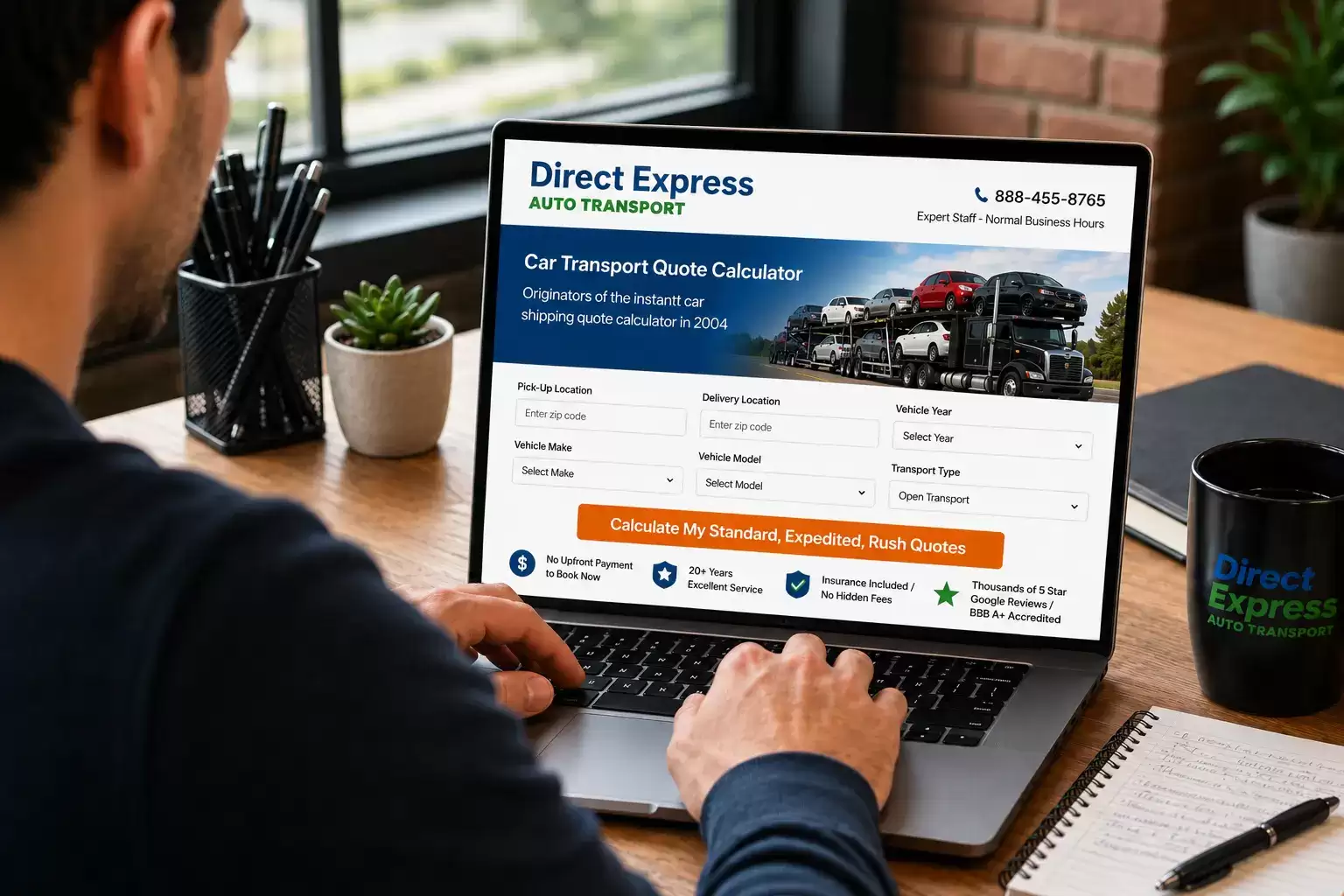
Need to ship a car to or from Washington State? Get a real-time, transparent price in 30 seconds — no phone calls, no risk, no upfront payment. Direct Express Auto Transport has been the Evergreen State’s most trusted auto transport broker since 2004, with a 4.6-star average across thousands of verified Google reviews.
★ 4.6/5 Google Reviews | BBB Accredited A+ | FMCSA Licensed (MC #479342) | USDOT #1240502 | No upfront payment required | 20+ years shipping vehicles


Washington car shipping costs vary based on your route, the time of year, vehicle size, and the service tier you choose. Use our instant calculator above for a real-time quote — or see the route-by-route pricing tables below for a fast ballpark. Most standard sedan shipments to or from Washington range from $285 on short hauls to Oregon up to $1,530+ on long-haul routes to the Southeast and East Coast. The Seattle-to-Los Angeles tech corridor is one of the most active Pacific Coast lanes in the country, typically running $550–$770 depending on tier and timing. Our Expedited and Rush pricing tiers hasten the process to create an even more satisfying experience.
What customers say about shipping a car to or from Washington with Direct Express Auto Transport


The interstate corridors that move Washington vehicles
Four primary highway arteries define Washington’s auto transport network:
I-5 (The Pacific Coast spine): Enters Washington from Oregon at the Columbia River and runs north through Vancouver, Olympia, Tacoma, Seattle, Everett, and Bellingham before crossing into Canada at the Blaine border. I-5 is Washington’s most important vehicle transport corridor — carrying the dominant share of northbound and southbound car shipments along the Pacific Coast. The I-5 corridor between Seattle and Portland is one of the most carrier-dense routes on the West Coast, and vehicles moving between Washington and California, Oregon, and the Southwest predominantly travel this artery.
I-90 (The Cascade crossing and eastern Washington gateway): Begins in Seattle at the shore of Lake Washington, crosses the Cascade Mountains via Snoqualmie Pass, and runs east through Ellensburg and Spokane before entering Idaho. I-90 is Washington’s primary east-west auto carrier corridor — the route used by carriers moving vehicles between the Puget Sound region and the inland Pacific Northwest, the northern Rockies, and ultimately the Midwest and East Coast via I-90 across Montana and South Dakota. Snoqualmie Pass on I-90 is subject to chain requirements and occasional closure during winter storms, which can delay eastbound transit between November and March.
I-82 (The Yakima Valley and Tri-Cities corridor): Branches southeast from I-90 near Ellensburg and runs through the Yakima Valley wine country and the Tri-Cities (Kennewick, Richland, Pasco) before entering Oregon near Umatilla. I-82 connects the eastern Washington agricultural communities to the primary Pacific Coast carrier network and provides an alternative southern routing for auto haulers moving between the Puget Sound and the Southwest.
US-2 (The Stevens Pass northern corridor): Runs east from Everett through Wenatchee and over Stevens Pass in the North Cascades before continuing to Spokane. US-2 provides the northernmost Cascade crossing used by carriers, serving communities like Wenatchee, Chelan, and the orchard communities of the Columbia River valley. Stevens Pass is higher and more prone to winter closures than Snoqualmie, so US-2 is primarily used as an alternative when I-90 is restricted and during summer months.
Vehicles shipping to or from the Seattle-Tacoma metro, Bellevue, Redmond, and Everett benefit from the highest carrier frequency in the state — multiple daily departures in every direction. Spokane has solid carrier frequency as the dominant hub for eastern Washington. More rural areas — particularly the Olympic Peninsula, the Okanogan Highlands, and communities north of Bellingham near the Canadian border — should expect longer pickup windows and are best served by the Expedited tier.
Washington’s carrier geography: the I-5 Pacific terminus and the Puget Sound hub structure
Washington occupies a uniquely challenging position in the national auto transport network: it is the western terminus of every major transcontinental route. I-90 ends at Seattle’s waterfront. US-2 ends at Everett. The I-5 Pacific spine dead-ends at the Canadian border north of Bellingham. Unlike pass-through states such as Montana or Kansas, where carriers can load westbound and continue through on a return run, every carrier that delivers a vehicle to Washington must either find a return load heading east or south — or deadhead empty. This structural reality means that auto shipping rates to and from Washington are more sensitive to directional imbalances than rates in through-states, and it is why carrier assignment windows can stretch on routes where return freight is thin.
The saving grace for Washington shippers is bidirectional demand that is unusually strong for a terminus state. The California tech corridor generates a constant outbound lane: Washington-to-California vehicle shipping (tech workers moving between Seattle and Silicon Valley or the LA tech scene) is one of the most reliably filled southbound lanes on the entire Pacific Coast, comparable to how California’s outbound exodus keeps their northbound return lanes competitive. JBLM’s PCS cycle creates return-leg military vehicle transport demand that fills eastbound capacity on I-90 throughout the summer. Together, these two demand generators — tech and military — keep Washington’s carrier network more balanced than geography alone would suggest.
The hub hierarchy within Washington shapes pickup windows and carrier frequency in predictable ways. Seattle-Tacoma-Bellevue-Everett is the primary hub cluster: this is among the highest-frequency auto transport zones on the entire West Coast outside of the Los Angeles basin. The concentration of tech employers, Boeing’s manufacturing facilities, and JBLM’s military population means that carriers rotate through the Puget Sound corridor daily. Spokane functions as the eastern hub, serving as the staging point for vehicles moving between the Pacific Northwest and the northern Rockies. Olympia and Bellingham are secondary I-5 nodes with solid but lower carrier density than the core metro.
The practical implication for anyone arranging vehicle shipping in Washington: Seattle metro customers enjoy some of the shortest pickup windows on the West Coast, with Standard tier often achieving pickup within 1–3 business days. Eastern Washington via the I-90 corridor gets solid frequency with Spokane as the anchor. Remote locations — the Olympic Peninsula west of Hood Canal, Whidbey Island (accessible by road via Deception Pass but off the main carrier corridor), and the San Juan Islands — require either a meet-point arrangement or Expedited tier to ensure reliable carrier assignment.
Shipping a car to or from the San Juan Islands: what you need to know
The San Juan Islands — including San Juan Island (Friday Harbor), Orcas Island, Lopez Island, and Shaw Island — are accessible only by Washington State Ferries or private boat. There is no road or bridge connection to the mainland. This creates a fundamental limitation for commercial auto transport carriers: standard open and enclosed car carriers cannot transport vehicles on Washington State Ferries, and the islands’ rural road networks and limited staging areas make them inaccessible to multi-car transporter equipment in any case.
If you are shipping a vehicle to or from any San Juan Island, the standard protocol is to arrange a meet-point at the Anacortes ferry terminal on the mainland. Your vehicle is delivered to or collected from the Anacortes terminal parking area by the auto transport carrier. You (or a designated local representative) then drive the vehicle onto the Washington State Ferry for the crossing to your island. From Friday Harbor, the crossing takes approximately 75 to 90 minutes with stops at intermediate islands depending on the route. Anacortes is a well-served auto transport location on the I-5/SR-20 network, so carrier access to the terminal is straightforward.
The Olympic Peninsula proper — including Port Angeles, Sequim, Port Townsend, Aberdeen, and the communities of the Olympic National Park perimeter — is accessible by road via the Hood Canal Bridge (SR-104) from the Kitsap Peninsula and via US-101 from the south. Commercial auto carriers can and do reach Olympic Peninsula destinations by road. However, the single-entry nature of the peninsula means carriers must make a significant detour, and carrier frequency is lower than in the Puget Sound core. Expedited tier is recommended for all Olympic Peninsula shipments, and some very remote communities near Forks and the Pacific Coast may require a meet-point in Port Angeles or Sequim.
Washington auto transport hubs ranked by carrier frequency
Not all Washington locations are equally accessible. Carrier frequency — the number of carriers who can realistically serve a given pickup or delivery point — is the primary driver of pickup window length. Here is how Washington’s major markets rank:
Tier 1 — Daily Carrier Access: Seattle, Tacoma, Bellevue, Renton, Kent, Federal Way, Everett, Kirkland, Redmond
Tier 2 — Frequent Carrier Access: Spokane, Vancouver, Kennewick, Richland, Pasco, Bellingham, Olympia, Lakewood
Tier 3 — Regular but Limited Carrier Access: Yakima, Marysville, Wenatchee, Mount Vernon, Bremerton
Tier 4 — Requires Coordination (Meet-Point May Apply): Port Angeles, Sequim, Port Townsend, Anacortes, Friday Harbor (San Juan Island), Eastsound (Orcas Island), Forks, Walla Walla, Pullman, Ellensburg
The I-5 tech corridor, JBLM PCS cycle, and Washington vehicle shipping timing
Washington’s vehicle shipping calendar is shaped by two overlapping demand cycles that are unlike any other state. The tech relocation cycle drives its heaviest inbound auto transport load in January through March, when new-hire cohorts at Amazon, Microsoft, Google, and the Eastside startup ecosystem arrive after accepting offers the prior fall. A second tech onboarding surge hits in August and September, aligned with the academic calendar and the timing of senior engineering offers. These are the windows when inbound vehicle transport demand from California, Texas, New York, and the Midwest is highest, and when Standard tier pickup windows can extend.
Overlaid on the tech cycle is JBLM’s PCS cycle, which peaks between June and August — the standard military summer moving season. When tech onboarding and military PCS overlap in July and August, Washington carrier capacity tightens dramatically across all tiers. This is the most competitive window of the year for Washington auto shipping, and it is when booking 2–3 weeks in advance matters most. If your move falls in this window, Expedited tier is the most reliable choice for predictable pickup timing.
Fall (September through November) and winter (December through February) represent the best windows for competitive car shipping pricing on non-mountain routes. Carrier supply stabilizes, demand softens, and Standard tier often performs reliably even on relatively short notice. The one important caveat: for any route that crosses the Cascades — vehicles heading from Seattle to Spokane, Chicago, New York, or anywhere east — the November through March window brings real risk of Snoqualmie Pass or Stevens Pass chain restrictions and delays. For Cascade-crossing routes in winter, Expedited tier is strongly recommended, and a transit buffer of 1–2 extra days should be built into your planning.
Washington car shipping prices: To & From
Prices shown are representative ranges for a standard sedan in good running condition. SUVs, trucks, and non-running vehicles cost more. Use our calculator for a precise quote on your specific route and vehicle.
Swipe to view full table →
| From | To | Distance (mi) | Estimated Days | Standard | Expedited | Rush |
|---|---|---|---|---|---|---|
| Oregon | Washington | 185 | 1–2 days | $285 | $340 | $400 |
| California | Washington | 1,140 | 2–4 days | $935 | $1,120 | $1,310 |
| Arizona | Washington | 1,405 | 3–5 days | $1,010 | $1,210 | $1,415 |
| Colorado | Washington | 1,280 | 3–5 days | $925 | $1,110 | $1,295 |
| Texas | Washington | 2,080 | 6–9 days | $1,300 | $1,560 | $1,820 |
| Illinois | Washington | 2,050 | 5–8 days | $1,280 | $1,535 | $1,790 |
| Michigan | Washington | 2,150 | 6–9 days | $1,340 | $1,610 | $1,875 |
| Ohio | Washington | 2,215 | 6–9 days | $1,385 | $1,660 | $1,940 |
| Georgia | Washington | 2,580 | 7–10 days | $1,400 | $1,680 | $1,960 |
| Florida | Washington | 3,180 | 7–10 days | $1,645 | $1,975 | $2,305 |
| North Carolina | Washington | 2,650 | 7–10 days | $1,480 | $1,775 | $2,070 |
| New York | Washington | 2,840 | 7–10 days | $1,515 | $1,820 | $2,120 |
Swipe to view full table →
| From | To | Distance (mi) | Estimated Days | Standard | Expedited | Rush |
|---|---|---|---|---|---|---|
| Washington | Oregon | 185 | 1–2 days | $285 | $340 | $400 |
| Washington | California | 1,140 | 2–4 days | $935 | $1,120 | $1,310 |
| Washington | Arizona | 1,405 | 3–5 days | $1,010 | $1,210 | $1,415 |
| Washington | Colorado | 1,280 | 3–5 days | $925 | $1,110 | $1,295 |
| Washington | Texas | 2,080 | 6–9 days | $1,300 | $1,560 | $1,820 |
| Washington | Illinois | 2,050 | 5–8 days | $1,280 | $1,535 | $1,790 |
| Washington | Michigan | 2,150 | 6–9 days | $1,340 | $1,610 | $1,875 |
| Washington | Ohio | 2,215 | 6–9 days | $1,385 | $1,660 | $1,940 |
| Washington | Georgia | 2,580 | 7–10 days | $1,400 | $1,680 | $1,960 |
| Washington | Florida | 3,180 | 7–10 days | $1,645 | $1,975 | $2,305 |
| Washington | North Carolina | 2,650 | 7–10 days | $1,480 | $1,775 | $2,070 |
| Washington | New York | 2,840 | 7–10 days | $1,515 | $1,820 | $2,120 |

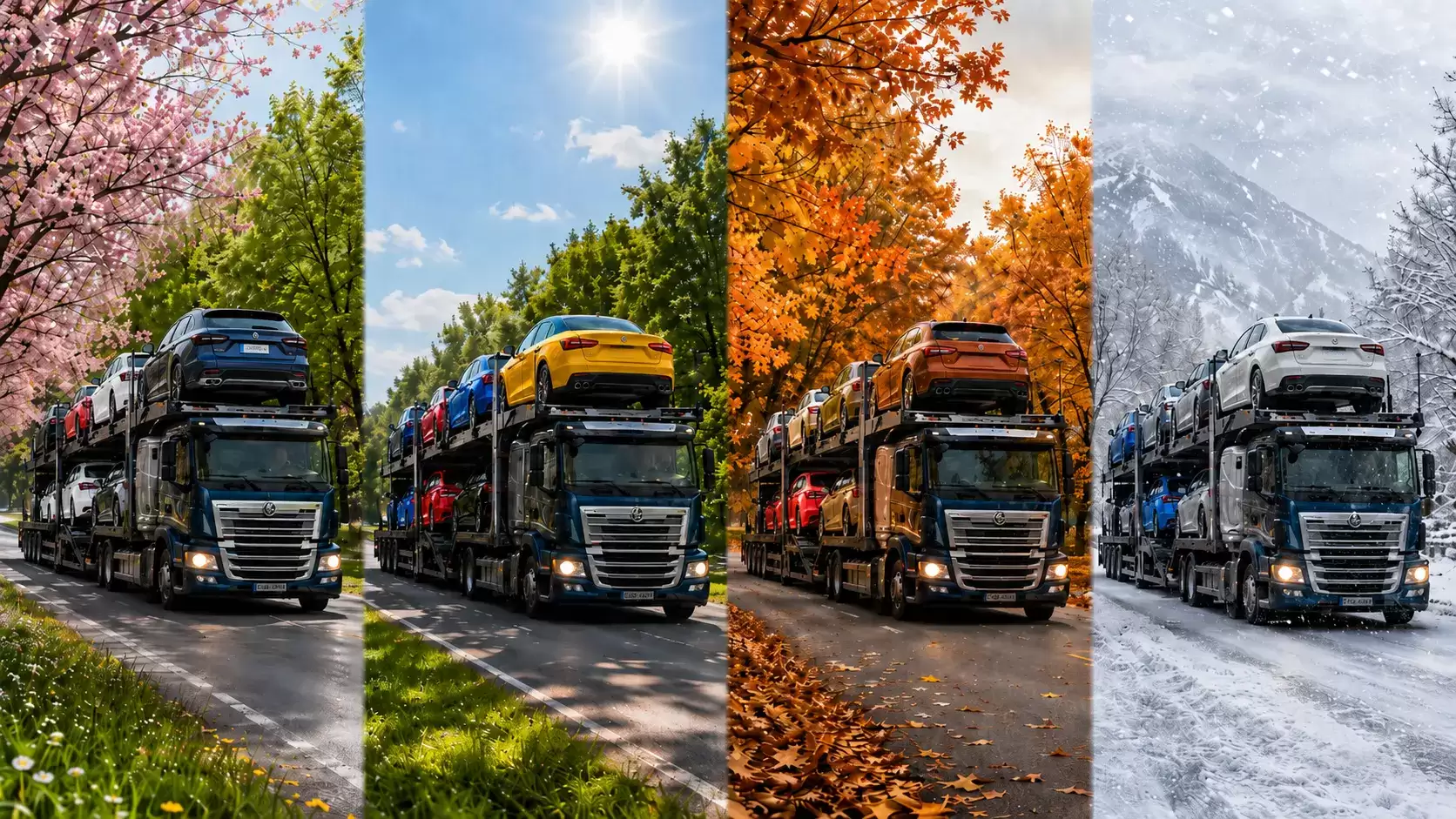
Best time to ship a car to or from Washington — the complete seasonal guide
Washington car shipping service tiers
Swipe to view full table →
| Tier | Best for Washington when… | What to expect |
|---|---|---|
| Standard | You have a flexible timeline of 1–2 weeks; shipping Seattle-to-California, Seattle-to-Oregon, or any high-frequency corridor during off-peak months (fall, winter west-side routes) | Listed at market rate; carrier assigned when an available truck is routed your way; pickup typically within 1–5 business days on major corridors |
| Expedited | You have a JBLM PCS report date, a corporate relocation deadline, or you’re shipping during summer peak (Jun–Aug); also the right choice for Olympic Peninsula, Whidbey Island, and winter cross-Cascade routes | Listed above market rate; attracts carriers faster; typical pickup in 1–3 days; approximately 18% above Standard pricing |
| Rush | You need same-day or next-day pickup; emergency relocation; last-minute PCS amendment; vehicle needed at destination immediately for time-critical reason | Listed well above market; highest priority carrier assignment; often same-day or next-day pickup; approximately 38% above Standard pricing |
Washington’s tier dynamics reflect the state’s dual personality. In the Seattle metro during off-peak months, Standard tier performs reliably — carrier density is high enough that even market-rate listings attract quick bids. During summer peak, or anywhere east of the Cascades in winter, Expedited tier is not a luxury: it is the mechanism that ensures your vehicle moves within a predictable window rather than waiting for a carrier whose I-90 routing happens to coincide with your pickup location. For JBLM PCS moves with hard report dates, we always recommend Expedited or Rush tier to avoid the risk of a delayed carrier assignment pushing you past your report deadline.

How to ship a car to or from Washington in 4 steps
Step 1 — Get an instant quote. Use our online calculator for a real-time price based on your exact pickup and delivery locations, vehicle type, and preferred service tier. No registration required. No phone call required.
Step 2 — Book and we assign a carrier. Once you book, our dispatch team lists your shipment to our vetted carrier network. Standard orders are typically picked up within 1–5 business days; Expedited and Rush orders move faster. We confirm carrier assignment and provide the driver’s contact information before pickup.
Step 3 — Pickup and inspection. The carrier arrives at your agreed location, inspects your vehicle, and documents its condition on the Bill of Lading. You sign the pickup report. For Seattle and Bellevue urban pickups, the carrier coordinates a nearby meet-point if needed. JBLM on-base pickups coordinate with the base transportation office.
Step 4 — Delivery and final inspection. Your vehicle arrives at the destination. Do a thorough inspection against the pickup Bill of Lading before signing the delivery report. Payment is due at delivery — typically by cash or certified funds payable to the carrier. We do not charge your card until delivery is complete.
Washington university and college car shipping
Washington’s research universities generate thousands of student and faculty vehicle shipments each year — particularly at the start and end of the academic year in late August through September and in May through June. If you are shipping a vehicle for a student or faculty member, book at least two weeks ahead during these peak windows. Our instant calculator works for any campus ZIP code.
Swipe to view full table →
| University | Location | Enrollment | Notes |
|---|---|---|---|
| University of Washington | Seattle | ~46,000 | UW Huskies; major research university; urban campus — meet-point often required |
| Washington State University | Pullman | ~21,000 | WSU Cougars; Palouse region; rural eastern WA; allow extra carrier lead time |
| Western Washington University | Bellingham | ~16,000 | WWU Vikings; near Canadian border; good I-5 carrier access |
| Seattle University | Seattle | ~7,500 | Jesuit university; Capitol Hill campus; urban meet-point protocol applies |
| Gonzaga University | Spokane | ~7,700 | Gonzaga Bulldogs; strong alumni relocation network to Seattle and Portland |
| Central Washington University | Ellensburg | ~12,000 | CWU Wildcats; near I-90 Snoqualmie corridor; moderate carrier access |
| Eastern Washington University | Cheney | ~12,000 | EWU Eagles; near Spokane; use Spokane pickup point for best carrier access |
| Pacific Lutheran University | Tacoma | ~3,100 | PLU Lutes; near JBLM; high military family enrollment |
| University of Puget Sound | Tacoma | ~2,600 | UPS Loggers; liberal arts; Tacoma I-5/I-705 corridor |
| Seattle Pacific University | Seattle | ~4,200 | SPU Falcons; Queen Anne neighborhood; urban street logistics apply |
Washington military base car shipping
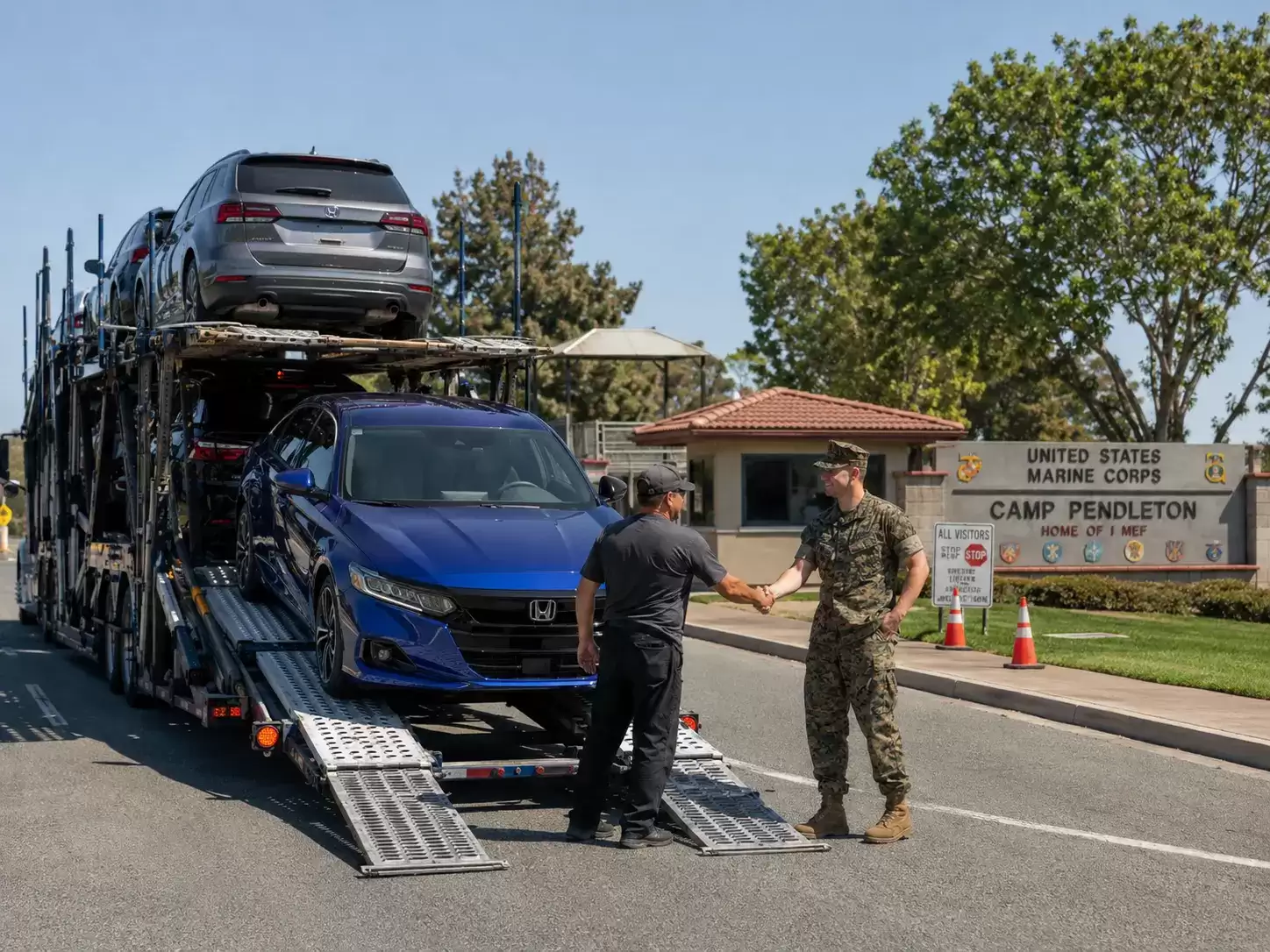
Washington is home to some of the most consequential military installations in the Pacific theater. PCS moves to and from these bases generate year-round auto transport demand, with summer peak season (June through August) being the most active period for military vehicle relocations. We are experienced with the military vehicle shipping process and can work within your PCS timeline.
Joint Base Lewis-McChord (JBLM) — Tacoma/Lakewood: JBLM is one of the largest and most active military installations in the United States for vehicle transport, housing the I Corps headquarters, the 7th Infantry Division, and the 62nd Airlift Wing with roughly 37,000 active-duty personnel. PCS car shipping to and from JBLM is concentrated on routes to Fort Liberty (North Carolina), Fort Cavazos (Texas), and Fort Campbell (Kentucky). On-base pickups coordinate through the base transportation office for gate access; Expedited tier is strongly recommended for all JBLM moves with fixed report dates.
Naval Base Kitsap — Bremerton/Silverdale: Naval Base Kitsap is home to the USS Nimitz carrier group and one of the Navy’s two Trident nuclear submarine fleets on the West Coast, making it a significant generator of military vehicle shipping demand year-round. Because the base sits across Puget Sound from Seattle, many service members coordinate vehicle transport using the Bremerton ferry terminal as a meet-point, allowing auto carriers to pick up or deliver on the east side of the Sound without navigating the ferry system. Expedited tier is recommended given the Kitsap Peninsula’s distance from the main I-5 carrier corridor.
Naval Station Everett — Everett: Naval Station Everett is the home port for a surface combatant group and sits adjacent to Boeing’s massive Everett Delivery Center, creating a dual military-and-aerospace vehicle relocation demand that keeps this area well-served by auto carriers year-round. I-5 access in Everett is excellent, and carrier frequency is high enough that Standard tier is often sufficient for non-emergency PCS moves. Common auto transport routes include Everett to Norfolk, San Diego, and Pearl Harbor feeder locations.
Fairchild Air Force Base — Spokane: Fairchild AFB is home to the 92nd Air Refueling Wing and a fleet of KC-135 and KC-46 aircraft, with a significant operational population that generates consistent PCS vehicle hauling demand to and from eastern Washington. Because Spokane is Washington’s eastern hub, Fairchild-area car shipping benefits from solid I-90 carrier frequency; Spokane serves as the de facto staging point for all Fairchild vehicle transport. Common PCS routes include Fairchild to Dyess AFB (Texas), Tinker AFB (Oklahoma), and McConnell AFB (Kansas).
Naval Air Station Whidbey Island — Oak Harbor: NAS Whidbey Island is the Navy’s premier electronic attack aviation base, home of the EA-18G Growler squadrons, and one of the more logistically challenging military auto transport locations in Washington. The base is accessible by road via the Deception Pass Bridge (SR-20) from the mainland, so commercial auto carriers can reach Oak Harbor by road — but the routing takes carriers significantly off the I-5 spine, and carrier frequency is lower than at mainland installations. Expedited tier is recommended for all NAS Whidbey Island vehicle shipments, and booking at least two weeks ahead is advisable for summer PCS moves.
Washington cities we serve
We ship to and from every city and community in Washington State. Below are individual descriptions of our most active markets and what to know about vehicle shipping in each area.
Seattle: Washington’s largest city and the Pacific Northwest’s dominant auto transport hub, Seattle generates the state’s highest volume of professional vehicle relocations driven by Amazon, Microsoft, and the broader Eastside tech ecosystem. Urban pickups in Capitol Hill, Queen Anne, Ballard, and South Lake Union typically require a meet-point at a nearby commercial street, as narrow residential blocks restrict multi-car transporter access — our team coordinates this routinely and it adds no meaningful delay.
Bellevue and the Eastside: Bellevue, Redmond, Kirkland, and Sammamish form Washington’s most affluent vehicle shipping corridor, with Microsoft’s Redmond headquarters and hundreds of tech employers driving a constant flow of professional car transport between the Eastside and Silicon Valley, Austin, and New York. Commercial arterials in Bellevue and Redmond give auto carriers easier access than downtown Seattle, making door-to-door service the norm on the Eastside.
Tacoma: Washington’s second city for vehicle shipping volume, Tacoma’s auto transport demand is driven overwhelmingly by JBLM’s 37,000-strong military population and the steady rhythm of PCS orders moving soldiers and airmen between the South Sound and bases nationwide. The I-5 corridor through Tacoma and Lakewood is among the most militarily active auto hauling lanes in the Western United States, and carrier frequency here is daily in both directions.
Spokane: Eastern Washington’s undisputed car shipping hub, Spokane sits at the crossroads of I-90 and US-395 and serves as the staging point for all vehicle transport between the Pacific Northwest and the northern Rockies, the Dakotas, and the Midwest. Gonzaga University, Fairchild AFB, Washington State University (in nearby Pullman), and a growing population of remote workers keep Spokane’s carrier lanes active year-round.
Everett: Home to Boeing’s Everett Delivery Center and Naval Station Everett, Snohomish County’s largest city generates a distinctive mix of aerospace-industry vehicle relocation and military car shipping that keeps I-5 and US-2 carrier lanes well-supplied. Engineering transfers between Everett and Boeing’s Charleston, Dallas-Fort Worth, and Huntsville facilities are among the most consistent professional auto transport routes in the state.
Vancouver (WA): Sitting directly across the Columbia River from Portland, Oregon, Vancouver functions as the I-5 gateway between Washington and the Pacific Coast corridor to the south. Vehicle transport to and from Vancouver benefits from Portland’s carrier density — one of the West Coast’s strongest secondary markets — and the I-5/I-205 interchange makes it one of the easiest locations in Washington for auto carrier access.
Bellingham: The northernmost major auto transport hub on Washington’s I-5 corridor, Bellingham combines Western Washington University’s student vehicle shipping cycle with a growing influx of Seattle remote workers drawn by lower housing costs and Puget Sound access. Anacortes, 20 miles southwest, is the critical mainland meet-point for all San Juan Island vehicle shipments and is served by I-5/SR-20 carriers daily.
Kennewick/Richland/Pasco (Tri-Cities): Washington’s Columbia River basin hub, the Tri-Cities serves the Hanford Site’s large federal workforce and the Yakima Valley agricultural economy via I-82 and US-395. Vehicle hauling demand here is steady rather than peak-driven, with federal contractor relocations and agricultural industry moves providing consistent year-round volume; Standard tier is usually sufficient outside of summer.
Olympia: Washington’s capital city anchors the southern end of the Puget Sound I-5 corridor, generating vehicle shipping demand from state government relocations and proximity to JBLM’s southern boundary. Carrier frequency is solid given Olympia’s position on the I-5 spine between Portland and the greater Seattle metro, and both Standard and Expedited tier options are readily available.
Yakima: Eastern Washington’s agricultural center, Yakima sits on I-82 at the heart of Washington’s apple, wine, and hop-growing economy. Vehicle transport demand reflects the area’s seasonal workforce patterns and the steady movement of agricultural management and winery professionals. Carrier access is good via I-82 from the Tri-Cities or I-90 from Ellensburg, though pickup windows are longer than in the Puget Sound core and Expedited tier is recommended for time-sensitive moves.

Washington State vehicle and driving resources
- Washington State Department of Licensing (DOL) — Vehicle registration, title transfers, new resident requirements. New residents must register within 30 days.
- DOL Emissions Testing — Clark County and Puget Sound area vehicles may need emissions inspection before registration.
- Good To Go! Toll Account — Electronic tolling for SR-520, I-405, SR-167, and Tacoma Narrows. Remove transponder before shipping.
- WSDOT Road Weather Information System — Real-time Cascade pass conditions, chain requirements, and closure info for Snoqualmie and Stevens passes.
- Washington State Patrol — Commercial vehicle regulations and chain law enforcement on mountain passes during winter.

Popular long-distance Washington car shipping routes
Washington to California Car Shipping
The Seattle-to-Los Angeles and Seattle-to-Bay Area corridors are among the most active tech relocation lanes on the Pacific Coast. Amazon and Microsoft employees moving between Seattle and Silicon Valley or the LA tech scene ship vehicles on this route constantly. The route follows I-5 south through Oregon the entire length of California. Standard transit is 2–4 days and carrier frequency is excellent. This is one of the easiest routes to fill on the West Coast.
Washington to Arizona Car Shipping
The Seattle-to-Phoenix and Seattle-to-Scottsdale corridor has emerged as a significant Snowbird route as Washington retirees increasingly winter in the Valley of the Sun. The route runs south on I-5 to California before connecting to I-10 east into Arizona. Standard transit is 3–5 days. Arizona’s growth has made this a reliable two-way vehicle transport corridor.
Washington to Colorado Car Shipping
The Seattle-to-Denver corridor serves tech professionals and outdoor enthusiasts relocating between the two fastest-growing states in the West. The route typically follows I-90 east to I-15 south or I-84 east to I-80 east depending on season and carrier preference. Cascade pass conditions can affect winter transit. Standard auto transport transit is 3–5 days.
Washington to Texas Car Shipping
The Washington-to-Texas corridor serves the growing migration of tech workers from the Seattle metro to Austin’s emerging tech scene, as well as military PCS moves between JBLM and Fort Cavazos (Killeen/Copperas Cove), Fort Sam Houston (San Antonio), and Dyess AFB (Abilene). Standard vehicle shipping transit is 6–9 days via I-84/I-80 or I-90/I-15/I-10 routings.
Washington to Illinois Car Shipping
The Seattle-to-Chicago route follows I-90 across Montana, Wyoming, and South Dakota — one of the great transcontinental auto carrier corridors in the country. Standard transit is 5–8 days. The northern I-90 routing is subject to winter weather delays across Montana and the Dakotas; allow extra time for November through March shipments.
Washington to Michigan Car Shipping
The Seattle-to-Detroit corridor is driven by Boeing-to-automotive and tech-to-automotive executive and engineering moves, as well as the reverse migration of Michigan transplants returning home from the Pacific Northwest. The route follows I-90 east across the northern tier before connecting to I-94 into Detroit. Standard car transport transit is 6–9 days.
Washington to Ohio Car Shipping
The Washington-to-Ohio corridor serves tech and aerospace vehicle relocations between Seattle and Ohio’s growing tech hubs in Columbus, Cleveland, and Cincinnati. The route follows I-90 across the northern tier into Ohio. Standard transit is 6–9 days. Carrier frequency is solid given the volume of through-traffic on the northern I-90 corridor.
Washington to Georgia Car Shipping
The Seattle-to-Atlanta corridor serves military PCS moves between JBLM and Fort Moore (Columbus) and Robins AFB (Warner Robins), as well as tech vehicle relocations between the Pacific Northwest and Atlanta’s growing tech sector. The route crosses the continent via I-90 or I-80 before connecting south through the Midwest to Georgia. Standard transit is 7–10 days.
Washington to North Carolina Car Shipping
The JBLM-to-Fort Liberty PCS corridor is one of the most specific and consistent military auto transport routes in the country. Soldiers transferring between the 82nd Airborne at Fort Liberty (Fayetteville) and I Corps at JBLM (Tacoma) ship vehicles on this route regularly. It is also driven by tech relocations between Seattle and the Research Triangle. Standard transit is 7–10 days.
Washington to Florida Car Shipping
The Seattle-to-Florida corridor is the ultimate Snowbird long-haul, covering nearly 3,200 miles from the Pacific Northwest to Miami or Tampa. Washington retirees who winter in Florida have increasingly added this route to the national Snowbird calendar. The route crosses the full width of the continent before running south on I-95 or I-75. Standard car shipping transit is 7–10 days.
Washington to New York Car Shipping
The Seattle-to-New York corridor is one of the longest and most complex routes in the domestic auto transport market. Tech workers moving between the Pacific Northwest and New York’s financial and media industries drive demand on this corridor, along with military PCS moves between JBLM and Fort Hamilton in Brooklyn. Standard transit is 7–10 days. This route rewards the Expedited tier for reliable vehicle shipping scheduling.
Washington to Oregon Car Shipping
The Seattle-to-Portland corridor is the most frequently shipped intra-Pacific Northwest route. Tech workers, students, and lifestyle movers constantly relocate between these two cities along I-5. Standard transit is just 1–2 days, and carrier frequency on this corridor is among the highest in the Western United States. Short-notice and same-week booking is often possible on Standard tier.

Nearby states we also serve from Washington
Oregon
Oregon is Washington’s most active neighboring state for auto transport. The Seattle-to-Portland corridor on I-5 is one of the most carrier-dense routes on the entire Pacific Coast. We serve all major Oregon cities — Portland, Eugene, Salem, Medford, Bend, and Ashland — with the same frequency and quality as the broader Pacific Northwest network.
Idaho
Idaho is the eastern gateway state for Washington vehicles heading across the Rockies. Spokane sits just miles from the Idaho border, making the Spokane-to-Boise and Spokane-to-Coeur d’Alene corridors among the most natural short-haul connections in the region. The I-90 corridor between Spokane and the Idaho border is served daily.
Montana
Montana is the first major transcontinental waypoint for vehicles shipping east from Washington. The I-90 corridor through Missoula, Butte, Bozeman, and Billings sees significant through-traffic from carriers moving Washington vehicles to the Midwest and East Coast. Standalone Washington-to-Montana vehicle shipments are readily available, particularly to Missoula and Bozeman.
California
California is Washington’s most important long-distance auto shipping partner. The I-5 corridor between Seattle and Los Angeles is one of the most active carrier lanes on the Pacific Coast, with tech relocations between Silicon Valley, the LA tech scene, and the Seattle-Bellevue-Redmond triangle generating constant two-way demand. San Francisco, San Jose, Los Angeles, San Diego, and Sacramento are all well-served destinations.
Alaska
Alaska vehicle shipping from Washington is handled through the Port of Tacoma or Port of Seattle using roll-on/roll-off (RoRo) ocean freight or containerized shipping — not conventional auto transport carriers. We can assist with Alaska vehicle logistics; contact us directly for routing options and current ocean freight schedules between the Puget Sound ports and Anchorage or Whittier.
Washington auto transport by region
Seattle Metro and the Eastside
The Seattle-Bellevue-Redmond-Kirkland corridor is the dominant auto transport hub in the Pacific Northwest. Amazon’s South Lake Union campus, Microsoft’s Redmond headquarters, and the concentration of tech employers on the Eastside generate the highest volume of professional vehicle relocations in the state. Carrier frequency is excellent across the I-5, I-405, and SR-520 corridors. Urban Seattle pickups in Capitol Hill, Queen Anne, Ballard, and the Central District coordinate a meet-point at a nearby commercial street when narrow residential blocks restrict multi-car transporter access. Downtown Bellevue, Redmond, and Kirkland have more accessible commercial arterials and are generally straightforward for door-to-door car hauling. Key cities: Seattle, Bellevue, Kirkland, Redmond, Shoreline, Burien, Sammamish, Issaquah, Mercer Island, Bothell, Woodinville.
Tacoma and the South Sound
Tacoma is Washington’s second-largest auto transport hub, driven almost entirely by JBLM’s enormous military population. The I-5 corridor through Tacoma, Lakewood, Federal Way, and Puyallup carries daily carrier traffic in both directions. JBLM’s main gate at DuPont generates PCS vehicle shipping moves that put this corridor among the most militarily active in the country. The Port of Tacoma adds a commercial logistics layer to the region’s vehicle transport profile. Key cities: Tacoma, Lakewood, Federal Way, Puyallup, Bonney Lake, Auburn, Sumner, Edgewood.
Everett and Snohomish County
Everett’s identity is defined by Boeing’s Everett Delivery Center — home of the 747, 767, 777, and 787 final assembly — and by Naval Station Everett. Boeing engineering moves between Everett and Charleston, Dallas-Fort Worth, and Huntsville drive professional vehicle transport on a consistent basis. I-5 and US-2 provide solid carrier access for communities from Everett north through Marysville, Arlington, and Stanwood. Key cities: Everett, Marysville, Lynnwood, Mukilteo, Lake Stevens, Monroe, Snohomish.
Spokane and Eastern Washington
Spokane is the undisputed hub of eastern Washington auto transport. Located on I-90 at the junction of US-395, Spokane is the primary carrier waypoint for all vehicles moving between the Pacific Northwest and the northern Rockies, the Dakotas, and the Midwest. Gonzaga University, Fairchild AFB, Washington State University (in nearby Pullman), and Eastern Washington University collectively generate thousands of vehicle shipments each year. The Tri-Cities (Kennewick, Richland, Pasco) on the Columbia River are served via I-82 and US-395. Key cities: Spokane, Spokane Valley, Kennewick, Richland, Pasco, Pullman, Cheney, Walla Walla.
Olympia and the South Puget Sound
Olympia, the state capital, and its surrounding communities of Lacey and Tumwater sit at the southern terminus of the I-5 Puget Sound corridor. State government relocations, community college transfers, and proximity to JBLM’s southern boundary give this area moderate but steady auto transport demand. The I-5 corridor through Olympia to the Chehalis and Centralia communities connects the Puget Sound market to the I-5 mid-corridor between Portland and Seattle. Key cities: Olympia, Lacey, Tumwater, Centralia, Chehalis, Shelton.
Bellingham and the North Puget Sound
Bellingham, home of Western Washington University, is the northernmost major vehicle shipping hub on the I-5 corridor before the Canadian border. The university generates student car transport each semester, and the growing tech spillover from Seattle has brought remote workers and small business owners to Bellingham’s more affordable housing market. Anacortes — the Washington State Ferries terminal for San Juan Island service — is an important meet-point city for island vehicle shipments and is served by I-5/SR-20 auto carriers daily. Key cities: Bellingham, Anacortes, Mount Vernon, Burlington, Sedro-Woolley, Oak Harbor (Whidbey Island).