California Car Shipping Services
Need to ship a car to or from California? Get a real-time, transparent price in 30 seconds — no phone calls, no risk, no upfront payment. Direct Express Auto Transport has been the Golden State’s most trusted auto transport broker since 2004, with a 4.6-star average across thousands of verified Google reviews.
★ 4.6/5 Google Reviews | BBB Accredited A+ | FMCSA Licensed (MC #479342) | USDOT #1240502 | No upfront payment required | 20+ years shipping vehicles


Virginia car shipping costs vary based on your specific origin or destination within the state, the route, the time of year, your vehicle size, and the service tier you choose. Use our instant calculator for a real-time quote — or see the pricing tables below for fast ballpark figures by route. Most standard sedan shipments to or from Virginia range from $515 on short East Coast hauls to neighboring North Carolina up to $1,465+ on long-haul routes to California or the Pacific Northwest. Northern Virginia and Richmond’s position on the I-95 corridor gives shippers in those markets particularly competitive pickup windows and pricing compared to equivalent East Coast markets. Our Expedited and Rush pricing tiers hasten the process for shippers with firm deadlines.

What customers say about shipping a car to or from Virginia with Direct Express Auto Transport


The interstate corridors that move Virginia vehicles
Five primary highway arteries define Virginia’s auto transport network, and understanding them explains why some Virginia markets are dramatically better served than others:
I-95 (The East Coast backbone): The most important auto transport corridor on the entire East Coast runs directly through Virginia from the Maryland border south through Woodbridge, Fredericksburg, and Richmond before splitting at Petersburg into I-85 toward North Carolina and continuing south as I-95 toward the Carolinas and Florida. Every carrier running the East Coast corridor — New England to Florida, New York to Georgia, DC to Miami — passes through Virginia on I-95. This gives Northern Virginia and Richmond two of the fastest carrier pickup windows on the East Coast. Fredericksburg, positioned exactly midway between Washington DC and Richmond on I-95, benefits from the same corridor density.
I-81 (The Shenandoah Valley corridor): Runs the full length of the Shenandoah Valley from the West Virginia border near Martinsburg south through Winchester, Harrisonburg, Staunton, Roanoke, and Christiansburg to Bristol on the Tennessee border. I-81 is a major regional freight corridor connecting the Northeast to the Southeast through the Appalachian interior. Carriers running I-81 from Pennsylvania south to Tennessee pass through every significant Shenandoah Valley city, giving those markets competitive access to car haulers running both northbound and southbound.
I-64 (Richmond to Hampton Roads and westward): Connects Richmond east to the Hampton Roads complex — passing through Williamsburg, Newport News, Hampton, and into Norfolk and Virginia Beach — and runs west from Richmond through Charlottesville and Staunton, where it intersects I-81. I-64 is the primary and only major interstate connecting Hampton Roads to the national carrier network. Auto carriers serving Hampton Roads must commit to the I-64 peninsula routing east of Richmond, which is why Hampton Roads has slightly longer pickup windows than Richmond or Northern Virginia despite being a much larger metro.
I-66 (Northern Virginia to DC): A shorter but critical corridor connecting Northern Virginia’s inner suburbs (Arlington, Fairfax) westward toward the I-81 junction near Front Royal. I-66 connects Northern Virginia to the Shenandoah Valley carrier network, which benefits Winchester-area shippers particularly. Large car carriers generally stage pickups in Northern Virginia at accessible off-peak commercial locations rather than attempting residential delivery on I-66-adjacent streets.
I-85 (Petersburg to North Carolina): Branches southwest from I-95 at Petersburg, serving South Hill and crossing into North Carolina toward Durham and Charlotte. Carriers running the I-85 corridor between Virginia and the Carolinas pass through Petersburg, making that city a secondary hub for southbound shipments that do not follow the coastal I-95 routing.
Virginia’s carrier geography: the I-95 through-corridor and the Hampton Roads peninsula terminus
Virginia contains two fundamentally different carrier environments within its borders, and understanding which one applies to your pickup or delivery location explains a great deal about availability and pricing.
Northern Virginia and Richmond — the through-corridor advantage:
Unlike a terminus state where every carrier that arrives must find a return load or deadhead empty, Northern Virginia and Richmond sit at the center of the most heavily traveled auto transport corridor in the country. I-95 passes through both markets continuously in both directions — New England to Florida, New York to Georgia, Washington to Miami — with loaded trailers running both ways every day of the year. This is the structural reason Northern Virginia and Richmond Standard tier pickup windows are among the fastest on the entire East Coast. Carriers are not making a special trip to serve your load. They are already coming through, and they need to fill open slots on trailers already in motion. Your shipment is a revenue opportunity, not a routing commitment.
Hampton Roads — the peninsula terminus:
Hampton Roads is structurally different from any other major Virginia market. The I-64 routing east of Richmond to reach Norfolk, Virginia Beach, Chesapeake, Newport News, and Hampton is a committed deviation from every major through-route — carriers cannot simply pick up a Hampton Roads load while passing through Virginia; they must specifically route onto the peninsula and then route back. This makes Hampton Roads the Virginia equivalent of a terminus market. Carriers who have just delivered vehicles into Hampton Roads need outbound loads actively, which keeps rates competitive in both directions and gives outbound Hampton Roads shipments better carrier interest than the peninsula geography might otherwise suggest. The practical consequence for shippers: Standard tier pickup windows in Hampton Roads run slightly longer than Richmond or Northern Virginia because carriers are making a deliberate routing commitment, not filling slots on a passing trailer. Expedited tier narrows this gap significantly and is the standard recommendation for all Hampton Roads shipments with firm pickup dates.
The military PCS cycle — Virginia’s built-in bidirectional equalizer:
Most civilian auto transport markets develop seasonal one-way imbalances. Virginia’s military installation density structurally corrects for this. PCS orders flow both INTO and OUT OF every Virginia installation simultaneously during the June through August peak — soldiers and sailors receiving orders to Virginia need vehicles shipped in while those leaving need vehicles shipped out. This simultaneous bidirectional pressure keeps carrier interest from tilting too far in either direction even during peak season. It is one of the reasons Virginia, despite its extreme summer demand spike, rarely produces the worst one-way pricing surges that afflict purely inbound or outbound states. The counterintuitive result: shipping a car FROM Hampton Roads to California during PCS peak often prices more competitively than the peninsula routing would suggest, because carriers delivering inbound are actively seeking cross-country return freight at the same moment.
Virginia’s major auto carrier hubs and what they mean for your shipment
Virginia’s three distinct markets behave very differently from a carrier standpoint. Here is how the major hubs rank:
Northern Virginia (Arlington, Alexandria, Fairfax, Tysons, Reston, Herndon, McLean, Woodbridge, Manassas): The dominant carrier hub for the Mid-Atlantic region and one of the most active auto transport markets on the entire East Coast. I-95 north-south carrier traffic combined with I-66 and the Dulles corridor gives Northern Virginia access to car haulers running in virtually every direction simultaneously. Federal contractor and government employee relocation demand provides a year-round baseline. Standard tier here performs comparably to Expedited tier in many secondary East Coast markets. Note: residential pickup logistics in Arlington and inner Alexandria require careful staging coordination due to narrow streets and overhead utilities. Commercial meet-points are standard in these areas.
Richmond metro (Henrico, Chesterfield, Hanover, Richmond City): Virginia’s second major carrier hub. Richmond sits at the junction of I-95 (north-south East Coast backbone), I-64 (east toward Hampton Roads, west toward Charlottesville and I-81), and I-85 (southwest toward the Carolinas). Three-direction interstate access gives Richmond carrier availability rivaling Northern Virginia on most routes. State government and healthcare sector relocations provide consistent demand. Standard pickup windows in Richmond are among the shortest in the state.
Hampton Roads (Norfolk, Virginia Beach, Chesapeake, Newport News, Hampton, Suffolk): Virginia’s largest metro by population and the state’s third major carrier hub. Hampton Roads is well-served but requires carriers to commit to the I-64 peninsula routing east of Richmond, which limits same-day dispatch flexibility compared to Richmond or Northern Virginia. Military PCS volume from Naval Station Norfolk, NAS Oceana, Little Creek, Langley-Eustis, and Fort Eustis generates enormous baseline demand. Standard tier in Hampton Roads is competitive for a major market. Expedited tier is recommended for time-sensitive moves during the June–August PCS peak.
Fredericksburg: Midpoint hub on I-95 between Northern Virginia and Richmond. Carriers running the I-95 corridor pass through Fredericksburg continuously, making it one of the best-positioned secondary markets in the state. Standard pickup windows in Fredericksburg are among the fastest outside of Northern Virginia and Richmond.
Charlottesville: University of Virginia hub at the I-64/US-29 junction. UVA’s 25,000-student enrollment and professional school system (law, medicine, business) create significant August arrival and May departure vehicle hauling spikes. Competitive for a mid-size university market; Expedited tier recommended during August move-in and May graduation windows.
Roanoke: Southwest Virginia hub at the I-81/I-581 junction. Roanoke is the largest city on the I-81 corridor and benefits from strong carrier frequency on the northbound and southbound Shenandoah Valley trunk route. Healthcare (Carilion Clinic) and regional corporate relocations provide consistent demand.
Harrisonburg: Shenandoah Valley hub at I-81 midpoint. James Madison University’s 22,000-student enrollment makes Harrisonburg a significant university auto shipping market with strong August and May spikes.
Winchester: Northern Shenandoah Valley hub at the I-81/I-66 junction near the West Virginia and Maryland borders. Winchester benefits from both I-81 north-south carrier traffic and I-66 east-west access to Northern Virginia. Military and federal workforce connections to nearby installations and the DC area create consistent demand.
Lynchburg / Southwest Virginia: Liberty University (15,000+ residential students) is the dominant demand driver in Lynchburg. US-460 and US-29 connect Lynchburg to Richmond and Roanoke but no direct interstate access means slightly longer carrier pickup windows than I-81 or I-95 markets. Expedited tier recommended for time-sensitive Lynchburg vehicle transport. Bristol, Danville, and far Southwest Virginia markets are the most isolated in the state and require Expedited tier for reliable scheduling.
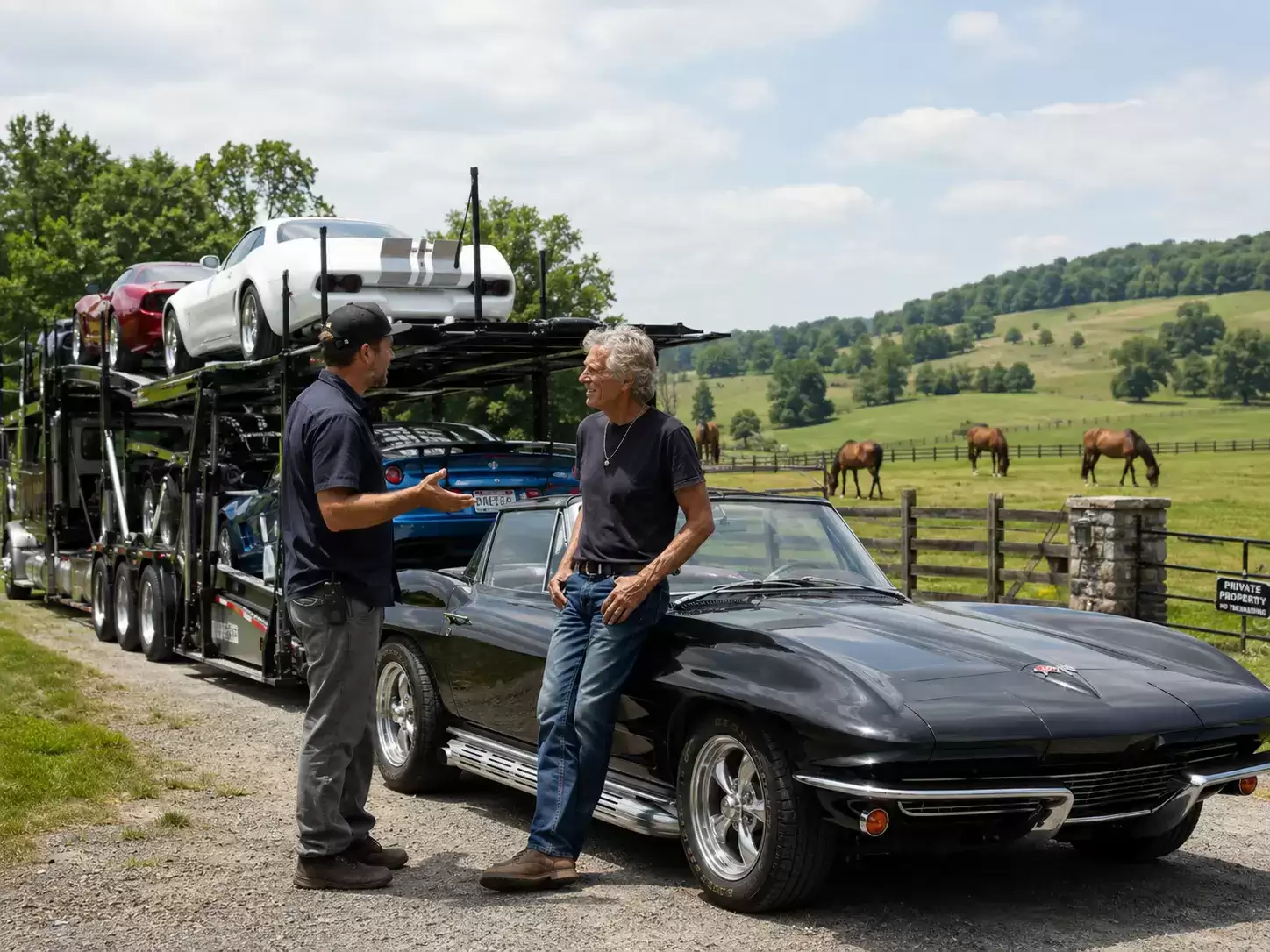
Virginia car shipping cost estimates: major routes
The tables below show estimated pricing for the most commonly requested Virginia auto transport routes, based on current market conditions for a standard operable sedan via open carrier. All prices reflect Standard, Expedited, and Rush tiers. Your actual quote may vary based on vehicle size, exact pickup/delivery zip code, and seasonal demand. Use our instant calculator for a real-time rate.
Popular Routes To Virginia
Swipe to view full table →
| From | To | Distance (mi) | Estimated Days | Standard | Expedited | Rush |
|---|---|---|---|---|---|---|
| New York | Virginia | 340 | 1–2 | $530 | $635 | $740 |
| North Carolina | Virginia | 330 | 1–2 | $515 | $620 | $720 |
| South Carolina | Virginia | 450 | 2–3 | $615 | $740 | $860 |
| Georgia | Virginia | 640 | 2–3 | $740 | $890 | $1,035 |
| Florida | Virginia | 1,100 | 3–5 | $900 | $1,080 | $1,260 |
| Ohio | Virginia | 480 | 2–3 | $650 | $780 | $910 |
| Michigan | Virginia | 620 | 2–3 | $740 | $890 | $1,035 |
| Illinois | Virginia | 790 | 3–4 | $790 | $950 | $1,105 |
| Texas | Virginia | 1,480 | 4–6 | $1,035 | $1,240 | $1,450 |
| Colorado | Virginia | 1,780 | 5–7 | $1,175 | $1,410 | $1,645 |
| Arizona | Virginia | 2,170 | 6–8 | $1,325 | $1,590 | $1,855 |
| California | Virginia | 2,760 | 7–9 | $1,465 | $1,760 | $2,050 |
| Washington State | Virginia | 2,830 | 7–9 | $1,445 | $1,735 | $2,025 |
📱 Mobile users: swipe table left/right to see all columns | Prices are representative ranges for a standard sedan. Use our calculator for an exact quote.
Popular Routes From Virginia
Swipe to view full table →
| From | To | Distance (mi) | Estimated Days | Standard | Expedited | Rush |
|---|---|---|---|---|---|---|
| Virginia | New York | 340 | 1–2 | $530 | $635 | $740 |
| Virginia | North Carolina | 330 | 1–2 | $515 | $620 | $720 |
| Virginia | South Carolina | 450 | 2–3 | $615 | $740 | $860 |
| Virginia | Georgia | 640 | 2–3 | $740 | $890 | $1,035 |
| Virginia | Florida | 1,100 | 3–5 | $900 | $1,080 | $1,260 |
| Virginia | Ohio | 480 | 2–3 | $650 | $780 | $910 |
| Virginia | Michigan | 620 | 2–3 | $740 | $890 | $1,035 |
| Virginia | Illinois | 790 | 3–4 | $790 | $950 | $1,105 |
| Virginia | Texas | 1,480 | 4–6 | $1,035 | $1,240 | $1,450 |
| Virginia | Colorado | 1,780 | 5–7 | $1,175 | $1,410 | $1,645 |
| Virginia | Arizona | 2,170 | 6–8 | $1,325 | $1,590 | $1,855 |
| Virginia | California | 2,760 | 7–9 | $1,465 | $1,760 | $2,050 |
| Virginia | Washington State | 2,830 | 7–9 | $1,445 | $1,735 | $2,025 |
📱 Mobile users: swipe table left/right to see all columns | Prices are representative ranges for a standard sedan. Use our calculator for an exact quote.
Why long-haul Virginia routes have a lower cost per mile: On a 2,760-mile California-to-Virginia vehicle transport, carriers running a full transcontinental route optimize their trailer mix across the distance, bringing the per-mile cost down. On a shorter 330-mile North Carolina-to-Virginia haul, fixed carrier costs spread across fewer miles, so the per-mile rate is higher. This is why Richmond to Charlotte at $515 costs more per mile than Richmond to Los Angeles at $1,465 — distance works in the shipper’s favor on long-haul vehicle transport routes.

Best time to ship a car to or from Virginia — the complete seasonal guide

Standard, Expedited, or Rush — which tier is right for your Virginia vehicle transport?
Swipe to view full table →
| Tier | Best for Virginia when… | What to expect |
|---|---|---|
| Standard | Flexible schedule; Dec–Feb outbound window; any route with a 10+ day window; non-urgent civilian moves on the Northern Virginia, Richmond, or Fredericksburg corridor | Assignment in 2–5 days on major I-95 corridor markets. Best value when you are not tied to a specific pickup date and can let the market work for you. |
| Expedited (most popular) |
Military PCS at any Virginia installation; Hampton Roads shipments during summer peak; Shenandoah Valley and Southwest Virginia origins; federal contractor relocations with firm start dates; any time you want assignment certainty | Assignment in 1–3 days. Strongly recommended Jun–Aug during PCS season and for any Virginia shipper with a fixed move date. |
| Rush | Last-minute PCS orders with a firm reporting date; emergency federal contractor relocations; estate vehicles; corporate deadline moves; Lynchburg and Southwest Virginia markets | Priority dispatch, often assigned within 24–48 hours. Best for urgent moves when Standard and Expedited windows are too long. |
On most Virginia routes, Expedited is the tier we recommend most often — not just during PCS season. Virginia’s military installation density is the highest of any state, and the summer PCS peak hits all three markets simultaneously: Naval Station Norfolk and Hampton Roads installations, Northern Virginia installations (Quantico, Fort Belvoir, JBMHH), and Fort Gregg-Adams. The step from Standard to Expedited is typically $75–$130 on a major corridor, and that premium meaningfully increases how quickly your load is matched to an auto carrier. Navy families PCSing out of Hampton Roads, Northern Virginia federal contractors relocating to new assignments, and university families with hard move-in dates all benefit from Expedited’s predictable pickup window.
Standard tier works well for: vehicle transport in December through February with a 10-day or longer flexible window; any route from Northern Virginia or Richmond where I-95 carrier frequency is naturally high; and budget-conscious shippers with no fixed move date who are shipping in the fall or spring shoulder seasons.
Rush tier is the right call for: last-minute PCS orders at Naval Station Norfolk or any Hampton Roads installation with a firm report date during the June–August peak; emergency federal contractor relocations with hard agency start dates; mid-cycle January PCS orders that execute on compressed timelines; and vehicle relocation from Lynchburg, Bristol, or Southwest Virginia markets where carrier deviation from the primary interstates is required.


How Virginia auto transport works: 4 simple steps
Step 1 — Get your instant quote. Use our online calculator to get a real-time Virginia vehicle shipping rate in 30 seconds. Enter your pickup zip code, delivery zip code, vehicle type, and preferred service tier. No registration required. No phone call required.
Step 2 — Book your shipment. Confirm your order online. We post your load to our network of vetted, FMCSA-licensed carriers at your chosen tier price. For military PCS moves at Naval Station Norfolk, Quantico, JBLE, Fort Gregg-Adams, or Fort Belvoir, our team contacts you directly to confirm your report date and schedule accordingly. You pay nothing until a carrier is assigned.
Step 3 — Pickup and inspection. Your assigned car carrier contacts you 12–24 hours before pickup to confirm the appointment. At pickup, both you and the driver complete a detailed vehicle inspection on the Bill of Lading, documenting every existing mark, scratch, or dent. For Northern Virginia pickups, be prepared to coordinate a nearby commercial meet-point if your address is on a residential street inaccessible to large transporters. Military installations coordinate through the base transportation office for gate access.
Step 4 — Delivery and final inspection. Your vehicle is delivered to the destination. Complete a second inspection against the original Bill of Lading before signing off. Payment is due at delivery — typically by cash or certified funds to the carrier directly. We do not charge your card until delivery is confirmed.
Virginia university auto transport: moving students’ vehicles
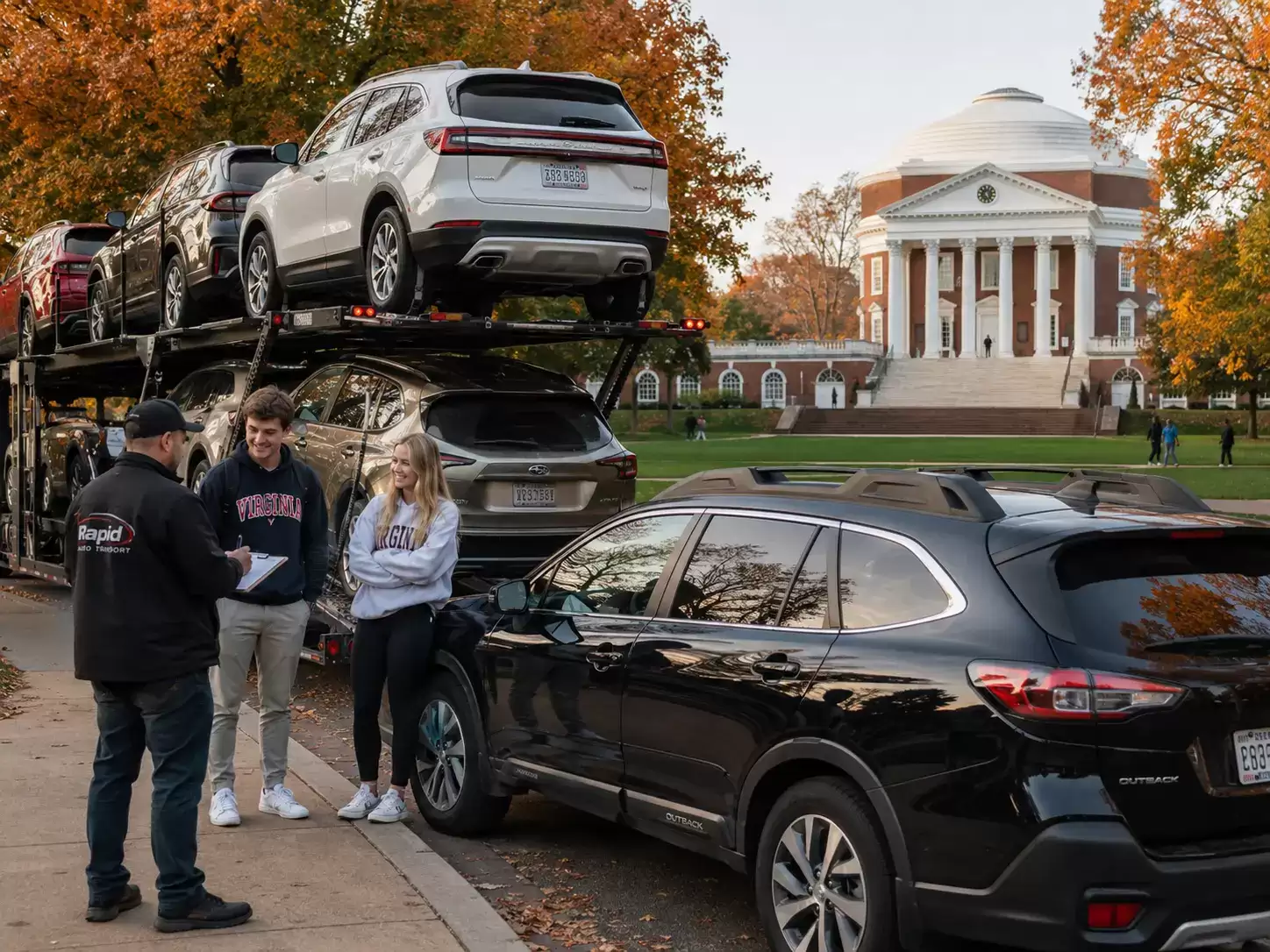
Virginia is home to one of the most academically distinguished university systems in the country. The University of Virginia, Virginia Tech, George Mason, Virginia Commonwealth, Old Dominion, and James Madison together enroll well over 175,000 students statewide. Student vehicle shipping peaks in late August (fall move-in) and May (end of spring semester), with a secondary peak in January for the spring semester start. Virginia’s university markets span three distinct carrier corridors: the I-95 spine (George Mason, VCU), the I-64 corridor (UVA, ODU, William & Mary), and the I-81 corridor (Virginia Tech, JMU, Liberty).
Swipe to view full table →
| University | Location | Enrollment | Nearest Major Carrier Corridor |
|---|---|---|---|
| University of Virginia | Charlottesville | ~25,000 | I-64 / US-29 Central Virginia |
| Virginia Tech | Blacksburg | ~37,000 | US-460 / I-81 Southwest Virginia |
| George Mason University | Fairfax | ~40,000 | I-66 / I-495 Northern Virginia |
| Virginia Commonwealth University | Richmond | ~29,000 | I-95 / I-64 Richmond |
| Old Dominion University | Norfolk | ~24,000 | I-64 Hampton Roads |
| James Madison University | Harrisonburg | ~22,000 | I-81 Shenandoah Valley |
| College of William & Mary | Williamsburg | ~10,000 | I-64 Peninsula Corridor |
| Liberty University | Lynchburg | ~15,000+ | US-460 / US-29 Central Virginia |
Tips for Virginia university vehicle transport: Book 2 to 3 weeks ahead of fall move-in dates, particularly for UVA in Charlottesville and Virginia Tech in Blacksburg, as August carrier demand tightens across all Virginia corridors simultaneously. George Mason University in Fairfax benefits from Northern Virginia’s excellent I-66/I-495 carrier access; door-to-door service is generally available to campus. ODU in Norfolk and William & Mary in Williamsburg both sit on the I-64 peninsula corridor, so Expedited tier is recommended during August and May peaks when Hampton Roads carrier capacity is shared with military PCS demand.

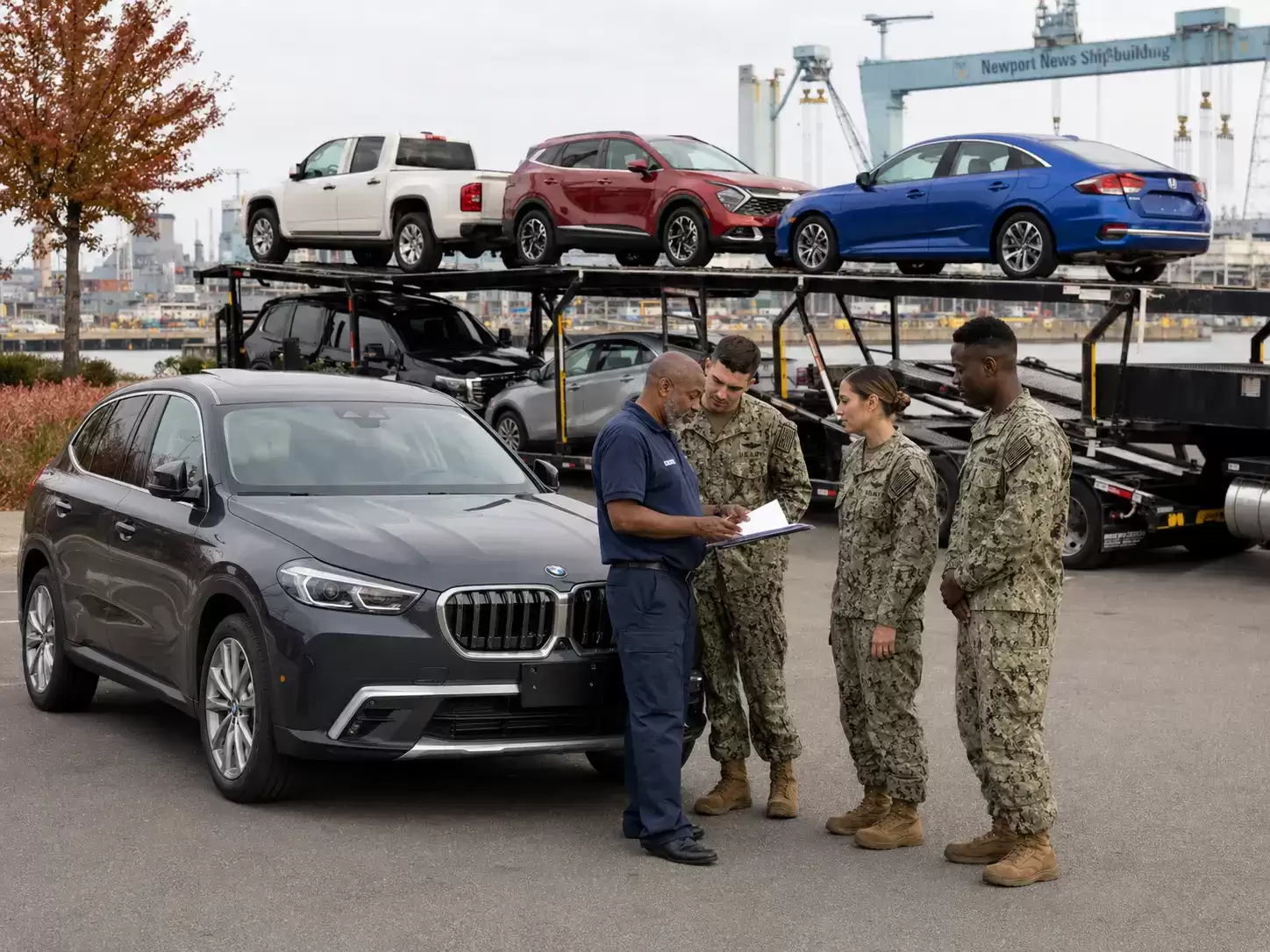
Military auto transport in Virginia: the most installation-dense state in the nation
Virginia hosts more military installations than any other state in the country, and the volume of PCS vehicle shipping those installations generate is among the highest of any state. Every branch of the armed forces has a major Virginia presence, and the summer PCS season (June through August) drives a simultaneous surge across every market in the state that is unlike anything seen in civilian-dominated auto transport markets. Military PCS season at Virginia’s installations is among the most intense of any state in the country — book as early as your orders permit, and allow at least 5 business days of lead time from your desired pickup date during June through August.
Naval Station Norfolk (Norfolk): The world’s largest naval station, home to the Atlantic Fleet, multiple carrier strike groups, and tens of thousands of active-duty Navy personnel. Naval Station Norfolk is the single largest generator of PCS vehicle shipping in Virginia — and one of the highest-volume military auto transport origins and destinations in the entire country. Sailors receiving orders to or from Norfolk ship vehicles through our network year-round, with the June–August PCS peak and a secondary January peak when mid-cycle orders execute. Carrier pickup and delivery to Naval Station Norfolk coordinates through the installation transportation office for gate access on the north and south main gates.
Naval Air Station Oceana (Virginia Beach): The East Coast’s master jet base, home to the F/A-18 Super Hornet community and multiple carrier air wings. Oceana pilots and aircrew cycle through assignment rotations that generate consistent vehicle shipping demand. Virginia Beach residential addresses near Oceana are generally accessible to standard car carriers; base pickup coordinates through the NAS Oceana transportation office.
Naval Amphibious Base Little Creek (Virginia Beach): Home to the Navy’s East Coast amphibious forces, SEAL Teams, and special operations units. Little Creek PCS traffic moves year-round, with a strong summer peak aligned with fleet unit deployment schedules.
Joint Base Langley-Eustis (Hampton): A combined Air Force and Army installation encompassing Langley Air Force Base (home to Air Combat Command — the headquarters command for Air Force combat aircraft) and Fort Eustis (home to Army Transportation School and Aviation Center of Excellence). JBLE generates dual-service PCS vehicle shipping traffic from both Air Force airmen and Army soldiers. Air Combat Command’s headquarters mission means a consistent flow of senior officers and senior NCOs transferring in and out with vehicles year-round.
Marine Corps Base Quantico (Quantico, Prince William County): “The Crossroads of the Marine Corps” — home to Officer Candidates School, The Basic School, Marine Corps University, the FBI Academy, and multiple intelligence units. Quantico is unique in that it generates vehicle shipping demand from both permanent-party Marines and the constant flow of students cycling through OCS and TBS. Quantico is on I-95 between Northern Virginia and Fredericksburg, making it one of the best-positioned military installations in the country for auto carrier access.
Fort Gregg-Adams (Petersburg): Home to the Army Combined Arms Support Command (CASCOM) and the Army Sustainment Center of Excellence. Fort Gregg-Adams (formerly Fort Lee) is the Army’s primary logistics and sustainment training installation. The school’s student throughput generates significant vehicle shipping demand from soldiers attending Quartermaster, Transportation, Ordnance, and related courses.
Fort Belvoir (Fairfax County): Home to the Defense Intelligence Agency, the National Geospatial-Intelligence Agency, the Army Installation Management Command, and dozens of Department of Defense tenant organizations. Fort Belvoir’s mix of military and civilian DIA/NGA employees creates a distinctive vehicle transport market that blends military PCS patterns with federal civilian relocation patterns. Its Northern Virginia location gives it excellent carrier access year-round.
Joint Base Myer-Henderson Hall (Arlington): Home to the Army Staff, the 3rd U.S. Infantry Regiment (The Old Guard), and the U.S. Army Band. As an Arlington installation adjacent to the Pentagon, JBMHH generates vehicle shipping primarily from senior Army officers and senior NCOs in Pentagon and Army Staff assignments.
Naval Surface Warfare Center Dahlgren (King George County): A research and engineering installation on the Potomac River. Dahlgren is a civilian-heavy installation with a large scientific and engineering workforce. Vehicle pickups often coordinate from the nearby Fredericksburg area rather than from the installation itself, taking advantage of Fredericksburg’s strong I-95 carrier access.
PCS shipping protocol for all Virginia installations: We do not require upfront payment — payment is due at delivery. We can coordinate on-base pickups with the installation transportation office for gate access at all Virginia installations. Expedited tier is strongly recommended for all PCS moves with a firm report date.
Virginia cities we serve
Direct Express Auto Transport provides vehicle shipping services to and from every city in Virginia. Our highest-volume Virginia markets include:
Northern Virginia (Arlington, Alexandria, Fairfax, Tysons, Reston, Herndon, McLean) — The dominant carrier hub for Virginia and the Mid-Atlantic region, powered by the densest concentration of federal agencies, defense contractors, and intelligence community employers in the country. I-95 north-south carrier traffic combined with I-66 and the Dulles corridor gives Northern Virginia access to car haulers running in virtually every direction simultaneously. Note: large auto carriers cannot access many residential streets in Arlington and Alexandria due to tree canopy and narrow lanes — most pickups stage at a nearby commercial meet-point. Standard tier here rivals Expedited performance in many secondary East Coast markets.
Richmond metro (Richmond City, Henrico, Chesterfield, Hanover) — Virginia’s second major auto transport hub at the junction of I-95, I-64, and I-85. State government and healthcare sector relocations provide a consistent year-round baseline alongside corporate and military demand. Standard pickup windows in Richmond are among the shortest in Virginia.
Hampton Roads (Norfolk, Virginia Beach, Chesapeake, Newport News, Hampton, Suffolk) — Virginia’s largest metro by population and the state’s third major carrier hub, driven by the world’s largest naval complex. Carriers must commit to the I-64 peninsula routing east of Richmond, which means Standard tier pickup windows are slightly longer than Richmond or Northern Virginia. Expedited tier is recommended during the June–August military PCS peak.
Fredericksburg — I-95 midpoint hub between Northern Virginia and Richmond, consistently one of the fastest secondary auto transport markets in Virginia. Every carrier running the East Coast trunk route passes directly through on every run, giving Fredericksburg pickup availability above its market size. Quantico’s proximity adds military vehicle shipping demand.
Charlottesville — UVA hub at the I-64/US-29 junction. Vehicle hauling demand spikes sharply in August (fall move-in) and May (graduation). Carriers from Richmond serve Charlottesville stops on combined I-64 corridor dispatches. Competitive pickup windows for a mid-size market.
Roanoke — The largest city on Virginia’s I-81 corridor and the strongest carrier hub in the Shenandoah Valley. Carriers running the I-81 northeast-to-southeast trunk route pass through Roanoke continuously, giving it carrier access above its market size. Healthcare sector and regional corporate relocations provide consistent baseline demand.
Harrisonburg — JMU university market at I-81 midpoint. Strong carrier frequency in both directions on I-81 combined with James Madison University’s 22,000 students creates predictable August and May vehicle shipping peaks. Eastern Mennonite and Bridgewater College add smaller volumes.
Winchester — Northern Shenandoah Valley hub at the I-81/I-66 junction near the West Virginia and Maryland borders. Benefits from both I-81 north-south carrier traffic and I-66 east-west access to Northern Virginia. Military and federal workforce connections to nearby installations and the DC area create consistent demand.
Woodbridge / Prince William County — Growing Northern Virginia suburb on I-95 between Fredericksburg and the NoVa core. An active carrier corridor benefiting directly from I-95 trunk route traffic. MCB Quantico is within the Prince William County market, adding military PCS vehicle shipping demand.
Virginia Beach — Major residential market and home to NAS Oceana and Naval Amphibious Base Little Creek. One of the largest vehicle hauling markets in Hampton Roads, well served by I-64 carriers. Residential neighborhoods near the oceanfront are generally accessible for door-to-door service.
Chesapeake — Large suburban market south of Norfolk with good interstate access via I-64 and I-664. Standard car carrier access is available throughout most of Chesapeake; coordinate meet-point logistics for neighborhoods far from the primary corridor.
Newport News / Hampton — JBLE corridor and major shipbuilding industry hub. Newport News Shipbuilding (Huntington Ingalls Industries) generates steady professional relocation demand alongside military PCS traffic from JBLE. I-664 and I-64 carrier access serves the peninsula market.
Lynchburg — Liberty University market on US-460 and US-29. No direct interstate access means slightly longer Standard tier pickup windows than I-81 or I-95 markets. Expedited tier recommended for time-sensitive Lynchburg vehicle transport. Liberty University’s 15,000+ residential students create strong August and May shipping peaks.
Bristol / Southwest Virginia — I-81/I-77 junction at Virginia’s southernmost point, marking the end of the Shenandoah Valley corridor at the Tennessee border. Carriers running I-81 between Northeast and Southeast pass through Bristol on every run. The most southern point of Virginia’s I-81 corridor, with carrier frequency comparable to other major I-81 cities.
Virginia vehicle registration and helpful government links
If you are moving to Virginia, you are required to register your vehicle and obtain a Virginia driver’s license within 30 days of establishing residency. The Virginia Department of Motor Vehicles manages vehicle registration, title transfers, and driver’s licenses statewide. Virginia localities also assess personal property tax on vehicles — check with your county or city treasurer after registering.
- Virginia DMV — Virginia’s primary portal for vehicle registration, title transfers, driver’s license applications, and tag renewals. New residents must register their vehicle and obtain a Virginia driver’s license within 30 days of establishing residency.
- Virginia Vehicle Registration — Covers vehicle registration requirements for vehicles brought into Virginia, including fee schedules, required documentation, and DMV customer service center locations statewide.
- Virginia Title Transfers — Instructions for transferring an out-of-state vehicle title to Virginia after moving. A Virginia title is required before Virginia plates are issued.
- Virginia Department of Taxation — Vehicle personal property tax information. Unlike most states, Virginia localities assess an annual personal property tax on vehicles based on assessed value. Contact your local commissioner of the revenue after registering.
- FMCSA SAFER System — The Federal Motor Carrier Safety Administration’s carrier lookup tool. Verify that any auto transport company you consider is federally licensed and insured before booking. Direct Express Auto Transport is FMCSA Licensed MC #479342.

Popular Long Distance Routes From or To Virginia
Virginia to Florida Car Shipping
Virginia’s most popular long-distance route. Northern Virginia and Hampton Roads both generate significant Snowbird vehicle relocation to Florida’s Gulf Coast and Atlantic Coast. Richmond is the primary hub for Virginia-to-Florida shipments via I-95. Standard transit from Richmond to Orlando is approximately 3–4 days; Richmond to Miami approximately 4–5 days. The spring Snowbird return (March through May) and fall departure (October through December) are the two busiest seasonal windows on this corridor, with fall southbound offering the best carrier availability for Virginia-to-Florida vehicle shipping.
Virginia to California Auto Transport
Virginia’s most popular cross-country route. Northern Virginia defense contractors relocating to Silicon Valley or Southern California tech employers, military PCS moves between Virginia’s Navy installations and San Diego or Naval Air Station Lemoore, and government civilian transfers between the DC area and California federal agencies all generate consistent traffic. Standard transit is 7–9 days. Expedited tier is strongly recommended for moves with firm arrival deadlines.
Virginia to Texas Vehicle Shipping
A high-volume corridor driven by military PCS moves (particularly Air Force PCS between Virginia installations and Joint Base San Antonio or other Texas bases), government contractor relocations, and energy industry moves. Standard transit from Richmond to Dallas is approximately 4–5 days. Texas’s position at the western extreme of the primary I-95 South/I-10 West corridor keeps carrier availability strong in both directions throughout the year.
Virginia to North Carolina Car Shipping
Virginia’s most popular short-haul corridor. I-95 from Petersburg to Raleigh-Durham and I-85 from Petersburg to Charlotte are among the highest-frequency carrier routes in the Southeast. Standard transit is typically 1–2 days. Pricing is among the most competitive in Virginia for a destination state. Fort Liberty (formerly Fort Bragg) in Fayetteville, NC, is a major PCS receiving installation for soldiers from Virginia’s installations.
Virginia to Georgia Car Transport
Virginia to Atlanta via I-95 and I-85 is a well-traveled auto carrier lane. Standard transit is 2–3 days. Fort Stewart, Hunter Army Airfield, and Moody AFB generate some PCS volume between Virginia and Georgia. The Atlanta corporate relocation market and the Savannah port area also contribute consistent demand in both directions.
Virginia to Ohio Vehicle Transport
Virginia to Ohio via I-64 west through Charlottesville and the Shenandoah Valley, then I-77 north or I-79 north, is a moderately traveled carrier route. Standard transit is 2–3 days. Wright-Patterson AFB in Dayton generates some PCS flow to and from Virginia Air Force installations.
Virginia to Illinois Auto Shipping
Virginia to Chicago via I-81 north or I-70 west is a 3–4 day transit. Illinois and Northern Virginia have significant government contractor workforce interchange. Rock Island Arsenal and Scott AFB in Illinois generate occasional PCS flows to and from Virginia installations, and the Chicago–DC business corridor drives consistent professional vehicle relocation demand.
Virginia to Michigan Car Shipping
Virginia to Detroit via I-66/I-70 or I-64/I-77 north is a 2–3 day transit. Automotive industry professionals relocating between Northern Virginia’s tech sector and Michigan’s automotive R&D corridor ship vehicles on this route regularly. Fort Custer Training Center (Battle Creek) and Selfridge ANGB generate occasional military volume.
Virginia to Colorado Car Shipping
Virginia to Denver via I-66/I-70 west is a 5–7 day transit. Peterson Space Force Base, Fort Carson, Buckley Space Force Base, and Schriever SFB in Colorado receive PCS moves from Virginia’s Air Force and Space Force installations. Government and corporate relocation between the DC area and Denver’s growing tech sector adds consistent vehicle transport volume year-round.
Virginia to Arizona Car Transport
Virginia to Phoenix or Tucson via I-40 west or I-10 west is a 6–8 day transit. Arizona’s Snowbird destination status draws Virginia retirees and second-home owners to the Scottsdale and Tucson areas. Luke AFB, Davis-Monthan AFB, and Fort Huachuca generate PCS traffic to and from Virginia installations throughout the year.
Virginia to New York Auto Transport
Virginia to New York City via I-95 north is one of the most carrier-dense short routes on the East Coast. Standard transit is 1–2 days. Northern Virginia and the DC area have enormous government and financial industry workforce overlap with New York. West Point, Fort Hamilton (Brooklyn), and Picatinny Arsenal generate some PCS volume on this corridor.
Virginia to Washington State Car Shipping
Virginia to Seattle or the Puget Sound area is a 7–9 day cross-country transit. Joint Base Lewis-McChord (Tacoma), Naval Base Kitsap (Bremerton), and Naval Station Everett generate PCS flows to and from Virginia’s Navy and Army installations. Pacific Fleet assignment rotations make this a recurring Navy-driven corridor connecting two of the country’s largest naval complexes.

Nearby states: auto transport to and from Virginia’s neighbors
North Carolina
Virginia’s most active border-state corridor. I-95 and I-85 connect the two states seamlessly, and car carriers run this lane daily in both directions. The Research Triangle (Raleigh, Durham, Chapel Hill), Charlotte, and Fort Liberty (formerly Fort Bragg) are the primary North Carolina destinations for Virginia shippers. Standard transit 1–2 days.
Maryland
Virginia’s northern neighbor. Northern Virginia and the greater DC area share a massive workforce with Maryland’s Montgomery and Prince George’s counties and the Baltimore metro. Aberdeen Proving Ground, Fort Meade, and NSA headquarters in Maryland generate consistent PCS flows to and from Virginia installations. Distances are short — 100 to 200 miles for most Virginia-to-Maryland routes — and auto carrier frequency is among the highest on the East Coast. Standard transit 1 day.
West Virginia
Virginia’s western neighbor, accessible via I-81 north from Winchester or I-64 west from Staunton. West Virginia’s population centers (Charleston, Huntington, Morgantown, Parkersburg) are moderate-frequency auto transport markets served by carriers on the I-77 and I-79 corridors. Standard transit 1–2 days.
Tennessee
Virginia’s southwestern neighbor via I-81 south from Bristol. Nashville, Knoxville, and Memphis are the primary Tennessee destinations for Virginia shippers. I-81 carrier frequency between Virginia and Tennessee is strong year-round. Fort Campbell (Clarksville), Arnold AFB, and Millington Naval Station generate PCS flows between the two states. Standard transit 1–2 days to Knoxville, 2–3 days to Nashville.
Kentucky
Accessible from Southwest Virginia via I-81 south to I-26 or via I-64 west through West Virginia. Fort Campbell straddles the Kentucky-Tennessee border and is a significant PCS generator for moves to and from Virginia installations. Louisville and Lexington vehicle shipping standard transit 2–3 days.

Major Cities From Virginia
I-95 Northern Virginia / Pentagon Corridor
Arlington Car Shipping Northern Virginia’s urban core and the closest Virginia jurisdiction to Washington DC, bordered by the Potomac River and home to the Pentagon, Reagan National Airport, Amazon’s HQ2, and dozens of federal agency satellite offices. Arlington is one of the most professionally dense auto transport markets on the East Coast, generating enormous inbound demand from New York, Boston, Chicago, and California as federal contractors and government agencies recruit nationally. Large carrier trucks cannot access many residential neighborhoods due to tree canopy, overhead utilities, and narrow streets — most Arlington pickups stage at a nearby commercial location. Coordinate your staging point at booking.
Alexandria Car Shipping Historic Old Town and the inner-ring NoVa suburb directly south of Arlington on I-395 and the GW Parkway. Alexandria combines government contractor workforce with a significant military population from nearby Fort Belvoir and the National Geospatial-Intelligence Agency campus in Springfield. Like Arlington, many Old Town Alexandria residential blocks require a commercial meet point for large carriers. The King Street corridor and the Van Dorn Street and Eisenhower Avenue commercial zones are standard staging areas for inner Alexandria shipments.
Fairfax / Tysons Vehicle Transport Fairfax County’s commercial core at the I-495 and I-66 interchange, encompassing the Tysons urban center, the Dulles Technology Corridor, and the sprawling suburban grid that houses the largest concentration of defense contractors in the country. Booz Allen Hamilton, Leidos, SAIC, CACI, and hundreds of smaller firms employ cleared professionals throughout this corridor. Corporate relocation demand here is among the most consistent and highest-income in the entire state. Suburban Fairfax County neighborhoods are generally carrier-accessible door-to-door, unlike inner Arlington and Alexandria.
Reston / Herndon / Sterling Auto Transport The Dulles Technology Corridor extending northwest from Tysons along the Dulles Toll Road and US-7. Reston, Herndon, and Sterling house a dense concentration of cybersecurity, cloud, and intelligence technology firms clustered around Dulles International Airport. The tech workforce draws inbound vehicle shipments from Silicon Valley, Austin, and Seattle continuously. Carriers serving the I-66/Dulles corridor include Reston and Herndon stops on regular dispatches from the Northern Virginia hub.
Woodbridge / Manassas Car Transport Prince William County’s fast-growing I-95 suburban corridor south of the Beltway. Woodbridge and Lake Ridge are natural waypoints for carriers running I-95 between Northern Virginia and Fredericksburg — daily dispatches pass through on both northbound and southbound runs. Manassas, accessible via I-66 west, is slightly off the primary carrier trunk but served on combined Prince William County dispatches. Quantico Marine Corps Base in southern Prince William County adds consistent military PCS shipping to this corridor.
McLean / Great Falls Vehicle Shipping Fairfax County’s highest-income residential corridor along the Potomac River north of Tysons. McLean is home to a concentration of senior government officials, intelligence community executives, and defense industry leadership. Carrier accessibility varies by street — many McLean residential roads are narrow and wooded. A commercial staging point at a nearby shopping center or office park is standard for most McLean residential pickups.
I-95 Richmond Corridor
Richmond Car Shipping Virginia’s state capital and the I-95/I-64/I-85 junction — the most important carrier crossroads in the state outside of Northern Virginia. Every carrier running the East Coast between New England and Florida passes through or near Richmond, giving the city carrier availability that rivals markets twice its size. State government, healthcare (VCU Health, Bon Secours), and financial sector relocations provide a year-round demand baseline. The Fan District, Carytown, and Shockoe Bottom neighborhoods are carrier-accessible; shorter residential streets in Church Hill may require a nearby staging point. Standard pickup windows in Richmond are among the shortest in Virginia.
Chesterfield / Midlothian Auto Transport Richmond’s fast-growing southwestern suburban corridor on US-360 and US-60. Chesterfield County’s population has grown dramatically over the past decade as Richmond professionals seek suburban space, generating increasing inbound vehicle shipping from the Northeast and Midwest. Carriers on I-95 south of Richmond include Chesterfield stops on combined South Richmond dispatches. Hull Street Road and Midlothian Turnpike commercial zones serve as natural carrier staging corridors.
Henrico / Short Pump Vehicle Shipping Richmond’s northwestern suburban market along I-64 west and US-250. Short Pump’s concentrated retail and office corridor on West Broad Street is a high-density staging zone for carriers serving West Henrico. Henrico County’s logistics-friendly grid of commercial corridors makes it one of the more straightforward pickup markets in Central Virginia. Carriers on the I-64 Richmond-to-Charlottesville leg routinely include Short Pump stops on westbound dispatches.
Fredericksburg Car Transport The strategic midpoint on I-95 between Northern Virginia and Richmond, roughly equidistant from both hubs. Fredericksburg benefits from near-continuous carrier traffic in both directions on I-95 — the highest-volume interstate on the East Coast — making it one of the best-served secondary markets in the state. Standard tier pickup windows in Fredericksburg are among the fastest outside of Northern Virginia and Richmond. The Quantico and Dahlgren military communities nearby contribute military PCS shipping that complements the civilian relocation baseline year-round.
Petersburg / Colonial Heights Auto Shipping The I-95/I-85 junction south of Richmond and home to Fort Gregg-Adams (formerly Fort Lee). Petersburg sits where I-85 branches southwest toward North Carolina and the Carolinas while I-95 continues south. Carriers routing Virginia vehicles toward Charlotte, Durham, or the Deep South via I-85 stage in the Petersburg-Colonial Heights corridor before heading southwest. Fort Gregg-Adams, the Army’s primary logistics and sustainment training installation, generates consistent military PCS vehicle transport in both directions throughout the year.
I-64 Hampton Roads / Naval Complex
Norfolk Car Shipping Virginia’s largest city and home to Naval Station Norfolk — the world’s largest naval station by ship count and one of the highest-volume PCS auto transport origins and destinations in the entire country. Norfolk sits at the end of the I-64 peninsula east of Richmond, which means carriers specifically routing to Hampton Roads to serve Norfolk are actively seeking outbound loads to make the run viable — a dynamic that keeps outbound Norfolk shipping competitive despite the peninsula geography. Daily carrier activity connects Norfolk to San Diego, Jacksonville, Pearl Harbor, Bremerton, and every major naval installation in the country.
Virginia Beach Vehicle Shipping Hampton Roads’ most populous city and one of Virginia’s most active auto transport markets, driven by the combination of Navy and Air Force personnel at Naval Air Station Oceana and Naval Amphibious Base Little Creek and the large permanent civilian retirement population that has settled near the oceanfront after completing military careers. Virginia Beach’s residential grid is generally carrier-accessible; the Oceanfront resort district and the narrow streets of the Linkhorn Bay area may require commercial staging. The Pembroke and Town Center commercial corridor is a common carrier meet point for the central Virginia Beach market.
Chesapeake Auto Transport Hampton Roads’ southern suburban market on I-64 and I-664 south of Norfolk. Chesapeake is a large and geographically sprawling city whose residential areas span from dense inner-city neighborhoods near the Norfolk border to rural farm communities near the North Carolina line. The Great Bridge, Greenbrier, and Chesapeake Square commercial corridors serve as natural carrier staging zones. Carriers serving the Hampton Roads market routinely include Chesapeake stops on combined South Hampton Roads dispatches alongside Norfolk and Virginia Beach.
Newport News Car Shipping The western side of the Hampton Roads peninsula on I-664 and US-60, anchored by the Newport News Shipbuilding and Drydock facility — the largest private-sector shipyard in the country — and Joint Base Langley-Eustis to the north in Hampton. Newport News Shipbuilding’s engineering and trades workforce draws skilled-labor relocations from Michigan, Pennsylvania, and the Gulf Coast continuously. Carriers entering Hampton Roads from the I-64 peninsula routing serve Newport News on the same westside dispatch circuit as Hampton and York County.
Hampton Vehicle Transport The northern end of the Hampton Roads peninsula on I-64 and Mercury Boulevard, home to Joint Base Langley-Eustis — a combined Air Force and Army installation housing Air Combat Command headquarters and the Army Aviation Center of Excellence. JBLE’s dual-service mission generates both Air Force airman and Army soldier PCS vehicle shipping continuously throughout the year. The Phoebus and downtown Hampton neighborhoods are carrier-accessible; carriers serving JBLE coordinate through the installation transportation office for base access when on-base pickup or delivery is required.
Suffolk / Isle of Wight Auto Shipping Hampton Roads’ western and southern suburban markets accessible via US-58, US-460, and I-664. Suffolk is one of the fastest-growing cities in Virginia, attracting families from the Hampton Roads core seeking more affordable residential space. Carrier access through Suffolk is tied to the Holland and Downtown commercial corridors on US-58. Isle of Wight County to the south and Smithfield are served on combined Western Hampton Roads dispatches and benefit from the military demand generated by the broader Hampton Roads naval complex.
I-81 Shenandoah Valley Corridor
Winchester Car Shipping Northern Shenandoah Valley gateway city at the I-81/I-66 junction near the West Virginia and Maryland borders. Winchester occupies a unique position where I-81’s north-south carrier flow and I-66’s east-west connection to Northern Virginia intersect — giving it carrier access from two directions simultaneously. Federal government and military workforce from nearby installations and the DC area provide a steady demand baseline. Carriers transitioning between the I-81 corridor and Northern Virginia via I-66 include Winchester stops on daily dispatches in both directions.
Harrisonburg Auto Transport Shenandoah Valley’s university hub at the I-81 midpoint, home to James Madison University’s 22,000-student enrollment. JMU creates two annual shipping surges — late August fall move-in and May graduation move-out — that rival military PCS peaks in terms of carrier demand concentration. Eastern Mennonite University and Bridgewater College add smaller volumes. I-81 carrier frequency in both directions through Harrisonburg is strong year-round; August Expedited tier is recommended for firm pickup dates during the back-to-school surge.
Staunton / Waynesboro Vehicle Shipping Central Shenandoah Valley market at the I-81/I-64 interchange — the junction where the Shenandoah Valley meets the Richmond-to-Charlottesville corridor. Staunton and Waynesboro benefit from both I-81 north-south carrier traffic and I-64 east-west access toward Richmond. Mary Baldwin University adds modest student shipping. The I-81/I-64 interchange itself is one of the most useful carrier staging junctions in the state for shippers who need connectivity to either the valley corridor or the central Virginia corridor simultaneously.
Roanoke Car Transport Southwest Virginia’s largest city at the I-81/I-581 junction, anchored by Carilion Clinic’s regional healthcare system and a growing technology and creative economy. Roanoke is the I-81 corridor’s most significant carrier hub south of Harrisonburg, with daily departures northbound toward the Shenandoah Valley, Washington, and the Northeast and southbound toward Tennessee and the Deep South. Standard pickup windows in Roanoke are competitive for its market size. Carriers on I-81 between Virginia and Tennessee routinely include Roanoke stops in both directions.
Christiansburg / Blacksburg Vehicle Transport Montgomery County’s dual-market corridor in the New River Valley, anchored by Virginia Tech’s 37,000-student Blacksburg campus. Blacksburg is connected to I-81 via US-460 through Christiansburg. Virginia Tech’s enrollment creates enormous August and May vehicle shipping surges — Blacksburg is one of the highest-volume university auto transport markets in the South. Book Expedited tier for any August Blacksburg pickup with a firm date; August carrier demand from Virginia Tech move-in is among the most intense university shipping windows in the state.
I-64 / US-29 University and Western Virginia Corridor
Charlottesville Car Shipping University of Virginia’s home city at the I-64/US-29 junction in the Blue Ridge foothills. UVA’s 25,000 students, five professional schools (law, medicine, business, education, and engineering), and nationally recruited faculty generate significant August arrival and May departure spikes. Charlottesville is also a growing destination for Northern Virginia professionals seeking a quieter lifestyle within commuting distance of DC — a migration pattern that keeps inbound demand strong outside of the university calendar. I-64 gives Charlottesville carrier access west toward Staunton and east toward Richmond on the same daily dispatch circuits.
Lynchburg Auto Transport Central Virginia city at the US-460/US-29 junction with no direct interstate access, home to Liberty University’s 15,000+ residential students. The lack of an interstate connection means standard carrier pickup windows run slightly longer than I-81 or I-95 markets. Liberty University creates two predictable demand surges each year — late August and early January — when student vehicle shipments concentrate. Expedited tier is recommended for any Lynchburg shipment with a firm pickup date, particularly during the fall and spring semester start windows.