
Car Shipping To or From South Carolina
Need to ship a car to or from South Carolina? Direct Express Auto Transport has been the Palmetto State’s most trusted auto transport broker since 2004 — with a 4.6-star average across thousands of verified Google reviews, no upfront payment required, and a real-time quote available in 30 seconds.
★ 4.6/5 Google Reviews | BBB Accredited A+ | FMCSA Licensed (MC #479342) | USDOT #1240502 | No upfront payment required | 20+ years shipping vehicles


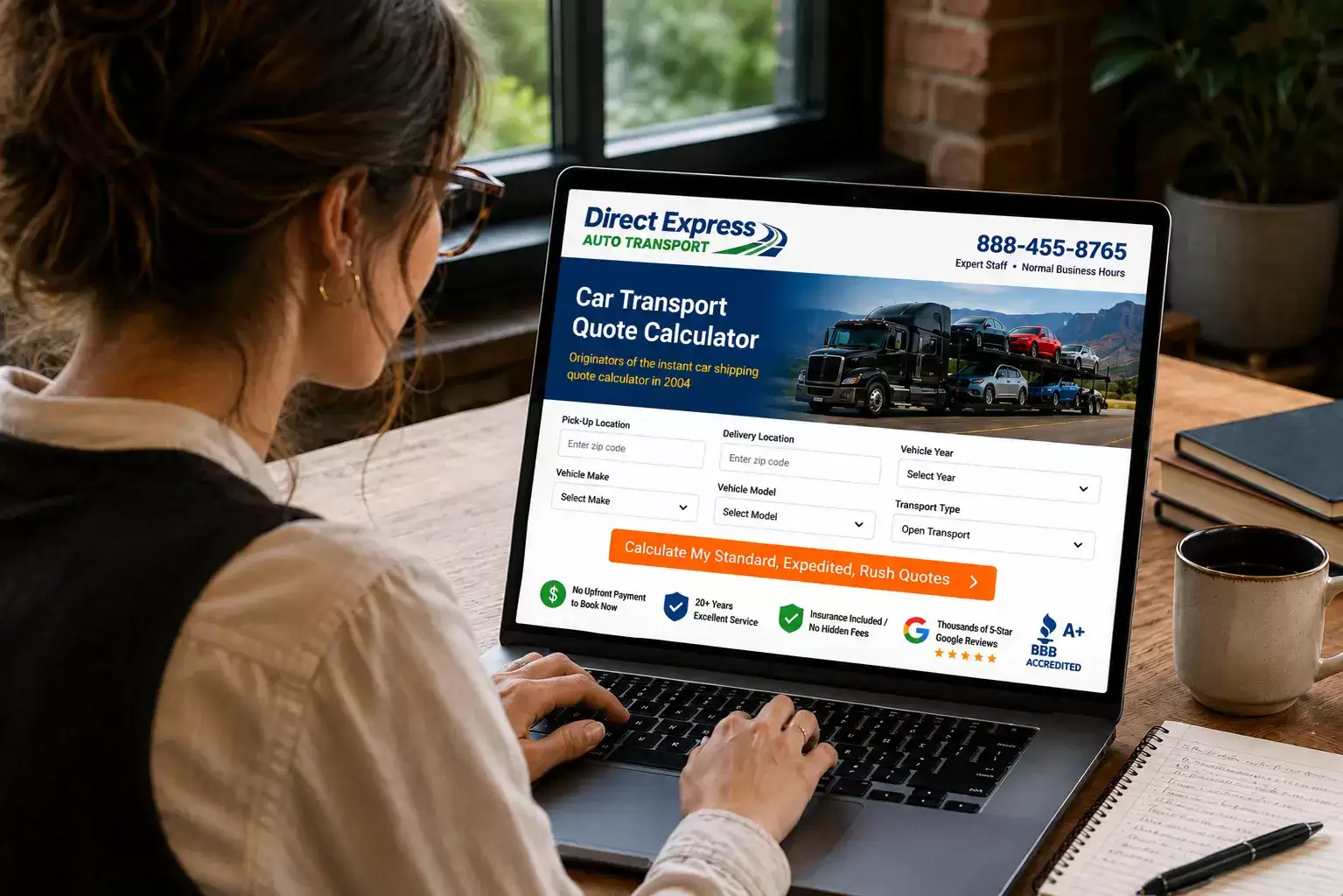
South Carolina car shipping costs vary based on your route, the time of year, vehicle size, and the service tier you choose. Use our instant calculator above for a real-time quote — or see the route-by-route pricing tables below for a fast ballpark. Most standard sedan shipments to or from South Carolina range from $350 for short hauls to neighboring states to $1,450+ on cross-country routes to California or the Pacific Northwest. Our Expedited and Rush pricing tiers hasten the process to create an even more satisfying experience.
What customers say about shipping a car to or from South Carolina with Direct Express Auto Transport


The interstate corridors that move South Carolina vehicles
Five primary highway arteries define South Carolina’s auto transport network:
I-26 (East-West backbone): The dominant corridor, connecting Charleston on the coast through Columbia and on to Spartanburg at the North Carolina border. I-26 is South Carolina’s most important carrier artery — virtually every vehicle moving between Charleston and the rest of the country travels some portion of I-26. Carriers running the Southeast coast to the Midwest frequently use I-26 as the inland connector from I-95 to the I-85 and I-77 networks. This makes I-26 the single most important highway to understand when shipping a vehicle in South Carolina.
I-95 (Coastal North-South backbone): The Eastern Seaboard’s primary carrier artery enters South Carolina near Dillon in the north and exits near Hardeeville in the south, running through Florence before skirting the coast. I-95 carries the highest volume of carrier trucks of any highway in South Carolina and connects the state to the entire Eastern Seaboard — from Miami to Boston. For shippers in Florence, Walterboro, and communities along the I-95 corridor, this creates exceptional northbound and southbound carrier access year-round.
I-85 (Upstate Connector): Enters South Carolina from Georgia near Gaffney and runs northeast through Spartanburg and into North Carolina near Greer. I-85 is the primary carrier corridor for the Greenville-Spartanburg Upstate market, connecting it directly to Atlanta to the southwest and Charlotte to the northeast. The BMW Manufacturing Plant in Greer operates adjacent to I-85, creating unique carrier activity in the Upstate corridor beyond standard relocation freight.
I-77 (Northern Gateway): Runs north from Columbia to the North Carolina border near Rock Hill, connecting South Carolina directly to Charlotte — the Southeast’s largest carrier hub. I-77 is South Carolina’s most direct connection to the Charlotte carrier network, and vehicles moving between Columbia and destinations in the Mid-Atlantic, Midwest, or Northeast frequently route through the Charlotte hub via I-77.
I-20 (Western Connector): Enters South Carolina from Georgia near Augusta and runs east through Aiken and Columbia before exiting northeast toward Florence and I-95. I-20 connects Columbia westward toward Atlanta, creating a secondary carrier corridor that supplements I-26 for Atlanta-bound traffic and provides Columbia with a direct western access route to Georgia and Texas-bound carrier lanes.
Vehicles shipping to or from Charleston or Columbia benefit from the highest carrier frequency in the state. Greenville and Spartanburg have strong secondary hub access on I-85. Florence is the most strategically positioned market for I-95 corridor access. Coastal resort markets — Myrtle Beach, Hilton Head, and Beaufort — and rural Pee Dee communities may require Expedited tier for time-sensitive shipments.

South Carolina as a Southeast destination market: what the retirement migration means for auto transport
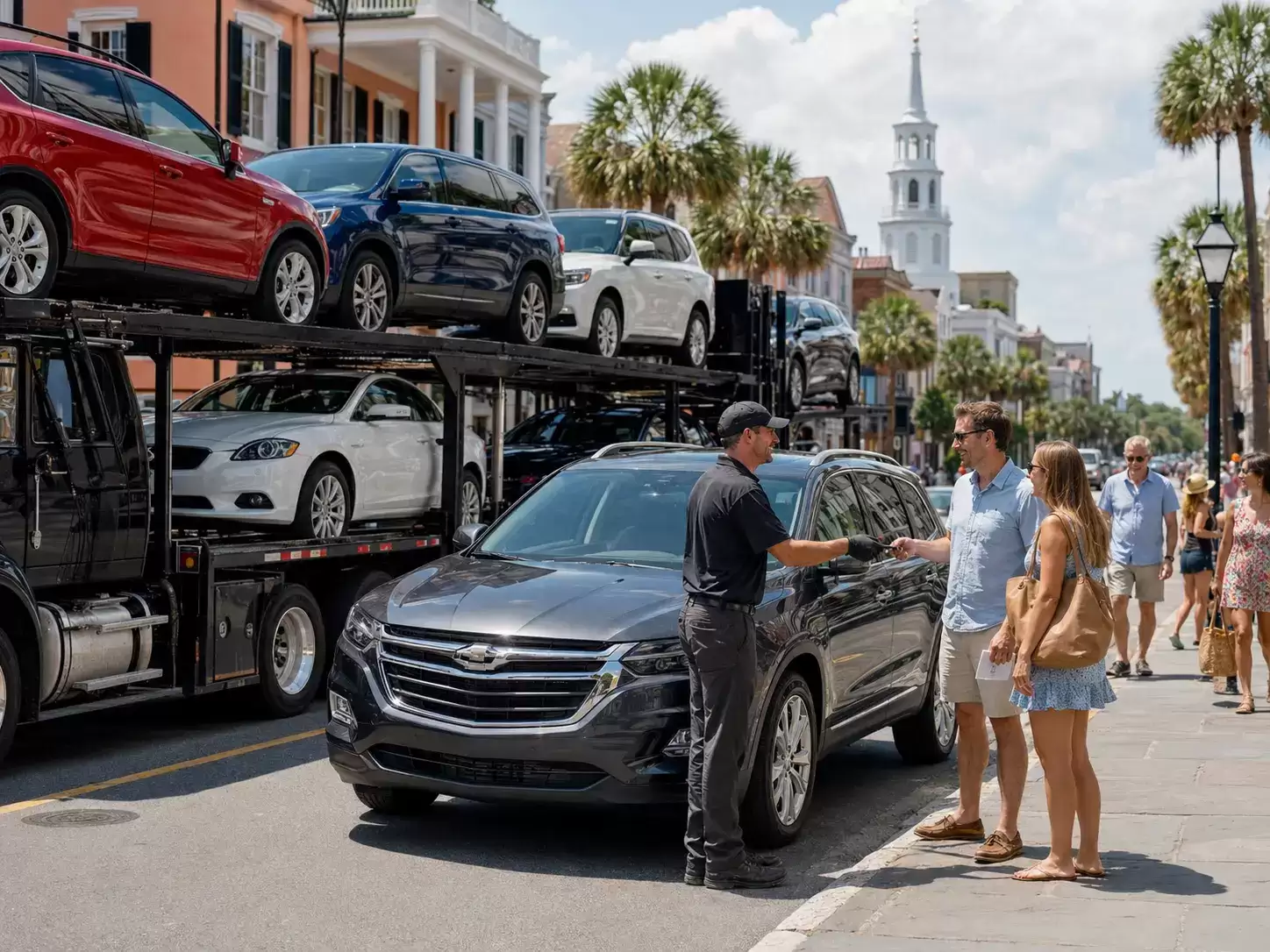
South Carolina occupies an unusual position in the national carrier network: it is both a significant carrier throughput state on the I-95 East Coast corridor and a major destination market for relocation freight from the Northeast. Understanding both dynamics helps South Carolina shippers time their bookings more effectively:
The Northeast-to-Lowcountry migration advantage: Tens of thousands of retirees and remote workers relocate annually from New York, New Jersey, Connecticut, Pennsylvania, and Massachusetts to coastal South Carolina — the Hilton Head, Beaufort, Bluffton, Myrtle Beach, and Charleston markets. This creates a sustained southbound carrier flow on I-95 and I-26 throughout the year, with peak intensity in late spring (April–June) and early fall (September–October) when most retirement relocations are finalized. Shippers moving from South Carolina to the Northeast can benefit from this dynamic in reverse: carriers who deliver southbound retirement loads need northbound return freight, creating favorable northbound pickup availability in the weeks following the spring and fall relocation peaks.
The I-95 throughput advantage for Florence and Walterboro: The I-95 corridor runs directly through eastern South Carolina, carrying the highest carrier density of any South Carolina highway. Communities near I-95 — Florence, Dillon, Orangeburg, and Walterboro — benefit from this through-carrier traffic even though they are not major metro areas. Standard tier performs reliably at these I-95 waypoint locations because carriers on the New York-to-Miami corridor pass through constantly in both directions.
The Charlotte hub multiplier for Columbia and the Upstate: Columbia sits 90 miles south of Charlotte via I-77, and Greenville-Spartanburg sits 75 miles south via I-85. Charlotte is one of the Southeast’s largest carrier hubs, and its proximity means that carriers based in Charlotte actively service South Carolina markets. This creates a carrier supply pipeline from Charlotte that keeps pickup windows competitive in the Columbia and Upstate markets even when South Carolina origin loads alone would not fill a trailer.
The coastal resort market caveat: Myrtle Beach, Hilton Head, and Pawleys Island are geographically offset from the major interstates in ways that require carriers to make deliberate detours. Myrtle Beach lies east of I-95 via US-501 or US-17; Hilton Head is accessible only via US-278 south of I-95. Both markets should use Expedited tier as the default, particularly outside of summer peak season when carrier demand for resort-area runs is lower.
South Carolina’s major auto carrier hubs and what they mean for you
Not all South Carolina cities are equal from a logistics standpoint. Here is how the major hubs rank in terms of carrier availability:
Charleston / I-26 / I-526 Mark Clark Expressway: The highest carrier density in South Carolina, driven by port logistics, the tourism economy, and the sustained retirement migration from the Northeast. The I-526 beltway loops around the Charleston metro, giving carrier trucks excellent access to all Charleston-area zip codes including North Charleston, Mount Pleasant, Summerville, and Goose Creek. Standard tier performs well in the Charleston metro during non-peak months; Expedited tier recommended from May through September during peak summer relocation season.
Columbia / I-20 / I-26 / I-77 Convergence: South Carolina’s state capital and geographic hub, sitting at the intersection of three interstates. The I-20/I-26/I-77 convergence in the Columbia metro makes it the best-connected carrier market in the state for vehicles moving in any direction — southeast toward Charleston, northeast toward Charlotte, northwest toward Spartanburg and Atlanta, and east toward Florence and I-95. Fort Jackson’s enormous military population generates consistent PCS shipping demand year-round. Standard tier is competitive in Columbia; Expedited recommended during peak PCS season (May–August).
Greenville / I-85 / I-385 Upstate Hub: The Upstate’s largest city and primary carrier hub, sitting on I-85 between Atlanta and Charlotte. Greenville benefits from constant through-carrier traffic on the Atlanta-Charlotte I-85 corridor. BMW’s manufacturing plant adjacent to I-85 in nearby Greer creates unique carrier activity in the Upstate. I-385 connects Greenville south toward Columbia. Expedited tier recommended for time-sensitive Greenville shipments during peak summer months.
Spartanburg / I-85 / I-26 Junction: Adjacent to Greenville and often treated as a single Greenville-Spartanburg carrier market. The I-85/I-26 junction in Spartanburg is one of the most strategically important highway intersections in the Upstate — I-26 heads southeast toward Columbia and Charleston, I-85 heads northeast toward Charlotte and southwest toward Atlanta. Practically all carrier trucks moving between the Southeast coast and the Upstate pass through or near this junction.
Florence / I-20 / I-95 Junction: Eastern South Carolina’s primary hub at the junction of I-20 and I-95, two of the most heavily traveled carrier arteries on the East Coast. Florence is a natural carrier waypoint for vehicles moving between Charlotte and Savannah, or between Columbia and the coast. Standard tier is reliable at Florence given the constant I-95 through traffic.
Myrtle Beach / Grand Strand / US-501 / US-17: The Grand Strand’s auto transport hub, serving Myrtle Beach, North Myrtle Beach, Conway, Pawleys Island, and the surrounding resort communities. Myrtle Beach lies east of I-95 via US-501 and along the coast via US-17, requiring carriers to make a deliberate detour from the primary corridor. Summer peak (June–August) sees significantly better carrier availability as resort-area demand justifies the detour; off-season moves should use Expedited tier.
Rock Hill / York County / I-77 Northern Gateway: The northernmost South Carolina hub on I-77 at the North Carolina border, effectively a satellite market of the Charlotte carrier hub. Rock Hill is the closest South Carolina market to Charlotte and benefits from daily carrier traffic on the I-77 Charlotte-to-Columbia corridor. Standard tier performs well in Rock Hill year-round given its proximity to Charlotte.
South Carolina auto transport cost estimates: major routes
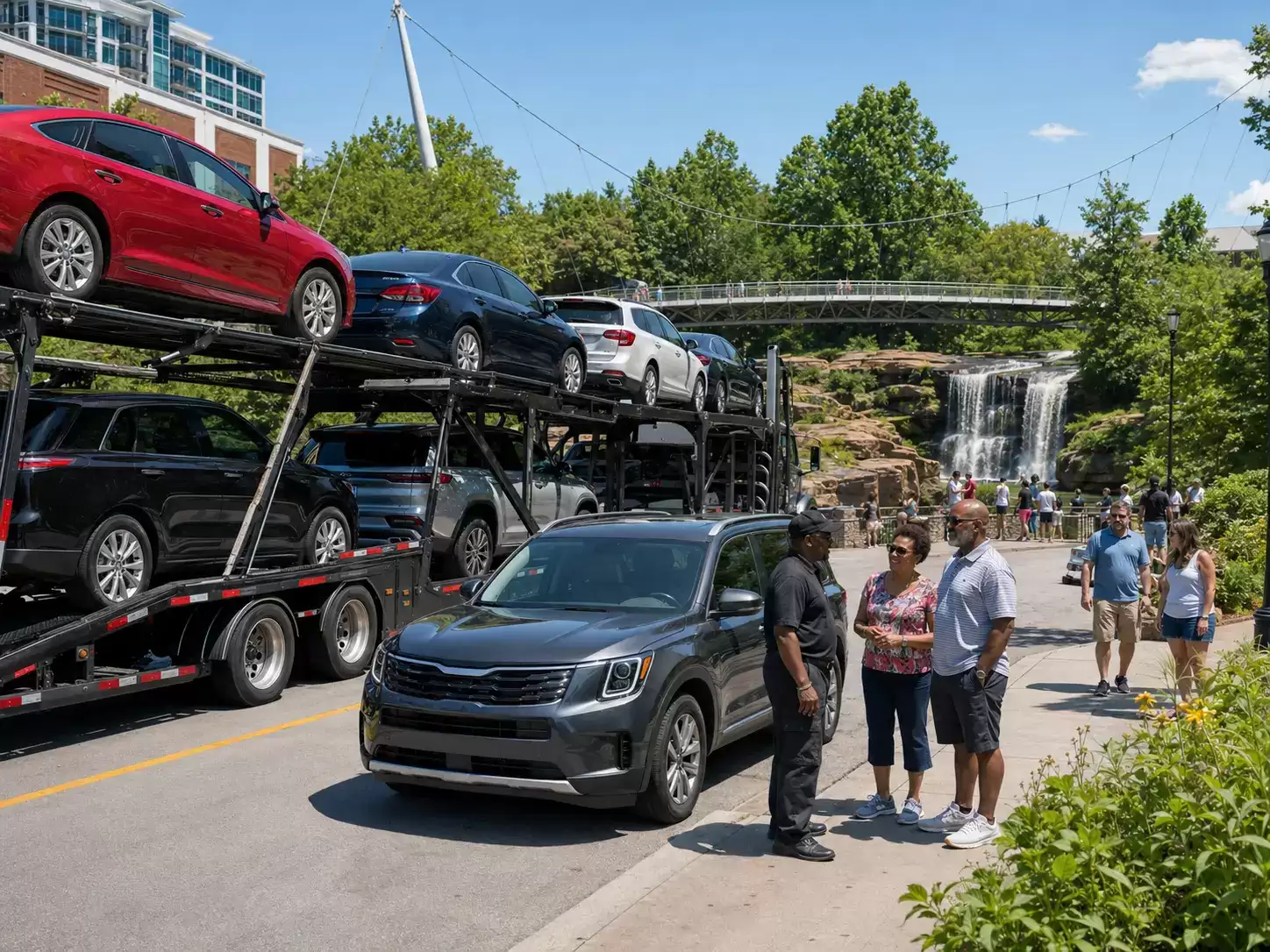
The tables below show estimated pricing for the most commonly requested South Carolina auto transport routes, based on real-time market data for a standard operable sedan via open carrier. All prices reflect current market conditions for Standard, Expedited, and Rush tiers. Your actual quote may vary based on vehicle size, exact pickup/delivery zip codes, and seasonal demand. Use our instant calculator for a real-time rate.
Popular Routes To South Carolina
Swipe to view full table →
| From | To | Distance (mi) | Estimated Days | Standard | Expedited | Rush |
|---|---|---|---|---|---|---|
| New York | South Carolina | 900 | 3–5 days | $775 | $930 | $1,085 |
| Florida | South Carolina | 500 | 2–3 days | $550 | $660 | $770 |
| Texas | South Carolina | 1,200 | 3–5 days | $925 | $1,110 | $1,295 |
| California | South Carolina | 2,600 | 7–10 days | $1,450 | $1,740 | $2,030 |
| Ohio | South Carolina | 750 | 2–4 days | $675 | $810 | $945 |
| Washington DC | South Carolina | 600 | 2–4 days | $575 | $690 | $805 |
| North Carolina | South Carolina | 250 | 1–2 days | $350 | $420 | $490 |
| Georgia | South Carolina | 340 | 1–2 days | $375 | $450 | $525 |
| Michigan | South Carolina | 1,050 | 3–5 days | $875 | $1,050 | $1,225 |
| Illinois | South Carolina | 900 | 3–5 days | $775 | $930 | $1,085 |
Popular Routes From South Carolina
Swipe to view full table →
| From | To | Distance (mi) | Estimated Days | Standard | Expedited | Rush |
|---|---|---|---|---|---|---|
| South Carolina | New York | 900 | 3–5 days | $775 | $930 | $1,085 |
| South Carolina | Florida | 500 | 2–3 days | $550 | $660 | $770 |
| South Carolina | Texas | 1,200 | 4–6 days | $925 | $1,110 | $1,295 |
| South Carolina | California | 2,600 | 7–10 days | $1,450 | $1,740 | $2,030 |
| South Carolina | Ohio | 750 | 2–4 days | $675 | $810 | $945 |
| South Carolina | Washington DC | 600 | 2–4 days | $575 | $690 | $805 |
| South Carolina | North Carolina | 250 | 1–2 days | $350 | $420 | $490 |
| South Carolina | Georgia | 340 | 1–2 days | $375 | $450 | $525 |
| South Carolina | Michigan | 1,050 | 3–5 days | $875 | $1,050 | $1,225 |
| South Carolina | Illinois | 900 | 3–5 days | $775 | $930 | $1,085 |
Why cross-country vehicle transport from South Carolina often costs less per mile than shorter hauls
South Carolina shippers are sometimes surprised to find that shipping a car to California runs only moderately more than shipping to New York, even though California is nearly three times the distance. The explanation is carrier economics. A carrier running Charleston to Los Angeles on I-10 is making a full transcontinental run, spreading fixed costs — driver time, fuel, insurance, overhead — across 2,600 miles. The per-mile cost drops sharply at that distance. On a shorter haul to New York (900 miles), the carrier makes a deliberate mid-range run with the same cost structure compressed into fewer miles, producing a higher per-mile rate even though the absolute dollar amount is lower. This is why South Carolina-to-Florida and South Carolina-to-New York rates often look closer to each other than the distance difference suggests, and why true cross-country moves from South Carolina frequently feel like the best value on a cost-per-mile basis.

Best time to ship a car to or from south Carolina — the complete seasonal guide

South Carolina car shipping service tiers
| Tier | How It Works | Pickup Window | Best For | Price vs. Standard |
|---|---|---|---|---|
| Standard | Listed at market rate; carrier assigned when available | 3–7 business days | Flexible schedules; off-peak season; Charleston and Columbia primary corridor pickups; I-95 Florence corridor | Base rate |
| Expedited (most popular) |
Listed above market rate; attracts carriers faster through the load board | 1–3 business days | Most South Carolina shippers; Fort Jackson PCS; Myrtle Beach and Hilton Head year-round; university and peak summer moves | +20% |
| Rush | Top of market; maximum carrier priority; first available driver assigned | Same or next business day | Hard Fort Jackson or MCAS Beaufort report-by dates; last-minute summer peak moves; urgent relocation deadlines | +40% |
The South Carolina-specific tier recommendation
For most South Carolina shippers using Charleston or Columbia as their origin or destination, Standard tier performs well during the off-peak period of December through March, when carrier availability is favorable and Fort Jackson’s baseline demand keeps the Columbia hub active without overwhelming it. The I-26 corridor between Charleston and Columbia, and the I-77 corridor between Columbia and Charlotte, both carry enough through-carrier traffic to support Standard tier pickup windows in the three-to-five business day range during quiet months. From April onward, and particularly from May through September, Expedited tier becomes the correct default for any South Carolina shipper with a meaningful delivery deadline: Fort Jackson PCS season, university move-out, the coastal resort peak, and the retirement migration all compete simultaneously for carrier capacity, and Standard listings in peak months can sit longer than most shippers find acceptable. Coastal resort markets — Myrtle Beach, Hilton Head, Beaufort, and Pawleys Island — should use Expedited as their baseline year-round given the detour required from the primary interstates. MCAS Beaufort and Shaw AFB shippers with hard report-by orders should default to Expedited and upgrade to Rush only when the report date is within a week of the desired pickup during the May-through-August PCS compression.


How to ship a car to or from South Carolina: 4 steps
Step 1: Get your instant quote. Use our South Carolina car shipping calculator above. Enter your pickup zip code, delivery zip code, vehicle year, make, and model. Your real-time quote appears in 30 seconds, with Standard, Expedited, and Rush pricing shown side by side. No phone call required.
Step 2: Book your order — no upfront payment. Select your tier and confirm your pickup window. We do not charge your card until a carrier is assigned and confirmed. Your card is only authorized when your driver is locked in and ready to pick up your vehicle.
Step 3: Carrier pickup and inspection. Your assigned carrier contacts you directly to confirm pickup timing. At pickup, the driver completes a Bill of Lading inspection report documenting your vehicle’s pre-transport condition on all panels. Review it carefully before signing — this document is your protection record at delivery.
Step 4: Delivery and final inspection. Your driver will contact you before arrival to coordinate delivery. At delivery, inspect your vehicle against the Bill of Lading before signing off. Payment to the carrier (cash or certified funds) is due at delivery. If you note any new damage, document it on the Bill of Lading before the driver departs — this is the required first step for any carrier insurance claim.
University and college vehicle transport in South Carolina
The University of South Carolina in Columbia and Clemson University collectively enroll more than 64,000 students and are two of the most recognizable university campuses in the Southeast. The August move-in and May move-out periods create a concentrated vehicle shipping demand in the Columbia and Upstate markets that, combined with the Fort Jackson PCS cycle, makes May through August South Carolina’s most competitive booking window for carrier availability. Book three to four weeks ahead and select Expedited tier if your shipment falls within two weeks of a university move period.
| University | Location | Approx. Enrollment |
|---|---|---|
| University of South Carolina | Columbia | ~36,000 |
| Clemson University | Clemson | ~28,000 |
| Coastal Carolina University | Conway (Myrtle Beach area) | ~11,000 |
| College of Charleston | Charleston | ~10,000 |
| Winthrop University | Rock Hill | ~6,000 |
| The Citadel | Charleston | ~4,000 |
| Francis Marion University | Florence | ~4,000 |
| South Carolina State University | Orangeburg | ~3,000 |
| Furman University | Greenville | ~3,000 |
| Bob Jones University | Greenville | ~3,000 |

Military base vehicle shipping in South Carolina
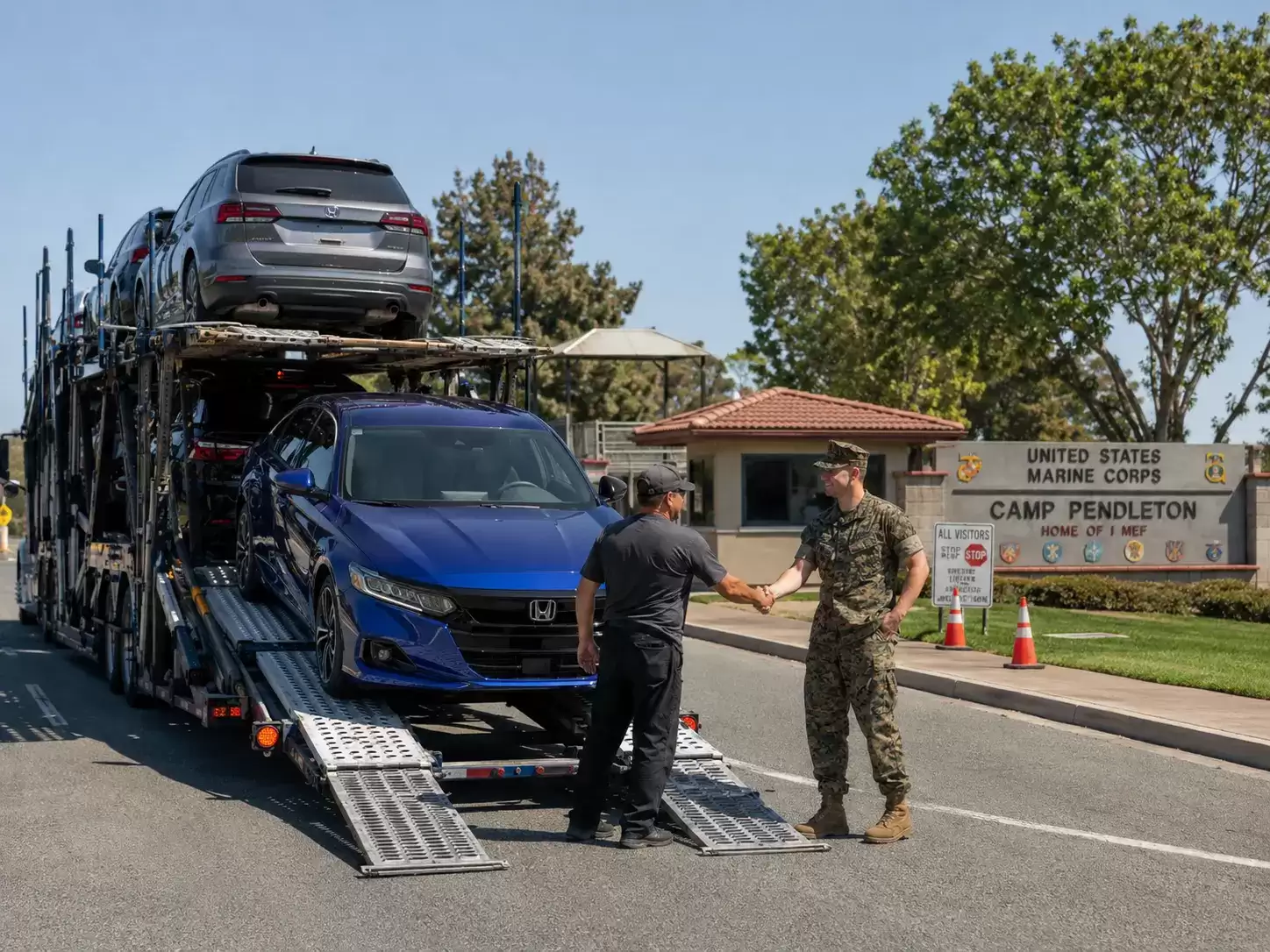
South Carolina hosts one of the most significant military footprints in the Southeast, anchored by Fort Jackson — the largest Army basic training installation in the United States. PCS vehicle shipping demand from South Carolina installations is among the highest per-capita of any state in the country, driven by Fort Jackson’s continuous training cycle and the concentrated Marine and Air Force presence along the coast and in the Midlands.
Fort Jackson — Columbia
The Army’s largest and most active Initial Entry Training installation sits on the eastern edge of Columbia, enrolling more than 50,000 trainees annually. Fort Jackson’s location inside the I-20/I-26/I-77 convergence hub gives PCS shippers direct access to South Carolina’s best carrier network. Soldiers receiving first duty station orders after Fort Jackson training ship vehicles to installations nationwide. Family members accompanying trainees relocate to the Columbia area continuously. Expedited tier recommended for hard report-by date PCS moves during May through August peak season.
Marine Corps Air Station Beaufort — Beaufort
MCAS Beaufort is one of the Marine Corps’ primary F/A-18 Hornet and F-35 pilot training installations, located in coastal Beaufort County on US-21 south of I-95. The station’s Lowcountry location — accessible only via US-21 or US-278 from the I-95 corridor — places it off the primary carrier trunk routes. Expedited tier is strongly recommended for all MCAS Beaufort PCS shipments, and Rush tier should be considered for hard report-by orders during the May–July peak PCS season.
Shaw Air Force Base — Sumter
Shaw AFB, home of the 20th Fighter Wing’s F-16CM Fighting Falcons, is located in Sumter County on US-76 between Columbia and Florence. Shaw sits between the I-20 and I-95 corridors with reasonable secondary access from both. Personnel at Shaw receive Charlotte and Columbia hub carrier service for most long-distance PCS routes. Expedited recommended for firm report-by date shipments during peak PCS season.
Joint Base Charleston — North Charleston
Joint Base Charleston combines Charleston AFB and Naval Weapons Station Charleston into a joint installation in the North Charleston metro, with direct I-26 and I-526 access. JB Charleston benefits from the full Charleston metro carrier network, making it the most logistically accessible South Carolina installation for PCS vehicle shipping. Standard tier is competitive at JB Charleston for off-peak moves; Expedited recommended during summer peak.
Cities we serve in South Carolina
We provide auto transport pickup and delivery throughout South Carolina. Cities on or near the I-26, I-95, I-85, and I-77 corridors have the shortest pickup windows and most competitive rates. Coastal resort communities and rural Pee Dee region markets may require Expedited tier for time-sensitive shipments.
Charleston Metro / I-26 / I-526 Mark Clark Expressway
Charleston — South Carolina’s largest metro and primary coastal carrier hub; I-26 direct access northwest toward Columbia; I-526 beltway serves all Charleston-area zip codes; sustained retirement and relocation demand from the Northeast; daily carrier departures in all directions. North Charleston — Joint Base Charleston host community and primary industrial district; I-26 and I-526 access with strong carrier truck infrastructure. Summerville — Dorchester County’s largest suburb northwest of Charleston on I-26; fast-growing retirement and relocation market with consistent carrier access from the I-26 corridor. Mount Pleasant — Easternmost Charleston suburb across the Cooper River; US-17 and I-526 access; strong retirement and luxury relocation market. Goose Creek and Hanahan — Berkeley County communities on I-26 northwest of Charleston; served from the Charleston metro hub with competitive pickup windows. Walterboro — Colleton County seat on I-95 between Charleston and Savannah; benefits from constant I-95 through-carrier traffic in both directions.
Columbia Metro / I-20 / I-26 / I-77 Convergence
Columbia — State capital and South Carolina’s most connected carrier hub at the convergence of I-20, I-26, and I-77; Fort Jackson generates year-round PCS demand; University of South Carolina drives annual student move demand; multiple interstate departures daily in all directions. West Columbia and Cayce — Lexington County communities immediately west of Columbia on I-26 and I-20; served from the Columbia hub with equivalent pickup windows. Irmo and Lexington — Rapidly growing Columbia suburbs in Lexington County; I-26 and I-20 beltway access. Aiken — Western South Carolina hub on I-20 toward Augusta; Savannah River Site generates nuclear industry relocation demand; Expedited recommended for time-sensitive moves. Orangeburg — Midlands hub on I-26 between Columbia and Charleston; home of South Carolina State University; reasonable carrier access from I-26 through traffic.
Upstate South Carolina / I-85 Greenville-Spartanburg Corridor
Greenville — Upstate’s largest city on I-85 and I-385; vibrant downtown relocation market; BMW Manufacturing Plant proximity creates unique carrier activity; direct Charlotte and Atlanta corridor access on I-85. Spartanburg — I-85/I-26 junction city; treated as a single Greenville-Spartanburg carrier market; BMW Zentrum and Upstate manufacturing corridor. Anderson — I-85 corridor between Greenville and the Georgia border; Clemson University proximity; reasonable carrier access from I-85 through traffic. Clemson — Home of Clemson University on US-123 west of Greenville; significant annual student vehicle shipping demand in August and May; Expedited recommended during university move periods. Gaffney — Cherokee County seat on I-85 near the North Carolina border; served from the Greenville-Spartanburg hub.
I-95 Coastal Corridor / Florence / Pee Dee Region
Florence — Pee Dee region’s primary hub at the I-20/I-95 junction; strategically positioned for both east-west and north-south carrier routes; Francis Marion University; Standard tier reliable year-round given I-95 through traffic. Dillon — Northernmost I-95 waypoint in South Carolina near the North Carolina border; served from the Florence hub. Sumter — Shaw AFB host community; US-76 access between Columbia and Florence; secondary carrier access from both the Columbia and Florence hubs. Conway — Horry County seat on US-501 between I-95 and Myrtle Beach; Coastal Carolina University campus; Expedited recommended.
Myrtle Beach / Grand Strand / Coastal Highway
Myrtle Beach — Grand Strand’s largest city; accessible via US-501 from I-95 or US-17 along the coast; deliberate carrier detour required year-round; summer peak sees best availability; Expedited strongly recommended outside of June–August. North Myrtle Beach and Surfside Beach — Grand Strand resort communities on US-17; served from the Myrtle Beach area market. Pawleys Island — Georgetown County barrier island community south of Myrtle Beach; upscale retirement and second-home market; Expedited required.
I-77 Northern Gateway / Rock Hill / York County
Rock Hill — York County seat at the North Carolina border on I-77; southernmost community in the Charlotte carrier market’s effective service area; Standard tier competitive year-round given Charlotte hub proximity. Fort Mill — York County’s fastest-growing community adjacent to Charlotte on I-77; essentially a Charlotte suburb with Charlotte-level carrier access. York and Clover — York County communities west of Rock Hill; served from the Rock Hill/Charlotte hub. Hilton Head Island — Beaufort County’s coastal resort and retirement island; accessible only via US-278 off I-95; Expedited strongly recommended year-round given the significant detour from the primary corridor; Rush tier should be considered for truly hard-deadline retirement move-in dates.
South Carolina government resources for vehicle shipping
- South Carolina Department of Motor Vehicles (SCDMV) — Official source for South Carolina vehicle registration, title transfer, and out-of-state vehicle titling requirements when your shipped vehicle arrives in South Carolina.
- South Carolina Department of Consumer Affairs — File a complaint or research a mover’s complaint history with South Carolina’s consumer protection office.
- FMCSA SAFER System — Look up any auto transport carrier’s federal operating authority, insurance status, and safety record before booking.
- FMCSA Protect Your Move — Federal consumer guidance on avoiding auto transport fraud and understanding your rights as a shipper.
- 511 South Carolina — Road Conditions — Current road conditions, construction updates, and traffic advisories on South Carolina interstates that may affect carrier transit times.

Popular long-distance South Carolina car transport routes
South Carolina to Florida: Car Shipping
South Carolina-to-Florida is the state’s highest-volume long-distance corridor, driven by both the retirement migration from South Carolina to South Florida and the reverse flow of Florida residents relocating to coastal South Carolina. I-95 south from Charleston and Columbia runs directly through Savannah, Jacksonville, and into Miami. The I-95 corridor is the most carrier-dense highway in South Carolina, and Florida-bound loads are available year-round. Transit is typically 2–3 days. This is one of the few South Carolina routes where Standard tier performs reliably year-round given the constant bidirectional carrier traffic.
South Carolina to New York: Auto Transport
I-95 north from Charleston and Columbia runs directly through the I-95 Northeast Corridor through Richmond, Washington DC, Baltimore, Philadelphia, and into New York. The Northeast Corridor is the single most carrier-dense highway segment in the United States, and New York-bound loads from South Carolina compete in a well-supplied market year-round. Transit is typically 3–5 days. The retirement migration from New York to coastal South Carolina ensures strong backhaul demand in both directions, keeping rates competitive.
South Carolina to Georgia: Vehicle Shipping
I-26 west from Columbia to Spartanburg connects directly to I-85 southwest toward Atlanta. Alternatively, I-95 south from Charleston exits into Savannah in approximately 105 miles. Both corridors are well-served by carriers running the Southeast. Atlanta’s enormous relocation demand creates constant Georgia-bound carrier freight. Transit from Columbia to Atlanta is typically 1–2 days.
South Carolina to North Carolina: Vehicle Transport
I-77 north from Columbia and I-85 north from Greenville-Spartanburg both reach Charlotte in under 90 minutes, giving South Carolina direct access to one of the Southeast’s largest carrier hubs. Charlotte serves as the gateway to all North Carolina markets including Raleigh-Durham, Greensboro, and Wilmington. Transit is typically 1–2 days to Charlotte and 2–3 days to eastern North Carolina.
South Carolina to Tennessee: Car Transport
South Carolina-to-Tennessee routes run north via I-85 through Charlotte and west toward Knoxville and Nashville, or north via I-77 to Charlotte and northwest via I-40 toward Asheville and Knoxville. Nashville’s status as one of the fastest-growing relocation markets in the country means Tennessee-bound carrier freight is well-supplied from South Carolina. Transit is typically 3–5 days.
South Carolina to Virginia: Auto Shipping
I-95 north from South Carolina runs directly through Richmond, providing straightforward access to the Northern Virginia/DC metro and Hampton Roads. Virginia-bound loads benefit from the I-95 Northeast Corridor’s year-round carrier density. Transit from Columbia to Richmond is typically 2–3 days; Northern Virginia is typically 3–4 days.
South Carolina to Texas: Vehicle Relocation
South Carolina-to-Texas routes run west via I-20 through Augusta and Atlanta, then west via I-20 to Dallas or south via I-10 toward Houston and San Antonio. Dallas and Houston are among the most active carrier destination markets in the country, ensuring good carrier availability for Texas-bound South Carolina freight. Transit is typically 4–6 days.
South Carolina to Ohio: Car Hauling
I-77 north from Columbia to Charlotte and then north via I-77 into Ohio reaches Charlotte, Statesville, and eventually I-77’s northern terminus near Cleveland. Alternatively, I-85 north to Charlotte and I-85 north into Virginia connects to I-81 north toward Ohio. Ohio’s manufacturing base ensures strong bidirectional carrier traffic on all Ohio-to-Southeast corridors. Transit is typically 2–4 days.
South Carolina to Michigan: Vehicle Hauling
I-77 or I-85 north to Charlotte, then I-77 or I-81 north through West Virginia and Ohio toward Detroit and the Michigan manufacturing corridor. Michigan’s automotive industry creates consistent freight demand between the Midwest and Southeast. Transit is typically 3–5 days.
South Carolina to Illinois: Auto Carrier
South Carolina-to-Illinois routes run north via I-26 and I-77 to Charlotte, then west via I-40 toward Nashville and north via I-65 to Chicago, or north via I-77 through Ohio and west via I-90 toward Chicago. Chicago’s role as the Midwest’s primary carrier hub keeps Illinois-bound loads well-served. Transit is typically 3–5 days.
South Carolina to Washington DC: Car Carrier
I-95 north from South Carolina runs directly to Washington DC in approximately 600 miles from Columbia — one of the most carrier-dense segments of the Eastern Seaboard. DC-bound loads from South Carolina are among the most reliably served on the East Coast given the constant bidirectional government and civilian relocation freight on this corridor. Transit is typically 2–4 days.
South Carolina to California: Vehicle Shipping
South Carolina-to-California routes run west via I-20 and I-10 through Atlanta, Houston, and El Paso, continuing west on I-10 to Los Angeles, or via I-40 through Albuquerque to the I-15 California corridor. Long-distance cross-country routes from South Carolina run on some of the most heavily traveled carrier arteries in the country. Transit is typically 7–10 days. Per-mile cost drops significantly on these full transcontinental runs.

Nearby states for South Carolina auto transport
North Carolina: Car Shipping
North Carolina borders South Carolina to the north along its entire length. I-77 connects Columbia directly to Charlotte in approximately 90 miles; I-85 connects Greenville-Spartanburg to Charlotte in approximately 75 miles; I-95 connects eastern South Carolina to the North Carolina border near Dillon. Charlotte is the Southeast’s most important carrier hub and its proximity to South Carolina’s northern border makes North Carolina-South Carolina one of the most carrier-dense neighboring market pairs in the region.
Georgia: Auto Transport
Georgia borders South Carolina to the southwest, with Savannah approximately 105 miles south of Charleston on I-95 and Atlanta approximately 220 miles west of Greenville on I-85. Both corridors are among the most heavily traveled carrier routes in the Southeast. Georgia-bound shipments from South Carolina benefit from Atlanta’s massive carrier hub amplifying available freight capacity in both directions.
Florida: Vehicle Shipping
Florida is South Carolina’s highest-volume long-distance corridor partner, driven by I-95 south through Savannah and Jacksonville. The sustained retirement migration from South Carolina to coastal Florida — and the reverse flow of Florida residents relocating to South Carolina — keeps this corridor among the most carrier-dense on the entire East Coast. Bidirectional carrier availability is strong year-round.
Virginia: Vehicle Transport
Virginia borders South Carolina to the north via North Carolina, accessible via I-95 north through the Northeast Corridor or I-77 north through Charlotte and West Virginia. The Northern Virginia and Richmond markets are key carrier origin points for the southbound retirement and relocation flow into South Carolina. Virginia-South Carolina is a well-served corridor with consistent bidirectional carrier traffic year-round.
Tennessee: Auto Shipping
Tennessee is accessible from South Carolina via I-85 north through Charlotte and I-40 west toward Knoxville and Nashville, or via I-77 north toward Bristol. Nashville’s boom as a relocation destination has significantly increased carrier traffic on all corridors connecting the Southeast to Middle Tennessee. Transit from Columbia to Nashville is typically 3–5 days.
Alabama: Car Hauling
Alabama is accessible from South Carolina via I-85 west through Atlanta and on into Birmingham and Montgomery, or via I-20 west through Augusta. Alabama-bound loads from South Carolina route through the Atlanta carrier hub, which amplifies available capacity for westbound Southeast freight. Transit from Columbia to Birmingham is typically 3–4 days.

Ready to ship your car to or from South Carolina?
Join hundreds of thousands of customers — Snowbirds, military families, tech relocators, students, and families moving across the country — who have trusted Direct Express Auto Transport with their South Carolina vehicle shipments since 2004. Get your instant, no-obligation quote now. It takes 30 seconds, requires no personal information, and there is no upfront payment required to hold your spot.
Instant quote — real-time pricing in under 5 seconds
No upfront payment — your card is charged only when a carrier is assigned
No risk to get a quote and book your order
BBB Accredited A+ since 2004
FMCSA licensed and fully bonded
4.6 stars across thousands of verified Google reviews