
Car Shipping To or From Oklahoma
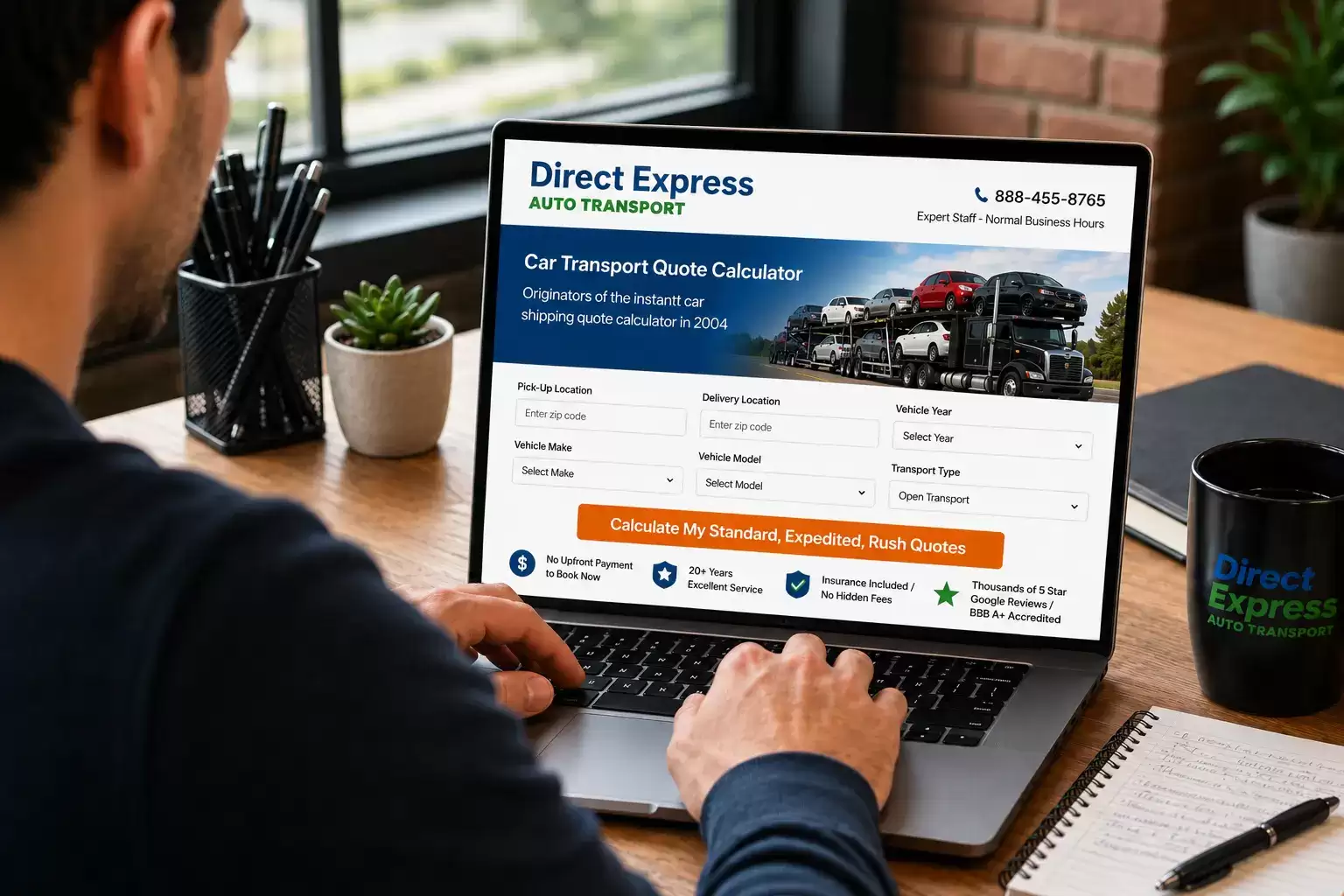
Need to ship a car to or from Oklahoma? Direct Express Auto Transport has been the Sooner State’s most trusted auto transport broker since 2004 — with a 4.6-star average across thousands of verified Google reviews, no upfront payment required, and a real-time quote available in 30 seconds.
★ 4.6/5 Google Reviews | BBB Accredited A+ | FMCSA Licensed (MC #479342) | USDOT #1240502 | No upfront payment required | 20+ years shipping vehicles


Oklahoma car shipping costs vary based on your route, the time of year, vehicle size, and the service tier you choose. Use our instant calculator above for a real-time quote — or see the route-by-route pricing tables below for a fast ballpark. Most standard sedan shipments to or from Oklahoma range from $375 for short-haul routes to Kansas to $1,275 or more on transcontinental routes to California. Our Expedited and Rush pricing tiers hasten the process to create an even more satisfying experience.
What customers say about shipping a car to or from Oklahoma with Direct Express Auto Transport


The interstate corridors that move Oklahoma vehicles
I-40 (East-West backbone): Oklahoma’s most important carrier artery and one of the most heavily traveled freight corridors in the United States, running from the Texas panhandle state line west of Shamrock east through Elk City, Clinton, Weatherford, Yukon, Oklahoma City, Shawnee, McAlester, and Henryetta before crossing into Arkansas. I-40 is the historic Route 66 corridor and is today the primary carrier route for all transcontinental east-west vehicle shipping across the southern United States. The Oklahoma City metro sits at the midpoint of I-40’s US run, and through-carrier traffic between California and the Southeast passes continuously through OKC in both directions every day.
I-35 (North-South backbone): Oklahoma’s primary north-south carrier artery, running from the Texas state line south of Gainesville north through Ardmore, Pauls Valley, Norman, Oklahoma City, Edmond, Guthrie, Stillwater (US-177 connector), and Ponca City before crossing into Kansas. I-35 is the primary carrier corridor for Texas-to-Midwest vehicle shipping and is the route most carriers use for OKC-to-Kansas City or OKC-to-Chicago loads. Norman, Edmond, and the Oklahoma City metro benefit directly from I-35 through-carrier traffic in both directions.
I-44 (OKC to Tulsa diagonal): The primary carrier route between Oklahoma City and Tulsa, running northeast from I-40 near OKC through Chandler, Stroud, Bristow, Sapulpa, and into Tulsa. I-44 also extends southwest from OKC through Lawton toward the Texas border, providing the primary carrier access to Fort Sill and the Lawton market. The OKC-to-Tulsa corridor on I-44 is one of the most consistent intrastate carrier routes in the state, with carriers frequently running loads between the two major metros.
I-240 (OKC South Loop): Runs from I-44 south of OKC east through the south Oklahoma City metro to I-40 near Tinker AFB in Midwest City. I-240 provides carrier access to Tinker AFB, the southeast OKC metro, and the I-40 eastern corridor without requiring carriers to traverse downtown Oklahoma City. The Midwest City and Del City communities along I-240 benefit from direct Tinker AFB carrier proximity.
US-412 / US-64 (Northwest-Southeast connector): Provides the primary carrier route through northwestern Oklahoma and connects Tulsa to the northwest via Claremore, Pryor, Vinita, and the I-44 Will Rogers Turnpike. Northeastern Oklahoma communities on this corridor have reasonable carrier access via the Tulsa market. Far northwestern Oklahoma including Woodward, Enid, and the Panhandle communities rely primarily on the I-40 carrier network to the south or the I-35 corridor to the east for carrier staging.
Oklahoma carrier dynamics: the I-40/I-35 crossroads advantage
The single most important fact about Oklahoma carrier dynamics is that Oklahoma City sits at the intersection of I-40 and I-35 — the two busiest carrier corridors in the central United States. This is not a local advantage. It is a national routing advantage. Carriers planning transcontinental loads from Los Angeles to Atlanta, or from Houston to Chicago, are routing through Oklahoma City regardless of whether they have any Oklahoma loads. Every day, dozens of carrier trucks pass through the OKC metro on through-corridor runs. These carriers have open slots. OKC shippers can fill those slots at competitive rates because the carrier is already coming through town.
The practical effect is that Oklahoma City and the immediate metro — Norman, Edmond, Midwest City, Moore, Yukon — consistently produce some of the fastest Standard tier pickup windows in the South-Central region. A shipper in Edmond moving a vehicle to Dallas will typically see a carrier assigned within 1–2 business days. A shipper in Norman moving to Los Angeles can access the westbound I-40 through-corridor carriers that pass through daily.
This through-carrier advantage diminishes as you move away from the I-40/I-35 corridor: Lawton on I-44 southwest requires carriers to deliberately detour and pickup windows extend to 3–6 business days on Standard tier. Enid, Stillwater, and Muskogee similarly extend to 3–5 business days on Standard. The western Panhandle communities of Guymon and Woodward have minimal direct carrier access and require Expedited tier for reasonable pickup timelines.
Tulsa benefits from its position on I-44 and from the volume of carrier traffic running between the OKC metro and Arkansas, Missouri, and the Southeast. The Tulsa metro — Broken Arrow, Owasso, Jenks, Bixby, Sand Springs — has pickup windows of 2–4 business days on Standard tier, slightly behind OKC but strong for a city of its size. The I-44 Will Rogers Turnpike between OKC and Tulsa is one of the most reliable intrastate carrier corridors in Oklahoma.
Oklahoma vehicle shipping hub rankings
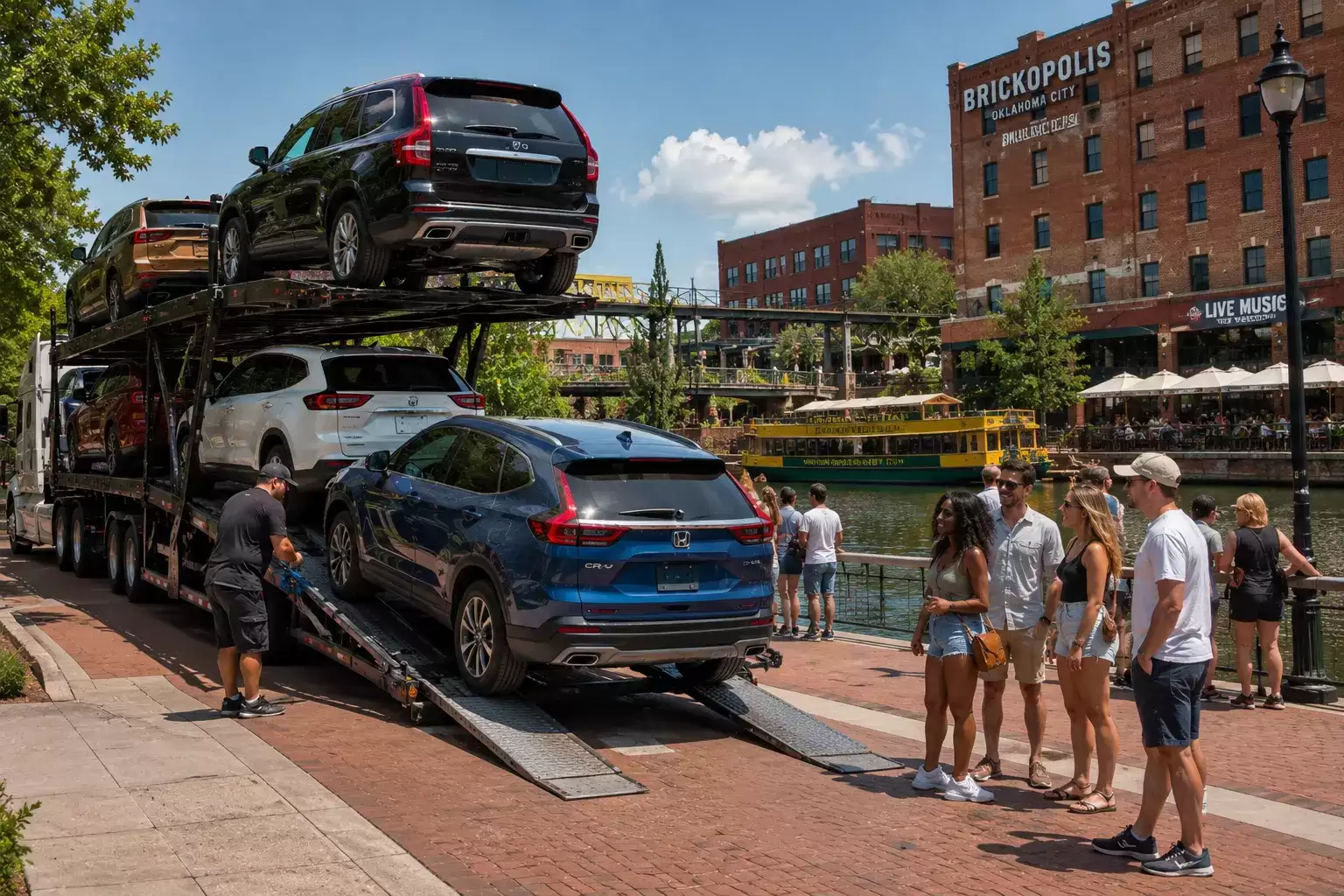
Oklahoma City / I-40 / I-35 / I-44 / I-240 — Tier 1 hub: Oklahoma’s largest city and the state’s dominant carrier hub. Oklahoma City sits at the convergence of I-40 and I-35 — the country’s primary east-west and north-south carrier corridors — and benefits from through-carrier traffic in four directions simultaneously. Standard tier is appropriate for virtually all OKC metro zip codes; pickup windows average 1–3 business days. The OKC metro’s grid of interstates and US highways gives carrier trucks excellent access to all neighborhoods from Bricktown and Midtown to the suburban communities of Yukon, Mustang, Moore, Del City, and Choctaw.
Tulsa / I-44 / US-75 / US-169 — Tier 1 hub: Oklahoma’s second-largest city and northeastern Oklahoma’s dominant carrier hub. Tulsa sits on I-44 between Oklahoma City and Joplin, Missouri, and benefits from carrier traffic running between the OKC metro and the Southeast. Standard tier works well for Tulsa with pickup windows of 2–4 business days. The Tulsa metro’s highway network including US-75 north and US-169 gives carrier trucks access to Broken Arrow, Owasso, Jenks, Bixby, and Sand Springs within the metro.
Norman / I-35 / SH-9 — Tier 1 hub: Home of the University of Oklahoma, Norman sits directly on I-35 twelve miles south of Oklahoma City and benefits from both the OKC metro carrier network and I-35 through-carrier traffic. Standard tier is appropriate for Norman; pickup windows average 1–3 business days, essentially matching the OKC metro. August and May generate a predictable student vehicle shipping surge that temporarily increases carrier demand but also increases supply, as carriers recognize the OU campus move cycle.
Edmond / I-35 / US-77 — Tier 1 hub: Oklahoma City’s primary northern suburb, Edmond sits directly on I-35 north of OKC and shares the metro’s exceptional carrier access. Standard tier produces pickup windows of 1–3 business days in Edmond. The University of Central Oklahoma in Edmond adds a student shipping component similar to Norman, with August and May demand spikes.
Broken Arrow / I-44 / US-51 — Tier 1 hub: Tulsa’s largest suburb and one of the fastest-growing cities in Oklahoma, Broken Arrow benefits from the Tulsa metro carrier network and US-51 access to I-44. Standard tier works well; pickup windows average 2–4 business days, matching Tulsa metro timing.
Midwest City / I-40 / I-240 — Tier 1 hub: Home of Tinker Air Force Base, the Air Force’s largest single-site employer, Midwest City sits at the I-40/I-240 junction east of Oklahoma City. Tinker AFB generates a year-round PCS vehicle shipping market that keeps carriers in the Midwest City corridor active. Standard tier is appropriate; pickup windows average 1–3 business days. Expedited is recommended for PCS moves with tight report dates.
Lawton / I-44 / US-62 — Tier 2 hub: Home of Fort Sill, one of the Army’s most active artillery training and PCS installations, Lawton sits on I-44 approximately 85 miles southwest of Oklahoma City. Expedited tier is strongly recommended for all Fort Sill PCS shipments and for most Lawton area moves. Standard tier produces pickup windows of 3–6 business days in Lawton, and Fort Sill gate access coordination requires advance carrier notification. Budget at least 7 days lead time for Fort Sill PCS vehicle shipping.
Enid / US-412 / US-60 — Tier 2 hub: Northwestern Oklahoma’s largest city, Enid has no direct interstate access and relies on the US-412/US-64 network to connect to I-35 and I-40. Standard tier produces pickup windows of 3–6 business days; Expedited is recommended for time-sensitive moves. Vance Air Force Base in Enid adds a PCS shipping component that keeps some carrier interest in the market year-round.

Oklahoma car shipping rates: popular routes and estimated costs
The tables below reflect current market averages for open-carrier transport of a standard sedan in good weather conditions. Prices vary based on fuel costs, carrier availability, season, and vehicle size. Use the calculator above for a real-time quote specific to your route and vehicle.
Popular routes from Oklahoma
| From | To | Distance (mi) | Estimated Days | Standard | Expedited | Rush |
|---|---|---|---|---|---|---|
| Oklahoma | Kansas | 200 | 1–2 | $375 | $450 | $525 |
| Oklahoma | Texas | 300 | 2–3 | $450 | $540 | $630 |
| Oklahoma | Arkansas | 300 | 2–3 | $450 | $540 | $630 |
| Oklahoma | Missouri | 375 | 2–3 | $475 | $570 | $665 |
| Oklahoma | Colorado | 625 | 3–4 | $600 | $720 | $840 |
| Oklahoma | Illinois | 750 | 3–5 | $700 | $840 | $980 |
| Oklahoma | Tennessee | 725 | 3–5 | $750 | $900 | $1,050 |
| Oklahoma | Georgia | 900 | 4–6 | $825 | $990 | $1,155 |
| Oklahoma | New York | 1,500 | 5–7 | $1,050 | $1,260 | $1,470 |
| Oklahoma | California | 1,450 | 5–8 | $1,275 | $1,530 | $1,785 |
Popular routes to Oklahoma
| From | To | Distance (mi) | Estimated Days | Standard | Expedited | Rush |
|---|---|---|---|---|---|---|
| California | Oklahoma | 1,450 | 5–8 | $1,275 | $1,530 | $1,785 |
| New York | Oklahoma | 1,500 | 5–7 | $1,050 | $1,260 | $1,470 |
| Georgia | Oklahoma | 900 | 4–6 | $825 | $990 | $1,155 |
| Tennessee | Oklahoma | 725 | 3–5 | $750 | $900 | $1,050 |
| Illinois | Oklahoma | 750 | 3–5 | $700 | $840 | $980 |
| Colorado | Oklahoma | 625 | 3–4 | $600 | $720 | $840 |
| Missouri | Oklahoma | 375 | 2–3 | $475 | $570 | $665 |
| Arkansas | Oklahoma | 300 | 2–3 | $450 | $540 | $630 |
| Kansas | Oklahoma | 200 | 1–2 | $375 | $450 | $525 |
| Texas | Oklahoma | 300 | 2–3 | $450 | $540 | $630 |
Why cross-country vehicle transport from Oklahoma is faster than you might expect
Shippers who have never shipped a vehicle long distance are often surprised by how quickly a cross-country move from Oklahoma City can be arranged. The reason is the I-40/I-35 crossroads. Carriers running California-to-Georgia loads on I-40 are already planning to pass through OKC. A vehicle origin in Norman or Edmond or Yukon is a minor detour from the I-35 corridor, not a deliberate excursion off the carrier’s planned route. Los Angeles to Oklahoma City is roughly 1,450 miles, and carriers running I-40 eastbound can pick up in OKC without adding meaningful mileage to their run. This is why OKC Standard tier pickup windows for transcontinental routes are measured in days, not weeks.
The I-35 north corridor is equally efficient. A carrier running Texas to Minneapolis will pass through Oklahoma City on I-35 without deviation. Kansas is 200 miles north of OKC on I-35 — short enough that carriers can add an Oklahoma load to a Kansas-bound run without significant route adjustment. Missouri, Iowa, and Minnesota are all accessible via I-35 with no major carrier routing challenge. This north-south corridor access, combined with I-40 east-west access, makes Oklahoma City one of the best markets for vehicle shipping in the central United States.

Oklahoma car shipping: month-by-month seasonal guide

Oklahoma auto transport service tiers: which is right for your move?
| Service Tier | Pickup Window | Best For | Price |
|---|---|---|---|
| Standard | 3–7 business days | OKC and Tulsa metro moves with flexible timelines. Best value for I-40/I-35 corridor cities. | Lowest |
| Expedited (most popular) |
1–3 business days | Fort Sill PCS orders, secondary markets (Lawton, Enid, Stillwater), spring tornado season, or any move requiring a reliable pickup window. | Moderate |
| Rush | Within 24–48 hours | Same-day or next-day pickup required. Unexpected PCS date changes, last-minute relocation, or emergency vehicle transport needs. | Premium |


How to ship a car to or from Oklahoma in 4 steps
Step 1: Get your instant quote. Use our online calculator above or call our team directly. Oklahoma City metro quotes typically return same-day carrier assignments at Standard tier. Secondary markets like Lawton and Enid may need 1–2 extra days of lead time for carrier matching.
Step 2: Book and schedule pickup. No upfront payment required. We match your vehicle to a licensed, insured carrier on your route. For Fort Sill PCS orders, provide your report date and we’ll coordinate gate access and the carrier timeline to align with your schedule. For Tinker AFB moves, the I-240 corridor gives carriers direct access without traversing downtown OKC.
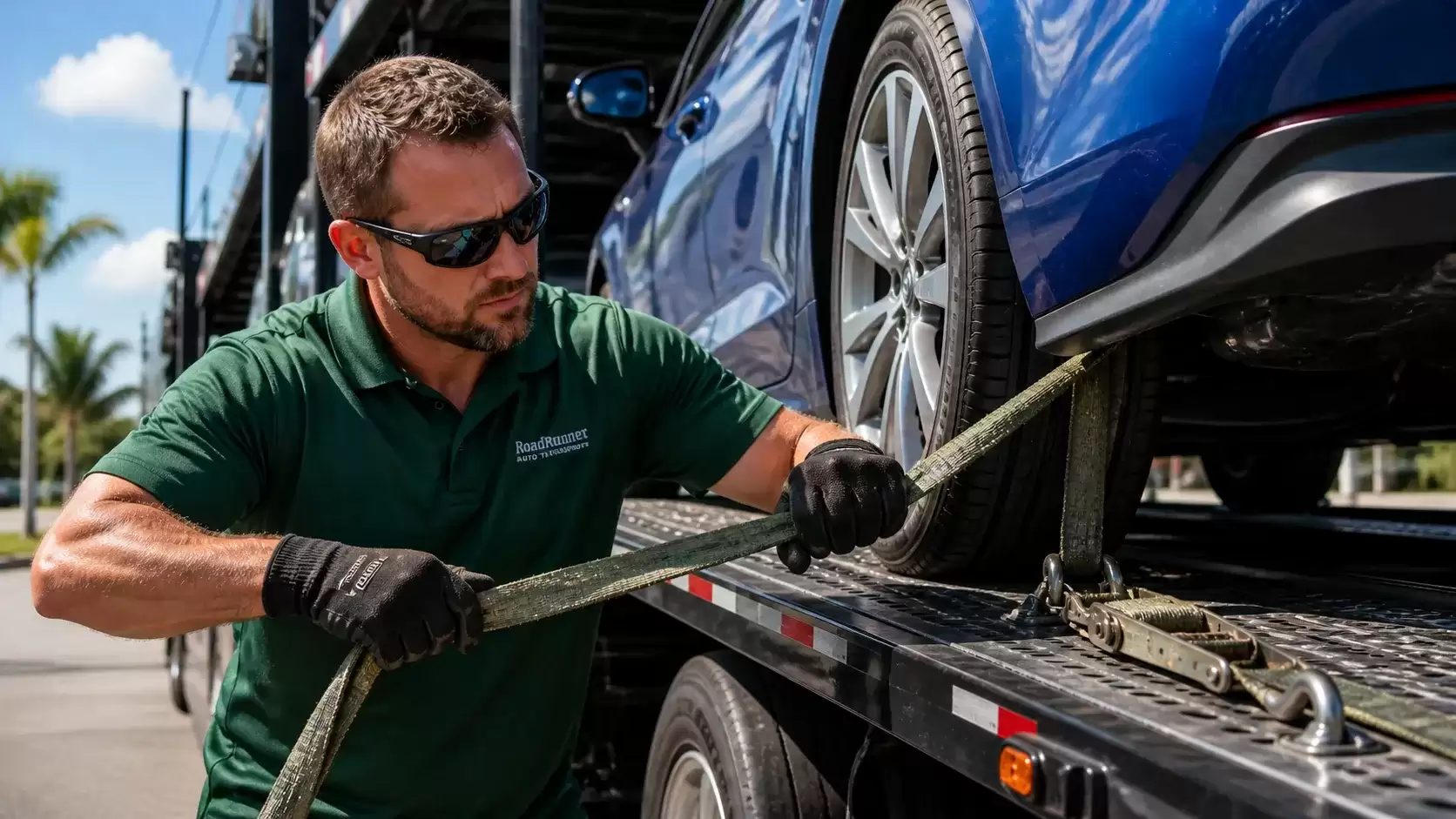
Step 3: Prepare your vehicle. Clean your vehicle inside and out, document all existing condition with time-stamped photographs, remove all personal items, and confirm your fuel level is at or below one-quarter tank. If shipping during spring tornado season (April–May), confirm your carrier has a flexible hold policy for brief weather delays during active severe weather days.
Step 4: Inspect and sign at delivery. Walk around the vehicle with the carrier before signing the Bill of Lading at delivery. Compare the delivery condition against your pre-shipment photographs. Any new damage must be noted on the Bill of Lading before you sign. Do not sign a clean Bill of Lading if there is new damage — document everything in writing at delivery.
Oklahoma university vehicle transport: campus shipping guide
Oklahoma’s universities generate predictable August move-in and May move-out vehicle shipping surges. The University of Oklahoma in Norman and Oklahoma State University in Stillwater are the two largest contributors to student vehicle shipping demand, but all campuses listed below add to the carrier activity cycle. Book 5–7 days in advance during August and May for the best Standard tier rates near major campuses.
| University | Location | Approx. Enrollment |
|---|---|---|
| University of Oklahoma | Norman | 30,000 |
| Oklahoma State University | Stillwater | 25,000 |
| University of Central Oklahoma | Edmond | 16,000 |
| Northeastern State University | Tahlequah | 8,500 |
| University of Tulsa | Tulsa | 4,500 |
| Oral Roberts University | Tulsa | 4,200 |
| Oklahoma City University | Oklahoma City | 3,500 |
| Cameron University | Lawton | 5,000 |
| Langston University | Langston | 3,000 |
| Northwestern Oklahoma State University | Alva | 2,000 |

Oklahoma military base auto transport guide
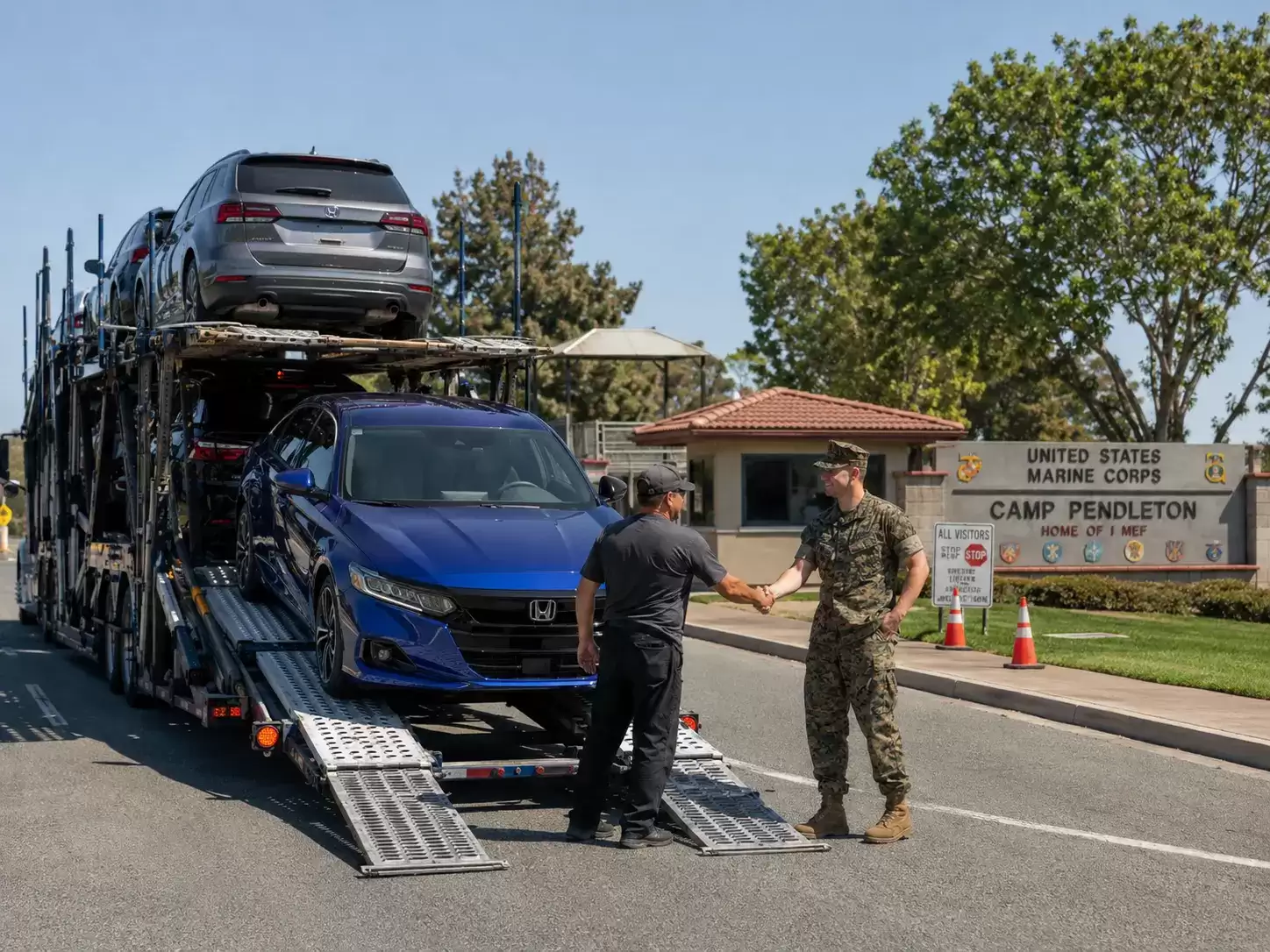
Tinker Air Force Base — Midwest City (I-240 / I-40): The Air Force’s largest single-site employer, Tinker AFB is located in Midwest City directly on the I-240 corridor east of Oklahoma City. Carrier access to the Midwest City area is excellent, and the proximity to I-40 and I-35 keeps carrier competition strong year-round. Standard tier is appropriate for most Tinker AFB PCS moves; the I-240/I-40 junction gives carriers direct access to the base area without navigating central OKC traffic. Expedited is recommended for PCS orders with tight report-date timelines. Budget 5–7 days lead time for Standard tier assignments around Tinker.
Fort Sill — Lawton (I-44 / US-62): One of the Army’s most active training and permanent change of station installations, Fort Sill sits adjacent to Lawton, 85 miles southwest of Oklahoma City on I-44. Expedited tier is strongly recommended for all Fort Sill PCS vehicle shipments. Lawton is not on a primary through-carrier route, and carriers must deliberately detour from I-44 or I-35 to reach the Lawton area. Standard tier pickup windows in Lawton average 5–7 business days. Budget at least 7–10 days lead time for any Fort Sill PCS move, and communicate your report date to our team so carrier coordination can begin immediately upon booking. Tip: if your timeline is extremely tight, staging your pickup at an Oklahoma City location and transporting personally to OKC for carrier pickup is an option that gives you access to the full metro carrier market.
Vance Air Force Base — Enid (US-412 / US-64): A USAF pilot training base located near Enid in north-central Oklahoma, Vance AFB is approximately 90 miles north of Oklahoma City via US-81 with no direct interstate access. Expedited is recommended for Vance AFB and Enid area PCS moves. Standard tier produces pickup windows of 4–7 business days. Vance’s flight training mission creates a predictable PCS cycle that keeps some carrier interest in the Enid market, but carrier volume is limited compared to the OKC metro.
Oklahoma City Metro and I-40/I-35 Corridor Auto Transport
Oklahoma City is the state’s largest city and its dominant carrier hub, anchored by the I-40/I-35 convergence. Through-carrier traffic in four directions keeps Standard tier pickup windows among the fastest in the South-Central region, averaging 1–3 business days. The OKC metro’s grid of interstates provides carrier truck access to every neighborhood including Bricktown, Midtown, the Paseo Arts District, and suburban communities throughout the metro.
Norman is the University of Oklahoma’s home city, located 12 miles south of OKC on I-35. Norman’s I-35 position means it shares OKC metro carrier access almost entirely, with Standard pickup windows of 1–3 business days. August and May generate predictable student vehicle shipping surges around the OU campus on the south side of the city.
Edmond is OKC’s primary northern suburb on I-35, home of the University of Central Oklahoma. Like Norman to the south, Edmond essentially shares OKC metro carrier access, with Standard pickup windows of 1–3 business days. The I-35 corridor through Edmond to Guthrie and Perry benefits from steady northbound through-carrier traffic toward Kansas.
Moore sits between Oklahoma City and Norman on I-35 and benefits from the full OKC metro carrier access. Standard tier works well for Moore, with pickup windows matching the OKC metro average. Moore’s I-35 frontage gives carriers direct access without detouring into residential areas.
Midwest City is adjacent to Tinker AFB and positioned directly on I-240 east of OKC. The Tinker AFB PCS market and the I-240/I-40 junction give Midwest City year-round carrier activity above what its residential population would generate independently. Standard tier is appropriate for most moves.
Yukon and Mustang are western OKC suburbs with access to I-40 west and Canadian County carrier staging areas. Standard tier pickup windows of 1–3 business days. Westbound I-40 loads toward Amarillo and the Southwest give these communities above-average outbound carrier availability.
Lawton is the state’s third-largest city and home of Fort Sill, but its distance from the primary I-40/I-35 corridor means carrier access is limited compared to the OKC metro. Expedited is strongly recommended for all Lawton and Fort Sill area moves. Standard tier produces pickup windows of 5–7 business days.
Tulsa Metro and I-44 Corridor Vehicle Shipping
Tulsa is northeastern Oklahoma’s largest city and the state’s second major carrier hub on I-44. The Tulsa metro benefits from carrier traffic running between OKC and Joplin, Springfield, and St. Louis to the northeast, giving Standard tier pickup windows of 2–4 business days. The Arkansas River corridor industrial zones provide carrier staging areas near the city center.
Broken Arrow is Tulsa’s largest suburb, located southeast of the city center with access to US-51 and the BA Expressway connecting to I-44. Standard tier works well for Broken Arrow, with pickup windows matching the Tulsa metro average of 2–4 business days.
Owasso is a fast-growing northern Tulsa suburb on US-169. Standard tier produces pickup windows of 2–4 business days, matching the Tulsa metro.
Jenks and Bixby are southern Tulsa suburbs along the Arkansas River corridor. Both benefit from Tulsa metro carrier access, with Standard pickup windows of 2–4 business days.
Sand Springs is a western Tulsa suburb on US-64/SH-97 with access to the I-44 corridor west of the city. Standard tier works well; pickup windows average 2–4 business days.
Claremore is northeast of Tulsa on US-66/SH-20 with access to the I-44 Will Rogers Turnpike. Standard tier usually works for Claremore, with pickup windows of 3–5 business days.
Secondary Oklahoma Markets and Western Oklahoma Corridor
Stillwater is home to Oklahoma State University, located on SH-51/US-177 between I-35 and US-412. Stillwater has no direct interstate access, and Standard tier produces pickup windows of 3–6 business days. Expedited is recommended for time-sensitive moves. August and May generate OSU student shipping surges that temporarily increase carrier interest but also increase competition for available loads.
Enid is north-central Oklahoma’s largest city and home of Vance AFB, with access via US-412 and US-81 to I-35 and I-40. Standard tier produces pickup windows of 4–7 business days; Expedited is recommended. The Vance AFB PCS market provides year-round carrier interest in the Enid market.
Muskogee is located east of Tulsa on US-69 with access to I-40 south and US-64 west to Tulsa. Standard tier produces pickup windows of 3–5 business days. The Muskogee port complex and industrial corridor provide some independent carrier staging activity.
Shawnee sits on I-40 east of Oklahoma City and benefits from direct interstate access, with Standard pickup windows of 2–4 business days. Pottawatomie County shippers on or near I-40 have better carrier access than the distance from OKC might suggest.
Ardmore is on I-35 between Oklahoma City and the Texas border. Its I-35 position gives it access to north-south through-carrier traffic, and Standard tier produces pickup windows of 2–4 business days for most Ardmore routes.
Elk City and Weatherford are western Oklahoma I-40 corridor cities that benefit from transcontinental carrier traffic on I-40 but have limited carrier staging depth. Standard tier produces pickup windows of 3–6 business days. Expedited is recommended for time-sensitive moves from far-western Oklahoma.
Woodward, Guymon, and the Oklahoma Panhandle communities are the most carrier-isolated areas of the state. Guymon in the Panhandle is approximately 60 miles from the nearest interstate corridor. Expedited tier is mandatory for Panhandle and far-western Oklahoma shipments, and budget at least 7–10 business days for Standard or 3–5 days for Expedited on Panhandle routes. Staging your vehicle in Elk City, Woodward, or even Liberal, Kansas may significantly improve pickup windows.

Oklahoma vehicle shipping: official government resources
- Oklahoma Tax Commission — Motor Vehicle Division — Oklahoma title transfers, registration renewals, and vehicle licensing.
- Oklahoma Attorney General — Consumer Protection — File complaints about deceptive auto transport practices or moving fraud in Oklahoma.
- FMCSA SAFER System — Verify any car carrier’s DOT number, insurance, and active operating authority before booking.
- FMCSA — Protect Your Move — Federal guidance on avoiding auto transport fraud and understanding your rights as a shipper.
- Oklahoma 511 — OK511 — Real-time Oklahoma road conditions, closures, and construction information including I-40, I-35, and I-44 corridor updates.

Popular long-distance auto transport routes to and from Oklahoma
Oklahoma to Texas: The South-Central Interstate Corridor
The Oklahoma City to Dallas run on I-35 is one of the most carrier-active routes in the South-Central United States. Dallas is approximately 200 miles south of OKC, and I-35 through-carrier traffic between the two metros is constant. Carriers run this corridor daily in both directions, producing Standard tier pickup windows of 1–2 business days in the OKC metro. Houston is accessible via I-35 south to I-45, and San Antonio via I-35 all the way to its southern terminus. Oklahoma-to-Texas is one of the most reliably priced and fastest-pickup routes in the country, with Standard sedan rates typically ranging from $400 to $500 depending on the Texas destination city.
Oklahoma to California: The I-40 Transcontinental Route
I-40 west from Oklahoma City directly to Los Angeles is one of the most important carrier corridors in the country. Carriers running coast-to-coast on I-40 pass through OKC daily in both directions, and Los Angeles to Oklahoma City is approximately 1,450 miles — a manageable single-run distance for experienced carriers. Standard tier pickup windows for OKC to Los Angeles average 1–3 business days, faster than most markets of OKC’s size. The I-40 corridor passes through Amarillo, Albuquerque, Flagstaff, and Barstow before reaching Los Angeles, and carriers on this route regularly accept Oklahoma loads because the state is on their planned route. Standard sedan rates typically range from $1,200 to $1,350 depending on the California destination.
Oklahoma to Florida: The Southeast Gulf Coast Corridor
Oklahoma to Florida typically routes via I-40 east to I-20 south to I-10 east through Alabama and into Florida, or via I-35 south to I-10 east along the Gulf Coast. Florida is one of the highest-volume destination states for Oklahoma vehicle shipments, driven by retiree relocations and the large number of Oklahoma military families transitioning to Florida bases. Jacksonville is approximately 1,150 miles from OKC, Miami approximately 1,400 miles. Standard tier produces pickup windows of 2–4 business days in the OKC metro for Florida routes; rates range from $925 to $1,075 for standard sedans depending on the Florida destination city.
Oklahoma to Illinois: The Midwest Connection via I-44 and I-55
Oklahoma to Illinois routes via I-44 northeast from OKC through Tulsa and Joplin, then I-44 continuing to St. Louis, and I-55 north to Chicago. Chicago is approximately 800 miles from Oklahoma City, and the I-44/I-55 corridor is one of the most carrier-active routes in the Midwest. Carriers running Oklahoma City to Chicago loads have a well-established routing on this corridor, and Standard tier pickup windows in the OKC metro for Illinois destinations average 2–4 business days. Rates typically range from $650 to $750 for a standard sedan to Chicago.
Oklahoma to Tennessee: The Nashville Corridor
Oklahoma to Nashville routes primarily via I-40 east through Arkansas and Memphis, continuing east to Nashville — a natural I-40 routing that places Oklahoma City and Nashville at opposite ends of the same primary interstate. Nashville is approximately 800 miles from OKC on I-40, and the through-carrier traffic on this corridor is consistent year-round. Standard tier produces pickup windows of 2–4 business days; rates typically range from $700 to $800 for a standard sedan.
Oklahoma to Georgia: The Atlanta Southeast Corridor
Oklahoma to Atlanta routes via I-40 east through Memphis, then I-22 or I-78 south to Atlanta, or via I-44 east to I-55 south to I-20 east into Atlanta. Atlanta is approximately 900 miles from OKC, and carrier traffic on the Oklahoma-to-Atlanta corridor is strong due to the large population difference between the two metros. Standard tier pickup windows in OKC for Atlanta destinations average 2–4 business days; rates range from $775 to $875 for a standard sedan.
Oklahoma to North Carolina: The Eastern Seaboard Route
Oklahoma to North Carolina typically routes via I-40 east all the way to the Research Triangle or the Charlotte metro, with I-40 running directly from Barstow, California to Wilmington, North Carolina — making this a direct interstate route with no major transfer required. Charlotte is approximately 1,200 miles from OKC; Raleigh and Durham are approximately 1,350 miles. Standard tier produces pickup windows of 3–5 business days; rates range from $975 to $1,075 for a standard sedan depending on the North Carolina destination.
Oklahoma to New York: The Northeast Transcontinental Haul
Oklahoma to New York City is a long-haul route of approximately 1,500 miles, typically via I-40 east to I-81 north or I-80 east, then down to the New York metro. The OKC to New York corridor is in demand year-round due to relocations between the two large metros. Standard tier produces pickup windows of 3–5 business days in the OKC metro; rates typically range from $1,000 to $1,100 for a standard sedan. New Jersey and Connecticut are accessible on the same carrier runs at similar rates.
Oklahoma to Colorado: The Denver Mile-High Corridor
Oklahoma to Denver routes primarily via I-35 north to Wichita then US-50 or I-70 west, or via US-270 northwest from OKC to Amarillo and I-25 north to Denver. Denver is approximately 650 miles from Oklahoma City, and the Colorado Front Range is one of the most popular inbound vehicle shipping destinations from Oklahoma. Standard tier produces pickup windows of 2–4 business days; rates range from $575 to $650 for a standard sedan. Colorado Springs is approximately 580 miles and priced similarly.
Oklahoma to Arizona: The Southwest I-40 Corridor
Oklahoma to Arizona routes directly via I-40 west, one of the most convenient long-distance routes available from OKC. Phoenix is approximately 1,200 miles west on I-40 via Albuquerque and then south on I-17. Tucson is accessible via I-10 west from the Tucson junction. The I-40 through-carrier advantage means that Arizona-bound loads from OKC access the same pool of transcontinental carriers running the California corridor. Standard tier pickup windows average 2–4 business days; rates range from $975 to $1,100 for a standard sedan to Phoenix.
Oklahoma to Ohio: The Midwest Great Lakes Connection
Oklahoma to Ohio routes via I-44 east through Tulsa and Joplin to St. Louis, then I-70 east through Indianapolis to Columbus, or I-75 north to Cincinnati. Columbus is approximately 1,050 miles from OKC; Cleveland approximately 1,200 miles; Cincinnati approximately 900 miles. The I-44/I-70 or I-44/I-75 corridors have consistent carrier traffic, and Standard tier produces pickup windows of 3–5 business days in the OKC metro. Rates range from $875 to $975 for a standard sedan depending on the Ohio destination city.
Oklahoma to Washington State: The Pacific Northwest Long Haul
Oklahoma to Seattle or the Pacific Northwest is one of the longest routes available from OKC, approximately 1,850 miles via I-40 west to I-15 north or via I-80 northwest. Seattle, Portland, and Spokane are the primary destinations, and this is a true transcontinental long haul that typically requires carrier relay or a dedicated long-haul carrier assignment. Standard tier produces pickup windows of 3–7 business days; rates range from $1,350 to $1,550 for a standard sedan depending on the Washington or Oregon destination city and the carrier routing used.

Nearby states for Oklahoma auto transport
Texas
Oklahoma’s southern neighbor and the most important carrier market adjacent to the state. The I-35 corridor south from OKC to Dallas is one of the most carrier-active routes in the central United States. Dallas is 200 miles south of Oklahoma City, and the constant through-carrier traffic between the two metros gives Oklahoma shippers among the fastest and most competitive Standard rates available. Texas is also the primary destination for eastbound I-40 loads connecting to the Gulf Coast. The I-35 and I-40 corridors make Oklahoma-to-Texas and Texas-to-Oklahoma two of the most reliably priced routes in the South-Central region.
Kansas
Oklahoma’s northern neighbor on I-35, Kansas is 200 miles north of Oklahoma City via one of the country’s most consistent carrier corridors. Wichita is the largest Kansas carrier market and sits on I-35 approximately 165 miles north of OKC. Kansas City is on I-35 approximately 350 miles north. The Oklahoma-to-Kansas route benefits from the same I-35 through-carrier advantage that makes Texas-to-Oklahoma so efficient, with southbound loads available year-round and northbound loads especially strong in the spring snowbird return season. Standard sedan rates for OKC to Wichita are among the most competitive short-haul rates in the state.
Missouri
Northeast of Oklahoma on I-44, Missouri is accessible via the Tulsa corridor and the I-44 Will Rogers Turnpike east toward Joplin and Springfield. Missouri is home to two major carrier markets — Kansas City and St. Louis — that generate strong backhaul loads back to Oklahoma. The I-44 corridor from OKC through Tulsa to Joplin and on to Springfield and St. Louis is one of the most carrier-active routes in the Midwest. Standard tier produces pickup windows of 2–4 business days for most OKC-to-Missouri routes.
Arkansas
Oklahoma’s eastern neighbor, accessible via I-40 east through Fort Smith and Little Rock. Arkansas is a pass-through state for many carriers running Oklahoma-to-Tennessee or Oklahoma-to-Georgia loads on I-40 east, and the Fort Smith market on I-40 at the Oklahoma-Arkansas border is the first major carrier transfer point east. Standard tier produces pickup windows of 2–4 business days for OKC-to-Arkansas routes; Fayetteville in northwest Arkansas is a particularly strong destination market due to the Walmart corporate headquarters and associated relocation activity.
Colorado
Northwest of Oklahoma, Colorado is accessible via I-35 north to Wichita and US-50 west, or via I-40 west to Amarillo and I-25 north. Denver is approximately 650 miles from OKC and is one of the highest-volume inbound vehicle shipping destinations from Oklahoma due to the large number of relocations between the two states. The Colorado Front Range — Denver, Colorado Springs, Fort Collins, Boulder — generates consistent return loads that help balance the Oklahoma-to-Colorado carrier equation and keep rates competitive in both directions.
New Mexico
Southwest of Oklahoma on I-40, New Mexico is the primary gateway state for transcontinental I-40 loads moving between Oklahoma and California. Albuquerque is approximately 650 miles west of OKC on I-40 and is a major carrier staging and relay point for transcontinental runs. New Mexico itself generates limited inbound vehicle shipping demand compared to larger states, but its position on I-40 means that New Mexico carriers are available for Oklahoma loads as part of their transcontinental routing. Standard sedan rates for OKC to Albuquerque typically range from $575 to $650.

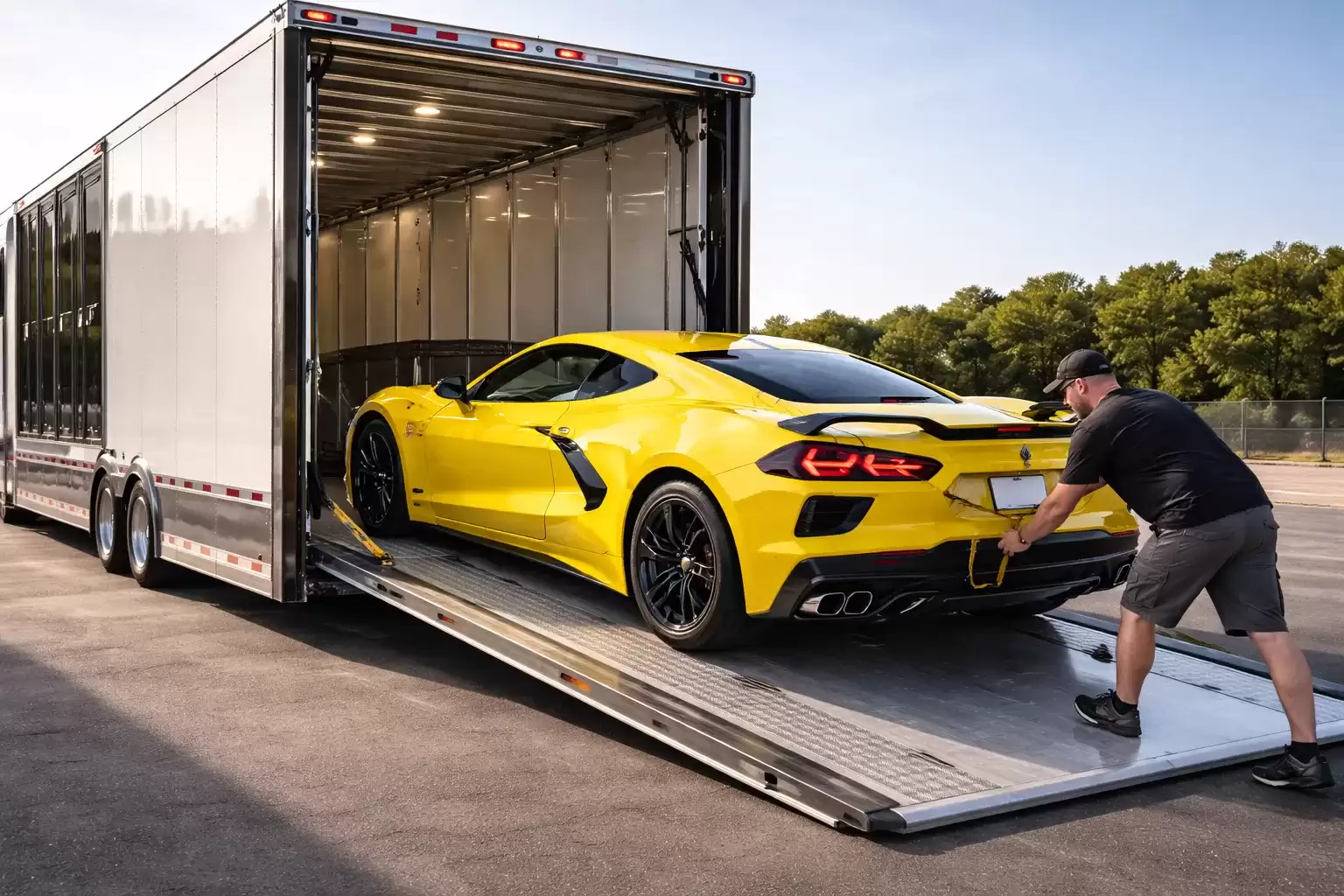
Ready to ship your car to or from Oklahoma?
Join hundreds of thousands of customers — Snowbirds, military families, tech relocators, students, and families moving across the country — who have trusted Direct Express Auto Transport with their Oklahoma vehicle shipments since 2004. Get your instant, no-obligation quote now. It takes 30 seconds, requires no personal information, and there is no upfront payment required to hold your spot.
Instant quote — real-time pricing in under 5 seconds
No upfront payment — your card is charged only when a carrier is assigned
No risk to get a quote and book your order
BBB Accredited A+ since 2004
FMCSA licensed and fully bonded
4.6 stars across thousands of verified Google reviews