Florida to Minnesota Car Shipping

The original instant car shipping calculator — trusted since 2004. Door-to-door Florida to Minnesota transport with no surprises, no hidden fees, and three options to ship your vehicle on your schedule.
Car Shipping Service Fast & Reputable

Florida to Minnesota Car Shipping

The original instant car shipping calculator — trusted since 2004. Door-to-door Florida to Minnesota transport with no surprises, no hidden fees, and three options to ship your vehicle on your schedule.

★ 4.6/5 Google Reviews  |  BBB Accredited A+  |  FMCSA Licensed (MC #479342)  |  USDOT #1240502  |  No upfront payment required  |  20+ years shipping vehicles
Geo City BBB Accredited Business Car Transport Services
Google Reviews for Car Shipping Services Nationwide

Car Shipping from Florida to Minnesota — See How It Works

Average Distance
1,400–1,830
Miles
Transit Time
4–6
Days
Best Time To Ship
Sep–Dec
Best Value Season

Florida to Minnesota Car Shipping Rates by City

Every Florida to Minnesota vehicle shipment is available at three service levels:

Standard, Expedited, & Rush Options


Choose the one that fits your timeline and budget. All three include full door-to-door service and carrier insurance.

Florida vehicle transport truck meeting 60 something customer
Best Value
Standard
Best available rate. Your vehicle ships on the next carrier heading your way when there is less competition for truck space. Ideal when your schedule has a few extra days of flexibility.
MOST POPULAR
Faster Pickup
Expedited
Moves your vehicle close to the front of the dispatch queue. Faster pickup assignment because it beats baseline prices. Improved carrier availability when your timeline matters.
Maximum Priority
Rush
Maximum priority dispatch. Your shipment is assigned as quickly as possible for urgent relocations and time-sensitive vehicle moves. Can get a carrier to jump.

Prices below are for a standard sedan via open carrier. Calculating your particular instant quote will reflect your exact vehicle, zip codes, and dates, which is even more precise.

From (Florida) To (Minnesota) Distance Standard Expedited Rush Transit
Jacksonville Minneapolis 1,500 mi$1,300$1,560$1,8204–5 days
Miami St. Paul 1,780 mi$1,500$1,800$2,1005–6 days
Tampa Rochester 1,500 mi$1,300$1,560$1,8204–5 days
Orlando Duluth 1,700 mi$1,450$1,740$2,0305–6 days
St. Petersburg Bloomington 1,570 mi$1,350$1,620$1,8904–6 days
Hialeah Brooklyn Park 1,790 mi$1,500$1,800$2,1005–6 days
Port St. Lucie Plymouth 1,720 mi$1,450$1,740$2,0305–6 days
Cape Coral Woodbury 1,690 mi$1,425$1,710$1,9954–6 days
Tallahassee Maple Grove 1,400 mi$1,225$1,470$1,7154–5 days
Fort Lauderdale St. Cloud 1,820 mi$1,525$1,830$2,1355–6 days
Pembroke Pines Eagan 1,770 mi$1,500$1,800$2,1005–6 days
Hollywood Eden Prairie 1,770 mi$1,500$1,800$2,1005–6 days
Miramar Coon Rapids 1,780 mi$1,500$1,800$2,1005–6 days
Coral Springs Burnsville 1,750 mi$1,475$1,770$2,0655–6 days
Clearwater Blaine 1,580 mi$1,350$1,620$1,8904–6 days
Lakeland Lakeville 1,590 mi$1,375$1,650$1,9254–6 days

* Prices shown for a standard sedan via open carrier. Trucks, SUVs, and vans are priced higher. Enclosed transport available at an additional premium. Use the instant quote calculator above for your exact vehicle, dates, and zip codes.

Calculate My Florida–Minnesota Car Shipping Rates

Florida Woman in office calculating online car shipping quote

The Company That Invented Instant Auto Transport Pricing

Direct Express Auto Transport pioneered online instant pricing for the auto transport industry in 2004. Before we built the first car shipping cost calculator, getting a quote from a broker meant phone calls, callbacks, and waiting — sometimes days. We changed that. Today you know your exact cost in 30 seconds, before committing to anything. No phone tag, no hassle. Just a real number, instantly.

Three Service Tiers for Every Florida to Minnesota Shipment

Every shipment on this Florida to Minnesota route is available at three service tiers so you can match your budget to your timeline. Standard delivers at the best available rate — ideal when your schedule has a few days of flexibility. Expedited moves your vehicle to the front of the dispatch queue for faster pickup. Rush gets your car picked up as fast as humanly possible — for spring snowbird returns with a firm arrival date, medical appointment schedules, military report dates, and any move where every day counts. All three tiers include full door-to-door service and carrier insurance.

Get My Florida to Minnesota Auto Transport Price


What customers say about shipping a car from Florida to Minnesota with Direct Express Auto Transport

Ward C.
1 day ago
Office was extremely polite and helpful. The transport driver was very helpful and polite along with his knowledge of the route to deliver our vehicle.
Sameer S.
1 day ago
Shipped from San Deigo to Bay Area. They offered one of the best rates while also having a good reputation, which held up -- I had a very smooth experience!
Robert K.
3 days ago
I've used Direct Express several times. This latest trip was the best experience yet. The driver made extra effort to get close to my location, was courteous, and his truck didn't break down like the last guy (who had my car stranded for three weeks....). I will continue to use DirectExpress Auto Transport.
Kiranmayi V.
2 weeks ago
Have used their services twice now, very reliable
JD M.
4 months ago
Top-notch service. Scheduling was easy, pricing was fair, and the entire process was handled with professionalism. Pickup and delivery were seamless, and I appreciated the consistent updates along the way. My vehicle arrived exactly as expected—no issues at all. You can tell this company takes pride in what they do.
Char P.
4 months ago
Is worried about shipping my car w/ them but they talked me through it and they awesome my car was pick up no problem and delivered no problem everyone was professional i will definitely be using there services again

Seasonal Pricing Guide: Florida to Minnesota

Florida to Minnesota is the northbound half of a marquee snowbird corridor — Minnesota is one of the biggest snowbird-origin states in the country, and the spring return home is the defining event of the year on this direction. Demand peaks March through June as Minnesota seasonal residents head north after the winter, with the Gulf Coast supplying the heaviest outbound volume. Best value comes in the fall, when carriers are running south into Florida ahead of the snowbird arrival and northbound legs need loads.


Florida to Minnesota car transport truck with a full load depicted in a montage in all four seasons

Period Season What to Expect Booking Notes
Jan – Feb Quiet Northbound / Secondary Value Window January and February are the quietest months on the FL→MN direction. Minnesota seasonal residents are settled in Florida for the season and almost nobody is moving a vehicle north voluntarily into subzero weather, so northbound volume is thin and pricing is soft. The one thing to plan around is the Minnesota delivery end: deep snow, extreme cold, and blowing snow on I-90 and I-94 can add a day, and an unheated vehicle sitting on a trailer arrives into genuinely severe conditions. Secondary value window. Book 5–7 days ahead. Add a 1-day weather buffer for any Minnesota delivery in January or February, and a second day for Greater Minnesota during a blizzard or extreme-cold event. Standard is workable for almost any flexible mid-winter FL→MN timeline; Expedited only if the Minnesota arrival date is firm.
Mar – May Peak Snowbird Return / Highest Demand March through May is the peak northbound window and the year’s defining event on this direction. Minnesota snowbirds head home as the Florida heat builds and Minnesota thaws, and April is the heaviest concentration — Gulf Coast departures from Naples, Fort Myers, Sarasota, Cape Coral, and the Tampa Bay area dominate the flow, with a secondary wave out of the tri-county South Florida area. Carrier competition for northbound slots is at its annual tightest, and the return wave runs into June for those who stay through spring. Peak demand. Book 14–21 days ahead for April pickups — earlier for Gulf Coast origins. Expedited for any firm Minnesota arrival date in the spring return. March has slightly better availability than April for time-flexible shippers. Keep a 1-day buffer for March Minnesota deliveries — the snow runs late.
Jun – Aug Summer Relocation Season June carries the tail of the snowbird return, then summer takes over as the national peak relocation season. Families moving permanently from Florida to Minnesota — for work, family, or to get out of the heat — concentrate their moves in June and July for school-year transitions. Students finishing Florida school years ship home to Minnesota in May and June. Expect extreme heat at the Florida pickup end and active Atlantic hurricane season from August; the Minnesota delivery end is clean all summer. Book 10–14 days ahead. June still carries snowbird-return pressure — treat it as a peak month. Expedited for any firm Minnesota delivery date. Monitor the Atlantic hurricane forecast for August Florida pickups. No weather buffer needed at the Minnesota delivery end June through August.
Sep – Oct Best Value Window Opens / Counter-Flow Season September and October open the best value window on the FL→MN direction. The Minnesota snowbird departure to Florida is at its peak, which floods carriers southbound into the peninsula — and those trucks need northbound loads to fill the return leg. That counter-flow puts FL→MN pricing at its most competitive of the year with excellent availability. September is peak Atlantic hurricane season, so watch the forecast for Florida pickup timing. Best value window for FL→MN. Book Standard with a 5–7 day flexible pickup window. Northbound availability is excellent because the fall snowbird flow south creates empty northbound legs. Monitor the hurricane forecast for September Florida pickups. No Minnesota weather buffer needed in September; add a day for late October.
Nov – Dec Counter-Flow Continues / Holiday Taper November keeps the counter-flow advantage: the snowbird wave south is still running, so northbound legs stay cheap and available. Minnesota winter now begins in earnest, with snow and extreme cold across the state and blowing snow on the open stretches of I-90 and I-94, so a 1-day delivery buffer is prudent statewide. December brings the holiday taper: industry-wide carrier availability tightens after about December 10th regardless of direction. November: strong value, book 5–7 days ahead. Add a 1-day buffer for Minnesota deliveries in winter weather, two for Greater Minnesota. December: book before December 5 for pre-holiday Minnesota delivery. After December 10th, use Expedited and plan for holiday delays. January is a clean alternative to forced December shipping if your schedule allows.

Get My Florida–Minnesota Seasonal Rates


Florida car transport carrier meeting 40 something customers

Who Ships a Car from Florida to Minnesota — and Why

The Florida to Minnesota corridor runs year-round, but a few consistent groups of shippers drive its heavy spring snowbird return.

Minnesota Snowbirds Returning Home for the Summer
Minnesota is one of the biggest snowbird-origin states in the country, and the spring return north is the dominant event on this corridor. Minnesotans who winter in Florida in large numbers head home as the peninsula heats up and Minnesota thaws — Gulf Coast departures from Naples, Fort Myers, Sarasota, Cape Coral, and the Tampa Bay area supply the heaviest volume, with a secondary wave out of the tri-county South Florida area and the Central Florida communities. The March through June return wave defines the year on this direction.
Permanent Relocation North: Family, Work & Escaping the Heat
Permanent relocation from Florida back to Minnesota is a steady, year-round segment distinct from the seasonal flow. Adult children and aging parents move closer to family, professionals take Twin Cities corporate positions with employers like Target, 3M, UnitedHealth, Best Buy, and Cargill, and a real share of former snowbirds decide the Florida summer heat and hurricane season are not worth it. These moves run in every season, not just spring.
Students Returning Home from Florida Campuses
Minnesota students at Florida schools — the University of Florida, Florida State, the University of Miami, UCF, USF, and FAU — ship their vehicles home at spring semester end in May, and back south again in August. At 1,400 to 1,830 miles, shipping is an easy alternative to a two-day solo drive, and the May move-out surge layers directly on top of the spring snowbird return, which is why May books tight.
Mayo Clinic Connections, Military PCS & Family Moves
Mayo Clinic’s Rochester campus draws patients, families, physicians, and staff north from Florida year-round — including from its own Jacksonville campus — and appointment calendars make those shipments deadline-driven. Military PCS transfers add consistent volume: Florida sending points such as MacDill AFB, NAS Jacksonville, Eglin AFB, Patrick Space Force Base, and NAS Pensacola route personnel north to the 133rd Airlift Wing at the Minneapolis-St. Paul Air Reserve Station, the 148th Fighter Wing in Duluth, and Camp Ripley. Firm report dates and medical schedules mean Expedited or Rush.

Instant Florida–Minnesota Car Shipping Quote


What Makes the Florida–Minnesota Auto Shipping Run Different

A few geographic quirks shape pricing and timing on the Florida to Minnesota corridor.

Florida auto transport driver meeting 20 something customers
The Gulf Coast Is the Corridor’s Busiest Loading Zone
The Gulf Coast is where Minnesota snowbirds spend the winter, so it is where most northbound loads originate. Naples, Fort Myers, Sarasota, Cape Coral, and the Tampa Bay area sit right on I-75 — the carrier is already on the northbound spine from the first mile. Those are the shortest, most direct Florida departures on this corridor, and they are also the tightest to book in April.
Atlantic Coast Origins Cut Across First
Miami, Fort Lauderdale, West Palm Beach, and Port St. Lucie start on I-95 and cut across to I-75 via the Florida Turnpike or Alligator Alley before the northbound run truly begins. That crossing adds miles and time, which is why South Florida’s east coast sits at the far end of the distance range while the Gulf Coast sits near the front.
Atlanta Is the Funnel Every Florida-to-Minnesota Load Passes Through
Whatever corner of Florida a carrier loads in, the run north converges on I-75 through Valdosta, Macon, Atlanta, and Chattanooga. Atlanta is the one predictable slow point — metro congestion can cost a carrier an hour or two of daylight — but it is the natural funnel for nearly all Florida-to-Upper-Midwest freight, and it is why transit on this route plans in days rather than hours.
Two Northbound Corridors: The I-35 Spine vs. The I-65/I-94 East-Side Approach
Past Chattanooga, carriers pick up I-24 to Nashville and then split. One line continues northwest to the I-40/I-35 crossing and runs I-35 straight north into the Twin Cities. The other takes the east-side approach: I-65 north through Louisville, then I-94 northwest through Chicago and Wisconsin. The mileage difference is small, and which one your carrier takes depends on the load board and the season.
Southeast Minnesota Comes First — Greater Minnesota Adds Real Miles
Rochester and the bluff-country cities along I-90 sit on the way in, so they are the state’s shortest deliveries from Florida. Past the Twin Cities, the miles keep adding: Duluth sits roughly 155 miles north of the metro, and Moorhead, Bemidji, and Brainerd are farther still, which is why Greater Minnesota pairs land at the high-mileage end of the pricing table. The Florida pickup end has no weather concern apart from summer heat and hurricane season, but the Minnesota delivery end does from November through March.


Other Florida to Minnesota Cities We Serve

Direct Express ships vehicles between hundreds of city pairs on this route. Below is a broader look at additional Florida origins and Minnesota destinations we regularly serve.


Florida to Minnesota Car Transporter with a full load rolling down the highway at sunset
From (Florida) To (Minnesota) Distance Transit
West Palm Beach Minnetonka 1,760 mi 5–6 days
Boca Raton Apple Valley 1,760 mi 5–6 days
Palm Coast Edina 1,570 mi 4–6 days
Fort Myers St. Louis Park 1,690 mi 4–6 days
Melbourne Mankato 1,600 mi 4–6 days
Kissimmee Moorhead 1,800 mi 5–6 days
Sarasota Shakopee 1,630 mi 4–6 days
Naples Maplewood 1,720 mi 5–6 days
Gainesville Cottage Grove 1,530 mi 4–5 days
Ocala Richfield 1,570 mi 4–6 days
Daytona Beach Roseville 1,600 mi 4–6 days
Pensacola Inver Grove Heights 1,340 mi 4–5 days
Bradenton Andover 1,610 mi 4–6 days
Deltona Brooklyn Center 1,570 mi 4–6 days
Pompano Beach Savage 1,760 mi 5–6 days
Panama City Oakdale 1,400 mi 4–5 days

Get a Quote for Your Florida–Minnesota Route


Minnesota Car Transporter delivering to 30 something couple

Florida and Minnesota Auto Shipping Zones Along the I-75, I-35, and I-94 Corridors

Florida-to-Minnesota auto transport runs roughly 1,340–1,830 miles depending on the Florida origin and Minnesota destination. The shortest runs come from the Panhandle and North Florida to Southeast Minnesota and the south metro. The longest come from South Florida’s Atlantic coast to Greater Minnesota — Duluth, Moorhead, St. Cloud. Florida origin zones are dominated by the Gulf Coast, where Minnesota snowbirds spend the winter, with strong secondary volume out of Central and South Florida and a smaller share from North Florida and the Panhandle.

Florida Origin Zones

Gulf Coast (Tampa / St. Petersburg / Clearwater / Sarasota / Bradenton / Fort Myers / Cape Coral / Naples)
right on the I-75 northbound line from the first mile; the corridor’s busiest loading zone and the winter home of most Minnesota snowbirds; standard residential throughout; many pickups sit inside gated or age-restricted seasonal communities — confirm gate access; tightest availability in April
Central Florida (Orlando / Kissimmee / Lakeland / Deltona)
I-4 corridor pickup connecting to I-75 north; standard residential throughout; strong carrier density driven by the Orlando metro’s volume; no pickup weather concerns any season apart from summer heat
South Florida (Miami / Fort Lauderdale / Hialeah / Hollywood / Pembroke Pines / West Palm Beach / Boca Raton)
starts on I-95 and crosses to I-75 via the Florida Turnpike or Alligator Alley; the farthest Florida origin zone from Minnesota; very dense downtown Miami and Brickell high-rises use nearby commercial staging; extreme summer heat but no pickup weather concerns
Northeast & North Florida (Jacksonville / Daytona Beach / Palm Coast / Gainesville / Ocala)
Florida’s primary I-95/I-10 freight hub at Jacksonville, plus the I-75 corridor through Gainesville and Ocala; standard residential; among the closest Florida origins to Minnesota and the departure point for Mayo Clinic Jacksonville travelers
Panhandle (Tallahassee / Pensacola / Panama City)
I-10 pickup connecting north via I-65 through Birmingham and Nashville; standard residential; the shortest Florida runs on the whole corridor and good access to the northbound spine for every Minnesota destination

Minnesota Delivery Zones

Minneapolis & the West Metro (Minneapolis / St. Louis Park / Edina / Richfield / Bloomington / Minnetonka / Eden Prairie / Golden Valley / Hopkins)
the highest-volume Minnesota delivery market on the corridor; reached on I-35 north or I-94 northwest; dense downtown Minneapolis, Uptown, and North Loop blocks may require nearby commercial staging; deep-winter delivery buffer November through March
East Metro / St. Paul & Suburbs (St. Paul / Woodbury / Maplewood / Roseville / Oakdale / Cottage Grove / Inver Grove Heights / Eagan)
the natural drop for carriers arriving on the I-94 east-side approach; standard residential outside the St. Paul downtown core; deep-winter delivery buffer November through March
South Metro (Burnsville / Lakeville / Apple Valley / Savage / Shakopee / Prior Lake / Rosemount / Farmington)
the first metro drops a northbound carrier reaches on I-35; the shortest Twin Cities deliveries from Florida; standard residential on wide suburban blocks; deep-winter delivery buffer
North Metro (Brooklyn Park / Coon Rapids / Blaine / Maple Grove / Plymouth / Andover / Brooklyn Center / Fridley)
the last metro drops on the route, past the downtown cores on I-694 and I-35W; adds metro miles versus a south-metro delivery; standard residential throughout; deep-winter delivery buffer
Southeast Minnesota / Rochester & Bluff Country (Rochester / Winona / Owatonna / Austin / Faribault / Northfield / Red Wing / Albert Lea)
on the way in via I-90 and lower I-35; the closest Minnesota deliveries to Florida and among the table’s shortest runs; standard residential; strong carrier activity around the Mayo Clinic campus; winter buffer for blowing snow on open I-90
Greater Minnesota (St. Cloud / Duluth / Mankato / Moorhead / Bemidji / Brainerd / Willmar / Alexandria)
the farthest Minnesota deliveries from Florida; Duluth sits roughly 155 miles north of the Twin Cities and Moorhead is on the Dakota line; standard residential; longest lead times and the heaviest winter exposure — allow two buffer days during a blizzard or extreme-cold event

Calculate My Florida–Minnesota Auto Transport Cost


car-transport-driver-strapping-down-a-blue-car-on-th-trailer

Florida to Minnesota Auto Transport Video Guide

Jump to the chapter most relevant to your Florida to Minnesota shipment

9 Chapters — Under 6 Minutes


Each chapter covers a specific part of the Florida to Minnesota shipping process. Click any card to open that chapter directly in YouTube.

[00:00] – Introduction to Florida to Minnesota Auto Transport

We begin with why the Florida to Minnesota corridor is a marquee snowbird return route — driven by seasonal residents heading home, students, medical travel, military moves, and permanent relocations. Our nationwide carrier network is built to handle vehicle shipping between Florida and Minnesota year-round.

[00:58] – How To Arrange Auto Transport

Learn how easy it is to schedule your Florida to Minnesota shipment. Whether you’re shipping from Miami or Tampa, we explain how the booking process works and how carriers are assigned along the route.

[01:29] – How Pricing Tiers Work

Florida to Minnesota pricing varies with direction of travel, time of year, and whether your origin or destination is a major hub or a smaller market. We explain how rates shift through the year and which of our three service tiers — Standard, Expedited, or Rush — matches your timeline and budget.

[02:48] – Where We Ship

We move vehicles between every Florida origin and every Minnesota destination — from the largest metros to smaller cities, college towns, lake country, and military communities across both states.

[03:06] – When To Expect Pickup

Pickup timing depends on route availability, carrier scheduling, and your chosen tier. We explain how pickup windows work and how carriers coordinate routes between Florida and Minnesota.

[03:37] – How Long Shipping Takes

Get realistic transit-time expectations for the Florida to Minnesota route, including the seasonal and weather factors that can affect timing on a Florida-to-Upper-Midwest run.

[03:55] – Preparing Your Vehicle

Before pickup, we recommend cleaning your vehicle, removing personal items, and photographing every panel. If you are shipping a vehicle to Minnesota, document its pre-existing condition carefully ahead of your Minnesota registration.

[04:25] – What To Expect At Pickup

We walk through the inspection and Bill of Lading process so you know exactly what happens when the carrier arrives, including how carriers handle gated seasonal communities and dense urban neighborhoods where staging at a nearby meet point may be required.

[04:57] – What To Expect At Delivery

The final inspection and delivery process is explained step by step, including how deliveries are handled in dense urban cores, suburban blocks, and rural addresses across Minnesota.

See My Florida–Minnesota Shipping Price in 30 Seconds


Open vs. Enclosed Car Transport on the Florida–Minnesota Route

Both methods are available on virtually every Florida to Minnesota lane. The right choice comes down to your vehicle’s value and the season.

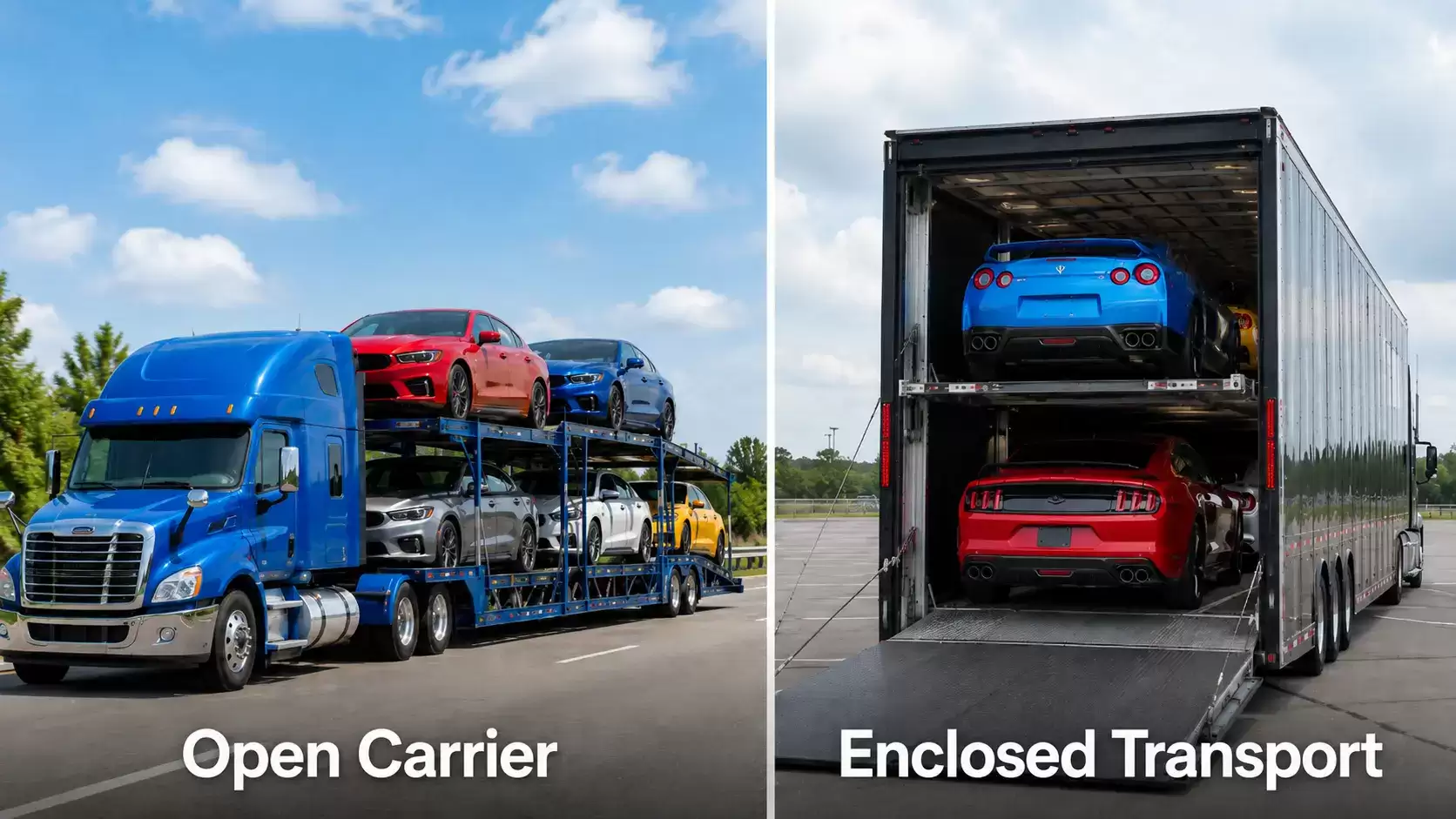
Open Transport — Recommended for Most
Carries 7–10 vehicles on an open-air trailer — the same method used to deliver new cars to dealerships. Most cost-effective, with consistently strong availability on the high-volume I-75 and I-35 northbound corridors. Well suited to standard sedans, trucks, SUVs and minivans. Your vehicle is exposed to road dust and light weather, which is normal for this type; on a late-fall or winter arrival, expect some road salt and spray from the last few hundred miles that a wash clears easily.
Enclosed Transport
Your vehicle travels inside a fully covered trailer, protected from road debris, winter salt on the Minnesota approach, and weather. Typically costs 40–60% more than open. Ideal for luxury, classic/collector, sports and custom-paint vehicles — South Florida is one of the country’s largest luxury and exotic markets, so high-end cars moving between Florida and Minnesota generate steady enclosed demand, especially from snowbirds bringing a second vehicle home in spring. Fewer enclosed carriers run this lane, so book earlier — 2–3 weeks ahead for the peak spring return.

Our honest recommendation: open transport for daily drivers worth under $60,000 — the I-75/I-35 northbound corridor is well-maintained, well-traveled, and carrier-rich. The enclosed premium is worth it for a classic, an exotic, a sentimental vehicle, or a winter arrival into salted Minnesota roads, particularly during the spring return and fall departure windows when enclosed demand concentrates.

Florida–Minnesota Open or Enclosed Transport Estimate

Types of transport - open carrier and enclosed transport trucks

Minnesota Car Transporter delivering to 50 something couple

Door-to-Door Car Shipping: What to Expect in Florida and Minnesota

Every Florida to Minnesota shipment is full door-to-door — we pick up at your Florida address and deliver to your Minnesota door, with commercial staging only where dense city streets require it.

Pickup in Florida
Door-to-door pickup across the Gulf Coast, Central Florida, South Florida, and North Florida and the Panhandle. Very dense downtown Miami, Brickell, and Midtown high-rises use commercial staging; the rest of South Florida, the Tampa Bay metro, and the Orlando I-4 corridor are standard residential. Many Gulf Coast pickups sit inside gated or age-restricted seasonal communities — confirm gate access and a contact name with your carrier 24 hours ahead. No pickup weather concerns in any season apart from summer heat and hurricane watch.
Delivery in Minnesota
Door-to-door delivery across Minneapolis and the west metro, the East Metro and St. Paul, the north and south metro suburbs, Southeast Minnesota and Rochester, and Greater Minnesota. Dense downtown Minneapolis, Uptown, and downtown St. Paul blocks use commercial staging at a nearby wide street; the suburbs and smaller markets are the most straightforward zones. Allow a 1-day buffer for Minnesota deliveries during a snow or extreme-cold event November through March, and two days for Greater Minnesota in a blizzard.

Pickup in Florida

Gulf Coast: Tampa Bay, Sarasota, Fort Myers, Cape Coral, and Naples

Standard door-to-door pickup throughout the Gulf Coast — the corridor’s busiest loading zone and the winter home of most Minnesota snowbirds. Tampa, St. Petersburg, and Clearwater: standard residential throughout the Tampa Bay metro; no staging concerns. Sarasota, Bradenton, Fort Myers, Cape Coral, and Naples: standard residential, right on the I-75 northbound line. Many pickups here sit inside gated or age-restricted seasonal communities — confirm gate access and a contact name with your carrier 24 hours ahead, since haulers cannot always enter narrow community streets. April is the tightest booking month in this zone.

Central Florida and the Atlantic Coast: Orlando, Melbourne, and Daytona Beach

Standard door-to-door pickup throughout Central Florida and the Atlantic coast. Orlando and the I-4 corridor (Kissimmee, Lakeland, Deltona): standard residential throughout; strong carrier density driven by the metro’s volume. Melbourne, Palm Bay, Daytona Beach, Palm Coast, and Port St. Lucie: standard residential, I-95 and Florida Turnpike access to the northbound spine. No pickup weather concerns in any season apart from summer heat.

South Florida: Miami, Fort Lauderdale, and West Palm Beach

Standard door-to-door pickup throughout South Florida. Miami-Dade: standard residential throughout; very dense downtown Miami, Brickell, and Midtown high-rise buildings require carrier staging on a nearby wide commercial street — confirm your pickup address at booking. Fort Lauderdale, Hollywood, Hialeah, Pembroke Pines, Miramar, Coral Springs, Pompano Beach, and Boca Raton: standard residential, no staging concerns. West Palm Beach and Boynton Beach: standard residential throughout. South Florida has excellent carrier density in all three service tiers, though summer heat is extreme.

North Florida and the Panhandle: Jacksonville, Gainesville, and Tallahassee

Standard door-to-door pickup throughout North Florida and the Panhandle. Jacksonville: standard residential throughout; Florida’s primary I-95/I-10 freight hub, among the closest Florida zones to Minnesota, and the departure point for Mayo Clinic Jacksonville travelers. Gainesville and Ocala: standard residential, I-75 access. Panhandle markets (Tallahassee, Pensacola, Panama City): standard residential, connecting north via I-65 through Birmingham and Nashville — the shortest Florida runs on the corridor.

Delivery in Minnesota

The Twin Cities Metro: Minneapolis, St. Paul, and the Suburbs

Standard door-to-door delivery throughout the Twin Cities region. Downtown Minneapolis, Uptown, the North Loop, and downtown St. Paul: carrier staging required — multi-car haulers cannot park on narrow city streets for unloading, so your carrier will stage at a nearby wide commercial street or accessible area. Bloomington, Edina, St. Louis Park, Richfield, Minnetonka, Eden Prairie, Woodbury, Maplewood, Roseville, Eagan, Brooklyn Park, Coon Rapids, Blaine, Maple Grove, Plymouth, Burnsville, Lakeville, and Apple Valley: standard residential delivery on wider suburban blocks. The Twin Cities are the highest-volume Minnesota delivery market on the corridor. Confirm your staging location with your carrier 24–48 hours before delivery, and allow a winter buffer during a snow or extreme-cold event.

Southeast Minnesota: Rochester and the Bluff Country

Standard door-to-door delivery throughout Southeast Minnesota. Rochester: standard residential, with strong carrier activity around the Mayo Clinic campus — confirm staging for downtown medical-district addresses and hotel or apartment deliveries. Owatonna, Faribault, Northfield, Austin, and Albert Lea: standard residential, right on the lower I-35 line and among the first Minnesota drops a northbound carrier reaches. Winona and Red Wing along the river bluffs: standard residential, I-90 and US-61 access. Blowing snow on the open stretches of I-90 can add a day between November and March.

Greater Minnesota: St. Cloud, Duluth, Mankato, and the North

Standard door-to-door delivery across the rest of the state. St. Cloud and Mankato: standard residential, straightforward I-94 and US-169 access from the metro. Duluth: standard residential, roughly 155 miles north of the Twin Cities and the state’s longest run past the metro. Moorhead, Bemidji, Brainerd, Willmar, and Alexandria: standard residential, longer lead times and lighter carrier density than the metro. These are the most winter-exposed deliveries on the corridor — allow a 1-day buffer November through March, and two days during a blizzard or extreme-cold event.

Minnesota Vehicle Registration for New Florida Arrivals

Minnesota requires new residents to title and register their vehicle at Minnesota Driver and Vehicle Services (DVS) within 60 days of establishing residency, presenting the out-of-state title, proof of identity and a Minnesota address, and payment of the applicable registration tax and fees; Minnesota has no state safety inspection and no emissions testing requirement, so no inspection is needed to register.

Preparing Your Vehicle

Before pickup in Florida: remove all personal items from the interior, leave no more than a quarter tank of fuel, disable your car alarm, and remove any exterior accessories or bike racks. Photograph your vehicle thoroughly from all angles with date-stamped images before the carrier arrives — a quick wash first makes it easier to document existing condition, especially after a season of coastal salt air. Vehicles with roof racks, spoilers, or exterior modifications should note these on the Bill of Lading at pickup. At delivery in Minnesota, inspect your vehicle carefully in daylight before signing the Bill of Lading — your signature without notation constitutes acceptance of the vehicle’s condition. Minnesota winter daylight is short, so if delivery occurs after dark, note on the Bill of Lading that inspection is pending daylight review.

Door-to-Door Florida–Minnesota Car Shipping Rates


Florida & Minnesota Auto Transport Resources

Florida Helpful Government Links

Minnesota Helpful Government Links

Federal Auto Transport Resources

Direct Express Customer Service Staff Representative at her desk


Florida to Minnesota Car Shipping — FAQ

How much does it cost to ship a car from Florida to Minnesota?

For a standard sedan on open transport, Florida to Minnesota generally runs roughly $1,225–$1,525 depending on the exact cities, vehicle, and season — shorter Panhandle and North Florida runs to Southeast Minnesota and the south metro sit at the lower end, longer South Florida runs to Greater Minnesota at the higher end. Pricing tracks the live market and shifts week to week, and the spring snowbird return firms rates on this direction, so use the instant calculator for your exact zip codes and dates.

How long does it take to ship a car from Florida to Minnesota?

Panhandle and North Florida origins to Southeast Minnesota and the south metro run 4–5 days — the shortest transit on this route. Most Gulf Coast and Central Florida origins to the Twin Cities run 4–6 days, while South Florida origins to Greater Minnesota run 5–6 days. This is a long Florida-to-Upper-Midwest haul rather than a regional hop, so plan 7–10 days total from booking to delivery, with the lower end possible during the fall counter-flow window when northbound carrier availability is at its annual peak.

What route do carriers take from Florida to Minnesota?

Carriers run I-75 north for most of the way: from the peninsula through Valdosta, Macon, and Atlanta to Chattanooga, then I-24 to Nashville. From there the route splits — one line runs northwest to the I-40/I-35 crossing and up I-35 straight into the Twin Cities, the other takes the east-side approach on I-65 north through Louisville and I-94 northwest through Chicago and Wisconsin. Atlantic-coast Florida origins start on I-95 and cut over to I-75 via the Florida Turnpike or Alligator Alley.

When is the best time to ship a car from Florida to Minnesota?

September through December is the best value window — the Minnesota snowbird departure to Florida is at its peak, so carriers running northbound out of the state are eager to fill return legs at excellent rates. January and February are a quiet second value window. The busiest stretch by far is the March through June snowbird return, with April the tightest month of the year; if your timing is flexible, ship in the fall instead.

Will winter weather delay my Florida to Minnesota shipment?

The delay risk is at the Minnesota delivery end, not in Florida. From November through March, deep snow, extreme cold, and blowing snow across the open country along I-90 and I-94 can add a day to a delivery during a storm — and a blizzard or extreme-cold event in Greater Minnesota can add two. Build in a 1-day buffer for any fixed delivery date in those months, and book Expedited if your Minnesota arrival date is firm. The Florida end and the long I-75 run north are clear in almost every season.

Can I ship a car to Minneapolis or St. Paul from Florida?

Yes — the Twin Cities are the highest-volume Minnesota delivery market on this corridor, reached on I-35 north or I-94 northwest from the I-24/I-75 spine. Carriers operate in the region daily. Dense downtown blocks, Uptown, and the North Loop may require a nearby staging location; the suburbs are standard residential. Confirm a suitable delivery location with your carrier 24–48 hours ahead, and allow a 1-day winter buffer for a snow or extreme-cold event.

Do I need to be present at pickup and delivery?

Yes — or a designated adult you trust must be present at both pickup in Florida and delivery in Minnesota to inspect the vehicle and sign the Bill of Lading. For gated or age-restricted Florida seasonal communities, confirm gate access and a contact name with your carrier 24 hours ahead. For downtown Minneapolis or St. Paul staging-area deliveries, ensure the designated person is at the agreed location at the scheduled time.

Minnesota Vehicle Transporter delivering to 70 something guy

Shipping from Minnesota to Florida instead?

We cover both directions on this corridor. See city-by-city rates, transit times, and seasonal pricing for the reverse direction. View Minnesota to Florida rates →

More Helpful Information

Other popular routes we serve.

How Auto Transport Works

How our car shipping cost calculator works its magic.

Get My Florida to Minnesota Car Shipping Quote