
Colorado Car Shipping Services

Need to ship a car to or from Colorado? Get a real-time, transparent price in 30 seconds — no phone calls, no risk, no upfront payment. Direct Express Auto Transport has been Colorado’s most trusted auto transport broker since 2004, with a 4.6-star average across thousands of verified Google reviews.
Car Shipping Service Fast & Reputable

Colorado Car Shipping Services

Need to ship a car to or from Colorado? Get a real-time, transparent price in 30 seconds — no phone calls, no risk, no upfront payment. Direct Express Auto Transport has been Colorado’s most trusted auto transport broker since 2004, with a 4.6-star average across thousands of verified Google reviews.

★ 4.6/5 Google Reviews  |  BBB Accredited A+  |  FMCSA Licensed (MC #479342)  |  USDOT #1240502  |  No upfront payment required  |  20+ years shipping vehicles

BBB Accredited Business Car Shipping Services
Google Reviews for Car Shipping Services Nationwide

New to Colorado car shipping? Watch this first!

Before you book, take six minutes to understand exactly how auto transport works — from getting your quote to handing over your keys and inspecting your vehicle at delivery. This video was produced by our team and covers the full process in plain language. It’s the same briefing our customer service reps give first-time car shippers every day.

Follow along to see how we manage Colorado auto transport from the Front Range urban corridor to the mountain resort communities and across the high plains to the Eastern Slope.

[00:00] – Introduction to Colorado Auto Transport
We begin by explaining why Colorado has become one of the fastest-growing auto transport markets in the country. The combination of explosive population growth driven by California migration, a massive military presence in Colorado Springs, two major university systems, and a booming outdoor recreation economy has made the Denver metro and Colorado Springs among the most active carrier corridors in the Mountain West.

[00:58] – How To Arrange Auto Transport
Learn how easy it is to schedule your Colorado shipment. Whether you’re shipping a truck from Denver to a new job in Austin or a family SUV from Chicago to Colorado Springs for a Fort Carson PCS move, we explain how the booking process works and how carriers are assigned on Colorado’s I-25 and I-70 corridors.

[01:29] – How Pricing Tiers Work
Colorado pricing can vary depending on the season, the corridor, and whether your origin or destination is a Front Range hub or a mountain community. We explain how I-70 mountain pass conditions affect winter transit and how your location within Colorado — from the densely served Denver metro to the more remote Western Slope — affects your quote.

[02:48] – Where We Ship
We transport vehicles throughout the entire state of Colorado — from the urban Front Range through the ski resort communities of Vail, Aspen, and Breckenridge to the high desert of the Western Slope. If you’re in Colorado, we ship there.

[03:06] – When To Expect Pickup
Pickup timing depends on route availability, carrier scheduling, and your chosen tier. We explain how pickup windows work along Colorado’s primary carrier corridors and how vehicles destined for mountain communities above the I-70 exits require coordination around mountain pass road conditions — especially from November through March.

[03:37] – How Long Shipping Takes
Get realistic transit time expectations for routes between Colorado and destinations across California, Texas, Florida, the Midwest, and the Northeast — including how I-70’s mountain crossing between Denver and Grand Junction affects winter transit times on west-coast-bound routes.

[03:55] – Preparing Your Vehicle
Before pickup, we recommend cleaning your vehicle, removing personal items, and photographing every panel. For Colorado-specific preparation: if shipping in winter and your vehicle has roof cargo systems, ski racks, or snowboard carriers, remove them before transport. Carriers cannot accommodate roof-mounted accessories under standard open-carrier clearances.

[04:25] – What To Expect At Pickup
We walk through the inspection and Bill of Lading process so you know exactly what happens when the carrier arrives. For mountain community deliveries in Aspen, Vail, Telluride, or Breckenridge, carriers coordinate a meet point at an accessible location since narrow mountain roads and resort parking structures cannot accommodate a full transporter. Plan for a short drive from the meet point to your final address.

[04:57] – What To Expect At Delivery
The final inspection and delivery process is explained step by step, including how deliveries are handled in gated mountain communities, ski resort base areas, and the dense urban cores of downtown Denver and Boulder where standard carrier trucks require a nearby accessible street.

How Much Does It Cost to Ship a Car to/from Colorado?

Colorado car shipping costs vary based on your route, the time of year, vehicle size, and the service tier you choose. Use our instant calculator above for a real-time quote — or see the route-by-route pricing tables below for a fast ballpark. Most standard sedan shipments to or from Colorado range from $730 on short Southwest hauls to Arizona and New Mexico up to $1,350+ on cross-country routes to the East Coast. Mountain community deliveries may carry a modest deviation surcharge depending on route. Our Expedited and Rush pricing tiers hasten the process to create an even more satisfying experience.
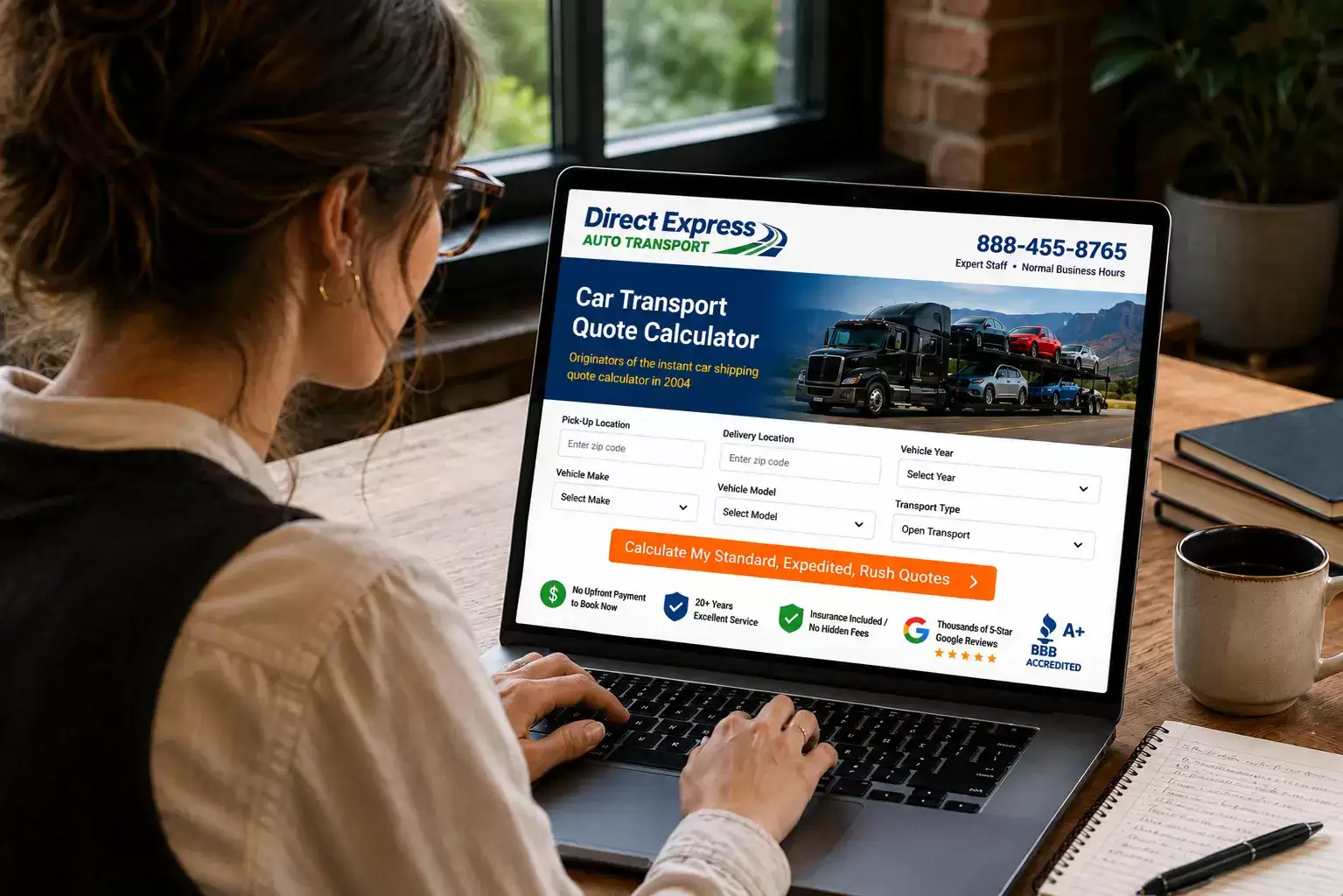
Colorado Woman in office calculating online car shipping quote

What customers say about shipping a car to or from Colorado with Direct Express Auto Transport

JD M.
3 months ago
Top-notch service. Scheduling was easy, pricing was fair, and the entire process was handled with professionalism. Pickup and delivery were seamless, and I appreciated the consistent updates along the way. My vehicle arrived exactly as expected—no issues at all. You can tell this company takes pride in what they do.
Char P.
3 months ago
Is worried about shipping my car w/ them but they talked me through it and they awesome my car was pick up no problem and delivered no problem everyone was professional i will definitely be using there services again
Anonymous R.
5 months ago
My experience was great! I paid for expedited shipping and pickup was set 4 days from that day. Direct express’s customer service is great. The carrier they picked did a good job and my car arrived in perfect condition within 3 days! All the stuff I left in the vehicle was intact.
Lesle C.
6 months ago
Booking with Direct Express Auto Transport via John was simple and completed quickly. I called and booked on Friday, their contracted hauler picked up my truck on Saturday afternoon. The truck was securely transported with delivery complete by dinner time on Sunday. The transport was from mid- florida to mid-Michigan! Fantastic job team! The price for an emergency transport was extremely reasonable. All conversations were positive with plan information complete in confirmation emails and up-date texts. I will definitely use their services again and highly reccomend Direct Express Auto Transport transport needs.
Sheri T.
9 months ago
There is a lot of anxiety shipping your car. However Direct Express
And their carrier Speedstar did an exceptional job.. everyone was
Courteous and the driver was extremely competent. They transported or car in 30 hrs from TX to MA. I would definitely use them again.
Adam
10 months ago
They did great. I had some unforeseen circumstances arise right before I was getting ready to ship my car. I had to change the pickup date twice. They were very patient and worked with me for the best outcome. I received my car a day early in good condition. I’ll be using them again in the future

Florida isn’t just a popular destination — it’s the single busiest state for car shipping in the continental United States. The combination of year-round warm weather, massive retirement and snowbird migration, and a dense interstate network makes Florida a constant high-priority corridor for carriers nationwide. Understanding how that market works is the key to getting your vehicle picked up quickly and at the right price.

Auto Transport Reviews From Our Customers in California & Beyond


  • My Auto Transport Experience

    Nancy B.

    I am so pleased with my decision to use Direct Express Auto Transport! Ashley was a knowledgeable and confidence inspiring representative and my driver was on time and my car was in perfect shape!

  • Great Auto Transport Service To Texas

    Steve S.

    Talked to Jessica on Wednesday to have 65 El Camino shipped from Calif to Texas. Was picked up on Thursday the 16th and delivered on Monday the 20th. Beautiful truck and great driver. Sebastian was the driver’s name. Also it was awesome to see all the other great cars.

  • Enclosed Auto Transport

    Derek K.

    Fantastic experience all around, from the office people calling me back on a Sunday when a question popped up, to getting the car delivered very quickly, the whole process went perfectly. Will use them again for sure.

  • My Car Arrived Sooner Than Expected!

    Charlie R.

    Driver was very efficient and accommodating! Once he picked up the vehicle he stayed in contact with us all the way to delivery. Thank you very much for hauling this vehicle for us because we have no way of doing it ourselves.

  • Auto Transport From Florida

    Alicia L.

    My car was picked up on a Friday morning and arrived at my destination two days later. The driver made sure that I was on time delivering my car and he made sure my car was delivered to me in a timely manner also…

  • Auto Transport Service To Arizona

    Jeff B.

    Another excellent job by Direct Express Auto Transport! This is the 3rd time we’ve shipped with this Direct Express Auto Transport. They’re courteous, professional, and on time. I highly recommend this company and their services!

  • Car Transported California to Texas

    Bill A.

    I used the expedited shipping option and they told me it will be picked up within 3-4days. Luckily my car was picked up on the very first day. It was assigned to one of their transport companies and I received my car within 10days. They are very professional.

Why Colorado is one of the fastest-growing auto transport markets in the Mountain West

Colorado has transformed from a regional auto transport market into one of the most active vehicle shipping states in the western United States over the past decade. The combination of sustained in-migration from California, a massive Colorado Springs military complex that generates constant PCS shipping demand, two major public university systems, a thriving tech industry centered in Denver, and the permanent draw of the Rocky Mountain outdoor lifestyle has created a market where carrier demand runs strong in both directions year-round.

Colorado sits at the crossroads of two of the most important auto transport corridors in the West: I-25, which runs north-south connecting Wyoming through Denver and Colorado Springs to New Mexico, and I-70, which runs east-west connecting Kansas City through Denver across the Rockies to Utah and ultimately California. That intersection in Denver makes the Front Range metro one of the most efficiently served auto transport markets between the Midwest and the Pacific Coast.

The California Exodus has been particularly significant for Colorado’s auto transport market. Colorado is the #1 destination for California residents relocating within the Mountain West, ahead of Nevada, Arizona, and Utah on a per-capita basis. This flow of vehicles from the San Francisco Bay Area, Los Angeles, and San Diego to Denver, Boulder, Fort Collins, and Colorado Springs has established Colorado as one of the country’s most consistently active inbound markets on the westbound carrier circuit — and has created strong return-load availability for outbound Colorado shipments heading west.


The interstate corridors that move Colorado vehicles

Three primary highway arteries define Colorado’s auto transport network:

I-25 (Front Range corridor): The primary north-south spine of Colorado auto transport, running from the Wyoming border south through Fort Collins, Denver, Colorado Springs, and Pueblo before crossing into New Mexico. Nearly 80% of Colorado’s population lives within 25 miles of I-25, which means the vast majority of Colorado shipments either originate or terminate on this corridor. Carriers on I-25 run the Denver-Colorado Springs circuit multiple times daily, giving these two cities among the best pickup availability in the Mountain West.

I-70 (Transcontinental mountain corridor): The primary east-west artery through Colorado and the most technically challenging section of any interstate in the country. East of Denver, I-70 runs through the high plains toward Kansas City, Denver, and ultimately St. Louis. West of Denver, I-70 climbs through the Eisenhower Tunnel (11,013 feet), crests the Continental Divide, descends through Vail Pass and Glenwood Canyon, and continues to Grand Junction before crossing into Utah. This corridor is the primary carrier route for vehicles moving between Colorado and California, Utah, Nevada, Arizona (from the north), and the Pacific Northwest. It is also the most weather-affected interstate in Colorado; winter closures at Eisenhower Tunnel and Vail Pass can delay transit by 12–48 hours during major storm events.

I-76 (Northeast Colorado corridor): Connects Denver northeast to the Nebraska Panhandle where it joins I-80 near Big Springs. I-76 is the primary carrier route for vehicles moving between Colorado and the northern Midwest — Iowa, Minnesota, Wisconsin, Michigan, and Chicago on the I-80 mainline. Carriers from Denver often choose between I-70 and I-76 depending on weather and destination; I-76 to I-80 is the preferred winter routing for Midwest-bound loads when I-70’s mountain passes are problematic.

Vehicles shipping to or from Denver, Colorado Springs, or Fort Collins benefit from the highest carrier frequency in the state — multiple daily departures in each direction. If you are shipping to a mountain resort community (Vail, Aspen, Breckenridge, Telluride), the Western Slope (Grand Junction, Montrose), or a rural Eastern Slope market (Pueblo, La Junta, Lamar), expect longer pickup windows due to the deviation from primary carrier trunk routes. Expedited tier is strongly recommended for mountain and Western Slope deliveries year-round.
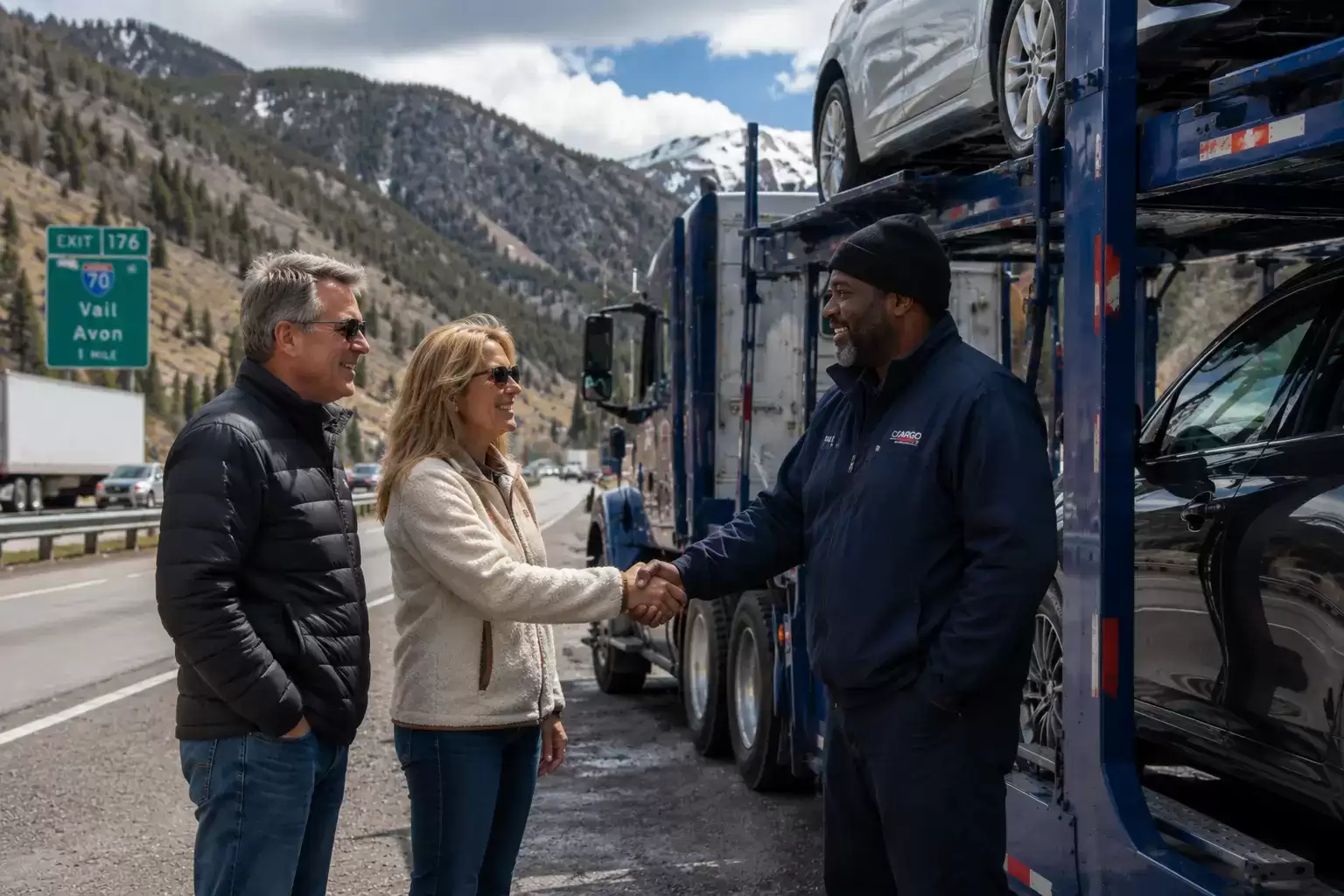
mature couple meeting an auto transport driver along I-70 in Colorado
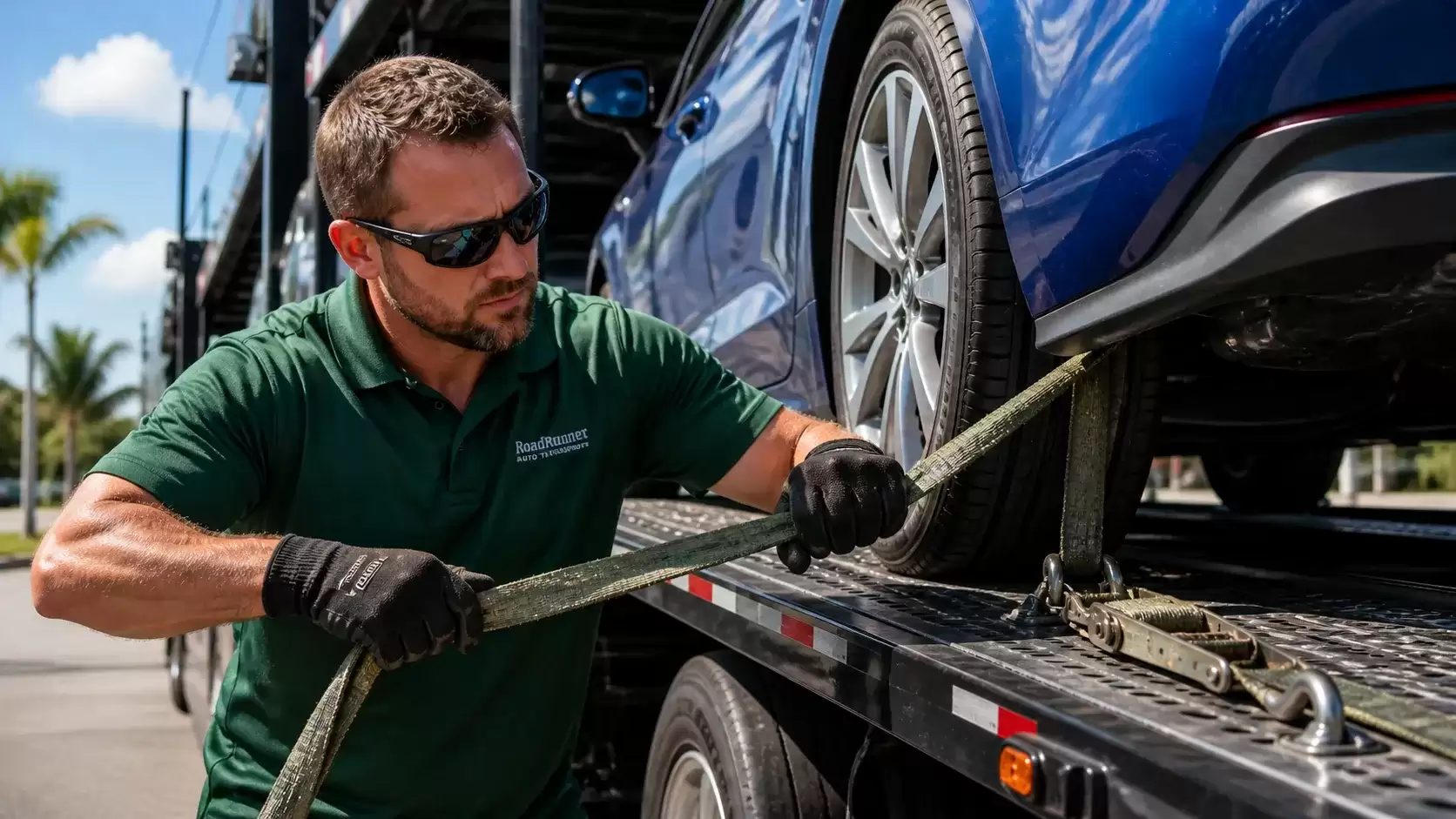
Colorado car-transport-driver-strapping-down-a-blue-car-on-th-trailer

Colorado as a destination and mountain crossroads: what it means for your shipment

Colorado occupies a unique position in the national auto transport network: it is simultaneously a major relocation destination (especially from California and Illinois) and a through-state for carriers connecting the Midwest to the Pacific Coast. This dual role has important implications for shippers:

Strong inbound demand year-round: Because Colorado is one of the top relocation destinations in the country, inbound carrier demand stays robust throughout the year. Even during Colorado’s slower winter months, California Exodus relocations and military PCS orders maintain a steady flow of vehicles into the state. This keeps carrier incentive for Colorado deliveries consistently higher than in comparable Mountain West markets.

Return-load pressure benefits outbound shippers: Carriers delivering vehicles into Colorado on I-25 northbound from New Mexico or westbound on I-70 from Kansas actively need return loads heading south, east, or west. This carrier-seeking-freight dynamic often works in the outbound Colorado shipper’s favor, particularly in winter when inbound demand eases and carriers are competing for available freight leaving Denver and Colorado Springs.

Mountain geography creates a two-market state: Colorado east of Denver (Front Range, Eastern Slope, Panhandle) and Colorado west of Denver (mountain communities, Western Slope, Grand Junction) are essentially two different markets from a carrier logistics standpoint. Front Range deliveries benefit from interstate highway access and high carrier frequency. West-of-Denver deliveries require carriers to navigate I-70’s mountain passes — adding time, weather risk, and modest cost to the route. Always specify whether your Colorado address is on the Front Range or the Western Slope when getting a quote, as this affects both pricing and pickup window estimates.

I-70 as a weather variable: I-70’s mountain segment is the most closure-prone major interstate in the country. From November through March, carriers monitor Eisenhower Tunnel and Vail Pass conditions continuously. CDOT (Colorado Department of Transportation) closes the corridor for weather events, rockslides, and chain law enforcement during major storms. If you are shipping to or from a Western Slope address between November and March, build an extra buffer day into your timeline and choose Expedited tier to offset weather-related delays.

Colorado’s major auto carrier hubs and what they mean for you

Not all Colorado cities are equal from a logistics standpoint. Here is how the major hubs rank in terms of carrier availability:

Denver / Aurora / Lakewood: The state’s dominant carrier hub. The I-25/I-70 interchange in the Denver metro is the single most important intersection for Colorado auto transport. Daily carrier departures to California (I-70 west), Kansas City and Chicago (I-70 east), Fort Collins and Wyoming (I-25 north), Colorado Springs and New Mexico (I-25 south), and Nebraska and the upper Midwest (I-76 northeast). Standard pickup windows in the Denver metro are among the shortest in the Mountain West. Tech industry relocation demand, university moves, and the sustained California Exodus inflow keep both directions active year-round.

Colorado Springs: Colorado’s second-largest city and the military auto transport capital of the Mountain West. Fort Carson, Peterson Space Force Base, Schriever Space Force Base, and the United States Air Force Academy together generate more PCS vehicle shipping demand than any other metro in the Mountain States. Colorado Springs sits 60 miles south of Denver on I-25 and benefits from the same carrier circuit, making it one of the best-served cities in the region. Standard pickup windows here are competitive with the Denver metro for most routes.

Fort Collins / Greeley: Northern Front Range hub on I-25 north of Denver. Colorado State University in Fort Collins generates consistent student vehicle demand each August and May. Fort Collins is served by carriers on the I-25 Denver-to-Wyoming corridor, making it one of the more accessible smaller cities in the state. Greeley adds volume from its agricultural and university (University of Northern Colorado) workforce.

Boulder: University of Colorado’s flagship campus generates high student relocation volume. Boulder is served via US-36 from Denver, placing it slightly off the primary carrier trunk routes. Pickups here are typically bundled with Denver metro dispatches and have competitive windows despite being 30 miles from the I-25 spine.

Pueblo: Southern Front Range hub on I-25, 100 miles south of Denver. Pueblo is Colorado’s most southern significant city before the New Mexico border and serves as a natural waypoint on the Denver-to-Albuquerque I-25 corridor. Fort Carson overflow relocations, steel industry workforce moves, and CSU Pueblo student shipping contribute to a year-round demand base.

Grand Junction: The Western Slope’s dominant city at I-70 and US-50 in Mesa County. Grand Junction is the primary carrier access point for the entire Western Slope, but it lies 240 miles west of Denver across I-70’s mountain passes. Carrier availability here is good for Western Slope standards, but pickup windows are longer than Front Range cities. Expedited tier is recommended for most Grand Junction shipments, and winter timing should account for potential I-70 pass closures.

Mountain resort communities (Vail, Aspen, Breckenridge, Steamboat Springs, Telluride): These communities present the most challenging carrier access in the state. High-clearance carrier trucks cannot navigate most mountain resort roads, ski area base facilities, or narrow canyon approaches. All deliveries to resort communities are staged at a carrier-accessible meet point (typically a commercial parking area near the I-70 or US-40 highway), and the vehicle is driven the final distance by the owner or a designee. Rush tier is recommended for hard-deadline ski season deliveries to resort communities. Plan for a meet point — not door-to-door — at most mountain addresses.
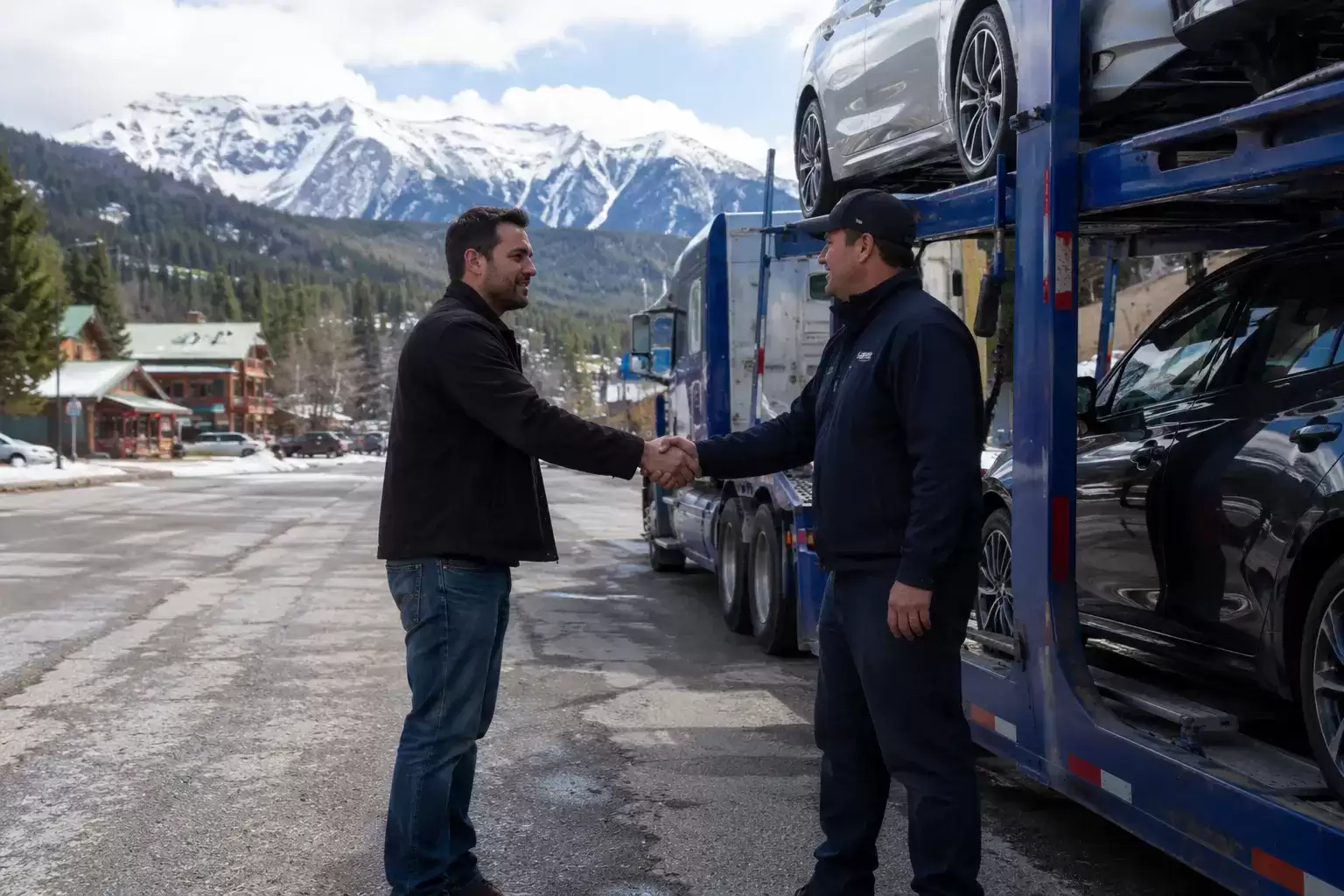
man meeting a car shipping driver in Colorado

Colorado car shipping cost estimates: major routes

The tables below show estimated pricing for the most commonly requested Colorado auto transport routes, based on real-time market data for a standard operable sedan via open carrier. All prices reflect current market conditions for Standard, Expedited, and Rush tiers. Your actual quote may vary based on vehicle size, exact pickup/delivery zip codes, and seasonal demand. Use our instant calculator for a real-time rate.

Popular Routes To Colorado

Swipe to view full table →

From To Distance (mi) Estimated Days Standard Expedited Rush
California Colorado 1,020 3–5 days $835 $1,000 $1,170
Texas Colorado 850 2–4 days $810 $970 $1,135
Florida Colorado 1,900 5–7 days $1,255 $1,505 $1,755
New York Colorado 1,780 5–7 days $1,175 $1,410 $1,645
Illinois Colorado 1,000 3–5 days $920 $1,105 $1,290
Washington Colorado 1,320 4–5 days $925 $1,110 $1,295
Georgia Colorado 1,540 4–6 days $1,015 $1,220 $1,420
Michigan Colorado 1,380 4–6 days $965 $1,160 $1,350
Minnesota Colorado 900 3–4 days $855 $1,025 $1,195
Arizona Colorado 600 2–3 days $730 $875 $1,020

Popular Routes From Colorado

Swipe to view full table →

From To Distance (mi) Estimated Days Standard Expedited Rush
Colorado California 1,020 3–5 days $835 $1,000 $1,170
Colorado Texas 850 2–4 days $810 $970 $1,135
Colorado Florida 1,900 5–7 days $1,255 $1,505 $1,755
Colorado New York 1,780 5–7 days $1,175 $1,410 $1,645
Colorado Illinois 1,000 3–5 days $920 $1,105 $1,290
Colorado Nevada 750 2–3 days $750 $900 $1,050
Colorado Georgia 1,540 4–6 days $1,015 $1,220 $1,420
Colorado Arizona 600 2–3 days $730 $875 $1,020
Colorado Washington 1,320 4–5 days $925 $1,110 $1,295
Colorado North Carolina 1,700 5–6 days $1,120 $1,345 $1,570

Why mountain-state routes from Colorado cost more per mile than cross-country shipments

On a 1,020-mile Denver to Los Angeles car shipment, carriers are running an efficient transcontinental route and can combine multiple vehicles heading the same direction. On a shorter 600-mile Colorado to Phoenix route, the per-mile rate is actually higher because the carrier cannot spread fixed costs across as many miles. A Denver to Phoenix shipment at $730 costs more per mile than a Denver to New York shipment at $1,175 — distance works in the shipper’s favor on long hauls. The mountain geography adds another factor: carriers running I-70 west from Denver face chain requirements, weight restrictions, and slower speeds that increase operating costs compared to flat interstate runs of equivalent mileage.


Young Couple getting an instant Colorado car shipping quote on the Direct Express Auto Transport calculator

Best time to ship a car to or from Colorado — the complete seasonal guide

Colorado’s auto transport market has a seasonal profile shaped by two dominant forces: the California Exodus relocation cycle and the Rocky Mountain military PCS season. Unlike coastal states where Snowbird patterns dominate the seasonal calendar, Colorado’s seasonality is driven primarily by relocation timing and by the practical realities of mountain pass weather on I-70. Timing your shipment correctly can affect both your rate and your pickup window by a meaningful margin.

Swipe to view full table →

Period Inbound (into Colorado) Outbound (from Colorado)
Sep – Oct MODERATE. Post-summer softening. California Exodus fall wave beginning. Rates easing from summer highs. Standard tier viable for flexible timelines on major Front Range routes. Good value window for inbound Colorado shipments. LOW-MODERATE. Some Colorado residents departing for Arizona and New Mexico before ski season. Carrier space available outbound. Best value window of the year for Colorado departures to warm-weather states.
Nov – Mar LOW-MODERATE inbound. Ski resort arrivals offset the winter relocation slowdown. I-70 mountain pass closures can delay west-coast-bound loads. Front Range inbound stays steady; Western Slope delays possible. Book Expedited and add buffer days for Western Slope deliveries. BEST RATES of the year for outbound. Colorado Snowbirds departing for Arizona and New Mexico with vehicles. Carriers seeking return loads are competitive on outbound pricing. Standard tier assigns quickly on Texas and Arizona corridors. January and February outbound windows are particularly favorable.
Apr – May HIGH. Spring relocation season building. California Exodus spring wave peaks. College move-out shipments returning vehicles to Front Range. I-70 mountain passes reopening improves Western Slope availability. Book Expedited 1–2 weeks ahead. MODERATE. Snowbirds returning from Arizona and New Mexico. Some outbound college moves. Good balance of supply and demand on most Front Range corridors. Standard tier typically assigns within 5–7 days.
Jun – Aug HIGHEST DEMAND of the year. Military PCS season at Fort Carson and Colorado Springs installations at peak. California Exodus summer wave intense. University move-ins begin in August at CU Boulder and CSU Fort Collins. Book Expedited 2–3 weeks ahead. Standard tier can run 8–12 days on popular corridors. HIGH. Military transfers out of Colorado installations. Post-graduation moves from Boulder and Fort Collins. Some reverse migration outbound. Book Expedited. Rush for hard move-out deadlines tied to PCS reporting dates.

I-70 mountain passes and winter car shipping — what Colorado shippers need to know

If your Colorado shipment involves a western or eastern crossing of the Rockies via I-70 between November and March, you need to understand how mountain pass conditions affect your transit timeline. This is the single most Colorado-specific factor in vehicle shipping and the one most frequently misunderstood by first-time shippers.

Eisenhower – Johnson Tunnel (I-70, mile marker 213): The Continental Divide crossing at 11,013 feet. CDOT closes the tunnels periodically during major storm events, chain law is enforced for commercial vehicles during moderate conditions, and carriers must plan around forecast conditions when transiting westbound or eastbound. Most closures last 2–8 hours. Extended closures of 12+ hours occur two to four times each winter season.

Vail Pass (I-70, mile marker 190): At 10,666 feet, Vail Pass is subject to chain law enforcement and periodic closures independently of Eisenhower Tunnel conditions. The combination of Vail Pass and Eisenhower Tunnel in the same corridor makes the Denver-to-Grand Junction segment the most weather-sensitive section of any carrier route in the Mountain West.

Glenwood Canyon (I-70, mile marker 116–133): A 12-mile section carved into sheer canyon walls that is subject to rockfall and mudslide closures year-round, with highest frequency in spring (runoff season) and fall (freeze-thaw cycles). Canyon closures are unpredictable and can last from a few hours to several days during major events.

For shippers with Western Slope destinations in winter, we recommend: choosing Expedited tier to ensure your vehicle is picked up during the first favorable weather window; scheduling your first available ship date to allow a 2–3 day buffer from your hard move-in date; and confirming with our team whether your delivery address requires I-70 west passage or can be approached from the south via US-160 or US-550 (which may be available as an alternate route for some Grand Junction, Montrose, and Durango addresses).

For Front Range addresses (Denver, Aurora, Colorado Springs, Fort Collins, Pueblo), winter mountain pass conditions have minimal effect on most routes, as I-25 north-south and I-70 east remain accessible throughout all but the most extreme storm events.

Ski season vehicle shipping to Colorado mountain resorts

Colorado’s ski industry generates a meaningful category of vehicle shipping demand each November through March. Seasonal workers, resort homeowners, and ski enthusiasts from California, Texas, Illinois, New York, and the Southeast ship vehicles to Colorado mountain communities for the season, then ship them back in April. Here is what you need to know about mountain resort deliveries:

Meet point is standard, not the exception: Vail, Aspen, Breckenridge, Keystone, Steamboat Springs, and Telluride all have road access challenges for full-size car carriers. Narrow mountain roads, resort parking structures with low clearances, and the sheer logistics of turning an 80-foot transporter in a ski town mean that virtually all mountain resort deliveries use a nearby accessible meet point. Plan for this at booking rather than at delivery, and choose your meet point in advance.

Book early for November openings: The first two weeks of November — when major resorts open — see a surge in vehicle shipping requests from seasonal workers and resort homeowners. If you need your vehicle in a mountain community by the resort opening weekend, book 10–14 days ahead and select Rush tier to maximize your assignment priority during the demand spike.

April returns from mountain communities: The end of ski season in April brings a corresponding outbound surge as seasonal residents ship vehicles back to their home states. Carrier space on return loads heading back to California, Texas, and the Midwest from Colorado mountain communities is typically available and competitively priced in April. Standard tier often assigns in 3–5 days during this window.

Standard, Expedited, or Rush — which tier is right for your Colorado shipment?

Direct Express Auto Transport pioneered the three-tiered pricing model that is still for the most part unique to us. Each tier represents a different level of carrier incentive — the higher the tier, the more attractive your shipment is to carriers on the dispatch board, and the faster your vehicle gets assigned. Here is how each tier performs specifically on Colorado routes:

Swipe to view full table →

Tier Best for Colorado when… What to expect
Standard Outbound CO in Jan–Mar, flexible timeline on Front Range routes, any Front Range shipment with a 10+ day window in spring or fall Assignment in 4–8 days on major corridors. Best value when you are not in a rush and your origin or destination is on the I-25 Front Range.
Expedited
(most popular)
Summer military PCS, spring California Exodus inbound, Western Slope or mountain community deliveries year-round, any time you want certainty on a Front Range corridor Assignment in 1–4 days. Strongly recommended for all Western Slope and mountain resort deliveries and for summer inbound on all Front Range routes.
Rush Hard military PCS reporting date, ski resort opening weekend arrivals, last-minute summer moves, vehicle needed at Colorado Springs or Denver by a fixed date Priority dispatch, often assigned within 24–48 hours. Best for urgent deliveries when Expedited windows are too long, particularly during summer peak and ski season.

The Colorado-specific tier recommendation

On most routes, Expedited is the tier we recommend most often for Colorado shipments — and not just during summer peak. Colorado’s mountain geography means that even Front Range deliveries occasionally require a carrier to hold at a pass during weather events, and the additional carrier incentive of Expedited tier helps ensure your vehicle is prioritized when road conditions reopen. The difference between Standard and Expedited is typically $80–$150 on most Colorado routes. That modest premium is worth it on any route that crosses I-70’s mountain segment or that originates from a Western Slope address.

Standard tier works well for: outbound Colorado shipments in January through March, vehicles on major I-25 Front Range routes with a 10-day or longer flexible window, and budget-conscious shippers on routes with naturally high carrier frequency like Denver to Dallas or Colorado Springs to Kansas City.

Rush tier is the right call for: anyone with a hard PCS reporting date at Fort Carson or Colorado Springs installations during June through August, ski resort opening deliveries in November, last-minute spring relocation moves from California, and vehicles that need to reach a specific Colorado destination by a fixed date during the summer peak.

Colorado woman in her 30s watching her non-running car get loaded

How to ship a car to or from Colorado: 4 steps

Step 1: Get your instant Colorado car shipping quote
Enter your pickup and delivery zip codes, your vehicle year, make, and model, whether it runs, and your preferred transport type (open or enclosed). Our calculator returns a real-time market rate in under 5 seconds. No name, phone number, or email required — you get the price first, every time.

Step 2: Choose your tier and confirm your dates
Select Standard, Expedited, or Rush based on your timeline and the seasonal guidance above. Enter your first available pickup date — you don’t need a firm date, just the earliest day the vehicle can be ready. If your delivery address is in a mountain community, note this at booking so our team can coordinate a meet point in advance. Our dispatch team starts working immediately.

Step 3: Secure your spot — no upfront payment
Complete your booking online or by phone. Your credit card is on file but not charged until a carrier is assigned to your shipment. There is no deposit, no cancellation fee, and no obligation until assignment. Once matched, you receive the carrier’s name, phone number, and estimated pickup date by email.

Step 4: Door-to-door pickup and delivery
Your carrier calls your pickup contact 12–24 hours before arrival to confirm timing and the meeting location. For mountain community deliveries, the driver will coordinate a safe accessible meet point near the highway exit. At delivery, inspect your vehicle thoroughly, note any issues on the Bill of Lading, and pay the carrier the balance due by cash or money order.

Shipping a Car to or From a Colorado College or University

Colorado is home to two flagship public university systems — the University of Colorado system and the Colorado State University system — as well as a growing cluster of private and metropolitan universities in the Denver metro. The combination of out-of-state students from California, Texas, Illinois, and the East Coast shipping vehicles to campus at semester start, and Colorado graduates relocating for careers in other states, makes university vehicle shipping one of the state’s most consistent demand drivers. The universities below each have a student population of 10,000 or more and represent major auto shipping demand centers, particularly in August, December, and May.

Swipe to view full table →

University Location Approx. Enrollment
University of Colorado Boulder Boulder ~37,000
Colorado State University Fort Collins ~34,000
Metropolitan State University of Denver Denver ~17,000
University of Colorado Denver Denver ~15,000
University of Denver Denver ~13,000
University of Colorado Colorado Springs Colorado Springs ~12,000
University of Northern Colorado Greeley ~10,000
Colorado Mesa University Grand Junction ~10,000

Tips for college car shipping to Colorado: Book 2 to 3 weeks ahead of move-in dates at CU Boulder and CSU Fort Collins, as August carrier availability tightens across the Mountain West. University of Colorado Boulder’s campus is accessible for most carrier staging on Broadway and 28th Street; deliveries to canyon neighborhoods west of campus may require a meet point near the Baseline Road corridor. Colorado Mesa University in Grand Junction requires the same I-70 mountain pass planning as any other Western Slope delivery.

College students preparing to ship a car to a Colorado university
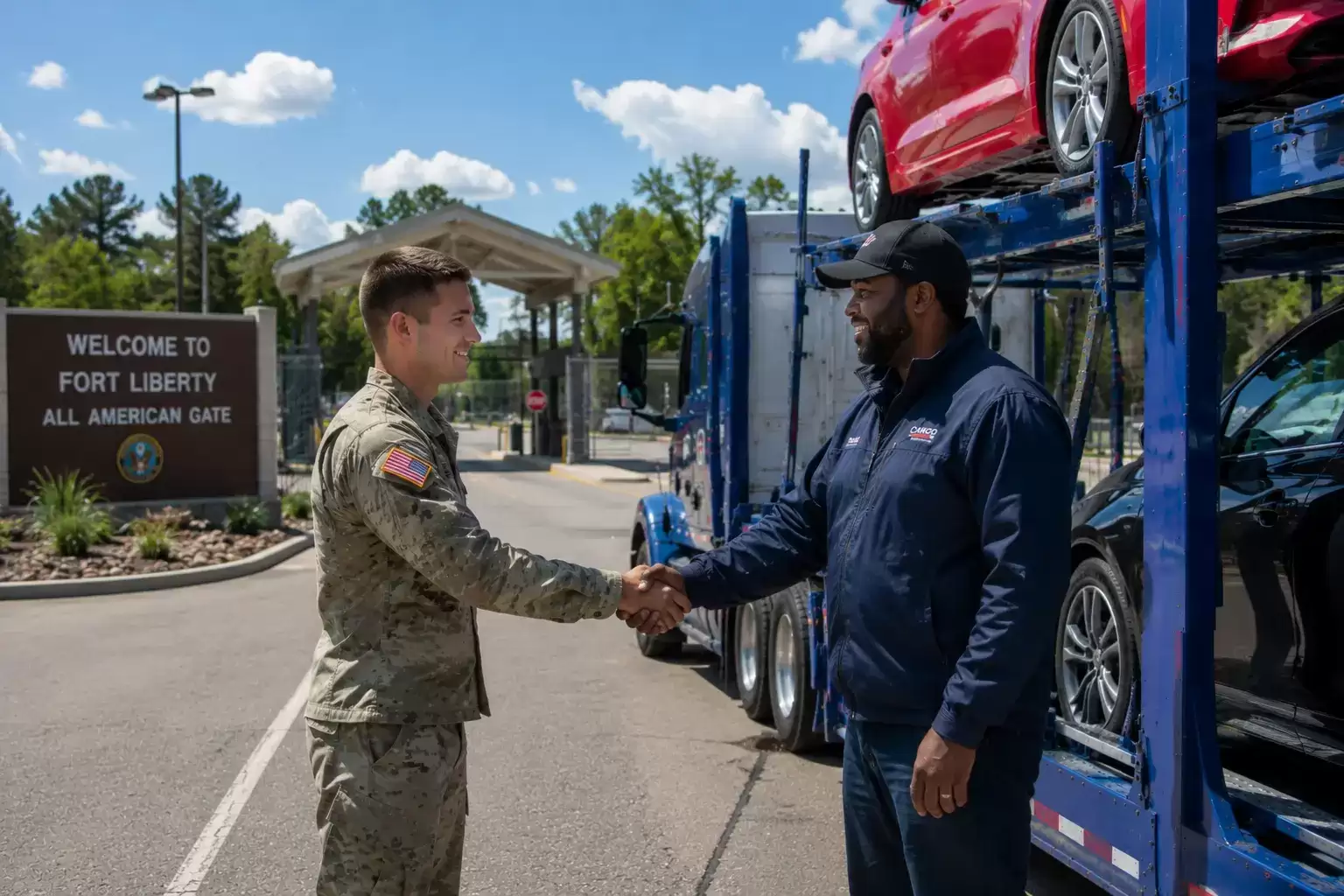
military man meeting a car transport driver in Colorado

Military Car Shipping to and From Colorado Bases

Colorado is home to one of the most concentrated military and defense communities in the country. Five major installations in the Colorado Springs area alone — Fort Carson, Peterson Space Force Base, Schriever Space Force Base, Buckley Space Force Base (in Aurora), and the United States Air Force Academy — generate a volume of PCS vehicle shipping demand that makes Colorado Springs one of the top military auto transport markets in the continental United States. We ship vehicles to and from all major Colorado military installations, including:

Fort Carson — Colorado Springs
The Army’s Mountain Post, home to the 4th Infantry Division and one of the largest Army installations in the country with approximately 30,000 active-duty soldiers. Fort Carson is the highest-volume military auto transport installation in Colorado and one of the top five in the Mountain West. The combination of the 4th ID’s rotation cycle, Combat Aviation Brigade deployments, and the constant flow of BOLC, NCOES, and unit transfer orders makes Fort Carson a year-round PCS shipping demand engine. The I-25 corridor provides direct carrier access from Pueblo to the south and the Denver metro to the north. Book 2–3 weeks ahead during June through August PCS peak; Rush tier is recommended for hard reporting dates during this period.

Peterson Space Force Base — Colorado Springs
Home to Space Operations Command and the 21st Space Wing, Peterson SFB sits on the eastern edge of Colorado Springs adjacent to Colorado Springs Airport. Peterson’s mission includes satellite tracking, missile warning, and space domain awareness operations. PCS moves to and from Peterson follow the Space Force career cycle, which generates a steady stream of vehicle shipping demand throughout the year. Carriers serving Fort Carson typically cover Peterson on the same Colorado Springs dispatch, keeping pickup windows competitive.

Schriever Space Force Base — Colorado Springs
Located 15 miles east of Colorado Springs on US-24, Schriever hosts GPS satellite operations, missile defense systems, and Space Force training programs. Vehicle shipping here is coordinated through the Colorado Springs carrier network. Most loads to Schriever are bundled with Peterson and Fort Carson dispatches when geographically logical, maintaining reasonable pickup windows for this eastern Colorado Springs installation.

United States Air Force Academy — Colorado Springs
Located 12 miles north of downtown Colorado Springs on I-25, the Academy generates vehicle shipping demand from incoming cadets, outgoing graduates relocating to first assignments, and faculty and staff PCS moves. The Academy’s calendar creates predictable annual demand spikes at graduation (May) and academic year start (August) when vehicle shipping demand peaks. Carriers on the I-25 Denver-to-Colorado Springs circuit serve the Academy efficiently.

Buckley Space Force Base — Aurora
Located in Aurora immediately east of Denver, Buckley hosts the 460th Space Wing, intelligence operations, and the Colorado Air National Guard. Its Denver metro location gives it the best carrier access of any Colorado military installation. The full I-25/I-70 Denver carrier network serves Buckley, and pickup windows here approach downtown Denver standards. Tech industry workforce in the adjacent Denver Tech Center adds civilian relocation volume to what is primarily a military market.

A note for military members: Always verify whether your branch covers POV (Privately Owned Vehicle) shipment costs under your PCS orders before booking. If your move qualifies, government shipping may be arranged through your transportation office, but many service members choose a private carrier for speed, flexibility, or to ship a second vehicle not covered by orders.

Colorado cities we serve

Direct Express Auto Transport provides car shipping services to and from every city in Colorado. Our highest-volume Colorado markets include:

Denver / Aurora / Lakewood — Colorado’s dominant auto transport hub at the I-25/I-70 crossroads. Daily carrier departures to California, Texas, the Midwest, the Southeast, and the Pacific Northwest. The fastest Standard pickup windows in the state. Tech industry relocation demand, California Exodus inbound traffic, and university shipping create a year-round demand profile matched by only a handful of Mountain West metros.

Colorado Springs — Military auto transport capital of the Mountain West. Fort Carson, Peterson SFB, Schriever SFB, and the Air Force Academy combine to create one of the most consistently active PCS shipping markets in the country. I-25 carrier access is direct and high-frequency year-round.

Fort Collins — Northern Front Range hub on I-25. Colorado State University generates strong student relocation volume. Carriers on the Denver-to-Wyoming I-25 corridor serve Fort Collins daily. Standard pickup windows comparable to the Denver metro for most routes.

Boulder — University of Colorado flagship campus generates high student and faculty relocation demand. Served via US-36 from Denver with pickup windows comparable to suburban Denver markets. Narrow downtown Boulder streets and university parking restrictions may require a nearby staging point for some deliveries.

Pueblo — Southern Front Range hub on I-25 between Colorado Springs and New Mexico. Steel industry workforce, CSU Pueblo, and Fort Carson overflow shipping support year-round carrier activity. Competitive pickup windows for an I-25 corridor city of its size.

Thornton / Westminster / Arvada — Denver north metro suburbs served by I-25 and US-36. Carriers covering the Denver metro circuit include these northern suburbs on shared dispatches, maintaining availability comparable to the Denver proper market.

Commerce City / Brighton — Northeast Denver metro on I-76. The Adams County corridor benefits from carrier activity on the Denver-to-Nebraska I-76 route. Carriers bound for the upper Midwest frequently pick up in Commerce City and Brighton as convenient pre-highway stops.

Castle Rock / Parker — South Denver suburban growth corridor on I-25 and US-83. Routinely bundled with Denver and Colorado Springs carrier dispatches on I-25 runs. Pickup windows slightly longer than downtown Denver but within one to two days on most routes.

Grand Junction — Western Slope hub at I-70 and US-50. Primary carrier access point for all of western Colorado. Expedited tier strongly recommended due to distance from Front Range carrier networks and potential I-70 mountain pass weather delays.

Durango — Southwest Colorado hub on US-160 and US-550. Durango is the most isolated significant Colorado market from a carrier standpoint, requiring deviation from both I-25 and I-70. Expedited or Rush tier is recommended year-round. Most loads to Durango are routed through Albuquerque on I-25 south and US-550 north, or through Grand Junction on I-70 and US-160 south.

Pueblo West / Cañon City — Southern Colorado communities between I-25 and the foothills. Served by carriers on the Colorado Springs-to-Pueblo I-25 leg. Pickup windows competitive for their size given the high carrier frequency on the I-25 southern corridor.

Loveland / Longmont — Northern Front Range communities between Denver and Fort Collins on I-25 and US-34. Carriers on the Denver-to-Fort Collins corridor include Loveland and Longmont stops on shared northbound dispatches.

woman meeting a car transport driver on a Colorado city street

Colorado Helpful Government Links

  1. Colorado Department of Revenue — Motor Vehicle Division — The primary resource for registering and titling a vehicle after it arrives in Colorado. Required for anyone establishing Colorado residency or purchasing an out-of-state vehicle.
  2. Colorado DMV — New Resident Vehicle Registration — Covers what new Colorado residents must do after establishing residency, including transferring an out-of-state title and obtaining Colorado plates. New residents typically have 90 days to register.
  3. Colorado Department of Public Health — Emissions Program — Certain Colorado counties require an emissions test (AIR CARE Colorado) for vehicles registered in the Denver metro area. Vehicles newly registered in these counties may need to pass an emissions test before plates are issued.
  4. CDOT — Road Conditions and I-70 Mountain Corridor — Colorado DOT’s real-time road conditions and closure information. Essential for anyone shipping to a Western Slope address. Check I-70 Eisenhower Tunnel and Vail Pass conditions November through March before finalizing your ship date.
  5. FMCSA — Verify a Carrier’s License (SAFER System) — The Federal Motor Carrier Safety Administration’s carrier lookup tool. Verify that any auto transport company you consider is federally licensed and insured before booking.

Colorado business woman in front of a full car carrier

Popular Long Distance Routes From or To Colorado

Colorado to California Car Shipping

The Colorado-to-California corridor has become one of the most active medium-haul routes in the western United States, fueled by the two-way flow of the California Exodus: Californians relocating to Colorado’s more affordable cities ship vehicles inbound, while Colorado residents returning to California’s coast or new Colorado residents keeping vehicles in storage in California ship outbound. At approximately 1,020 miles via I-70 west and I-15 south, Standard transit runs three to five days. The route crosses the Rockies, so winter scheduling should account for potential I-70 pass delays. Carriers on this corridor are among the most experienced at mountain pass operations in the country.

Colorado to Texas Auto Transport

The Colorado-to-Texas corridor is one of the most carrier-rich regional routes in the Mountain West. At 850–950 miles via I-25 south through New Mexico and on to Dallas, Houston, or San Antonio, Standard transit runs two to four days. The I-25 corridor from Denver through Colorado Springs to Albuquerque and then east to Texas sees high carrier frequency year-round. Texas-to-Colorado inbound is particularly strong in the summer California Exodus wave, when Texas residents and California-to-Texas migrants make secondary moves north to Colorado’s climate and recreation. Carrier availability is excellent in both directions throughout most of the year.

Colorado to Florida Auto Transport

Florida is one of Colorado’s most popular Snowbird destinations, with Front Range and Colorado Springs retirees wintering on Florida’s Gulf Coast. At approximately 1,900 miles via I-25 south and I-10 east, Standard transit runs five to seven days. The bidirectional Snowbird cycle — Colorado vehicles heading to Florida in October through December and returning in March through May — makes this a well-established corridor with predictable carrier availability. Book Expedited 2–3 weeks ahead for October departures and March returns when Snowbird competition for carrier space is highest.

Colorado to New York Vehicle Shipping

At approximately 1,780 miles via I-70 east and I-76 northeast to I-80 east, Standard transit runs five to seven days. The Colorado-to-New York corridor carries finance industry relocations, East Coast college student moves to Colorado schools, and the growing flow of tech workers relocating between Denver’s tech sector and New York’s financial district. Carriers prefer the I-70/I-76/I-80 northern routing in summer and can route via I-70/I-40/I-81 in favorable conditions.

Colorado to Illinois Car Transport

Chicago and the broader Midwest represent a strong relocation corridor for Colorado. At approximately 1,000 miles via I-70 east or I-76 to I-80, Standard transit runs three to five days. Tech industry moves between the Denver Tech Center and Chicago’s financial and corporate headquarters district, University of Illinois and Northwestern alumni returning to Colorado after graduation, and general Midwest-to-Colorado lifestyle migration make this a consistent bidirectional route. Carriers running I-70 from Denver can reach Chicago in a single-driver run with overnight, making this one of the more efficiently served medium-haul corridors from Denver.

Colorado to Ohio Auto Shipping

Ohio is a meaningful Midwest destination for Colorado vehicle shipments, primarily serving the Cleveland, Columbus, and Cincinnati markets. At approximately 1,360 miles via I-70 east, Standard transit runs four to five days. The I-70 corridor connects Denver to Columbus nearly directly — one of the most geographically straightforward routes in Colorado auto transport. Ohio State and other Big Ten alumni returning to Colorado from the Midwest use this corridor consistently in both directions each summer.

Colorado to Michigan Vehicle Transport

Detroit, Ann Arbor, and Grand Rapids are the primary Michigan destinations for Colorado vehicle shipments. At approximately 1,380 miles via I-70/I-76/I-80, Standard transit runs four to six days. Automotive industry engineers and executives relocating between Detroit and Colorado’s growing EV and aerospace tech sector in the Denver metro use this corridor regularly. University of Michigan alumni returning to Boulder and Denver for Rocky Mountain lifestyle also contribute consistent demand.

Colorado to Georgia Car Shipping

Atlanta has emerged as a major destination for Colorado vehicle shipments as the Southeast’s tech and entertainment hub. At approximately 1,540 miles via I-25 south and I-20/I-285, Standard transit runs four to six days. Military transfers between Fort Carson and Fort Moore (formerly Fort Benning), Dobbins ARB, and Robins AFB add consistent demand to what is also a growing civilian relocation corridor.

Colorado to Washington State Auto Transport

The Amazon/Microsoft tech corridor in Seattle draws significant tech worker relocation demand from Colorado’s Denver Tech Center, and outdoor recreation lifestyle migration between the Pacific Northwest and the Rockies runs in both directions year-round. At approximately 1,320 miles via I-15 north and I-90, Standard transit runs four to five days. Carriers on the Pacific Coast circuit between Los Angeles and Seattle often run through Denver or Salt Lake City, giving Colorado-to-Washington loads good carrier availability.

Colorado to Pennsylvania Auto Transport

Pennsylvania is a major East Coast destination for Colorado vehicle shipments, serving Philadelphia, Pittsburgh, and the Lehigh Valley markets. At approximately 1,700 miles via I-70 east and I-76, Standard transit runs five to seven days. Military transfers between Colorado Springs installations and Carlisle Barracks, Tobyhanna Army Depot, and the Philadelphia region add steady demand alongside the growing civilian relocation market.

Colorado to Tennessee Car Transport

Nashville’s emergence as a corporate and entertainment hub has made the Colorado-to-Tennessee corridor one of the more active mid-distance routes from Denver. At approximately 1,500 miles via I-70 east and I-24, Standard transit runs four to six days. Finance and healthcare industry relocations between Nashville and Denver are the primary civilian demand driver, complemented by military transfers between Fort Campbell (near Nashville) and Colorado Springs.

Colorado to North Carolina Vehicle Shipping

The Research Triangle, Charlotte, and the Fort Liberty military corridor are the primary North Carolina destinations. At approximately 1,700 miles via I-70 east and I-77 south, Standard transit runs five to six days. Military transfers between Fort Carson and Fort Liberty (Fayetteville), Camp Lejeune, and Seymour Johnson AFB are a meaningful component of this corridor. North Carolina’s growing tech sector has added civilian demand to the well-established military base.

Colorado to Virginia Auto Transport

Virginia’s concentration of federal government, defense contracting, and military employment makes it an active East Coast destination for Colorado vehicle shipping. Pentagon employees and defense contractors relocating between Colorado Springs’ Space Force installations and Northern Virginia’s defense tech corridor represent a consistent demand base. At 1,800–1,900 miles, Standard transit runs six to eight days.

Colorado to Minnesota Vehicle Shipping

Minneapolis and the Twin Cities metro are a primary upper Midwest destination for Colorado vehicle shipments. At approximately 900 miles via I-76 northeast to I-80 and I-35W, Standard transit runs three to four days. Minnesota Snowbirds shipping vehicles to Arizona and New Mexico for winter sometimes stop in Denver as a midpoint, and the reverse spring return generates Colorado connection traffic. The corridor benefits from consistent I-76/I-80 carrier activity between Denver and Chicago.

Colorado to Massachusetts Car Shipping

Boston’s university and biotech ecosystem draws Colorado talent in both directions. At approximately 2,100 miles via I-70 and I-90, Standard transit runs six to eight days. University of Colorado and Colorado State graduate relocations to Boston-area academic and medical positions are a consistent demand driver. The corridor shares the I-70/I-80 northeastern network with New York-bound traffic, giving it good carrier availability despite the distance.

Friends loading up for a Colorado road trip — or shipping the car

Nearby States

Colorado to Utah Car Shipping

Utah is Colorado’s most natural short-haul partner in auto transport. At 500–600 miles via I-70 west and I-15 north to Salt Lake City, Standard transit runs two to three days. The I-70 mountain corridor through Glenwood Canyon and east Utah high desert makes this one of the more scenically dramatic but also weather-sensitive routes in the West. Salt Lake City, Provo, and St. George are the primary Utah destinations. Carriers running I-15 between Las Vegas and Salt Lake City routinely combine Colorado and Utah loads, giving Salt Lake City-bound shipments from Denver strong carrier availability.

Colorado to New Mexico Auto Transport

New Mexico is Colorado’s most active southern short-haul corridor. Albuquerque and Santa Fe are the primary destinations on I-25 south, and the route is one of the most carrier-frequent in the Mountain West due to the heavy use of I-25 for both Texas-bound and Colorado-bound loads. At 450–550 miles, Standard transit runs two to three days. Colorado Snowbirds spending winters in New Mexico’s warmer southern destinations — particularly Truth or Consequences, Las Cruces, and the Albuquerque area — drive a predictable seasonal outbound surge from October through November.

Colorado to Wyoming Car Shipping

Wyoming is Colorado’s northern neighbor with a tight carrier connection on I-25 north. Cheyenne, the nearest major Wyoming city, is just 100 miles from Denver and is routinely included on the same carrier dispatch. Casper and points north require slightly longer lead times. At 100–350 miles, Standard transit runs one to two days. Wyoming’s oil and energy industry generates a steady workforce relocation demand, and the Cheyenne-to-Denver I-25 corridor is one of the shortest and most carrier-efficient routes available from Colorado.

Colorado to Kansas Auto Transport

Kansas is Colorado’s primary eastern neighbor and the first Midwest state on the I-70 east corridor. Wichita and Kansas City are the primary destinations. At 370–600 miles, Standard transit runs two to three days. Carriers running I-70 from Denver to the Midwest pass through Kansas continuously, making Kansas one of the most carrier-accessible destinations from Colorado despite being a smaller market. Agricultural and military workforce relocations (Fort Riley in Junction City) provide a consistent demand base.

Colorado to Nebraska Car Shipping

Nebraska is Colorado’s northeastern neighbor on I-76 north to I-80 east. Omaha and Lincoln are the primary destinations. At 500–600 miles, Standard transit runs two to three days. The I-76 corridor runs through the sparsely populated northeast Colorado plains before connecting to I-80 near Sidney, Nebraska. Carriers bound for Chicago and the upper Midwest frequently pick up Colorado loads at Denver before making their northeastern run, giving Nebraska-bound shipments from Colorado competitive availability despite the lower freight density of the I-76 corridor.


Major Cities From Colorado

I-25 Denver Front Range Metro Corridor

Denver Car Shipping
Colorado’s dominant auto transport hub at the junction of I-25 and I-70. Denver generates more car shipping volume than any other Colorado city by a wide margin. The California Exodus inbound, Colorado-to-Texas outbound, Denver Tech Center corporate relocation demand, and the annual military PCS cycle from Buckley Space Force Base and nearby installations create a year-round market with pickup windows shorter than any other Mountain West city. Enclosed transport for luxury vehicles is well-supported here, reflecting Denver’s growing luxury real estate and tech executive market.

Aurora Auto Transport
Denver’s eastern suburb and home to Buckley Space Force Base on I-70 and I-225. Aurora is integrated into the Denver metro carrier circuit and handles military and civilian shipments on the same dispatch runs. The I-70/I-225 interchange gives Aurora strong access to both the I-70 east/west transcontinental carriers and the Buckley military base market. Pickup windows here mirror the Denver metro.

Lakewood / Englewood Vehicle Shipping
Southwest Denver metro on I-70 and US-285. Lakewood and Englewood are routinely bundled with Denver proper on carrier dispatches covering the western Denver suburbs. The US-285 corridor also provides access to mountain community staging for carries heading up to Evergreen, Conifer, and the southwest foothills.

Thornton / Westminster Car Transport
North Denver metro on I-25 and US-36. Carriers on the I-25 northbound Denver-to-Fort Collins run include Thornton and Westminster stops on combined dispatches, keeping pickup windows competitive with the Denver proper market. US-36 provides secondary access connecting Thornton and Westminster to Boulder.

Arvada / Broomfield Auto Shipping
Northwest Denver metro at the US-36 and I-76 interchange. Arvada and Broomfield are served by carriers on the Denver-to-Boulder US-36 corridor and the I-76 northeast corridor, giving them access to two separate carrier networks simultaneously. Growing tech corridor employment in Broomfield has increased inbound demand in recent years.

Castle Rock / Parker Vehicle Shipping
South Denver metro growth corridor on I-25 and E-470. Castle Rock and Parker are among Colorado’s fastest-growing communities. Carriers on the I-25 Denver-to-Colorado Springs corridor include Castle Rock on southbound dispatches. Parker is served via E-470 and I-25 connections. Pickup windows run one to two days longer than downtown Denver but remain competitive for suburban markets of their size.

I-25 Colorado Springs / Military Corridor

Colorado Springs Car Shipping
The military auto transport capital of the Mountain West. Fort Carson, Peterson Space Force Base, Schriever Space Force Base, Buckley Space Force Base, and the Air Force Academy together generate PCS shipping volume that few non-coastal cities can match. Colorado Springs sits 60 miles south of Denver on I-25 and is covered by the same carrier circuit, meaning vehicles here are often picked up on the same Denver dispatches. The I-25 corridor north to Denver and south to Pueblo gives Colorado Springs multi-direction daily carrier access throughout the year.

Security-Widefield / Fountain Auto Transport
Southern Colorado Springs suburban communities adjacent to Fort Carson on I-25. These communities are effectively extensions of the Fort Carson military housing market and are bundled with Colorado Springs dispatches on carrier runs serving the post. Pickup windows match Colorado Springs proper.

Pueblo Vehicle Shipping
Southern Front Range hub 100 miles south of Denver on I-25. Pueblo marks the transition between the Denver-Colorado Springs carrier circuit and the New Mexico-bound southern I-25 corridor. CSU Pueblo, the Evraz steel mill workforce, and Colorado Springs military overflow relocations support year-round carrier activity here. Pickup windows are somewhat longer than Colorado Springs due to lower overall demand density, but the I-25 corridor keeps Pueblo connected to both northern and southern carrier circuits.

US-36 / Boulder Corridor

Boulder Car Shipping
Home to the University of Colorado’s flagship campus and a major hub of tech, biotech, and aerospace industry employment in the Denver metro region. Boulder is served via US-36 from Denver and sits 27 miles northwest of the I-25/I-70 interchange. Carriers covering the Denver metro circuit frequently include Boulder on combined dispatches with Westminster and Broomfield. CU Boulder student vehicle moves in August and May are the highest-volume shipping events on the Boulder calendar. Narrow downtown streets on Pearl Street and University Avenue require staging at accessible nearby commercial areas for most carrier deliveries.

Longmont / Loveland Car Transport
Northern Boulder County and southern Larimer County communities on US-287 and I-25. Longmont is served by carriers combining Boulder, Broomfield, and the US-36 corridor; Loveland is on the I-25 north circuit between Boulder and Fort Collins. Pickup windows for both are within one to two days of Denver metro standards.

I-25 North / Fort Collins Corridor

Fort Collins Auto Transport
Northern Front Range hub and home to Colorado State University. Fort Collins sits on I-25 north of Denver near the Wyoming border, placing it on the primary carrier route between Denver and Cheyenne. CSU’s 34,000-student enrollment creates significant vehicle shipping demand each August and May. The growing tech industry workforce corridor along I-25 between Denver and Fort Collins has increased inbound demand substantially over the past five years. Standard pickup windows here are competitive with Denver suburbs on most routes.

Greeley Vehicle Shipping
Weld County hub on US-34 and US-85 east of I-25. Home to the University of Northern Colorado and a major agricultural processing workforce. Greeley is served by carriers on the I-25/US-34 connection from Fort Collins and by carriers running US-85 between Denver and Cheyenne. Pickup windows run slightly longer than Fort Collins due to the deviation from I-25 proper, but the UNC campus and agricultural workforce maintain consistent shipping demand.

I-70 West / Mountain and Western Slope Corridor

Grand Junction Car Shipping
The Western Slope’s dominant hub at I-70 and US-50 in Mesa County. Grand Junction is the primary carrier access point for all of western Colorado, but its position 240 miles west of Denver across I-70’s mountain passes means all shipments must account for the Eisenhower Tunnel and Vail Pass crossing. Colorado Mesa University, the energy industry workforce (oil shale, natural gas), and growing agricultural sector shipping support year-round demand. Expedited tier strongly recommended; book winter shipments with a 2–3 day weather buffer.

Montrose Auto Transport
Southwest Colorado hub on US-50 south of Grand Junction. Montrose is served by carriers approaching from Grand Junction on US-50 west. Pickup windows are longer than Grand Junction; most loads require bundling with Grand Junction dispatches for efficiency. Expedited tier recommended year-round for Montrose shipments.

Durango Vehicle Shipping
Southwest Colorado’s largest city on US-160 and US-550. Durango is Colorado’s most isolated significant auto transport market, requiring a long deviation from both I-25 and I-70. Carriers typically approach from Albuquerque northbound on US-550 (the Million Dollar Highway) or from Grand Junction via US-160. Fort Lewis College generates some student shipping demand. Rush or Expedited tier is strongly recommended for all Durango shipments; contact our team for seasonal routing options.

Eastern Slope / I-70 East Corridor

Pueblo / Pueblo West Car Shipping
As noted above, Pueblo is the southern anchor of the Front Range I-25 corridor. Pueblo West, an unincorporated community west of Pueblo on the Arkansas River, is served on the same carrier dispatches. The I-25/US-50 junction at Pueblo also provides access to the eastbound US-50 route toward La Junta and the Kansas border, which carriers use for some Eastern Plains deliveries.

Colorado Springs East / Falcon / Calhan Auto Transport
Eastern El Paso County communities accessed via US-24 east from Colorado Springs. These communities are within the Colorado Springs carrier circuit for most loads. Schriever Space Force Base in this corridor generates military vehicle shipping demand that keeps carriers moving through the eastern Colorado Springs area regularly.

Colorado Car Shipping — Frequently Asked Questions

How early should I book car shipping to or from Colorado?

For summer inbound shipments (June through August), especially to Colorado Springs military installations or the Denver metro during peak relocation season, we recommend booking 10–14 days before your desired pickup date and selecting Expedited tier. Military PCS moves to Fort Carson are among the most time-sensitive Colorado shipping situations; Rush tier is worth considering for hard reporting dates in summer. For Western Slope and mountain resort deliveries, add an extra 2–3 days of buffer from November through March to account for potential I-70 pass delays. For flexible Front Range shipments in spring or fall, Standard tier can assign within 4–7 days on most routes.

Is it cheaper to ship a car to Denver or Colorado Springs?

On most routes from the East Coast, Midwest, California, and Texas, Denver and Colorado Springs are comparably priced — the difference is typically under $50–$75 on similar routes because both cities sit on the I-25 Front Range carrier corridor with daily departures. Denver can come in slightly lower on some routes because it has more trunk-line connections at the I-25/I-70 interchange. Colorado Springs occasionally runs slightly higher on routes where carriers must dead-head the additional 60 miles south from Denver. Use our instant calculator to compare your specific route to both cities — the difference may surprise you.

Can you ship a car to mountain resort communities like Vail, Aspen, or Breckenridge?

Yes. We arrange vehicle transport to all Colorado mountain resort communities with road access. However, virtually all resort community deliveries use a carrier-accessible meet point near the highway rather than true door-to-door delivery. Full-size car carriers cannot navigate resort parking structures, narrow canyon roads, or the traffic-restricted base areas of most ski resorts. The carrier will coordinate a meet point — typically a commercial parking area near the I-70 exit or a flat commercial street near downtown — and your vehicle is driven the short final distance to your address. Plan for this at booking rather than at delivery, and confirm your preferred meet point location with our team. Rush or Expedited tier is strongly recommended for hard-deadline resort arrivals during ski season.

What happens if I-70 mountain passes close during my Colorado car shipment?

I-70 Eisenhower Tunnel and Vail Pass closures are a normal part of winter auto transport in Colorado. If your carrier is en route when a closure occurs, the driver will hold at a safe staging area (typically Dillon, Vail, or Grand Junction) until CDOT reopens the corridor. Most closures last 2–8 hours. If a closure occurs before your vehicle is picked up, your dispatch timing may shift by one to two days. Direct Express Auto Transport has no cancellation fees. We recommend all Western Slope shipments between November and March use Expedited tier and include a 2–3 day buffer between your first available ship date and your hard move-in deadline.

How long does it take to ship a car to Colorado from California?

A vehicle shipping from Los Angeles or the Bay Area to Denver typically takes three to five days in transit once picked up. The approximately 1,020-mile route via I-70 and I-15 is well-traveled by carriers on the California Exodus circuit. Most of the variation in total time comes from assignment speed — how quickly a carrier is matched to your shipment. Expedited tier typically assigns within one to four days; Standard tier within four to eight days. Total time from booking to delivery is typically seven to fourteen days. Note that westbound California shipments from Denver cross the Rockies, so winter scheduling should account for I-70 mountain pass conditions.

How long does it take to ship a car from Colorado to Texas?

Transit time from Denver or Colorado Springs to Dallas, Houston, San Antonio, or Austin is typically two to four days once picked up. The I-25 south to Albuquerque and on to Texas is one of the most carrier-rich routes in the Mountain West. Assignment time follows the standard tier guidelines. The Colorado-to-Texas corridor benefits from sustained demand in both directions, which means carriers rarely run empty on this route and assignment times are competitive year-round.

Does Colorado require a vehicle inspection for a car shipped into the state?

Colorado does not require a vehicle safety inspection before registration for most vehicles. However, certain counties in the Denver metro area (Adams, Arapahoe, Boulder, Broomfield, Denver, Douglas, El Paso, Jefferson, Larimer, and Weld) require vehicles registered in those counties to pass the AIR CARE Colorado emissions test before plates are issued. Check whether your specific county requires emissions testing at colorado.gov/aircare. Out-of-state vehicles newly registered in Colorado may need to pass this test if they are registering in an emissions-program county. There is no state-wide safety inspection requirement for most personal vehicles.

Is open transport safe for Colorado shipments in winter?

Yes, and open transport accounts for approximately 95% of all Colorado shipments including winter months. Colorado’s dry climate and low humidity make open transport a sensible choice for virtually all standard vehicles. Road salt is used on I-25 and I-70 during winter events, and carriers cross states using road salt before entering Colorado as well; if you are concerned about undercarriage exposure, a quick rinse after delivery is recommended. Enclosed transport is worth considering for luxury, classic, or collector vehicles for maximum protection from road debris during mountain pass crossings. Do not leave aerosol cans, lithium battery packs, or pressurized items in the vehicle during winter transport.

Do I need to be present for pickup and delivery in Colorado?

You or an authorized representative must be present at both pickup and delivery to inspect the vehicle and sign the Bill of Lading. Many Colorado customers — especially those flying separately from their vehicle or those using a resort property manager for delivery — designate a trusted neighbor, family member, property manager, or real estate agent to handle pickup or delivery on their behalf. This works perfectly well. Just make sure your designated contact is reachable by phone on the pickup or delivery day, since the carrier will call 12–24 hours ahead to confirm timing and meet location.

Is Direct Express Auto Transport a licensed Colorado car shipping company?

Yes. Direct Express Auto Transport is a federally licensed auto transport broker registered with the Federal Motor Carrier Safety Administration (FMCSA, MC #479342) and the U.S. Department of Transportation (USDOT #1240502). We have maintained an A+ rating with the Better Business Bureau since 2004 and a 4.6-star average across thousands of Google reviews. Every carrier in our Colorado network is independently verified for active insurance and FMCSA operating authority before we dispatch your vehicle.

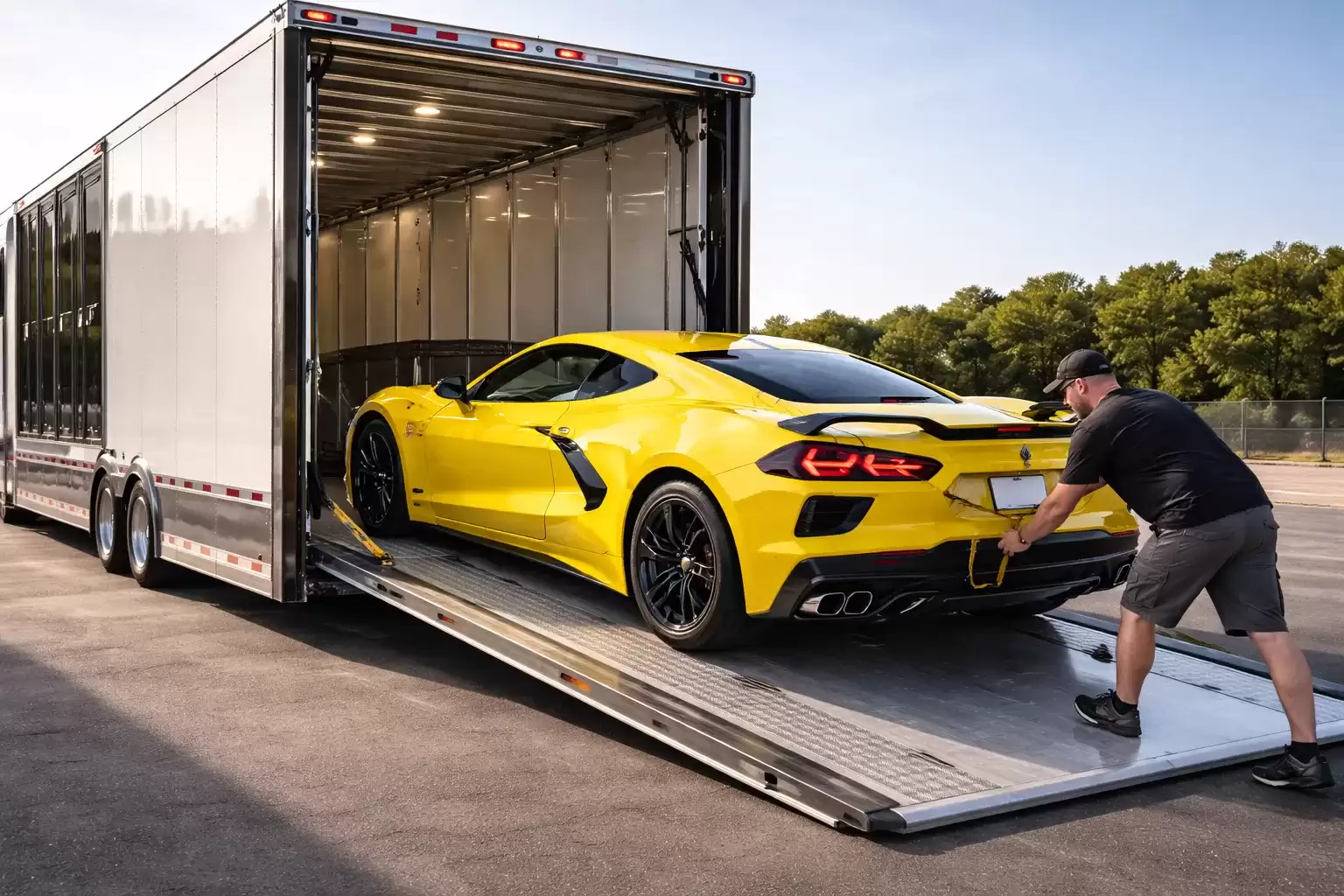
Yellow sports car being loaded into an enclosed auto transport trailer for Colorado delivery

Ready to ship your car to or from Colorado?

Join hundreds of thousands of customers — military families at Fort Carson and Colorado Springs, California Exodus relocators, ski resort homeowners, university students, and families moving across the country — who have trusted Direct Express Auto Transport with their Colorado vehicle shipments since 2004. Get your instant, no-obligation quote now. It takes 30 seconds, requires no personal information, and there is no upfront payment required to hold your spot.

Instant quote — real-time pricing in under 5 seconds
No upfront payment — your card is charged only when a carrier is assigned
No risk to get a quote and book your order
BBB Accredited A+ since 2004
FMCSA licensed and fully bonded
4.6 stars across thousands of verified Google reviews