
Alaska Vehicle Shipping Services
Need to ship a car to or from Alaska? Get a real-time, transparent mainland price in 30 seconds — no phone calls, no risk, no upfront payment. Direct Express Auto Transport has been the Frontier State’s most trusted auto transport broker since 2004, with a 4.6-star average across thousands of verified Google reviews.
★ 4.6/5 Google Reviews | BBB Accredited A+ | FMCSA Licensed (MC #479342) | USDOT #1240502 | No upfront payment required | 20+ years shipping vehicles


Total Alaska shipping cost has two independent components. The continental US land leg (our service, door to Tacoma/Seattle port) runs $200–$1,500 depending on your mainland origin. Portland to Tacoma runs $200–$350. Los Angeles to Tacoma runs $500–$700. Chicago to Tacoma runs $1,050–$1,300. New York to Tacoma runs $1,400–$1,700. The ocean freight leg (TOTE Maritime or Matson, booked separately) from Tacoma to Anchorage runs approximately $1,100–$1,800 for a standard sedan as of recent published rates — verify current pricing directly with the carrier as fuel surcharges vary. Alaska-side in-state delivery from the Anchorage port to interior destinations (Fairbanks, Kenai Peninsula, Mat-Su Valley) requires a separate local arrangement and adds $200–$600 depending on distance.
⚠ Book Expedited or Rush for Every Alaska Port Delivery — Here Is Why It Matters
The 5-day free storage clock. Once your vehicle arrives at the Tacoma or Seattle marine terminal, the clock starts. Port terminals grant a free storage window of approximately five days. After that grace period expires, daily vehicle storage fees begin — typically $25–$75 per day depending on the terminal operator. A vehicle sitting on day six or seven has already generated storage charges that erase whatever you saved by choosing Standard over Expedited. With TOTE Maritime sailing twice weekly, a delayed carrier pickup that causes you to miss a sailing costs 3–4 days of storage while waiting for the next vessel — on top of the daily fees already accumulating.
Port gate wait times punish carriers on Standard rates. Commercial port terminals are notoriously slow for auto carriers. Gate security checks, appointment windows, yard coordination, and vessel traffic hold carriers waiting at the Tacoma and Seattle gates for three to eight hours per pickup — sometimes an entire day. A carrier dispatched to a port gate on a Standard-rate assignment absorbs that multi-hour wait with no additional compensation. Carriers know this, which is why Standard-rate port pickups frequently go unfilled, get deprioritized, or fall through entirely. Expedited and Rush rates include the premium necessary to compensate carriers fairly for port gate time and to ensure your vehicle is treated as a priority dispatch rather than an afterthought.
The math is simple. The rate difference between Standard and Expedited is typically $75–$200 on most mainland routes. A single day of port storage plus a missed vessel sailing costs far more than that — and with TOTE’s twice-weekly schedule, even a missed sailing means 3–4 days of storage fees before the next departure. We strongly recommend Expedited or Rush service for all Alaska-bound and Alaska-returning port deliveries without exception. On a shipment of this complexity and cost, the service level upgrade is the one decision that most reliably protects your timeline and your total budget.

What customers say about shipping a car to or from Alaska with Direct Express Auto Transport


The two-leg Alaska car shipping process explained
Leg 1 (Direct Express Auto Transport — use Expedited or Rush): We pick up your vehicle at any continental US address and deliver it to the marine terminal at Tacoma (Port of Tacoma) or Seattle. Because port terminals charge storage fees after approximately five free days — and because carriers dispatched to port gates on Standard-rate assignments routinely absorb three to eight hours of unpaid wait time, making Standard-tier port pickups unreliable — we strongly recommend Expedited or Rush for the land leg on every Alaska shipment. We provide a condition report at pickup and a terminal delivery confirmation when your vehicle arrives at the port.
Leg 2 (Ocean Freight — you book): TOTE Maritime (totemaritimealaska.com) is the dominant vehicle carrier on the Tacoma-Anchorage route, sailing twice weekly from Tacoma to Anchorage. Matson also operates Alaska service from Seattle. You book directly with the carrier, provide your vehicle’s VIN and dimensions, and receive a vessel cutoff date. Coordinate your mainland delivery with us to arrive at the terminal 2–3 business days before the vessel cutoff.
Leg 3 (Alaska local — you arrange): After ocean transit, your vehicle clears at the Port of Anchorage. A local Alaska transporter or rental car company can move it from the port to your Anchorage, Mat-Su, or Kenai Peninsula address. For Fairbanks or interior destinations, Alaska-based carriers run the Parks Highway or Richardson Highway. Southeast Alaska communities (Juneau, Ketchikan, Sitka) not connected by road to Anchorage must use the Alaska Marine Highway System separately.
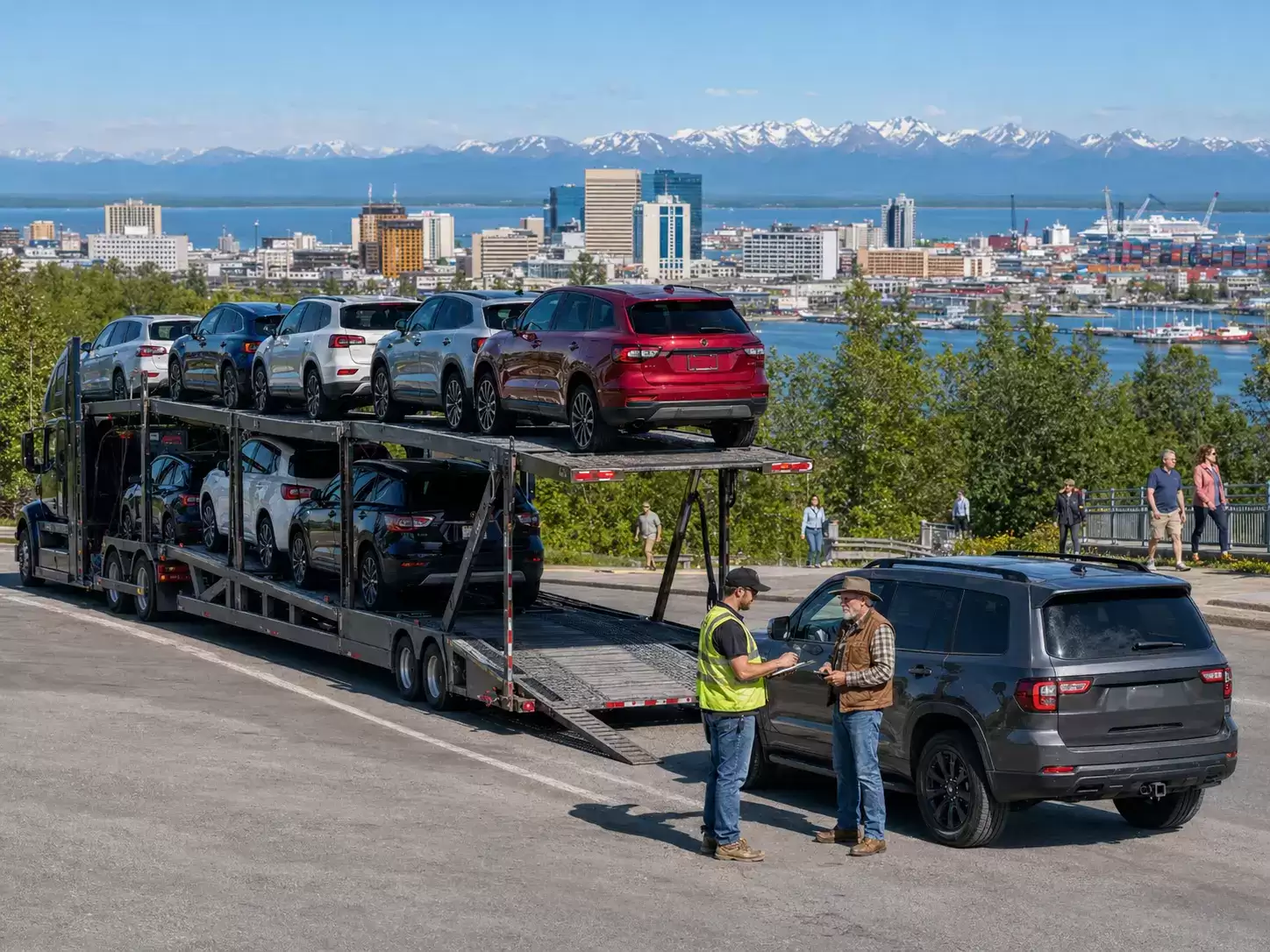
Which mainland departure port should you use for Alaska?
Tacoma (Port of Tacoma) — Primary Choice. TOTE Maritime’s primary Alaska terminal operates out of the Port of Tacoma. TOTE sails twice weekly to Anchorage, providing the most scheduling flexibility of any Alaska ocean carrier. The 4–5 day ocean transit is the fastest Alaska-bound option available. For virtually all shippers, Tacoma is the recommended departure port because TOTE’s twice-weekly schedule minimizes waiting time for the next sailing. Pacific Northwest shippers (Seattle, Portland, Spokane) have the shortest overland haul and pay the lowest total land-leg cost.
Seattle — Secondary Option. Matson operates Alaska-bound sailings from Seattle. Seattle’s terminal is located at the Port of Seattle. Matson’s Alaska service is less frequent than TOTE’s Tacoma schedule; confirm current sailing frequency directly with Matson Alaska (matson.com) when planning. For Seattle-area shippers who prefer Matson’s customer service or pricing over TOTE, Seattle is a viable alternative. Both Tacoma and Seattle ports are served by the same carrier network for the mainland land leg — we deliver to either terminal with no difference in our service quality.
A note on overland via the Alaska Highway (ALCAN): The Alaska Highway runs 1,422 miles from Dawson Creek, British Columbia to Delta Junction, Alaska. While some private drivers make this overland journey with their vehicles, commercial auto transport carriers do not operate on this route. The overland path crosses Canadian territory, requiring Canadian carrier operating authority, customs broker involvement, provincial permits, and carrier insurance applicable in Canada. No licensed US auto transport carrier runs ALCAN routes commercially. If you want a company to drive your vehicle overland to Alaska, that is a specialized driveaway service — a completely different product. We do not offer ALCAN driveaway.
Alaska ocean freight carriers: TOTE Maritime, Matson, and Alaska Marine Lines
TOTE Maritime Alaska (totemaritimealaska.com) is the dominant vehicle carrier on the Tacoma-Anchorage corridor, operating LNG-powered vessels twice weekly. TOTE’s RoRo service carries standard passenger vehicles, light trucks, motorcycles, and ATVs. The twice-weekly frequency is the key advantage over alternatives — a missed vessel cutoff means a 3–4 day wait rather than a full week. TOTE’s Anchorage terminal is at the Port of Anchorage (South Addition). Contact TOTE vehicle booking directly for current rates and sailing schedules — fuel surcharges and seasonal demand adjust pricing throughout the year.
Matson Alaska (matson.com) offers service from Seattle to Anchorage and to other Alaska ports including Kodiak. Matson is a viable alternative to TOTE and worth a parallel quote. Matson has served Alaska since 2015 when it acquired Horizon Lines’ Alaska assets. Current sailing frequency should be confirmed directly with Matson at booking.
Alaska Marine Lines (lynden.com/aml) is a subsidiary of Lynden Transport specializing in Alaska freight. AML handles bulk cargo and containerized freight primarily, but they also facilitate vehicle shipments to smaller Alaska ports not served by TOTE or Matson. For vehicles destined for Kodiak, Homer, Seward, Valdez, or smaller coastal communities, Alaska Marine Lines may be the appropriate ocean carrier. Contact AML directly for current vehicle shipping rates and port coverage.
Vehicle prep for Alaska ocean freight: TOTE and Matson require fuel levels at or below a quarter tank, no personal items inside the vehicle, proof of ownership and registration, and a functioning battery without aftermarket alarms. Vehicles headed to interior Alaska face extreme cold upon arrival — confirm that your battery, antifreeze, and oil grade are appropriate for temperatures that can reach -40°F in Fairbanks and interior communities.
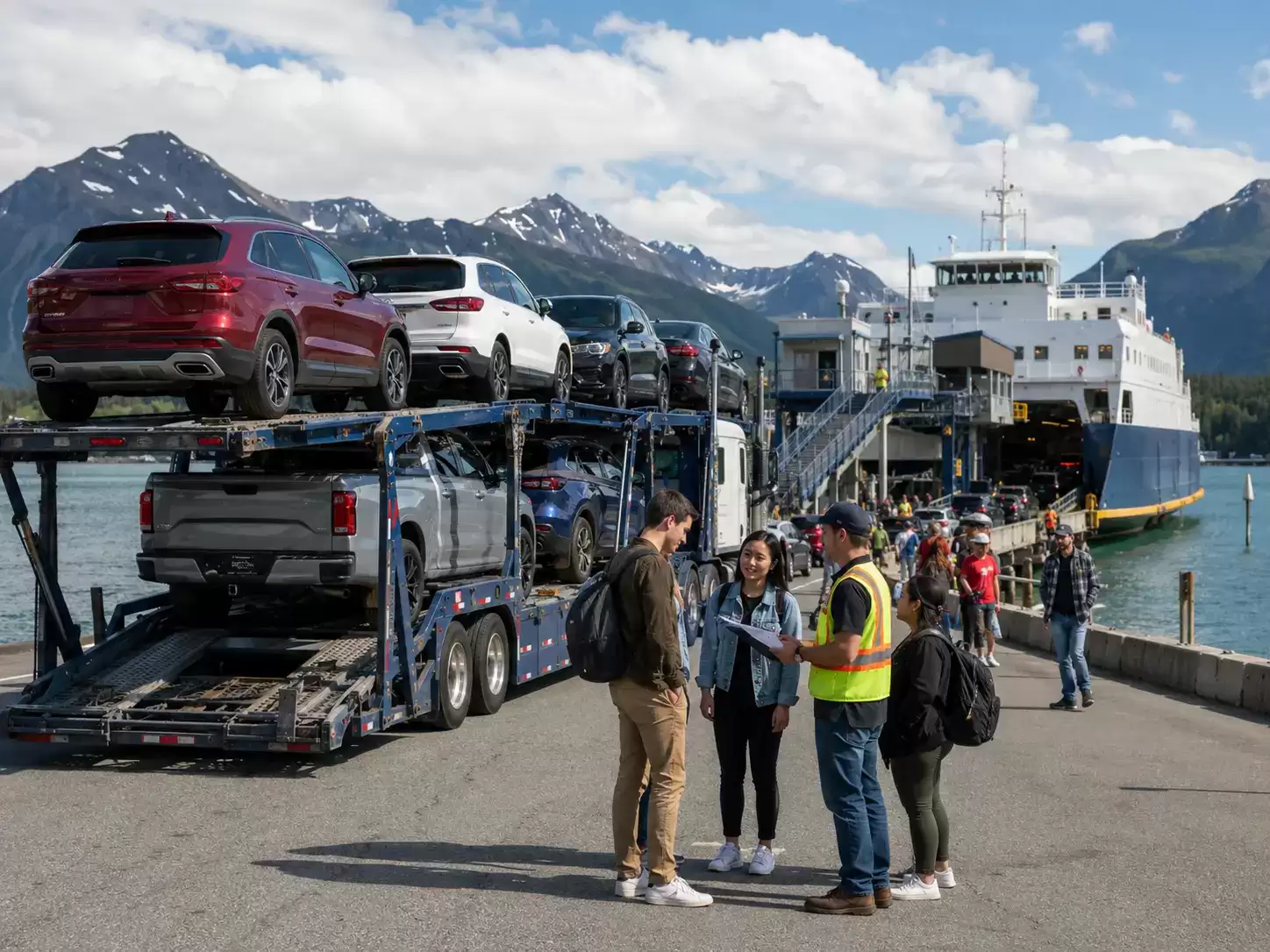
Continental US land leg pricing: your origin to Tacoma/Seattle port
Prices reflect the Direct Express Auto Transport continental US leg only. Ocean freight, port fees, and Alaska-side delivery are booked and paid separately.
| Route (To Tacoma/Seattle Port) | Standard Open | Expedited Open | Rush Open |
|---|---|---|---|
| Portland, OR to Tacoma Port | $250 | $300 | $350 |
| San Francisco, CA to Tacoma Port | $400 | $480 | $560 |
| Los Angeles, CA to Tacoma Port | $550 | $660 | $770 |
| Las Vegas, NV to Tacoma Port | $600 | $720 | $840 |
| Phoenix, AZ to Tacoma Port | $750 | $900 | $1,050 |
| Denver, CO to Tacoma Port | $850 | $1,020 | $1,190 |
| Dallas, TX to Tacoma Port | $1,100 | $1,320 | $1,540 |
| Chicago, IL to Tacoma Port | $1,100 | $1,320 | $1,540 |
| New York, NY to Tacoma Port | $1,500 | $1,800 | $2,100 |
| Miami, FL to Tacoma Port | $1,400 | $1,680 | $1,960 |
Continental US land leg pricing: Tacoma/Seattle port to your destination
For vehicles arriving from Alaska at the Tacoma or Seattle port, we handle delivery from the port to any continental US destination. Prices are the same in both directions for equivalent routes.
| Route (From Tacoma/Seattle Port) | Standard Open | Expedited Open | Rush Open |
|---|---|---|---|
| Tacoma Port to Portland, OR | $250 | $300 | $350 |
| Tacoma Port to San Francisco, CA | $400 | $480 | $560 |
| Tacoma Port to Los Angeles, CA | $550 | $660 | $770 |
| Tacoma Port to Las Vegas, NV | $600 | $720 | $840 |
| Tacoma Port to Phoenix, AZ | $750 | $900 | $1,050 |
| Tacoma Port to Denver, CO | $850 | $1,020 | $1,190 |
| Tacoma Port to Dallas, TX | $1,100 | $1,320 | $1,540 |
| Tacoma Port to Chicago, IL | $1,100 | $1,320 | $1,540 |
| Tacoma Port to New York, NY | $1,500 | $1,800 | $2,100 |
| Tacoma Port to Miami, FL | $1,400 | $1,680 | $1,960 |
Understanding total Alaska car shipping cost end-to-end
A realistic total cost estimate for a Chicago resident shipping a standard sedan to Anchorage: $1,100 (our continental US land leg, Chicago to Tacoma port) + approximately $1,200–$1,600 (TOTE Maritime ocean freight, Tacoma to Anchorage) + $0 if self-collecting at port, or $200–$400 for local Anchorage-side delivery = approximately $2,500–$3,100 total. For a Portland, Oregon resident: $250 (land leg) + $1,200–$1,600 (TOTE ocean) = approximately $1,450–$1,850 total. For a New York resident: $1,500 (land leg) + $1,200–$1,600 (TOTE ocean) = approximately $2,700–$3,100 total. The land leg varies enormously by mainland origin; the ocean leg is relatively fixed regardless of where on the mainland you start. Get your TOTE or Matson ocean quote first, then contact us for the land leg to complete your total budget picture.

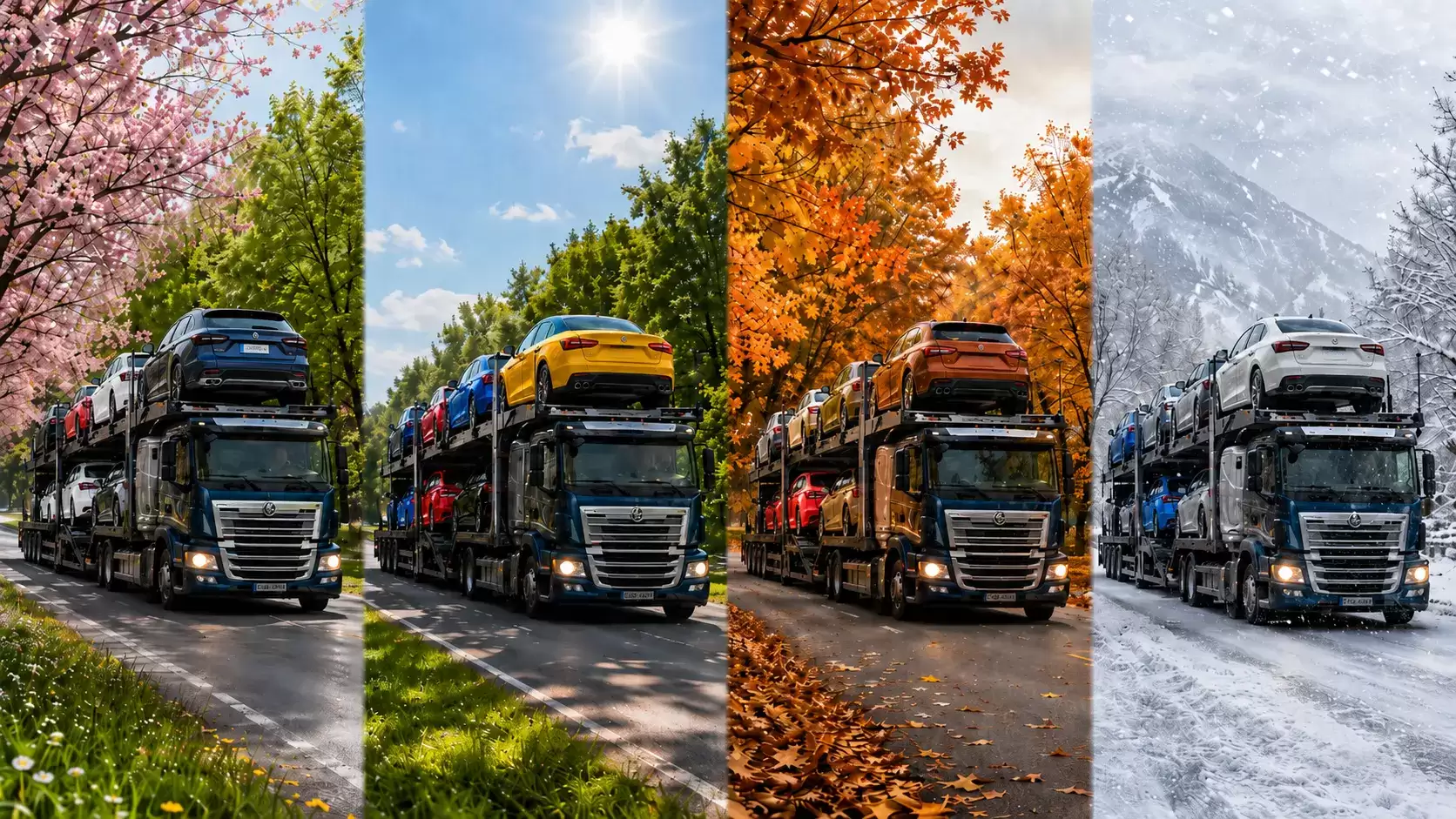
Alaska car shipping seasonal guide
Alaska shipping: port selection and service guide
| Departure Port | Primary Ocean Carrier | Best For | Ocean Transit to Anchorage |
|---|---|---|---|
| Tacoma (Port of Tacoma) | TOTE Maritime (twice weekly) | All mainland US origins; most frequent sailings; fastest transit | 4–5 days |
| Seattle (Port of Seattle) | Matson | Seattle-area shippers preferring Matson; confirm current frequency | 4–6 days |
| Bellingham, WA (AMHS only) | Alaska Marine Highway System | Southeast Alaska communities only (Juneau, Ketchikan, Sitka); state ferry, not RoRo | 2–3 days to Ketchikan; 3–4 days to Juneau |


How to ship your car to Alaska in 4 steps
Step 1: Book your ocean freight first. Contact TOTE Maritime (totemaritimealaska.com) or Matson Alaska (matson.com) to get ocean freight pricing and confirm vessel sailing schedules and terminal cutoff dates. Securing your sailing confirmation first gives you the port delivery target date to coordinate with us on the land leg.
Step 2: Book the continental US land leg with us — choose Expedited or Rush. Enter your mainland origin, Tacoma or Seattle port, vehicle type, and service level. Select Expedited or Rush, not Standard. Port terminals begin charging storage fees after approximately five free days, and carriers on Standard-rate assignments routinely wait three to eight hours at the port gate with no extra compensation — making Standard-tier port pickups unreliable and slow. The Expedited or Rush premium is almost always less expensive than even a single day of port storage or a missed TOTE sailing. Provide your vessel cutoff date and we will schedule your port delivery to arrive 2–3 business days before it.
Step 3: Mainland pickup and port delivery. Your driver meets you at your mainland location, completes a condition report, and delivers your vehicle to the TOTE Maritime or Matson terminal. We provide you with a delivery confirmation to present to your ocean carrier. Inspect your vehicle at pickup — the condition report documents all pre-existing marks before the ocean voyage.
Step 4: Ocean transit and Alaska arrival. Your vehicle sails to the Port of Anchorage. After port clearance (typically 1–2 business days), you or your Alaska-side representative picks up the vehicle. If you are shipping to Fairbanks or interior Alaska, arrange a local carrier for the onward leg from Anchorage. Inspect the vehicle against the mainland pickup condition report before signing the delivery receipt.
Alaska universities and college auto transport
| University | Location | Approx. Enrollment |
|---|---|---|
| University of Alaska Anchorage | Anchorage | 14,000 |
| University of Alaska Fairbanks | Fairbanks | 7,500 |
| University of Alaska Southeast | Juneau | 2,500 |
| Alaska Pacific University | Anchorage | 700 |
| Charter College | Anchorage | 2,000 |
| Prince William Sound College | Valdez | 600 |
| Ilisagvik College | Utqiaġvik (Barrow) | 300 |
| Kenai Peninsula College (UAA) | Soldotna | 2,200 |
| Matanuska-Susitna College (UAA) | Palmer | 2,500 |
| Kodiak College (UAA) | Kodiak | 600 |

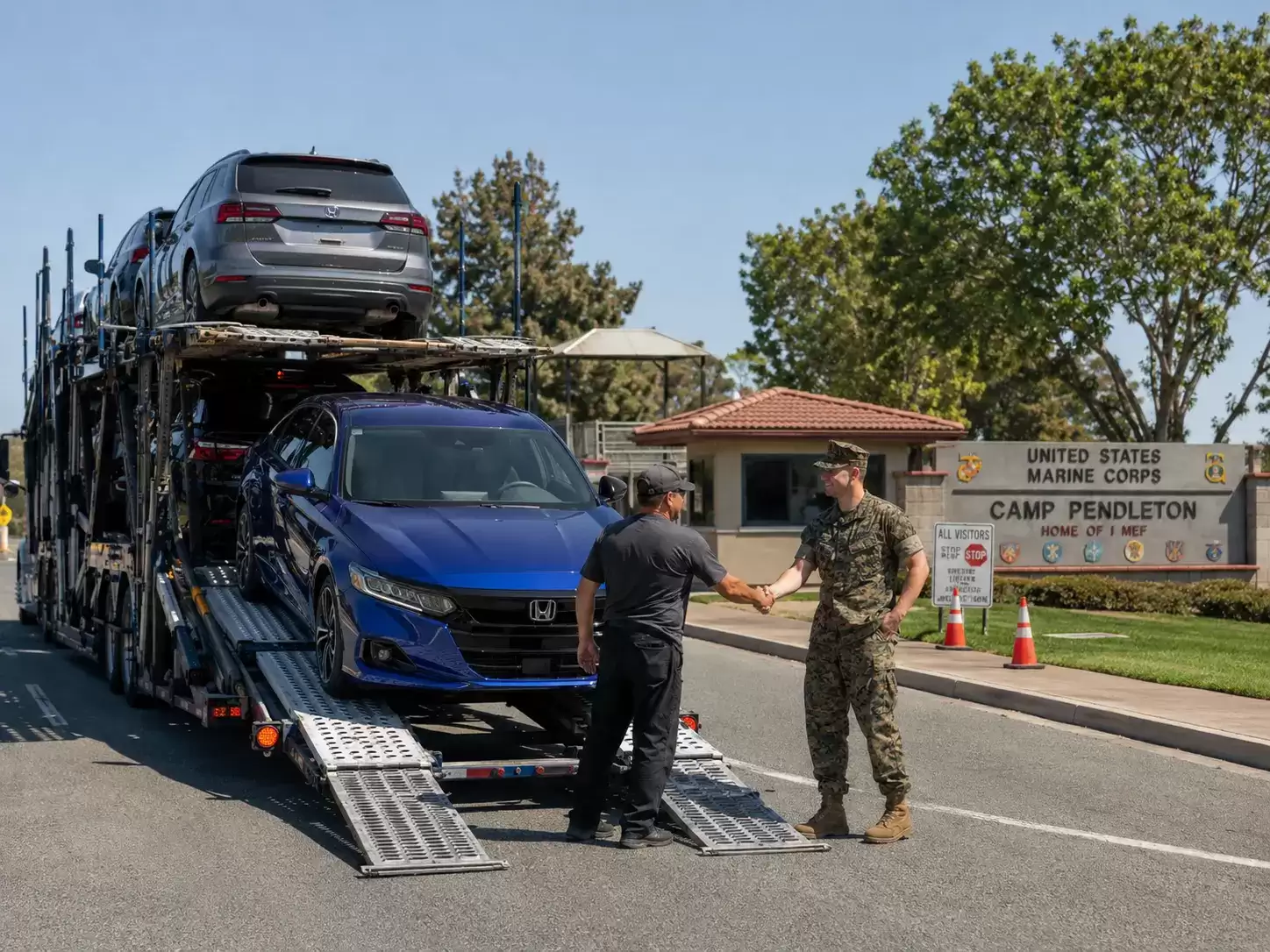
Alaska military auto transport
Alaska hosts some of the most strategically significant military installations in the US, and the resulting PCS auto transport volume is among the highest per-capita of any state.
Joint Base Elmendorf-Richardson (JBER) in Anchorage is the largest installation, hosting the 3rd Wing (Air Force, F-22 Raptors and C-17s) and the 4th Infantry Brigade Combat Team (Army).
Fort Wainwright in Fairbanks hosts the 1st Stryker Brigade Combat Team and is one of the northernmost major Army installations in the world.
Eielson Air Force Base outside Fairbanks (15 miles southeast) is home to the 354th Fighter Wing and the 168th Air Refueling Wing.
Fort Greely near Delta Junction operates the Ground-Based Midcourse Defense missile field. Clear Space Force Station near Nenana operates missile warning radar.
Military shippers to Alaska should confirm GBL entitlement with the installation transportation office before booking privately. The military vehicle shipping allowance covers one vehicle per authorized member; PCS orders to Alaska qualify for DITY/PPM reimbursement. Book 8–10 weeks before your report date during summer PCS season (June–August) to secure both TOTE sailing space and land-leg carrier availability.
Alaska car shipping: who we serve
Direct Express Auto Transport picks up and delivers vehicles at any continental US address for Alaska-bound or Alaska-returning shipments. Common mainland origins include Seattle, Portland, San Francisco, Los Angeles, Las Vegas, Phoenix, Denver, Salt Lake City, Dallas, Houston, Chicago, Atlanta, Miami, New York, Washington DC, Boston, and hundreds of smaller cities across all 48 lower states.
We deliver to the TOTE Maritime terminal at the Port of Tacoma or the Matson terminal at the Port of Seattle. We do not currently provide in-state Alaska transport — vehicles are delivered to the port terminal. For Alaska-side port-to-door delivery to Anchorage, Mat-Su Valley, or the Kenai Peninsula, local Alaska transport providers can be arranged. For Fairbanks or interior Alaska delivery, Alaska-based long-haul carriers run the Parks and Richardson Highways; contact us and we can provide referrals to vetted providers we have worked with.

Alaska government resources for vehicle transport
Alaska Division of Motor Vehicles — doa.alaska.gov/dmv — handles Alaska title transfers and registration for vehicles imported from the lower 48. Alaska Department of Transportation — dot.alaska.gov — provides road condition reports for Alaska highways relevant to in-state delivery coordination after port arrival. The Alaska Marine Highway System — ferry.alaska.gov — is the state ferry service connecting Southeast Alaska communities not accessible by road; relevant for Juneau, Ketchikan, Sitka, and Kodiak-bound shipments. TOTE Maritime Alaska — totemaritimealaska.com — is the primary ocean freight carrier for Tacoma-Anchorage vehicle transport. The Federal Motor Carrier Safety Administration — fmcsa.dot.gov — verifies carrier licensing for the continental US land leg.

Popular long distance routes for Alaska car shipping
California to Alaska Auto Transport
California is the most common mainland origin for Alaska-bound vehicle shipments given its large population and proximity to the Tacoma port corridor. Los Angeles to Tacoma port runs $500–$700; San Francisco to Tacoma runs $350–$550. California shippers save significantly on the land leg compared to Midwest or East Coast origins, making total Alaska shipping cost among the most affordable available. California-based military families at Camp Pendleton, Fort Irwin, Beale AFB, and Travis AFB receiving Alaska PCS orders are among the most frequent California-to-Alaska auto transport customers.
Washington State to Alaska Vehicle Shipping
Washington State shippers have the lowest land-leg cost of any mainland origin — Seattle and Tacoma are the departure ports themselves. A Tacoma or Seattle origin going to the TOTE terminal is essentially a local port delivery run costing $150–$300. Eastern Washington (Spokane) to Tacoma runs $300–$450. Washington State is the natural gateway for Alaska shipping; Pacific Northwest carriers serving the I-5 corridor maintain consistently good availability for port deliveries. No other mainland state has the geographic advantage Washington offers for Alaska-bound vehicle transport.
Oregon to Alaska Car Transport
Oregon shippers enjoy the second-shortest land leg to the Tacoma port after Washington. Portland to Tacoma runs $200–$350 on Standard open carrier — a same-day or next-day transit. Eugene and Medford are 2–3 hours further but still among the most cost-effective mainland origins for Alaska shipping. Oregon’s fishing and forestry industries drive inter-state worker relocations to Alaska’s fishing and resource extraction sectors, making this an active corridor year-round.
Texas to Alaska Auto Shipping
Texas to Alaska is an active corridor driven by energy sector relocations between the Texas Permian Basin and Houston energy hub and Alaska’s North Slope and Kenai Peninsula oil and gas operations. It is also driven by military PCS moves from Fort Hood (Killeen), Fort Bliss (El Paso), and Joint Base San Antonio to JBER and Fort Wainwright. Dallas to Tacoma port runs $1,050–$1,300. Houston to Tacoma runs $1,050–$1,300. Texas military shippers should book 8–10 weeks ahead for summer PCS season.
Arizona to Alaska Vehicle Transport
Arizona to Alaska shipping is driven by Alaska residents who winter in Phoenix, Scottsdale, and Tucson and return their vehicles north each spring. Phoenix to Tacoma port runs $700–$950 on Standard open carrier. The April Alaska return surge aligns with Arizona snowbirds departing for Alaska — book 6–8 weeks ahead for April departures to secure TOTE sailing space and land-leg carrier availability before the spring rush peaks.
Nevada to Alaska Car Shipping
Nevada to Alaska shipping is a moderate-volume corridor. Las Vegas to Tacoma port runs $550–$750. Reno to Tacoma runs $450–$650. Nevada shippers benefit from the I-80 west or US-395 north routing to the Pacific Northwest, both well-served corridors with consistent carrier availability. Nevada’s large military veteran population generates a portion of this corridor’s volume from veterans relocating to Alaska’s growing veteran-friendly communities.
Colorado to Alaska Auto Transport
Colorado to Alaska shipping connects two of the Mountain West’s outdoor recreation and natural resource economies. Denver to Tacoma port runs $800–$1,050 via I-90 west or I-80 west to I-84 northwest. Colorado Springs to Tacoma is similar. Colorado generates consistent Alaska shipping volume from outdoor recreation professionals, National Park Service and Forest Service workers, and military families at Peterson SFB and Fort Carson receiving Alaska PCS orders.
Midwest to Alaska Vehicle Shipping
Chicago, Minneapolis, and Detroit are the primary Midwest origins for Alaska shipping. Chicago to Tacoma port runs $1,050–$1,300 on Standard open carrier with 3–4 day transit via I-90 west. Minneapolis to Tacoma runs $1,000–$1,250 via I-90 west. Midwest military families at Fort Riley (Kansas), Scott AFB (Illinois), and Wright-Patterson AFB (Ohio) receiving Alaska PCS orders represent a significant share of Midwest-to-Alaska auto transport volume. Book 8–10 weeks ahead for summer PCS season departures from the Midwest.
New York to Alaska Car Transport
New York to Alaska is one of the longest continental US land legs, with New York City to Tacoma port running $1,400–$1,800. Despite the cost, the New York–Alaska corridor is active given the large number of federal government workers and defense contractors in the tri-state area receiving Alaska assignments. West Point military academy graduates receiving Fort Wainwright or JBER assignments frequently use this route. Enclosed carrier demand is disproportionate on this corridor given the luxury vehicle segment connected to Alaska resort and lodge properties.
Florida to Alaska Auto Shipping
Florida to Alaska is among the longest and most expensive continental land legs, with Miami to Tacoma running $1,350–$1,700. Despite the distance, this is an active corridor. Military families at Eglin AFB (Fort Walton Beach), MacDill AFB (Tampa), and Patrick SFB (Brevard County) regularly receive Alaska PCS orders. Florida retirees with Alaska hunting and fishing properties also ship vehicles north seasonally. Book the Florida-to-Tacoma land leg on Expedited service to ensure port delivery ahead of the TOTE vessel cutoff without timing risk on this long-haul route.
Virginia to Alaska Vehicle Transport
Virginia generates high Alaska shipping volume from the massive Northern Virginia defense and intelligence community and from Hampton Roads military installations. Pentagon civilians and contractors receiving Alaska assignments, and Navy and Air Force personnel cycling through JEB Little Creek-Fort Story, Naval Station Norfolk, and Langley AFB frequently ship vehicles to JBER and Eielson. Northern Virginia to Tacoma port runs $1,300–$1,600. Norfolk to Tacoma runs $1,300–$1,600. Book 8–10 weeks ahead for summer PCS season departures from Virginia.
Georgia to Alaska Car Shipping
Georgia generates consistent Alaska-bound military PCS volume. Fort Moore (Columbus, formerly Fort Benning) regularly sends infantry and Ranger personnel to Fort Wainwright. Robins AFB (Warner Robins) sends aviation maintenance personnel to Eielson. Atlanta to Tacoma port runs $1,100–$1,400. Savannah-area shippers (close to Fort Stewart) run $1,100–$1,400 as well. Georgia military shippers coordinate through the installation transportation office for GBL authorization before booking privately.

Nearest mainland states for Alaska auto transport
Washington Auto Transport
Washington is the mainland gateway to Alaska shipping. TOTE Maritime’s Tacoma terminal and Matson’s Seattle terminal are both in Washington State. Washington shippers have the shortest land leg of any mainland origin and can deliver vehicles to the port terminal in a single day from most Puget Sound locations. For Alaska-bound shipping, no other state offers the combination of port proximity, carrier availability, and ocean freight frequency that Washington does.
Oregon Vehicle Shipping
Oregon is the second-closest mainland state to the Alaska departure ports. Portland to Tacoma is a 145-mile run on I-5 north — a same-day transit with strong carrier supply on the Pacific Northwest freight corridor. Oregon shippers have nearly the same cost advantage as Washington shippers for the land leg. Eugene, Medford, and Bend shippers add 2–4 hours of drive time but remain among the most economical mainland origins for total Alaska shipping cost.
California Car Transport
California is the highest-volume mainland origin for Alaska shipping after Washington and Oregon. I-5 north through California connects to the Tacoma terminal efficiently. Southern California (LA, San Diego) has the longest California-to-Tacoma land haul but remains significantly cheaper than Midwest or East Coast origins. Northern California (San Francisco, Sacramento) shippers can reach Tacoma in 2 transit days. California’s large military population at bases throughout the state generates consistent Alaska PCS auto transport volume year-round.
Nevada Auto Shipping
Nevada shippers route to Tacoma via US-395 north (Reno area) or I-15 north to I-84 northwest (Las Vegas area). Las Vegas to Tacoma is a 1,125-mile run taking 2 transit days on Standard service. Reno to Tacoma is 860 miles — a 1–2 day run. Nevada’s casino and resort industry generates some Alaska shipping volume from workers rotating to Alaska fishing lodge and resort operations during summer season.
Idaho Vehicle Transport
Idaho connects to Tacoma via I-84 west to I-82 north or via I-90 west to I-5 north. Boise to Tacoma runs 500 miles — a 1–2 day Standard transit. Idaho is one of the closer inland states to the Alaska departure ports, keeping land-leg costs below the Midwest average. Idaho’s agricultural sector generates inter-state worker relocation to Alaska’s fishing and resource industries, contributing to consistent moderate volume on this corridor.
Montana Car Shipping
Montana connects to Tacoma via I-90 west. Billings to Tacoma runs 870 miles; Missoula to Tacoma runs 570 miles. Montana is a moderate-volume Alaska shipping origin. Military families at Malmstrom AFB (Great Falls) receiving Alaska PCS orders are the primary driver of Montana-to-Alaska auto transport. Great Falls to Tacoma runs 730 miles — a 2-day Standard transit. Montana shippers benefit from I-90’s carrier density connecting to the Pacific Northwest corridor.

Get your Alaska car shipping quote
Ready to ship your vehicle to or from Alaska? Use our quote form to get the continental US land leg pricing for your specific origin, port, vehicle type, and service level. Remember to book your TOTE Maritime or Matson ocean freight separately — have your ocean quote in hand before finalizing your land leg booking so you can coordinate port delivery timing precisely. Our team is available to help you plan both legs and can connect you with vetted Alaska-side transport providers for Fairbanks and interior deliveries.
Instant quote — real-time pricing in under 5 seconds
No upfront payment — your card is charged only when a carrier is assigned
No risk to get a quote and book your order
BBB Accredited A+ since 2004
FMCSA licensed and fully bonded
4.6 stars across thousands of verified Google reviews