
Car Shipping To or From Alabama
Need to ship a car to or from Alabama? Direct Express Auto Transport has been the Heart of Dixie’s most trusted auto transport broker since 2004 — with a 4.6-star average across thousands of verified Google reviews, no upfront payment required, and a real-time quote available in 30 seconds.
★ 4.6/5 Google Reviews | BBB Accredited A+ | FMCSA Licensed (MC #479342) | USDOT #1240502 | No upfront payment required | 20+ years shipping vehicles


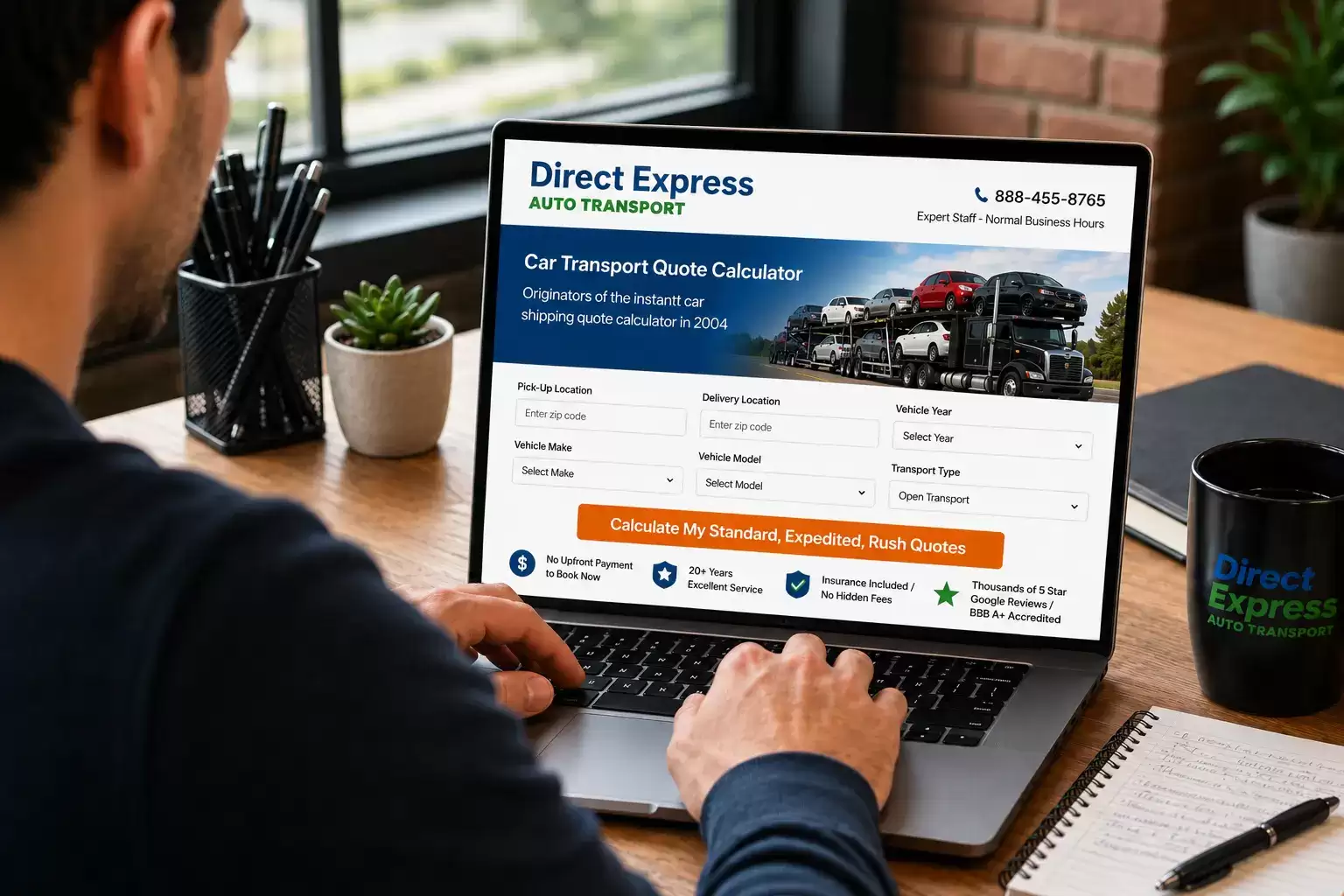
Alabama car shipping costs vary based on your route, the time of year, vehicle size, and the service tier you choose. Use our instant calculator above for a real-time quote — or see the route-by-route pricing tables below for a fast ballpark. Most standard sedan shipments to or from Alabama range from $350 for short-haul routes to Georgia or Tennessee to $1,350+ on transcontinental routes to California. Our Expedited and Rush pricing tiers hasten the process to create an even more satisfying experience.
What customers say about shipping a car to or from Alabama with Direct Express Auto Transport


The interstate corridors that move Alabama vehicles
I-65 (North-South backbone): Alabama’s most important carrier artery, running from the Tennessee state line near Athens south through Decatur, Birmingham, and Montgomery to Mobile and I-10 at the Gulf Coast. I-65 is the primary carrier route connecting Alabama to Tennessee and Kentucky to the north and Florida to the south, and is the reason the Birmingham-to-Mobile corridor has strong carrier availability year-round. Virtually all north-south vehicle shipping in Alabama moves on or near I-65.
I-20 / I-59 (East-West through Birmingham): The two interstates that converge near the Mississippi state line and run together through Birmingham before separating — I-20 continuing northeast toward Atlanta and I-59 continuing northeast toward Chattanooga. The I-20/I-59 corridor is Alabama’s primary east-west carrier route and is responsible for Birmingham’s exceptional carrier access. Vehicles moving between Alabama and Georgia, Florida’s Atlantic coast, or the Carolinas typically route through this corridor.
I-85 (Montgomery northeast toward Atlanta): Runs from Montgomery northeast to the Georgia state line at Lanett, connecting the Alabama state capital to Atlanta. The I-85 corridor carries strong carrier traffic between Montgomery and Atlanta and is the primary route for Hyundai manufacturing employee relocations between Montgomery and the Southeast. Montgomery’s position at the I-65/I-85 junction makes it Alabama’s second most carrier-accessible city after Birmingham.
I-22 (Birmingham northwest toward Memphis): Runs from Birmingham northwest to the Mississippi state line, connecting Alabama to Memphis and the I-40 transcontinental corridor. I-22 is Alabama’s gateway to the Mid-South and is increasingly used by carriers routing between Alabama and the Midwest on the Memphis hub network. Birmingham shippers can access Memphis-routed loads on this corridor, and Alabama-to-Illinois or Alabama-to-Missouri routes frequently use I-22 as the first leg.
I-10 (Gulf Coast east-west): Runs through Mobile along the Gulf Coast, connecting Alabama to Florida to the east and Mississippi and Louisiana to the west. I-10 is Alabama’s only east-west interstate on the Gulf Coast and is the primary carrier route for Mobile shipments and for vehicles moving between Florida’s Gulf Coast and Texas. Mobile sits at the I-10/I-65 junction, making it the southernmost carrier hub in Alabama with access to both north-south and east-west corridors.
I-565 (Huntsville spur): Runs from the I-65/I-565 interchange near Decatur east into downtown Huntsville and the Redstone Arsenal Research Park. While technically a spur rather than a through route, I-565 is carrier-accessible from I-65 and connects Huntsville to the main Alabama carrier network. Vehicles moving to or from Huntsville are assigned to carriers running the I-65 north corridor who detour east on I-565 — a short and efficient detour that keeps Huntsville pickup windows reasonable for an I-65-adjacent city.

Alabama carrier dynamics: where loads originate and where they terminate
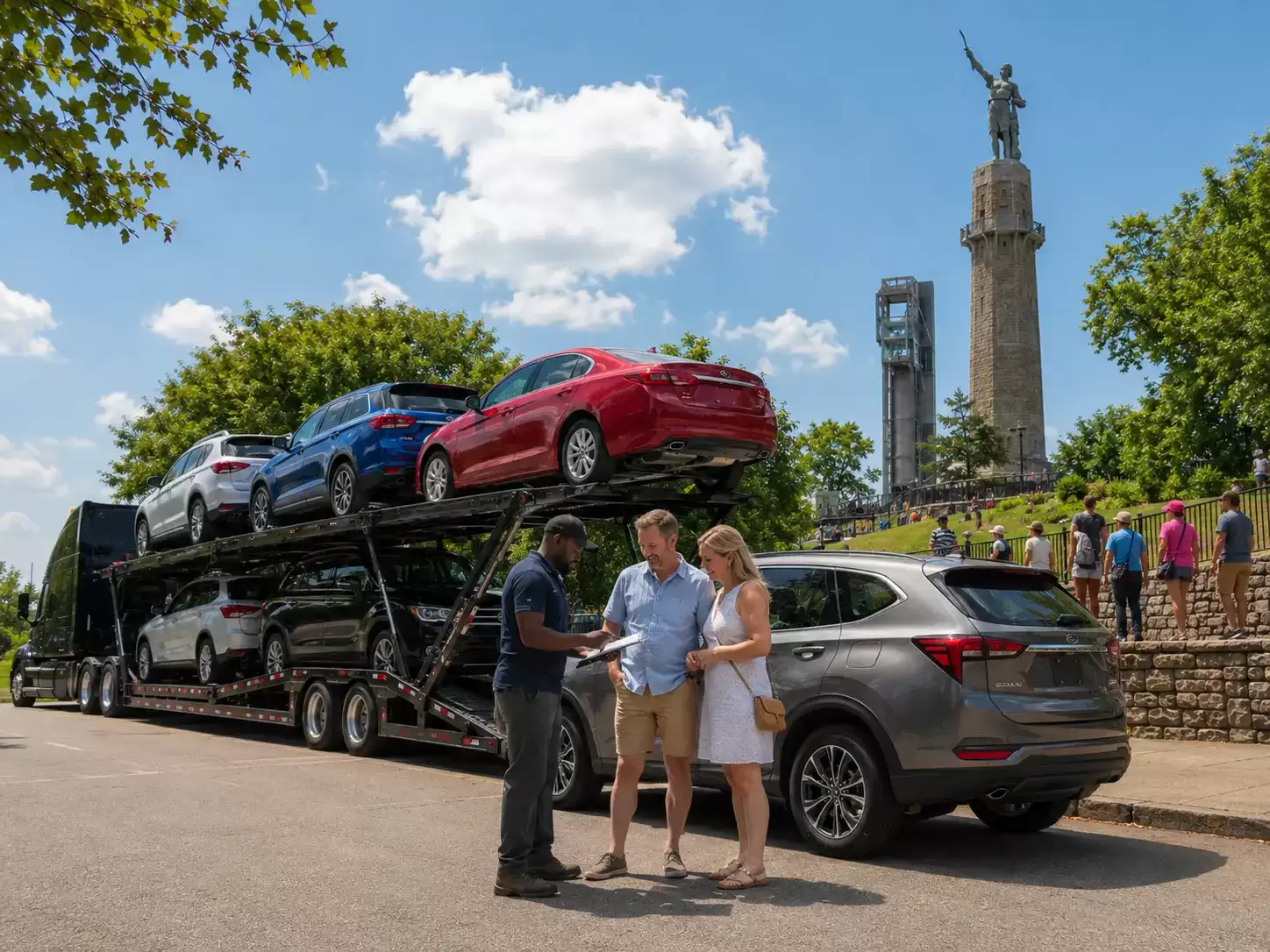
Alabama sits at the midpoint of the I-65 north-south corridor that connects the Great Lakes manufacturing belt to the Florida Gulf Coast. This geographic position creates a consistent flow of through-carrier traffic that Alabama shippers can access regardless of whether a specific carrier originated in Alabama or is simply passing through. Northbound loads on I-65 from Florida often have open slots for Alabama pickups heading to Tennessee, Kentucky, or Indiana. Southbound loads from the Midwest heading to Florida pass through Birmingham and Montgomery and can accommodate Alabama origin loads heading to the Gulf Coast or Florida.
The automotive manufacturing plants add a commercial layer on top of this residential flow. Mercedes-Benz in Vance, Honda in Lincoln, Hyundai in Montgomery, and Mazda Toyota in Huntsville all generate dealer delivery transport runs that position carriers throughout the state. Return-freight loads from these manufacturing hubs compete for residential pickup slots, which means Alabama shippers benefit from commercial carrier infrastructure that far exceeds what a state this size would otherwise attract. The effect is most visible on the I-20/I-59 corridor west of Birmingham toward Tuscaloosa, on I-65 between Birmingham and Montgomery, and on US-72/I-565 in the Huntsville corridor.
The Gulf Coast terminus creates a useful seasonal dynamic. From October through March, Midwest snowbirds and retirees route south on I-65 through Alabama to Florida and the Gulf Shores/Orange Beach market. Carriers making this southbound run are available for Alabama origin loads heading south, and the return-freight dynamic in spring (carriers heading back north from Florida) produces competitive Alabama-to-Midwest rates from March through May. Alabama shippers planning northbound moves should book in the March-April spring window for the most competitive rates and fastest pickup times.
Alabama vehicle shipping hub rankings
Birmingham / I-20 / I-59 / I-65 — Tier 1 hub: Alabama’s largest city and primary carrier hub, Birmingham sits at the convergence of three interstates and generates more carrier activity than the rest of the state combined. Standard tier is the right choice for virtually all Birmingham metro shipments; pickup windows average 1–3 business days. The surrounding Jefferson County suburbs — Hoover, Vestavia Hills, Mountain Brook, Bessemer, and Trussville — all benefit from Birmingham’s exceptional carrier access.
Huntsville / I-565 / I-65 — Tier 1 hub: Alabama’s second-largest city and fastest-growing metro, Huntsville is carrier-accessible via I-565 from the I-65 mainline. The Redstone Arsenal/NASA/defense contractor employment base generates substantial year-round PCS and relocation demand, and the Mazda Toyota Manufacturing plant adds commercial carrier volume to the corridor. Standard tier works well for most Huntsville shipments; pickup windows average 2–4 business days. Madison and the Research Park corridor are also well-served.
Montgomery / I-65 / I-85 — Tier 1 hub: The state capital and home to Hyundai Motor Manufacturing Alabama, Montgomery sits at the I-65/I-85 convergence and has strong carrier access on two interstate corridors. Standard tier is appropriate for Montgomery, with pickup windows of 2–4 business days. Maxwell AFB and Gunter Annex are within the Montgomery carrier zone and benefit from the city’s dual-interstate access.
Mobile / I-10 / I-65 — Tier 1 hub: Alabama’s only Gulf Coast metro and the state’s historic port city, Mobile sits at the I-10/I-65 junction and has access to both the north-south and east-west carrier corridors. Standard tier works for Mobile, with pickup windows of 2–4 business days. The Port of Mobile and the Mobile Bay industrial complex generate commercial freight traffic that supports strong carrier availability.
Tuscaloosa / I-20 / I-59 — Tier 1 hub: Home to the University of Alabama and the Mercedes-Benz US International plant in nearby Vance, Tuscaloosa sits on the I-20/I-59 corridor west of Birmingham and benefits from both the university relocation market and the commercial carrier activity generated by Mercedes dealer delivery transport. Standard tier is appropriate; pickup windows average 2–4 business days.
Decatur / I-65 — Tier 2 hub: An industrial city on the Tennessee River and the I-65 mainline, Decatur has solid carrier access as a through-stop on the north-south corridor. Standard tier usually works; Expedited is recommended for time-sensitive moves. Pickup windows average 3–5 business days.
Dothan / US-231 — Tier 3 hub: Alabama’s largest city in the southeastern corner of the state, Dothan sits at the convergence of several US highways but lacks direct interstate access. Fort Novosel (formerly Fort Rucker) is nearby. Expedited tier is strongly recommended for Dothan; carriers must deliberately detour from I-65 or I-10 to serve the area, and Standard pickup windows can extend to 5–10 business days.

Alabama car shipping rates: popular routes and estimated costs
The tables below reflect current market averages for open-carrier transport of a standard sedan in good weather conditions. Prices vary based on fuel costs, carrier availability, season, and vehicle size. Use the calculator above for a real-time quote specific to your route and vehicle.
Popular routes from Alabama
| From | To | Distance (mi) | Estimated Days | Standard | Expedited | Rush |
|---|---|---|---|---|---|---|
| Alabama | Georgia | 175 | 1–2 | $350 | $420 | $490 |
| Alabama | Tennessee | 210 | 1–2 | $375 | $450 | $525 |
| Alabama | Florida | 350 | 2–3 | $475 | $570 | $665 |
| Alabama | Mississippi | 275 | 1–2 | $400 | $480 | $560 |
| Alabama | North Carolina | 600 | 3–5 | $750 | $900 | $1,050 |
| Alabama | Texas | 800 | 3–5 | $875 | $1,050 | $1,225 |
| Alabama | Ohio | 750 | 3–5 | $800 | $960 | $1,120 |
| Alabama | Illinois | 725 | 3–5 | $800 | $960 | $1,120 |
| Alabama | New York | 1,200 | 4–6 | $975 | $1,170 | $1,365 |
| Alabama | California | 2,175 | 7–10 | $1,350 | $1,620 | $1,890 |
Popular routes to Alabama
| From | To | Distance (mi) | Estimated Days | Standard | Expedited | Rush |
|---|---|---|---|---|---|---|
| California | Alabama | 2,175 | 7–10 | $1,350 | $1,620 | $1,890 |
| New York | Alabama | 1,200 | 4–6 | $975 | $1,170 | $1,365 |
| Illinois | Alabama | 725 | 3–5 | $800 | $960 | $1,120 |
| Texas | Alabama | 800 | 3–5 | $875 | $1,050 | $1,225 |
| Florida | Alabama | 350 | 2–3 | $475 | $570 | $665 |
| Georgia | Alabama | 175 | 1–2 | $350 | $420 | $490 |
| Tennessee | Alabama | 210 | 1–2 | $375 | $450 | $525 |
| Mississippi | Alabama | 275 | 1–2 | $400 | $480 | $560 |
| Ohio | Alabama | 750 | 3–5 | $800 | $960 | $1,120 |
| North Carolina | Alabama | 600 | 3–5 | $750 | $900 | $1,050 |
Why cross-country car transport from or to Alabama costs what it does
Alabama sits near the geographic center of the eastern United States, which produces an interesting pricing dynamic: the state has consistently competitive short-haul rates to Georgia, Tennessee, Mississippi, and Florida because carrier competition on I-65 and I-20 is strong, but transcontinental routes to California are longer than most southeastern states because Alabama sits further east than Texas or Louisiana. Birmingham to Los Angeles is approximately 2,175 miles by carrier route via I-20 west and I-10 or I-40 — longer than Dallas-to-LA (1,430 miles) or Nashville-to-LA (2,100 miles), but competitive with Atlanta-to-LA (2,175 miles). Fuel surcharges, carrier deadhead positioning, and load-return economics all factor into your final quote. The rates above represent open-carrier transport averages and will vary based on these market conditions at the time of booking.

Best time to ship a car to or from Alabama — the complete seasonal guide

Which service tier is right for your Alabama shipment?
| Feature | Standard | Expedited (most popular) |
Rush |
|---|---|---|---|
| Pickup window | 3–7 business days | 1–3 business days | Within 24–48 hours |
| Best for | Flexible schedules on I-65 / I-20 corridors | Most Alabama moves; military PCS; manufacturing relocations | Last-minute moves; closings with firm dates |
| Price vs. Standard | Base rate | +20% | +40% |
| Secondary market use | Not recommended for Dothan, Gadsden, Florence | Strongly recommended for off-corridor cities | Guaranteed fastest available |
For most Alabama shipments on the I-65, I-20, or I-85 corridors — Birmingham, Huntsville, Montgomery, Mobile, Tuscaloosa — Standard tier delivers within the normal pickup window without issue. Expedited is the right default for secondary markets like Dothan, Gadsden, Anniston, Florence, and Muscle Shoals, where carrier detours from the primary interstate network make Standard pickup windows unreliable. Any Alabama shipment with a hard pickup date — a PCS reporting date, a real estate closing, a flight departure — should use Expedited as the minimum, and Rush for closings within 48 hours.


How Alabama car shipping works: 4 steps
Step 1: Get your instant quote. Use the calculator above to enter your origin zip code, destination zip code, vehicle year/make/model, and transport type. You’ll receive a real-time price based on current Alabama carrier market conditions. No personal information required to see your quote.
Step 2: Book your shipment. Select your service tier — Standard, Expedited, or Rush — and provide your contact details and pickup/delivery addresses. No upfront payment is required to book. You pay the carrier directly at or after delivery, not before.
Step 3: Carrier assignment and pickup. We broadcast your load to our vetted Alabama carrier network. Once a carrier accepts your load, you receive their name, DOT number, and contact information. Your carrier will call you 24 hours before pickup to confirm the appointment window. Photograph your vehicle before the carrier arrives and note any pre-existing condition on the Bill of Lading.
Step 4: Delivery and inspection. Your carrier delivers your vehicle to the destination address. Inspect your vehicle before signing the delivery receipt. Note any new damage on the Bill of Lading before the carrier departs. All carriers in our network carry full cargo insurance; if damage occurs in transit, the carrier’s insurance covers it, and your documentation is your evidence.
University and college auto transport in Alabama
Alabama’s universities generate one of the most reliable recurring vehicle shipping markets in the southeastern United States. The University of Alabama football program alone drives significant vehicle activity in Tuscaloosa from August through January, and the combined enrollment of Alabama’s major universities produces a predictable August move-in and May move-out surge that keeps the I-65 and I-20 carrier corridors active through shoulder seasons.
| University | Location | Approx. Enrollment |
|---|---|---|
| University of Alabama | Tuscaloosa | 38,000 |
| Auburn University | Auburn | 34,000 |
| University of Alabama at Birmingham (UAB) | Birmingham | 22,000 |
| Troy University | Troy | 16,000 |
| University of Alabama in Huntsville (UAH) | Huntsville | 10,000 |
| Jacksonville State University | Jacksonville | 9,000 |
| University of North Alabama | Florence | 8,500 |
| Alabama A&M University | Normal (Huntsville) | 6,500 |
| Samford University | Birmingham | 5,500 |
| Auburn University at Montgomery | Montgomery | 5,000 |
Tuscaloosa sits on the I-20/I-59 corridor west of Birmingham and has excellent carrier access for both University of Alabama student moves and the Mercedes-Benz manufacturing corridor traffic. August and May are peak periods; book at least two weeks ahead for Tuscaloosa moves during those months. Auburn is on US-280/US-431 east of Montgomery, slightly off the primary interstate network, but benefits from Montgomery carrier overflow on I-85. Expedited is recommended for Auburn moves during peak periods.


Military auto transport in Alabama
Redstone Arsenal (Huntsville): One of the largest Army installations in the United States, Redstone Arsenal is the home of the Army Materiel Command, Army Aviation and Missile Command, NASA’s Marshall Space Flight Center, and dozens of major defense contractors and agencies. With more than 40,000 military and civilian employees, Redstone is the single largest employer in Alabama and generates substantial year-round PCS vehicle shipping demand. Carrier access via I-565 and the US-72/Research Park corridor is solid. Standard tier works well for Redstone PCS moves with adequate lead time (7–10 days); Expedited is recommended for PCS orders with firm reporting dates or fewer than 5 days of lead time.
Maxwell Air Force Base / Gunter Annex (Montgomery): Maxwell AFB is home to Air University, the Air Force’s professional military education hub, which generates a significant officer PCS market as students rotate through PME programs. Gunter Annex houses Air Force cyberspace and intelligence operations. Montgomery’s position at the I-65/I-85 convergence gives Maxwell and Gunter excellent carrier access on two interstate corridors. Standard tier is appropriate for Maxwell/Gunter PCS moves with 5–7 days of lead time. The Air University student rotation schedule — with classes starting in January, June, and August — creates predictable PCS surges; book Expedited if your orders fall within two weeks of a class rotation start date.
Fort Novosel (Dothan, formerly Fort Rucker): Fort Novosel is the U.S. Army’s primary helicopter aviation training base, home to the Army Aviation Center of Excellence. Located near Dothan in the southeast corner of Alabama, Fort Novosel sits well away from the primary interstate network. Carriers must deliberately detour from I-65 (approximately 100 miles west) or I-10 (approximately 75 miles south) to serve the area. Expedited tier is strongly recommended for all Fort Novosel PCS moves without exception. Standard tier pickup windows at Fort Novosel can extend to 10–14 business days, which is unacceptable for most PCS reporting schedules. A practical tip: if your personal property shipment allows flexibility, staging your vehicle at a Dothan-area address closest to US-231 will give the carrier a slightly easier access point than the main post gates.
Birmingham Metro / I-20 / I-59 / I-65 Convergence Hub
Birmingham is Alabama’s largest city and the state’s dominant auto transport hub. The convergence of I-20, I-59, and I-65 within the metro makes Birmingham one of the most carrier-accessible cities in the southeastern United States. Carriers routing from Atlanta to Memphis, from Nashville to Mobile, or from the Northeast to Texas all pass through or near Birmingham, and many are available for Birmingham origin loads heading in those directions. Standard tier produces reliable 1–3 business day pickup windows for virtually all Birmingham metro zip codes.
Hoover is Birmingham’s largest suburb on the I-65 south corridor and benefits from direct interstate carrier access. Standard tier appropriate; same pickup windows as Birmingham proper.
Vestavia Hills and Mountain Brook are southeastern Birmingham suburbs with easy I-65 and I-459 access. Standard tier works well; slightly longer pickup windows than Hoover due to residential street access from the interstate.
Bessemer sits on I-20/I-59 west of Birmingham and is a common carrier staging point for trucks running the Tuscaloosa corridor toward the Mercedes plant. Strong carrier access on both interstates; Standard tier appropriate.
Trussville and Gardendale are northeastern Birmingham suburbs accessible from I-459 and I-65 north. Standard tier works; allow 3–4 business days for pickup.
Huntsville / Tennessee Valley / I-565 Corridor
Huntsville is Alabama’s second-largest city and fastest-growing metro, anchored by Redstone Arsenal, NASA’s Marshall Space Flight Center, and the Mazda Toyota Manufacturing plant. I-565 connects Huntsville to the I-65 mainline at Decatur, a short and efficient detour that produces carrier access comparable to I-65 corridor cities. Standard tier works well for Huntsville with 2–4 business day pickup windows. The Research Park corridor along US-72 is carrier-accessible and commonly served on Redstone Arsenal carrier runs.
Madison is Huntsville’s fastest-growing suburb on the I-565/US-72 corridor and is within the Huntsville carrier zone. Standard tier appropriate; same windows as Huntsville proper.
Decatur sits directly on I-65 at the I-565 interchange and is one of the better-located secondary cities in Alabama for carrier access. Carriers passing through on the north-south I-65 corridor can service Decatur without significant detour. Standard tier works; allow 3–5 business days.
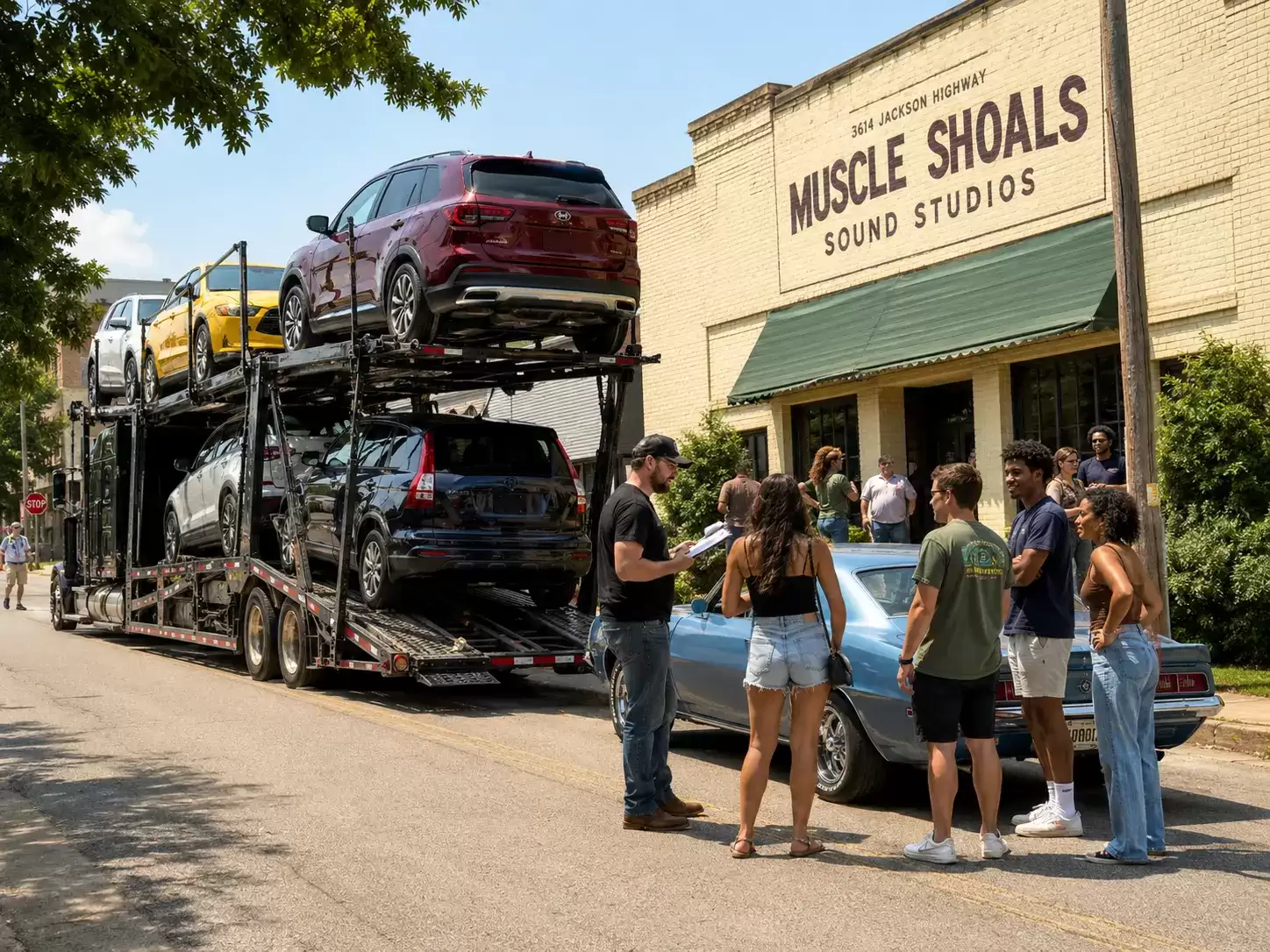
Florence and Muscle Shoals are northwestern Alabama cities on the Tennessee River accessible via US-72 and I-65 north, but without direct interstate connection to the Birmingham market. Expedited tier is recommended; allow 4–6 business days with Standard. The Muscle Shoals recording history draws some inbound relocation interest, but carrier coverage remains secondary-market level.
Montgomery / I-65 / I-85 State Capital Corridor
Montgomery is Alabama’s state capital and the home of Hyundai Motor Manufacturing Alabama, producing strong commercial carrier activity on both I-65 north toward Birmingham and I-85 northeast toward Atlanta. Montgomery’s dual-interstate position makes it one of Alabama’s most accessible secondary cities for auto transport, with Standard tier producing 2–4 business day pickup windows. Maxwell AFB and Gunter Annex are within the Montgomery carrier zone and benefit from both I-65 and I-85 access.
Prattville is Montgomery’s primary northwestern suburb on I-65 and is within the Montgomery carrier zone. Standard tier appropriate.
Auburn and Opelika are college and manufacturing cities on I-85 northeast of Montgomery. Auburn is the home of Auburn University and sits within reach of the I-85 corridor. Expedited is recommended for Auburn and Opelika; while I-85 does run through the area, carrier density is lower than the I-65 mainline. Allow 3–6 business days with Standard.
Mobile / I-10 / I-65 Gulf Coast Terminus
Mobile is Alabama’s only Gulf Coast metro and the southern terminus of the I-65 corridor. The Port of Mobile generates commercial freight activity that supports carrier availability, and I-10 provides east-west access to Florida and Mississippi. Standard tier works for Mobile with 2–4 business day pickup windows. Mobile is an excellent staging point for vehicles moving between Alabama and the Florida panhandle, New Orleans, or Houston via I-10.
Daphne and Fairhope are eastern Shore communities across Mobile Bay on US-98 and I-10. Carrier access is solid via I-10; Standard tier works. These cities attract significant retirement relocation interest and have a growing inbound vehicle shipping market.
Gulf Shores and Orange Beach are Alabama’s Gulf Coast beach communities on AL-59 south of I-10. These communities attract a growing snowbird and retirement market, but their distance from the interstate network (approximately 45 miles south of I-10) places them in a carrier secondary zone. Expedited is recommended for Gulf Shores and Orange Beach; Standard pickup windows can extend to 7–10 business days, especially outside summer season.
Tuscaloosa / I-20 / I-59 Mercedes-Benz Corridor
Tuscaloosa is Alabama’s fifth-largest city, home to the University of Alabama and within 10 miles of the Mercedes-Benz US International plant in Vance. The I-20/I-59 corridor connecting Tuscaloosa to Birmingham (60 miles east) and Meridian, Mississippi (90 miles west) is a solid carrier route, and the Mercedes dealer delivery pipeline adds commercial carrier volume to the corridor that benefits residential shippers. Standard tier is appropriate for Tuscaloosa with 2–4 business day pickup windows. August (University of Alabama move-in) is the single busiest shipping week in Tuscaloosa; book Expedited and give 2 weeks of lead time for August moves.
Northport is Tuscaloosa’s sister city across the Black Warrior River on US-82 and is within the Tuscaloosa carrier zone. Standard tier appropriate.
Dothan / Fort Novosel / Southeast Alabama
Dothan is Alabama’s largest city in the southeastern corner of the state, situated at the convergence of US-231, US-431, and US-84. Without direct interstate access, Dothan requires carriers to detour from I-65 (approximately 100 miles west) or I-10 (approximately 75 miles south). Expedited tier is the correct default for all Dothan shipments. Fort Novosel (formerly Fort Rucker), the Army’s helicopter aviation training base, is approximately 20 miles northwest of Dothan on AL-85. Despite the installation’s size, the limited carrier access to the Dothan/Fort Novosel area is a consistent planning challenge; budget extra lead time regardless of tier selected.
Enterprise is the city nearest Fort Novosel and is in the same carrier secondary zone as Dothan. Expedited is mandatory; carrier detour fees are typical.
Alabama government resources for auto transport consumers
- Alabama Law Enforcement Agency — Motor Vehicle Division — Vehicle title transfers, registration, and license plate information for vehicles shipped to Alabama.
- Alabama Attorney General — Consumer Protection Division — File a complaint or check the status of an auto transport company operating in Alabama.
- FMCSA SAFER System — Verify any auto transport carrier’s USDOT number, operating authority, and safety rating before booking.
- FMCSA Protect Your Move — Federal consumer protection resources and guidance for vehicle shipping, including how to identify and avoid broker fraud.
- ALDOT AlgoTraffic — Alabama Department of Transportation real-time traffic and road condition information for I-65, I-20, I-59, and all major Alabama carrier routes.

Popular long-distance car shipping routes from Alabama
Alabama to California auto transport
The Alabama-to-California corridor is one of the longer transcontinental routes in the southeastern United States, covering approximately 2,175 miles from Birmingham to Los Angeles via I-20 west and I-10 or I-40 through Texas, New Mexico, and Arizona. The primary routing follows I-20 west from Birmingham through Meridian and Jackson, Mississippi, then continues through Louisiana via I-20 to I-10, running along the Gulf Coast and through Texas before crossing into New Mexico and Arizona. Most Birmingham-to-Los Angeles shipments move in 7–10 transit days. The westbound I-20/I-10 corridor carries strong carrier traffic from Atlanta and Birmingham toward Los Angeles, and rates are competitive for a transcontinental route. Expedited tier is recommended for this distance to maintain predictable scheduling.
Alabama to Florida vehicle shipping
The Alabama-to-Florida corridor is one of the state’s highest-volume routes, driven by the I-65 snowbird corridor and the Gulf Coast retirement market. Most Alabama-to-Florida shipments route south on I-65 from Birmingham and Montgomery to Mobile, then east on I-10 to Florida destinations on the Gulf Coast and I-75 toward Tampa, Orlando, and Miami. Transit time is typically 2–3 days. Fall is the most competitive season on this route; carriers heading south on I-65 with snowbird loads from Tennessee and Kentucky commonly have open slots for Alabama-origin loads. Standard tier works well for most Alabama-to-Florida moves with adequate lead time.
Alabama to Georgia car carrier
The Alabama-to-Georgia corridor is among the state’s highest-frequency routes, running primarily on I-20 east from Birmingham to Atlanta. The 175-mile Birmingham-to-Atlanta segment is one of the most carrier-dense routes in the southeastern United States; Atlanta is a major carrier hub with dozens of loads originating and terminating daily. Transit time is 1–2 days. The Hyundai plant in Montgomery adds I-85 east traffic toward Atlanta as a secondary corridor. Standard tier is almost always appropriate for Alabama-to-Georgia moves at competitive rates.
Alabama to Tennessee auto shipping
The Alabama-to-Tennessee corridor runs primarily on I-65 north from Birmingham through Decatur and Huntsville to Nashville (approximately 190 miles) and on I-59 northeast from Birmingham to Chattanooga (approximately 145 miles). Both are well-traveled carrier routes with strong bidirectional traffic. Nashville is a major carrier hub and generates return-freight loads heading south toward Alabama and Florida. Transit time is 1–2 days; Standard tier works well for most Alabama-to-Tennessee moves.
Alabama to Texas vehicle relocation
The Alabama-to-Texas corridor runs on I-20 west from Birmingham through Mississippi and Louisiana toward Dallas (approximately 800 miles) or continues south on I-10 toward Houston (approximately 750 miles from Mobile). Carrier density on I-20 west is strong given the Atlanta-to-Dallas freight corridor, and Alabama shippers benefit from eastbound return-freight availability heading toward Texas. Transit time is 3–5 days; Expedited is recommended for Texas moves with firm delivery dates.
Alabama to New York car hauling
The Alabama-to-New York corridor covers approximately 1,200 miles via I-65 north to Nashville, then I-24 to I-81 north, or via I-20 east to Atlanta and I-85/I-95 up the East Coast. Transit time is 4–6 days. New York is the largest carrier destination in the northeastern United States and generates consistent southbound return-freight loads that benefit northbound Alabama shippers seeking competitive rates. Expedited tier is recommended for New York moves.
Alabama to Illinois auto transport
The Alabama-to-Illinois corridor covers approximately 725 miles via I-65 north from Birmingham through Nashville to Louisville, then I-65 continuing to Indianapolis and Chicago, or via I-22 northwest from Birmingham to Memphis and I-55 north to St. Louis and Chicago. Transit time is 3–5 days. The I-65 corridor from Nashville to Chicago is one of the busiest north-south carrier routes in the Midwest, and Alabama shippers routing through Nashville benefit from strong carrier access on this corridor. Standard or Expedited depending on your timeline.
Alabama to North Carolina vehicle transport
The Alabama-to-North Carolina corridor runs approximately 600 miles via I-20 east from Birmingham to Atlanta, then I-85 northeast through Spartanburg to Charlotte and onward to Greensboro, Raleigh, and the Triangle. Transit time is 3–5 days. Charlotte is a major carrier hub on the I-85 corridor, and the Alabama-to-Charlotte segment benefits from strong I-85 carrier traffic between Atlanta and the Carolinas. Standard tier works well for most Alabama-to-North Carolina moves.
Alabama to Mississippi car transport
The Alabama-to-Mississippi corridor runs approximately 275 miles via I-20/I-59 west from Birmingham to Meridian and Jackson, or south on I-65 and US-98 toward Hattiesburg. Transit time is 1–2 days. Mississippi lacks the carrier density of larger neighboring states, but the I-20 west corridor is well-served given Atlanta-to-Dallas through traffic. Standard tier works for most Alabama-to-Mississippi moves on the I-20 corridor; Expedited is recommended for Jackson, Hattiesburg, and Gulf Coast Mississippi destinations.
Alabama to Louisiana auto carrier
The Alabama-to-Louisiana corridor runs approximately 500 miles via I-10 west from Mobile through Biloxi and Gulfport to New Orleans, or via I-20 west through Mississippi. Transit time is 2–3 days. New Orleans is a major carrier hub on the I-10 Gulf Coast corridor, and Mobile’s position at the I-10/I-65 junction makes it an excellent staging point for vehicles moving west. Standard tier is appropriate for most Alabama-to-Louisiana moves; Expedited recommended for time-sensitive moves to New Orleans.
Alabama to Ohio vehicle hauling
The Alabama-to-Ohio corridor runs approximately 750 miles via I-65 north through Nashville and Louisville, then I-71 northeast toward Cincinnati and Columbus. Transit time is 3–5 days. The I-65 north corridor from Birmingham through Nashville is one of the most active north-south carrier lanes in the Southeast, and Louisville and Cincinnati are significant carrier redistribution hubs with strong connections to Columbus, Cleveland, and all of Ohio. Expedited is recommended for Ohio moves.
Alabama to Virginia auto shipping
The Alabama-to-Virginia corridor runs approximately 850 miles via I-20 east to Atlanta, then I-85 north through Charlotte and Petersburg to Richmond, or I-81 north from Roanoke through the Shenandoah Valley. Transit time is 4–6 days. The I-85/I-95 East Coast corridor is carrier-dense with strong bidirectional traffic between the Southeast and Mid-Atlantic. Expedited is recommended for Virginia moves, particularly for Northern Virginia and the DC metro area where carrier demand is high year-round and pickup competition is significant.

Nearby states for Alabama auto transport
Tennessee car shipping
Tennessee borders Alabama to the north along a 200-mile shared border from the Mississippi state line to the Georgia border. I-65 is the primary carrier corridor connecting Birmingham and Huntsville to Nashville (190 miles), and I-59 northeast connects Birmingham to Chattanooga (145 miles). Nashville is one of the top carrier hubs in the southeastern United States and provides strong access to the northeastern I-65 corridor toward Kentucky and Indiana. Tennessee-to-Alabama moves are among the state’s fastest and most competitively priced routes, with Standard tier typically producing pickup within 2–3 business days.
Georgia auto transport
Georgia borders Alabama to the east with Atlanta sitting approximately 175 miles from Birmingham on I-20. Atlanta is the largest carrier hub in the southeastern United States and generates a continuous flow of eastbound and westbound carrier traffic that Alabama shippers can access from both I-20 east and I-85 northeast from Montgomery. Georgia-to-Alabama and Alabama-to-Georgia routes are among the most carrier-competitive short-haul corridors in the region; Standard tier is almost always appropriate and pickup windows average 1–3 business days.
Florida vehicle shipping
Florida borders Alabama to the southeast and provides both the primary snowbird destination for Alabama retirees and the major carrier volume driver on the I-65 south corridor. Orlando, Tampa, Miami, and Jacksonville are all accessible from Birmingham or Mobile via I-65 and I-10, with transit times of 2–4 days. The fall southbound snowbird wave (October–December) and the spring northbound return (March–May) create consistent carrier competition on this corridor that benefits Alabama shippers in both directions.
Mississippi car carrier
Mississippi borders Alabama to the west, with the primary carrier corridor running on I-20/I-59 west from Birmingham through Meridian to Jackson and on I-10 west from Mobile through Biloxi. Mississippi is a secondary carrier market compared to neighboring Georgia and Tennessee, but the I-20 west corridor carries sufficient Atlanta-to-Dallas through traffic to support competitive rates for Jackson, Hattiesburg, and Gulf Coast Mississippi. Standard tier works for most Alabama-to-Mississippi routes on the I-20 corridor.
North Carolina vehicle transport
North Carolina is accessible from Alabama via I-20/I-85 through Atlanta and Charlotte, approximately 600–700 miles from Birmingham. The I-85 corridor from Atlanta to Charlotte is one of the most carrier-dense southeast-to-mid-Atlantic routes in the United States, and Alabama shippers routing through Atlanta can access this carrier volume for North Carolina destinations. The Research Triangle (Raleigh-Durham-Chapel Hill) and Charlotte are both major carrier destinations with good availability. Expedited is recommended for North Carolina moves from Alabama.
South Carolina auto shipping
South Carolina is accessible from Alabama via I-20 east through Atlanta and on to I-26 or I-85 northeast into the Palmetto State, approximately 600–750 miles from Birmingham. The I-20 east corridor from Birmingham to Augusta and Charleston is well-traveled, and the Port of Charleston’s growing container activity drives a supplemental carrier presence in coastal South Carolina. Expedited is recommended for South Carolina moves from Alabama; transit time is 3–5 days.

Ready to ship your car to or from Alabama?
Join hundreds of thousands of customers — Snowbirds, military families, tech relocators, students, and families moving across the country — who have trusted Direct Express Auto Transport with their Alabama vehicle shipments since 2004. Get your instant, no-obligation quote now. It takes 30 seconds, requires no personal information, and there is no upfront payment required to hold your spot.
Instant quote — real-time pricing in under 5 seconds
No upfront payment — your card is charged only when a carrier is assigned
No risk to get a quote and book your order
BBB Accredited A+ since 2004
FMCSA licensed and fully bonded
4.6 stars across thousands of verified Google reviews