Georgia to California Car Shipping
The original instant car shipping calculator — trusted since 2004. Door-to-door Georgia to California transport with no surprises, no hidden fees, and three options to ship your vehicle on your schedule.
★ 4.6/5 Google Reviews | BBB Accredited A+ | FMCSA Licensed (MC #479342) | USDOT #1240502 | No upfront payment required | 20+ years shipping vehicles


Georgia to California Car Shipping Rates by City
Every Georgia to California vehicle shipment is available at three service levels:
Standard, Expedited, & Rush Options
Choose the one that fits your timeline and budget. All three include full door-to-door service and carrier insurance.
The Company That Invented Instant Auto Transport Pricing
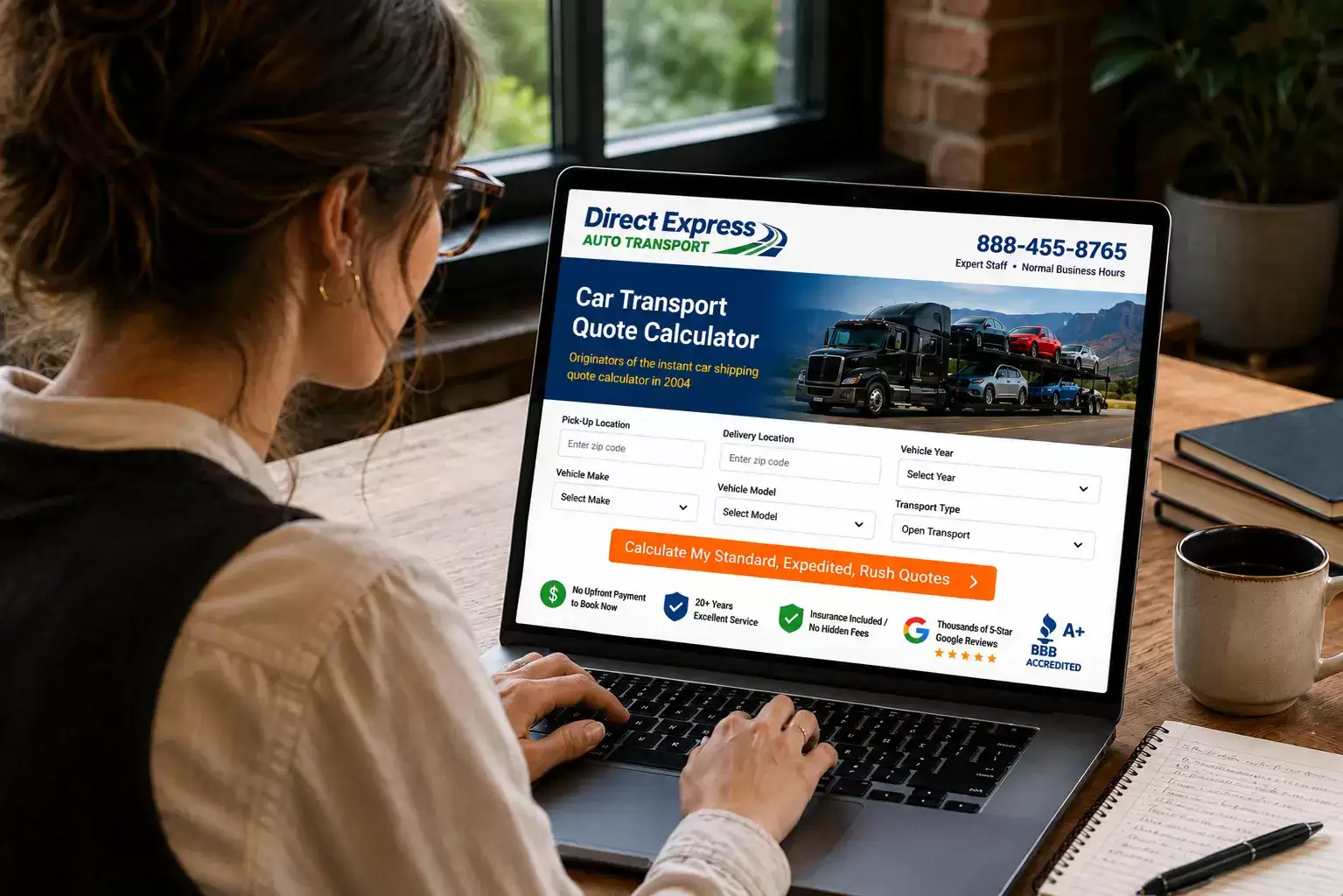
Direct Express Auto Transport pioneered online instant pricing for the auto transport industry in 2004. Before we built the first car shipping cost calculator, getting a quote from a broker meant phone calls, callbacks, and waiting — sometimes days. We changed that. Today you know your exact cost in 30 seconds, before committing to anything. No phone tag, no hassle. Just a real number, instantly.
Three Service Tiers for Every Georgia to California Shipment
Every shipment on this Georgia to California route is available at three service tiers so you can match your budget to your timeline. Standard delivers at the best available rate — ideal when your schedule has a few days of flexibility. Expedited moves your vehicle to the front of the dispatch queue for faster pickup. Rush gets your car picked up as fast as humanly possible — for moves where every day counts. All three tiers include full door-to-door service and carrier insurance.
What customers say about shipping a car from Georgia to California with Direct Express Auto Transport


Seasonal Pricing Guide: Georgia to California
Georgia-to-California is the westbound leg of one of the country’s most dynamically growing bicoastal corridors. Georgia sends its military personnel west under PCS orders every summer, its entertainment industry workers back to Los Angeles at the end of production cycles, its university graduates to California careers in technology and film, and a growing stream of upwardly mobile Atlantans pursuing opportunities in California’s technology and entertainment economies. Seasonal pricing tracks the national demand calendar with a familiar summer peak and a fall value window that consistently rewards shippers with flexibility.


Who Ships a Car from Georgia to California — and Why
Georgia-to-California is a westbound corridor defined by the industries that connect the two states — military service, entertainment production, technology careers, and the return migration of California transplants who’ve made Georgia their home for a season or a career and are now heading back. The motivations are diverse, but the corridor is real and consistent.
Military PCS: Fort Moore / Moody AFB / Kings Bay → Camp Pendleton and California
Military PCS transfers are the corridor’s most consistent driver. Fort Moore near Columbus — the Army’s largest training installation — generates more westbound California PCS orders than any other Georgia installation. Soldiers completing training receive orders to Camp Pendleton, Fort Irwin, Fort Ord, and Presidio of Monterey. Kings Bay Naval Submarine Base sends personnel to Naval bases in San Diego.
Atlanta Entertainment Industry Professionals Moving to Los Angeles
Georgia’s film and television ecosystem — Tyler Perry Studios, Pinewood Atlanta, and the metro soundstage network — regularly draws California production professionals who relocate to Atlanta for projects and return home when they end. These are repeat shippers: vehicles move east when productions begin and west when seasons wrap, making this one of the corridor’s most predictable reverse-flow segments.
Georgia University Graduates Moving to California Technology and Finance
Georgia Tech engineers, Emory graduate school alumni, UGA graduates, and Georgia State professionals pursue California opportunities in technology, venture capital, and entertainment. Atlanta’s growing tech ecosystem has created a talent pool that California companies actively recruit. These are typically young professionals in their late 20s or early 30s shipping a single vehicle one-way.
What Makes the Georgia–California Auto Shipping Run Different
The Route: I-20 West to I-40, or I-75 North to I-40
Georgia-to-California carriers depart Atlanta via two primary routing options. The most common westbound corridor follows I-20 west through Birmingham, Jackson, and Dallas/Fort Worth, then transitions to I-40 westbound at Amarillo for the cross-country run to California. An alternate northern route follows I-75 north through Chattanooga, I-24 to Nashville, then I-40 west. Savannah and east Georgia loads often depart on I-16 west to Macon before joining I-20 westbound toward Birmingham and the I-40 connection.
I-40 West Through Albuquerque and Flagstaff: The Desert Crossing
From Amarillo, I-40 west crosses New Mexico through Albuquerque and Flagstaff, Arizona before the final Mojave Desert crossing to Barstow and the Los Angeles basin. This 1,400-mile desert leg from Dallas/Fort Worth to LA is the defining feature of the GA→CA run — typically 3–4 days of total transit from Atlanta pickup to California delivery.
Atlanta’s Size Is an Advantage for Pickup
Atlanta is the most active large-carrier pickup and delivery hub in the Southeast. The concentration of inbound California-to-Georgia carrier loads creates excellent backhaul volume for outbound Georgia-to-California runs — carriers dropping loads in Atlanta need to return westbound, which increases carrier availability and helps keep GA-to-CA rates competitive relative to corridors with weaker backhaul volume. This structural advantage benefits all Atlanta-metro shippers year-round and is especially pronounced in fall when demand drops but carrier frequency remains high.
September and October: Peak Value Window on the GA→CA Corridor
This backhaul advantage is most visible in September and October, when decreased summer peak demand combines with high carrier availability from Georgia to California, creating some of the strongest value pricing on any long-haul corridor. Shippers departing Atlanta in fall typically see faster-than-average pickup windows and competitive Standard tier pricing.
NorCal Delivery Premium — Bay Area and Sacramento
Southern California — Los Angeles, San Diego, and the Inland Empire — is the natural western terminus of every I-40/I-20 run from Georgia. Carriers unload in the SoCal basin at the end of the desert crossing, making LA the highest-frequency delivery destination on this corridor. Northern California delivery (San Francisco, Oakland, San Jose, Sacramento) requires the carrier to continue north on I-5 or I-580, adding 400+ miles and 1–2 transit days past the natural SoCal stopping point.
Bay Area and Sacramento: 400+ Miles and 1–2 Transit Days Beyond SoCal
Northern California delivery (San Francisco, Oakland, San Jose, Sacramento) requires the carrier to continue north from the LA area on I-5 or I-580, adding 400+ miles and 1–2 transit days past the natural SoCal stopping point. The $275–$300 NorCal delivery premium from any Georgia origin reflects this additional leg.
Pickup from Coastal Georgia and Military-Area Cities
Savannah, Brunswick, and the Georgia coast are a flat, accessible pickup zone year-round with no access complications. Fort Stewart near Hinesville generates reliable carrier traffic on the I-95/I-16 corridor, which means easternmost Georgia pickup has better carrier frequency than many similarly remote areas. Augusta, served by Fort Eisenhower traffic, also has reasonable carrier frequency for its size. Columbus and the Fort Moore area generate their own PCS-driven carrier traffic, which helps pickup availability from Georgia’s western corridor cities throughout the summer PCS season.
Fort Stewart, Fort Eisenhower, and Fort Moore: Military PCS Carrier Density
Fort Stewart near Hinesville, Fort Eisenhower (Augusta), and Fort Moore (Columbus) generate reliable carrier traffic on the I-95/I-16 and I-75 corridors. Military PCS season (May–August) increases carrier frequency from these areas significantly. Columbus and the Fort Moore area see their own PCS-driven carrier traffic throughout the summer, improving pickup availability from Georgia’s western corridor cities.
Other Georgia to California Cities We Serve
Direct Express ships vehicles between hundreds of city pairs on this route. Below is a broader look at additional Georgia origins and California destinations we regularly serve.
Hub Cities Along the Georgia–California Car Shipping Corridor
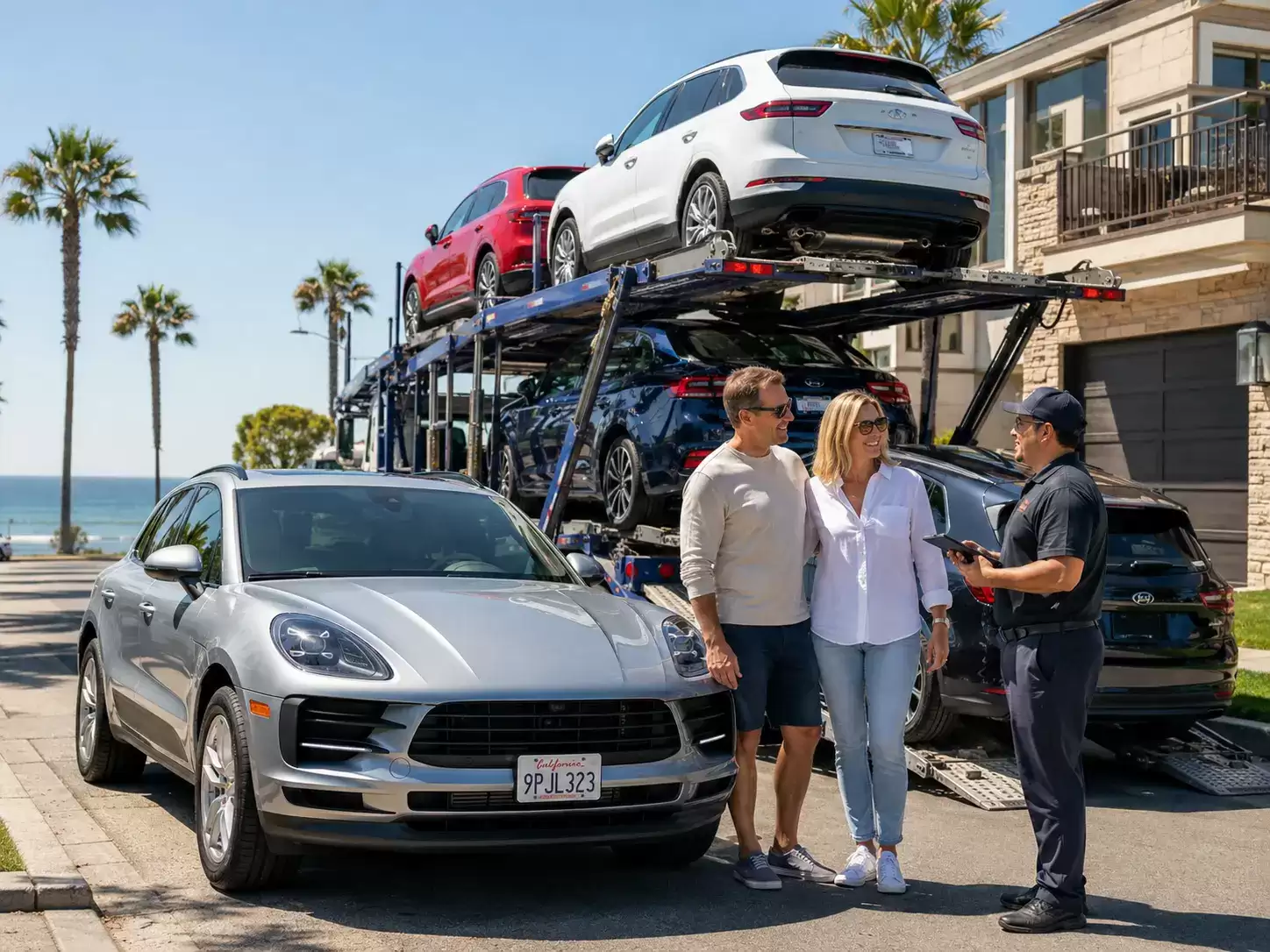
Georgia-to-California carriers depart Atlanta westbound on I-20 through Birmingham and Dallas, then follow I-40 west across the country. Atlanta and the Georgia military cities anchor the eastern origin zone; Los Angeles and the Bay Area anchor the California delivery zone.
Major Origin Hubs in Georgia
I-20 / I-40 Corridor Cities
Major California Delivery Points
Dallas: The Midway Exchange City: Dallas sits at the midpoint of the Georgia-to-California run — approximately 780 miles from Atlanta and roughly 1,400 miles from Los Angeles on the I-20/I-40 corridor. It is one of the most important carrier relay and load-exchange cities in the country for southeast-to-California long-haul auto transport. Drivers completing the Birmingham-to-Dallas leg regularly hand off loads to fresh drivers for the Amarillo-to-California leg. Dallas’s position at the confluence of I-20, I-30, I-35, and I-45 makes it a natural convergence point for loads coming from multiple southeastern origins heading to multiple California destinations. Every Georgia-to-California shipment on the southern corridor passes through or near Dallas.
Open vs. Enclosed Car Transport on the Georgia–California Route
The Georgia-to-California haul covers 2,100–2,600 miles on a well-traveled southern carrier corridor. Georgia pickup is uncomplicated year-round — the state has mild winters throughout, with no meaningful snow or ice complications for vehicle transport at either the Atlanta end or the coastal end. California delivery is uncomplicated year-round as well. This is one of the cleanest weather profiles of any long-haul corridor in the country.
Open Transport Recommended for Most
- Open-air trailer carrying 7–10 vehicles — the industry standard for virtually all everyday vehicle shipments on this lane
- Most cost-effective option; Atlanta’s position as the Southeast’s largest auto transport hub means strong open carrier availability for westbound loads year-round
- Well-suited for daily drivers, commuter vehicles, SUVs, trucks, minivans, and any vehicle under approximately $60,000
- Georgia pickup and California delivery are both uncomplicated year-round — no weather, mountain crossing, or access complications at either end
- Road film after 2,100–2,600 miles across the southern corridors is normal — a standard wash upon California delivery addresses it completely
Enclosed Transport
- Vehicle travels in a fully enclosed, weatherproof trailer from Georgia to California
- Typically 40–60% more expensive than open transport
- Recommended for luxury vehicles, exotics, collector cars, show-quality finishes, and any vehicle over approximately $75,000
- Atlanta’s high-income suburban markets (Buckhead, Alpharetta, Milton, Johns Creek) generate above-average enclosed transport demand — European luxury sedans and exotic vehicles are a regular enclosed-carrier cargo type on the GA-to-CA westbound lane
- Film industry crew shipping personal vehicles back to Los Angeles from extended Georgia production cycles occasionally choose enclosed for documented condition delivery — especially for collector vehicles that were shipped east at the start of the assignment
- Book 2–3 weeks ahead — fewer enclosed carriers on this lane than open
Our honest recommendation: Open transport for the everyday vehicle — this is a reliable, all-weather corridor with strong carrier availability from Atlanta and all major Georgia pickup zones to all California delivery points. Enclosed for luxury vehicles, exotics, and film or entertainment professionals returning high-value vehicles to California.

Door-to-Door Car Shipping: What to Expect in Georgia and California
Pickup in Georgia
Metro Atlanta and North Georgia
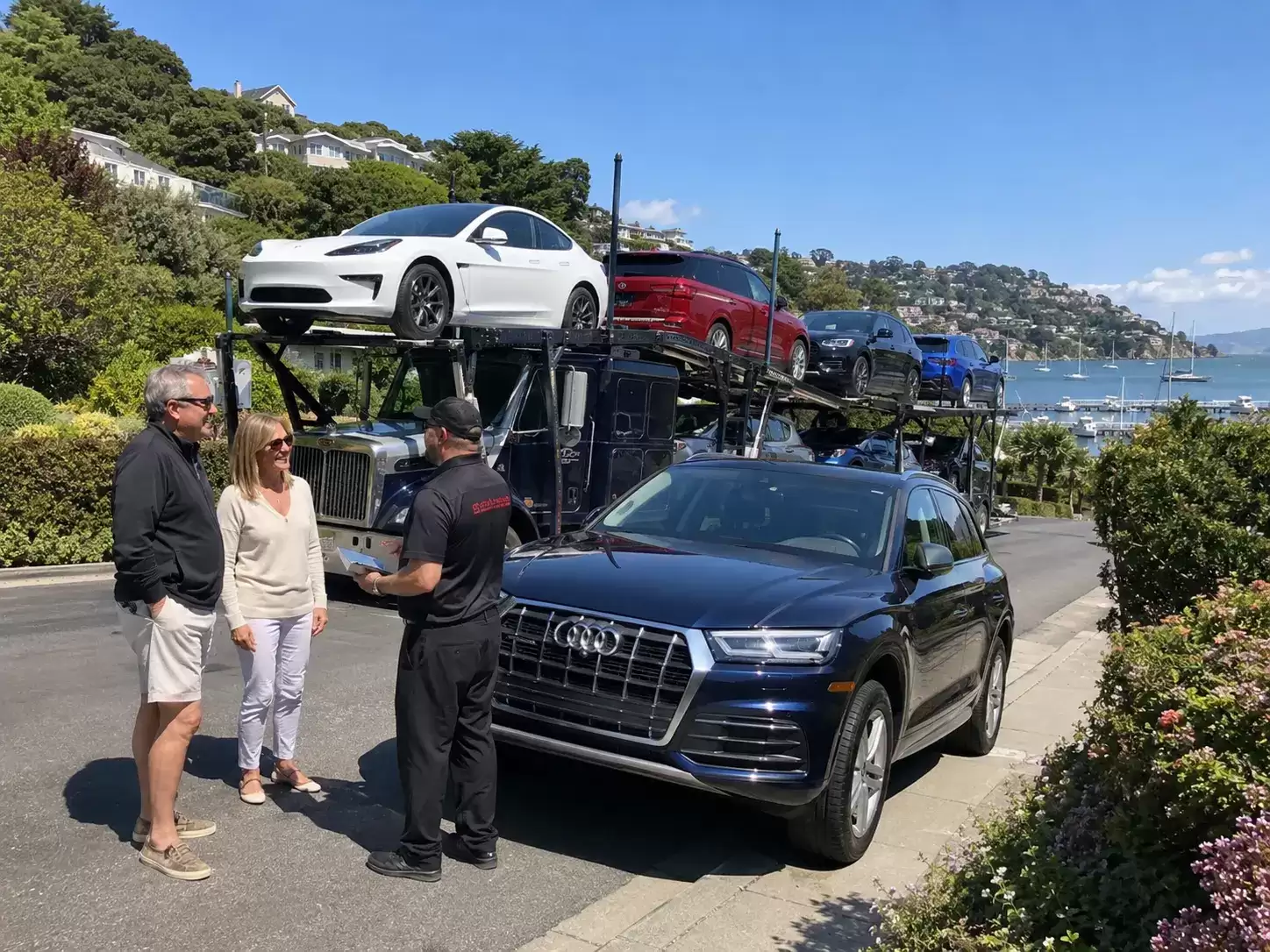
Standard door-to-door pickup throughout Metro Atlanta and North Georgia. Atlanta proper: standard residential throughout; very dense downtown Atlanta, Midtown, and Buckhead high-rise and loft addresses require carrier staging on a nearby wide commercial street — confirm your address at booking. Atlanta suburbs (Marietta, Kennesaw, Smyrna, Sandy Springs, Alpharetta, Roswell, Duluth, Lawrenceville, Stockbridge, Peachtree City): standard residential throughout, no staging concerns. North Georgia (Gainesville, Dalton, Rome): standard residential. Metro Atlanta is Georgia’s dominant carrier hub — strong dispatch availability for all service tiers.
Savannah, Augusta, Columbus, and Secondary Georgia Markets
Standard door-to-door pickup throughout Savannah, Augusta, Columbus, and secondary Georgia markets. Savannah: standard residential throughout; Port of Savannah proximity generates strong carrier activity; historic district narrow streets may require nearby staging — confirm at booking. Fort Stewart (Army, near Savannah): confirm on-base vehicle access at booking for military PCS pickups. Augusta and Fort Eisenhower (Army): confirm on-base access at booking for military PCS pickups. Columbus and Fort Moore (Army, formerly Fort Benning): standard residential; confirm on-base access. Allow additional dispatch lead time for secondary Georgia markets relative to Metro Atlanta.
Delivery in California
Southern California: Los Angeles, San Diego, and Orange County
Standard door-to-door delivery throughout Southern California. Los Angeles basin: standard residential delivery throughout; very dense downtown LA, Koreatown, Hollywood, and Westlake addresses require carrier staging on a nearby wide commercial street — confirm your delivery address at booking. San Diego and Chula Vista: excellent carrier access, standard residential. Orange County (Anaheim, Irvine, Santa Ana, Fullerton): standard residential, no staging concerns. No heat protocol at coastal SoCal delivery destinations in any season.
Inland Empire and Central Valley
Standard door-to-door delivery throughout the Inland Empire and Central Valley. Riverside, San Bernardino, Fontana, and Ontario: excellent suburban carrier access; the Inland Empire is one of the most active inbound carrier zones in California. Summer heat note at delivery: IE and Central Valley destinations reach 105–115°F June–September — for exotic or luxury vehicles sensitive to heat, enclosed transport keeps the vehicle sealed during transit to these destinations. Fresno, Bakersfield, Modesto, and Stockton: standard residential throughout.
Bay Area and Sacramento
Standard door-to-door delivery throughout the Bay Area and Sacramento. San Jose, Oakland, Fremont, Vallejo, and Concord: standard residential access. San Francisco: carrier staging required for steep-grade neighborhood deliveries (Pacific Heights, Russian Hill, Nob Hill) — confirm your delivery address at booking. Sacramento: standard residential throughout. No heat protocol at coastal Bay Area delivery in any season. Bay Area delivery carries a pricing premium due to distance from most origins and carrier positioning requirements in the metro.
Georgia TAVT Refund or Transfer — If You’re Leaving Georgia
If you paid Georgia’s Title Ad Valorem Tax (TAVT) when you originally registered your vehicle in Georgia, and you are now permanently relocating to California, Georgia does not offer a TAVT refund when you de-register. Budget accordingly — California will assess its own registration fees when you register in California. The TAVT paid in Georgia does not transfer or credit against California registration fees. Consult the Georgia Department of Revenue and the California DMV for current guidance specific to your situation.
Preparing Your Vehicle
Before pickup: remove all personal items from the interior, leave no more than a quarter tank of fuel, disable your car alarm, and remove any exterior accessories. Photograph your vehicle thoroughly from all angles with date-stamped images before the carrier arrives. At delivery in California, inspect your vehicle carefully before signing the Bill of Lading — note any concerns before signing. Your signature without notation constitutes acceptance of the vehicle’s condition.
Georgia & California Auto Transport Resources
Georgia Helpful Government Links
- Georgia Department of Driver Services (DDS) — Primary agency for Georgia driver’s licenses and vehicle registration. If you are leaving Georgia permanently, obtain your Georgia title before shipping — California requires it to complete registration. Cancel your Georgia registration once you’ve registered in California.
- Georgia DDS — Title and Registration — Guidance on releasing your Georgia title for out-of-state transfer. Complete the title release before your vehicle is picked up for transport to California.
- Georgia Department of Revenue — TAVT Information — Information on the Title Ad Valorem Tax. If you paid TAVT when you registered in Georgia, consult this resource for the current policy on de-registration and any applicable partial credits or transfers.
California Helpful Government Links
- California Department of Motor Vehicles (CA DMV) — Primary agency for California vehicle titles and registration. New California residents must register their out-of-state vehicle within 20 days of establishing residency.
- CA DMV — Registering an Out-of-State Vehicle — Step-by-step guidance for transferring your Georgia title and obtaining California registration and plates. California requires a smog inspection before registration for most vehicles.
- CA DMV — Vehicle Registration Fees — California registration fees are calculated on vehicle value. Estimate your cost before your vehicle arrives at your California address.
Federal Auto Transport Resources
- FMCSA — Verify a Carrier’s License (SAFER System) — Verify that any auto transport company you consider is federally licensed and insured before booking.
- FMCSA — Protect Your Move — Federal consumer guidance about hiring vehicle shippers, including red flags for broker scams and your rights as a shipper.