Michigan to Texas Car Shipping
The original instant car shipping calculator — trusted since 2004. Door-to-door Michigan to Texas transport with no surprises, no hidden fees, and three options to ship your vehicle on your schedule.
★ 4.6/5 Google Reviews | BBB Accredited A+ | FMCSA Licensed (MC #479342) | USDOT #1240502 | No upfront payment required | 20+ years shipping vehicles


Michigan to Texas Car Shipping Rates by City
Every Michigan to Texas vehicle shipment is available at three service levels:
Standard, Expedited, & Rush Options
Choose the one that fits your timeline and budget. All three include full door-to-door service and carrier insurance.

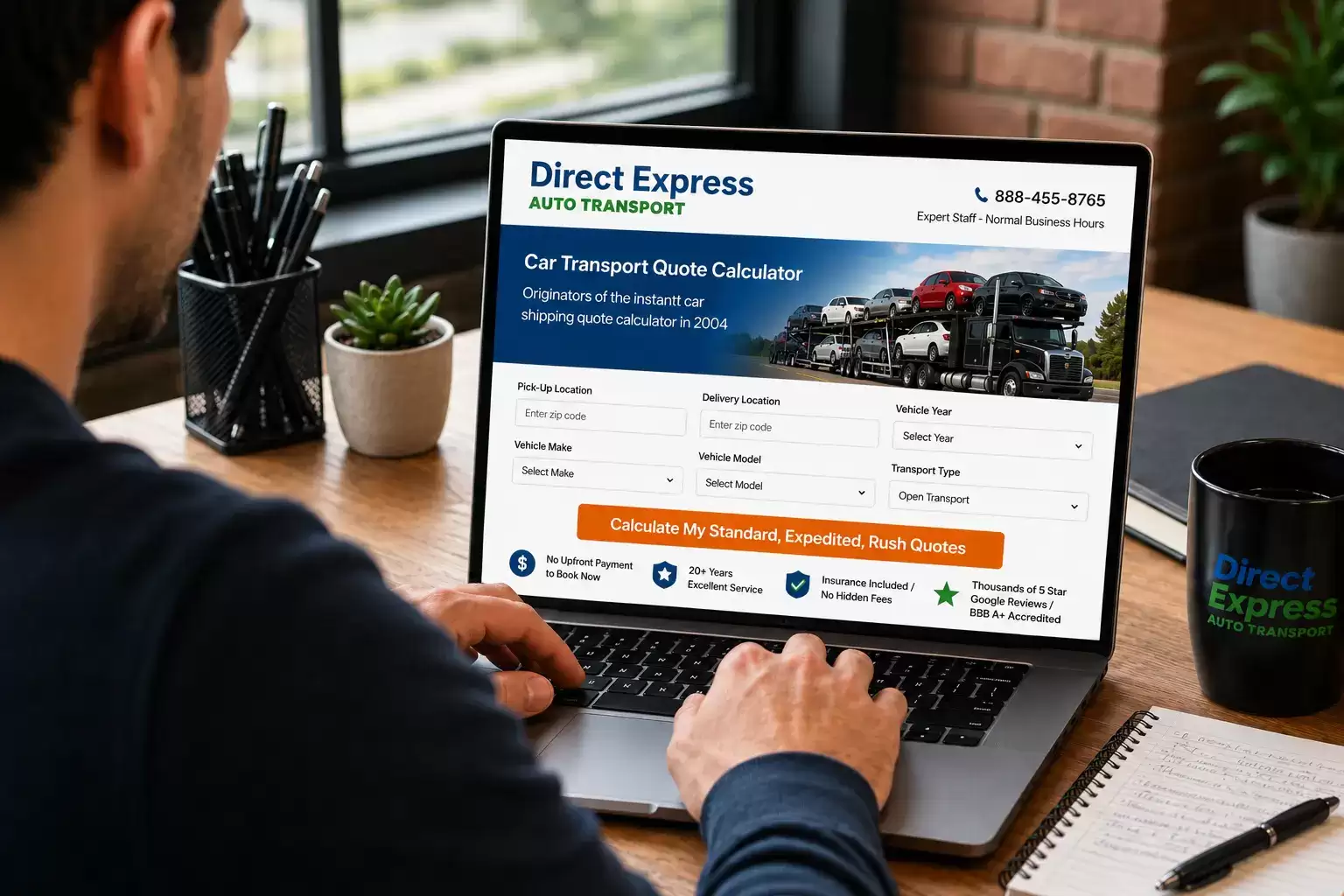
The Company That Invented Instant Auto Transport Pricing
Direct Express Auto Transport pioneered online instant pricing for the auto transport industry in 2004. Before we built the first car shipping cost calculator, getting a quote from a broker meant phone calls, callbacks, and waiting — sometimes days. We changed that. Today you know your exact cost in 30 seconds, before committing to anything.
Three Service Tiers for Every Michigan to Texas Shipment
Every shipment on this Michigan to Texas route is available at three service tiers so you can match your budget to your timeline. Standard delivers at the best available rate — ideal when your schedule has a few days of flexibility. Expedited moves your vehicle to the front of the dispatch queue for faster pickup. Rush gets your car picked up as fast as humanly possible — for moves where every day counts.
All three tiers include full door-to-door service and carrier insurance. No phone tag, no hassle. Just a real number, instantly.
What customers say about shipping a car from Michigan to Texas with Direct Express Auto Transport


Seasonal Pricing Guide: Michigan to Texas
Michigan to Texas has a genuine fall peak — Winter Texans depart south in October–November, creating concentrated southbound demand. January–February is best value once the snowbird migration has ended.

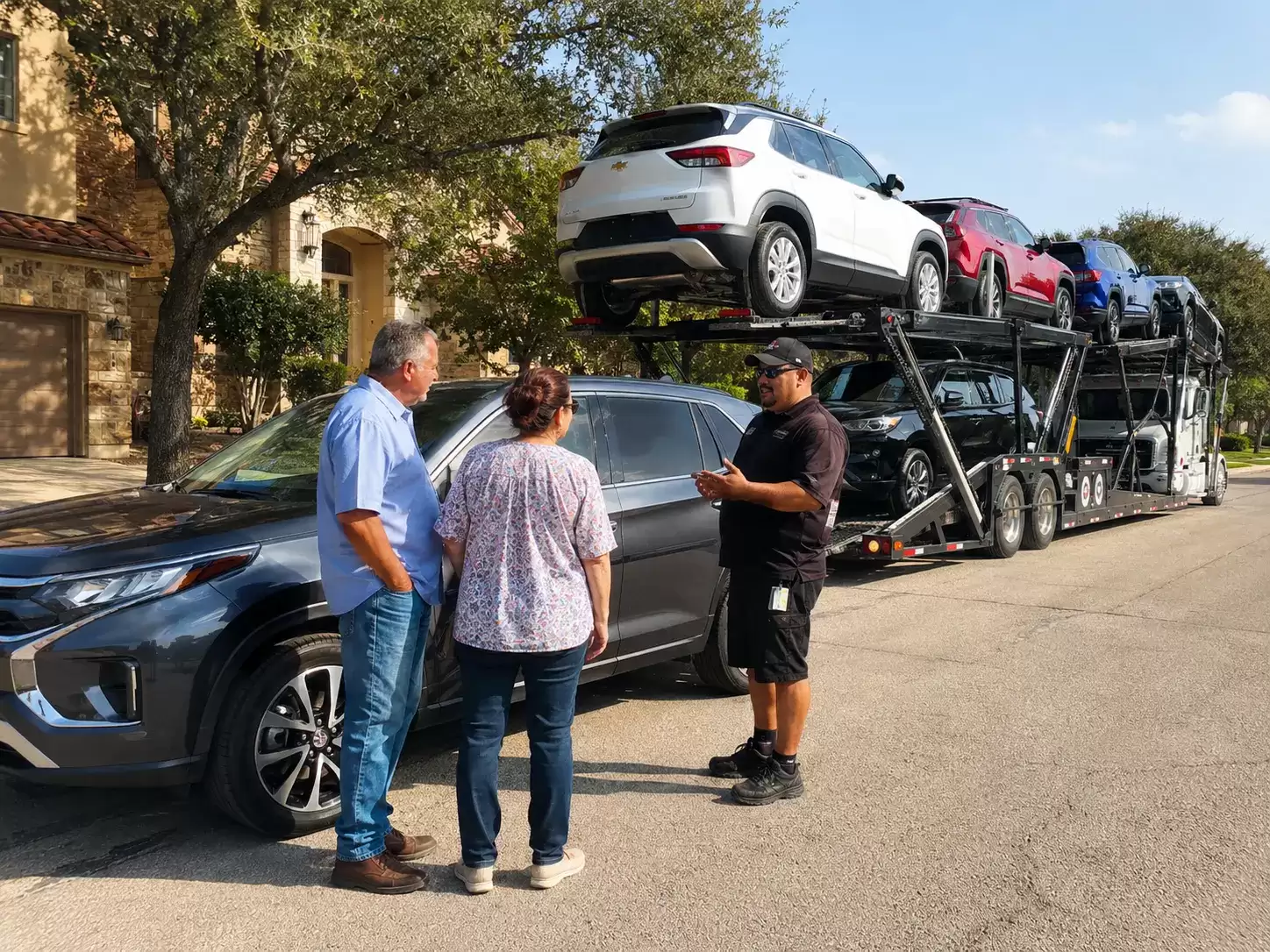
Who Ships a Car from Michigan to Texas — and Why
Michigan Snowbirds Shipping Vehicles to South Texas and the Gulf Coast for Winter
The most distinctive and high-volume driver on the Michigan-to-Texas southbound corridor is the Winter Texan migration. Michigan retirees and semi-retired residents who maintain a second home, RV lot, or rental in South Texas — particularly in the Rio Grande Valley (McAllen, Mission, Harlingen, Brownsville) and along the Texas Gulf Coast — ship one or more vehicles south each fall before the Michigan winter fully arrives.
Snowbird Logistics: Drive South, Ship North — Split-Vehicle Strategy
The vehicle shipping logistics vary. Some snowbirds drive south but ship their primary vehicle (or a second vehicle for a spouse who flew). Others ship in October and follow by car in November. Still others ship everything and fly.
Michigan Residents Relocating Permanently to Texas for Tax and Cost-of-Living Reasons
Michigan’s individual income tax rate of 4.25% — applied against all earned income including pension income — combined with high property taxes in Oakland, Macomb, and Wayne Counties, makes Texas’s zero income tax an increasingly compelling draw for Michigan residents at every income level.
Remote Work Acceleration and Growing Economic Migration to Texas
This economic migration is consistent, year-round, and accelerating. Remote work has amplified it significantly — Michigan residents in technology, finance, and professional services who no longer need to be in Detroit five days a week are making the Texas move in meaningful numbers. The Troy → Irving, Southfield → Garland, and Livonia → Frisco pairings reflect the white-collar Detroit suburban corridor precisely — established Michigan professionals moving to equivalent DFW professional neighborhoods.
Automotive Industry Personnel: Michigan Headquarters to Texas Plant Operations
Michigan’s Big Three — Ford (Dearborn), GM (Warren/Detroit), and Stellantis (Auburn Hills) — all operate manufacturing and supply chain facilities in Texas. GM’s Arlington Assembly Plant (Arlington, TX) produces some of GM’s highest-volume vehicles. Ford has commercial and fleet operations in Texas. The automotive supply chain runs thousands of Michigan-headquartered companies with Texas operations, from Tier 1 suppliers to logistics and aftermarket firms.
Dearborn–Laredo Pairing and Michigan-to-Texas Auto Sector Routes
The Dearborn → Laredo pairing in this table is unusual — Laredo is not typically a major automotive destination — but it represents the supply chain and customs brokerage corridor connecting Dearborn’s Ford-adjacent supplier network to the Texas-Mexico border manufacturing zone. More typically, automotive transfers land in DFW (GM Arlington) or Houston (energy and automotive engineering crossover). Warren → Beaumont captures the petrochemical engineering corridor, where Detroit Arsenal-area engineers transition to Gulf Coast industrial roles.
Military PCS: Selfridge ANGB and Michigan Installations to Fort Cavazos and Texas
Selfridge Air National Guard Base in Harrison Township (Macomb County) sends personnel to Texas installations on every PCS cycle. Fort Cavazos (home of the 1st Cavalry Division) in Killeen, Joint Base San Antonio, and other Texas Army and Air Force installations regularly receive Selfridge-area personnel.
Camp Grayling and Battle Creek ANG to Texas Army Installations
Camp Grayling (Army National Guard, northern Michigan) and Battle Creek Air National Guard Base also generate Texas-bound PCS volume during activation and training cycles. Michigan National Guard soldiers with extended active duty orders to Texas training installations ship vehicles when the assignment exceeds 90 days.
Michigan University Graduates Moving to Texas Energy, Technology, and Finance Careers
University of Michigan (Ann Arbor), Michigan State (East Lansing), Wayne State (Detroit), and Michigan Tech (Houghton) all send graduates to Texas jobs at meaningful volume. Texas’s energy sector — ExxonMobil, ConocoPhillips, Chevron Phillips, and the broader Houston petrochemical complex — recruits heavily from Michigan engineering programs, particularly from UM’s College of Engineering and Michigan Tech. The Ann Arbor → Austin pairing in this table captures the University of Michigan to Texas technology and healthcare corridor precisely.
Texas Financial Services Recruiting from Michigan Universities
Texas financial services and professional services also recruit from Michigan universities. Grand Rapids-area graduates entering corporate finance, consulting, and healthcare often discover that Texas starting salaries go substantially further than Michigan equivalents given Texas’s zero income tax. These are May and June moves — the spring graduation to summer start date cycle drives a predictable surge in Michigan-to-Texas university graduate shipments in May and June.
What Makes the Michigan–Texas Auto Shipping Run Different
The Main Corridor: I-94 West to Chicago, Then I-55 South to St. Louis, I-44 to OKC, and I-35 South to Texas
The Michigan-to-Texas routing mirrors the reverse Texas-to-Michigan corridor exactly: I-94 west from Detroit metro origins reaches Chicago in approximately 285 miles, where it connects to I-55 south — the southbound mainline. I-55 south runs 296 miles to St. Louis, the corridor’s central relay hub at the junction of I-55, I-44, and I-64. From St. Louis, I-44 southwest runs 406 miles through Joplin and Tulsa to Oklahoma City. From OKC, I-35 south reaches Dallas in 207 miles and continues through Waco, Austin, and San Antonio to Laredo and the Texas border.
Grand Rapids and Western Michigan: US-131 South to I-94 Before the Chicago Run
For western Michigan origins (Grand Rapids, Kalamazoo, Muskegon, Battle Creek), the I-94 west approach is actually shorter than from Detroit — Kalamazoo to Chicago via I-94W is only 145 miles, and Grand Rapids to Chicago via I-196 south is about 185 miles.
Lansing → Fort Worth and Jackson → Arlington: The Table’s Cheapest Pairs at $950 Standard
Lansing to Fort Worth at 1,060 miles and Jackson to Arlington at 1,070 miles are the table’s cheapest pairs — both at $950 Standard. Lansing is Michigan’s state capital on I-96 west of Detroit, approximately 175 miles from Chicago via I-96W — already 110 miles further along the I-55 approach than Detroit. Jackson is on I-94, 75 miles west of Detroit, making its approach to Chicago approximately 210 miles. Both cities strip approach mileage from the run compared to Detroit metro origins.
The Cheapest Route Formula: Closest Michigan City to Chicago + Closest DFW Suburb to I-35
Fort Worth and Arlington are the western DFW cities closest to the I-35 southbound corridor — carriers arriving from OKC reach Fort Worth and Arlington before Dallas proper, eliminating any eastbound approach within DFW. The combination of shorter Michigan approach and western DFW delivery produces the table’s most efficient pairings.
Sterling Heights → Corpus Christi: The Most Expensive Pair
Sterling Heights to Corpus Christi at 1,445 miles and $1,200 Standard is the table’s most expensive pair. Sterling Heights is in Macomb County, northeast of the Detroit metro — slightly further from Chicago than Dearborn or Southfield, adding approach mileage at the Michigan origin end. Corpus Christi requires carriers to drive 145 miles south of San Antonio on I-37 after completing the I-35 southbound run from OKC — that I-37 south leg is approach mileage at the Texas delivery end.
Double Deep Approach: Northeast Detroit Plus I-37 South to the Texas Coast
The combination of northeast Detroit suburb origin (maximum Michigan approach) and deep South Texas coastal delivery (maximum Texas approach) creates the table’s most extended effective run. If you’re shipping from Macomb County or northeastern Detroit suburbs to Corpus Christi or the South Texas coast, Expedited is strongly recommended for any firm delivery date.
Western Michigan Origins: The Kalamazoo and Grand Rapids Approach Advantage
Western Michigan cities — Kalamazoo, Grand Rapids, Battle Creek, Holland, Muskegon — sit 100–175 miles west of Detroit, putting them significantly closer to Chicago and the I-55 south mainline than Detroit metro origins. A carrier loading in Kalamazoo reaches Chicago in approximately 145 miles via I-94W — 140 miles less than a Detroit departure — and Grand Rapids is about 185 miles from Chicago via I-196 south. At the per-mile rate on this corridor, that approach difference is meaningful pricing.
Kalamazoo → Waco vs. Lansing → Fort Worth: Why Waco’s South-of-Dallas Depth Erases the Approach Savings
Despite this approach advantage, the Kalamazoo → Waco pairing in this table prices at $975 Standard rather than the $950 of Lansing → Fort Worth — because Waco is 95 miles south of Dallas on I-35, adding delivery approach at the Texas end that partially offsets Kalamazoo’s proximity to Chicago.
Detroit Metro Origins: The Most Important Source of Volume on This Corridor
Despite the approach advantage held by western Michigan and Lansing-area origins, the overwhelming majority of Michigan-to-Texas volume originates in the Detroit metro — Wayne, Oakland, and Macomb Counties. Detroit, Warren, Dearborn, Southfield, Troy, Pontiac, Sterling Heights, Livonia, and the broader Detroit suburban ring collectively dwarf every other Michigan origin zone. The I-94W from Detroit to Chicago is the most heavily traveled route on this corridor, and carrier availability from Detroit metro to Texas is correspondingly strong throughout the year.
Troy, Southfield, Livonia, Kalamazoo → DFW at $975: The 110-Mile Approach Gap in One Price Tier
The four Detroit-adjacent DFW pairings on this table (Troy → Irving, Southfield → Garland, Livonia → Frisco, and Kalamazoo → Waco) all price at $975 Standard — one tier above the cheapest $950 pairs. The difference is entirely the approach: Detroit metro is 285 miles from Chicago vs. Lansing’s 175 miles. That 110-mile difference is reflected in the $25 price gap.
South Texas Delivery: Border Cities and the Rio Grande Valley
The Rio Grande Valley destinations (McAllen, Mission, Harlingen, Brownsville, Laredo) are the deepest-approach Texas deliveries on this corridor — and also the largest single driver of Michigan-to-Texas volume during the October snowbird departure peak. Carriers delivering to the Valley from Michigan must travel 150–280 miles south of San Antonio on I-35 (Laredo) or various Valley approaches before reaching the delivery zone. This adds 1–2 days to Valley delivery compared to DFW delivery from the same Michigan origin.
Rio Grande Valley Snowbird Peak: Why October Laredo and McAllen Volume Drives Expedited Recommendations
Dearborn → Laredo at 1,395 miles and $1,175 Standard reflects this deep approach. East Lansing → Harlingen, Portage → McAllen, Roseville → Mission, and Taylor → Brownsville in the Other Cities table all represent the snowbird winter home corridor, running 1,500–1,560 miles.

Other Michigan to Texas Cities We Serve
Direct Express ships vehicles between hundreds of city pairs on this route. Below is a broader look at additional Michigan origins and Texas destinations we regularly serve.
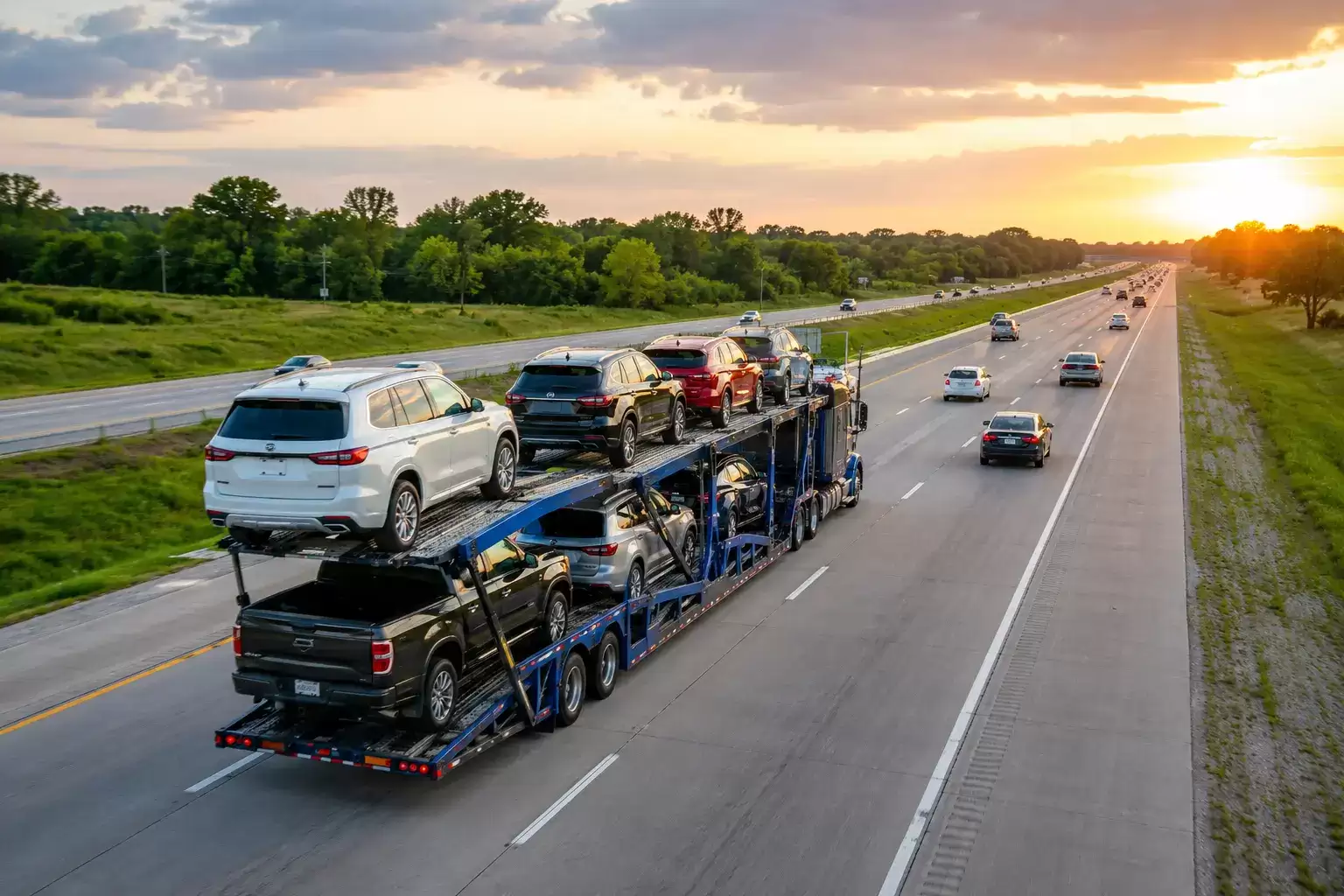

Michigan and Texas Auto Shipping Zones Along the I-94 / I-55 / I-35 Corridor
Michigan to Texas runs west on I-94 to Chicago, then south on I-55 through St. Louis, southwest on I-44 to Oklahoma City, and south on I-35 to Texas — the same 1,060–1,445 mile corridor as its reverse. Five states, three major relay hubs, and a route that crosses from winter-locked Great Lakes shoreline to subtropical South Texas.
Michigan Origin Zones
Mid-Corridor Relay Points
Texas Delivery Zones
Open vs. Enclosed Car Transport on the Michigan–Texas Route
Open Transport: The Right Choice for the Overwhelming Majority
Open transport handles virtually all Michigan-to-Texas shipments. Snowbird winter home vehicles, permanent relocation moves, military PCS, corporate transfers, and university graduate moves all ship open. Open is appropriate for every daily driver, pickup truck, SUV, and standard vehicle moving from any Michigan origin to any Texas destination — regardless of season, distance, or destination city.
Michigan Winter Pickup and the Road Salt Question
Michigan’s aggressive road salt use from November through April raises a question that does not exist on warmer-state corridors: is a vehicle picked up in Michigan in January worth protecting with enclosed transport to prevent salt spray exposure? The honest answer for almost all vehicles is no — if the vehicle has been driving on Michigan roads in winter, it has already been exposed to salt. Enclosed transport prevents salt spray during the carrier run itself, but a Michigan winter vehicle picked up in January has the same accumulated salt exposure whether you ship open or enclosed.
The exception is a vehicle that has been in climate-controlled storage all winter and is being shipped south in pristine condition — a collector car taken out of a heated garage for the first time in spring, or an exotic that has not been driven since October. For these vehicles, enclosed eliminates road spray during the pickup leg and the carrier run itself.
Open Transport Recommended for Most
- All snowbird winter vehicle shipments from Michigan to Texas — open regardless of season
- Permanent relocations, military PCS, and corporate moves of any kind
- Daily drivers, pickup trucks, SUVs, and standard vehicles at any time of year
- Michigan winter pickup: open is appropriate even November–April for vehicles already exposed to salt
- Texas summer delivery: quarter tank of fuel, remove all personal items, arrange prompt covered delivery
Enclosed Transport
- Collector cars, exotics, and low-mileage pristine vehicles shipping from Michigan garages to Texas collections
- Vehicles in climate-controlled storage that have not been driven on Michigan salt roads in winter
- High-value vehicles being delivered to Texas garage storage or auction consignment
- Barrett-Jackson Houston-consigned vehicles or other Texas auction lot deliveries from Michigan collections
- Typically 40–60% more expensive than open transport
Our honest recommendation: Open for every snowbird, relocation, military, and standard vehicle move. Enclosed only for climate-storage vehicles, collector cars, and exotics where exposure during the carrier run itself — not just Michigan winter roads — matters for the vehicle’s value or condition.

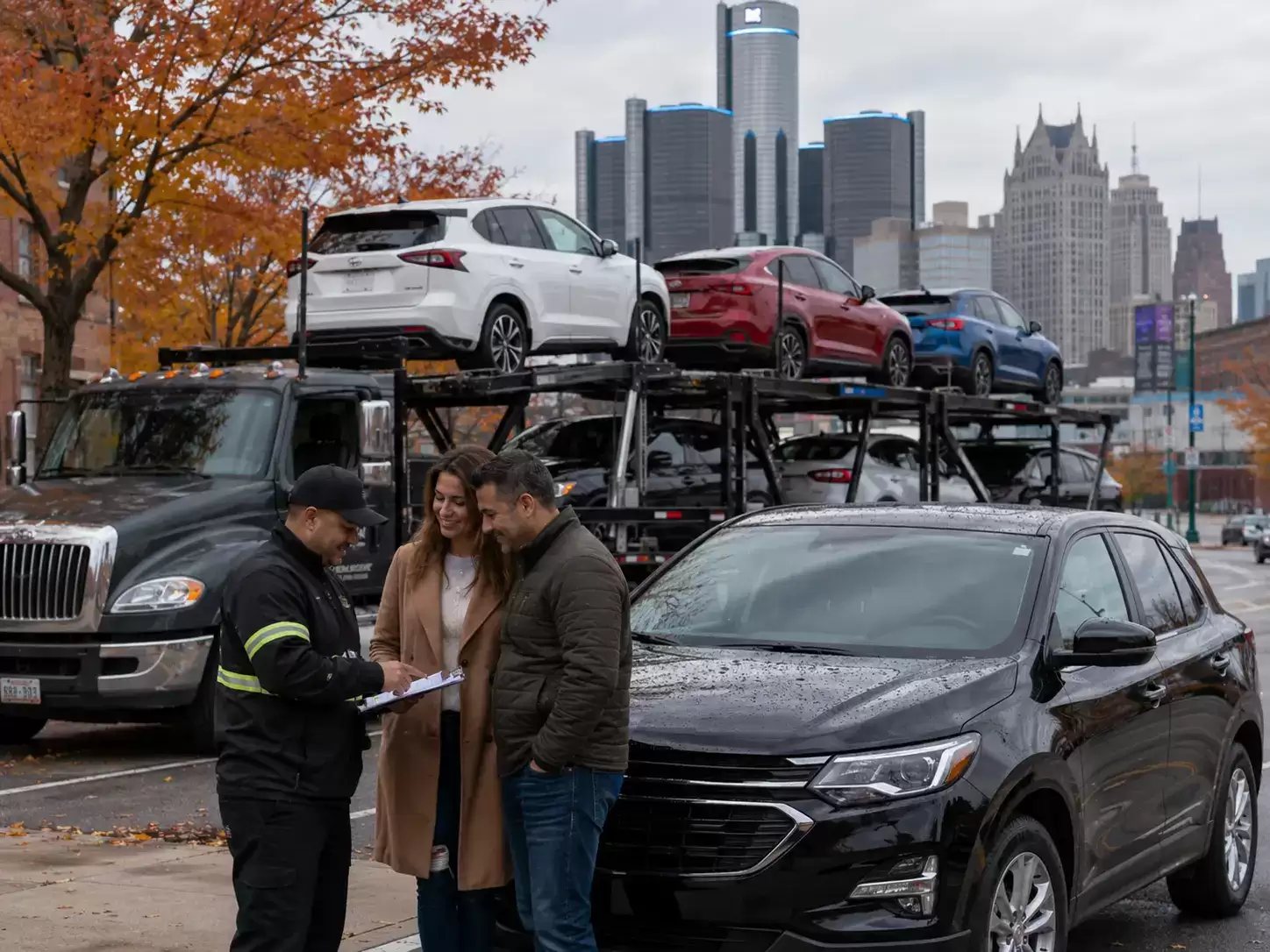
Door-to-Door Car Shipping: What to Expect in Michigan and Texas
Pickup in Michigan
Detroit City Proper and Wayne County
Detroit city proper uses commercial staging for large multi-car haulers — dense Detroit neighborhoods are inaccessible to 8–10 car carriers. Your carrier coordinator establishes a pickup staging point at the nearest accessible interchange, typically near I-94W, I-96W, or I-75S approach routes. Wayne County suburban addresses (Dearborn, Livonia, Westland, Taylor, Wyandotte, Inkster) receive standard door-to-door pickup without staging. Michigan road salt (November–April): have a cleared staging area with accessible driveway or adjacent commercial lot, and build a 1–2 day buffer for major winter weather events in this window.
Detroit Metro: Oakland, Macomb, and Washtenaw Counties
Standard door-to-door pickup applies throughout Oakland County (Southfield, Troy, Pontiac, Rochester Hills, Waterford), Macomb County (Warren, Sterling Heights, Roseville, St. Clair Shores, Ferndale), and Washtenaw County (Ann Arbor, Ypsilanti). All three counties have clean carrier access via the suburban street network and major highway approaches. Selfridge Air National Guard Base in Harrison Township (Macomb County): confirm on-base pickup protocol for military PCS vehicles. Michigan winter road salt is present throughout all three counties from mid-November through April — cleared staging and a weather buffer apply in this period.
Western Michigan: Grand Rapids, Kalamazoo, and the I-94/I-196 Corridor
Grand Rapids, Kalamazoo, Holland, Battle Creek, Muskegon, and Portage all receive standard door-to-door pickup. Western Michigan carriers typically use I-96S from Grand Rapids or I-94W from Kalamazoo to reach Chicago — the most direct southbound approach on the entire Michigan origin zone. Grand Rapids to Chicago via I-196S/I-90W is approximately 175 miles, making Grand Rapids one of the most efficiently positioned Michigan origin cities for Texas shipments. Winter pickup in western Michigan: lake-effect snow from Lake Michigan can be more intense than in the Detroit metro — allow additional buffer for major lake-effect events in November through February.
Mid-Michigan: Lansing, Flint, Saginaw, and Bay City
Lansing and East Lansing pickup is standard door-to-door via I-96W. The Lansing metro is one of the corridor’s most efficient Michigan origins — I-96W from Lansing reaches Chicago approximately 175 miles away, shorter than any Detroit metro approach. Flint (I-75S to Detroit, then I-94W), Saginaw, and Bay City (I-75S south) add approach mileage via the Detroit connection. Bay City is the northernmost origin on this table — winter conditions in Bay City (Saginaw Bay, central Michigan) can be significant from November through March, and carrier scheduling from this zone builds in weather buffer automatically in those months.
Delivery in Texas
Dallas–Fort Worth Metro
Standard door-to-door delivery throughout DFW. Fort Worth, Arlington, Irving, Dallas, Plano, Garland, Frisco, and Denton all receive standard delivery via I-35, I-20, I-30, and the DFW metro connector system. Texas summer heat (June–September): vehicle interiors exceed 150°F in direct sun. Arrange prompt covered delivery or garage access for vehicles arriving at DFW in summer. Gated community and high-rise addresses use nearby commercial staging as needed — confirm delivery arrangements at booking.
Greater Houston Metro and Southeast Texas
Standard door-to-door delivery throughout Houston, Pasadena, Sugar Land, League City, Conroe, Beaumont, and Port Arthur. I-10, I-45, and I-69 provide carrier access throughout the metro. Houston summer delivery involves the same extreme heat considerations as DFW — quarter tank of fuel, remove all electronics and personal items, arrange covered delivery if possible. League City and Pasadena (southeast Houston) are accessible via I-45SE and Highway 146. Beaumont and Port Arthur access I-10 and Highway 73 directly.
East Texas and Central Texas
East Texas delivery — Tyler, Longview, Nacogdoches, Lufkin, Texarkana — is standard door-to-door. Carriers from Michigan reaching the OKC junction take I-35S to Dallas then I-20E for Tyler and Longview, or continue on I-30 east through Greenville for Texarkana. Alternatively, the Memphis alternate via I-55S from Chicago serves Texarkana and Longview efficiently. Central Texas (Waco, Killeen, Temple, Austin, College Station) is standard via I-35S from DFW. Fort Cavazos and Temple military zones: confirm on-post delivery protocol for active duty recipients at booking.
South Texas and Border Cities
San Antonio, Corpus Christi, Laredo, McAllen, Mission, Harlingen, and Brownsville are all served standard door-to-door. South Texas and Rio Grande Valley delivery is the corridor’s longest haul from Michigan origins — 1,395–1,560 miles for border city and Valley destinations from the main table and Other Cities pairings. Plan 5–8 days transit for Valley deliveries, and book Expedited for any firm arrival date. Snowbirds shipping vehicles to Valley winter RV parks and residential communities: confirm access and parking at the delivery site and whether the carrier needs a specific staging area within the park.
Texas Vehicle Registration for Michigan Arrivals
Texas requires registration within 90 days of establishing residency. Visit your county tax assessor-collector office with your out-of-state title, proof of Texas insurance, and proof of Texas address; a vehicle safety inspection is also required. Cancel your Michigan registration once your Texas plates arrive.
Preparing Your Vehicle
Before Michigan pickup: remove all personal items from the passenger compartment, disable car alarms, remove Michigan E-ZPass or other toll transponders, and leave no more than a quarter tank of fuel. Photograph your vehicle from all angles with date-stamped images before the carrier arrives. Michigan winter pickup (November–April): confirm the vehicle starts reliably in cold weather, that the battery passes a cold-weather load test, and that a cleared staging area accessible to the carrier is available on pickup day.
Texas delivery: inspect your vehicle carefully before signing the Bill of Lading. Wash on arrival — open transport vehicles accumulate road film over the 1,060–1,560 mile run. For summer Texas arrivals (June–September): remove any remaining personal items and electronics immediately upon delivery — interior temperatures will exceed 150°F in direct sun within minutes. For snowbirds delivering to Valley RV parks or outdoor Texas winter home storage: rinse the undercarriage on arrival to clear any residual Michigan road salt from the pickup region.
Michigan & Texas Auto Transport Resources
Michigan Helpful Government Links
- Michigan Secretary of State (michigan.gov/sos) — Michigan vehicle title, registration, and driver’s license agency. Obtain a title release from the Michigan SOS before transferring to Texas. Michigan does not have a separate DMV; all vehicle services are through the Secretary of State.
- Michigan SOS — Vehicles and Titles — Title release and transfer procedures for Michigan vehicles establishing Texas registration.
- Michigan SOS — Driver’s License — Michigan driver’s license surrender procedures when obtaining a Texas driver’s license.
- Michigan SOS — Branch Office Locator — Locate the nearest SOS office to obtain your title release before shipping south. Appointments are available and recommended for title transactions.
- Michigan SOS — Military and Veteran Provisions — Title and registration provisions for active duty military receiving PCS orders from Michigan installations to Texas.
Texas Helpful Government Links
- Texas Department of Motor Vehicles (TxDMV) — Texas vehicle title and registration agency. Register your Michigan vehicle within 90 days of establishing Texas residency.
- TxDMV — Title Transfer and Registration — Out-of-state vehicle title transfer and registration procedures for Michigan vehicles arriving in Texas.
- TxDMV — Military Provisions — Active duty non-resident exemptions for military arriving at Fort Cavazos, JBSA, and other Texas installations on PCS orders from Michigan.
- Texas DPS — Driver License — Obtain your Texas driver’s license within 90 days of establishing Texas residency. Your Michigan license is surrendered at the DPS office.
- TCEQ — Vehicle Emissions Testing Counties — Identify whether your Texas destination county requires vehicle emissions testing before registration (Harris/Houston, Dallas, Tarrant/Fort Worth, Travis/Austin, Bexar/San Antonio, and others).
Federal Auto Transport Resources
- FMCSA — Verify a Carrier’s License (SAFER System) — Verify that any auto transport company is federally licensed and insured before booking.
- FMCSA — Protect Your Move — Federal consumer guidance on hiring vehicle shippers and your rights on a cross-country move.