Michigan to California Car Shipping
The original instant car shipping calculator — trusted since 2004. Door-to-door Michigan to California transport with no surprises, no hidden fees, and three options to ship your vehicle on your schedule.
★ 4.6/5 Google Reviews | BBB Accredited A+ | FMCSA Licensed (MC #479342) | USDOT #1240502 | No upfront payment required | 20+ years shipping vehicles


Michigan to California Car Shipping Rates by City
Every Michigan to California vehicle shipment is available at three service levels:
Standard, Expedited, & Rush Options
Choose the one that fits your timeline and budget. All three include full door-to-door service and carrier insurance.
The Company That Invented Instant Auto Transport Pricing
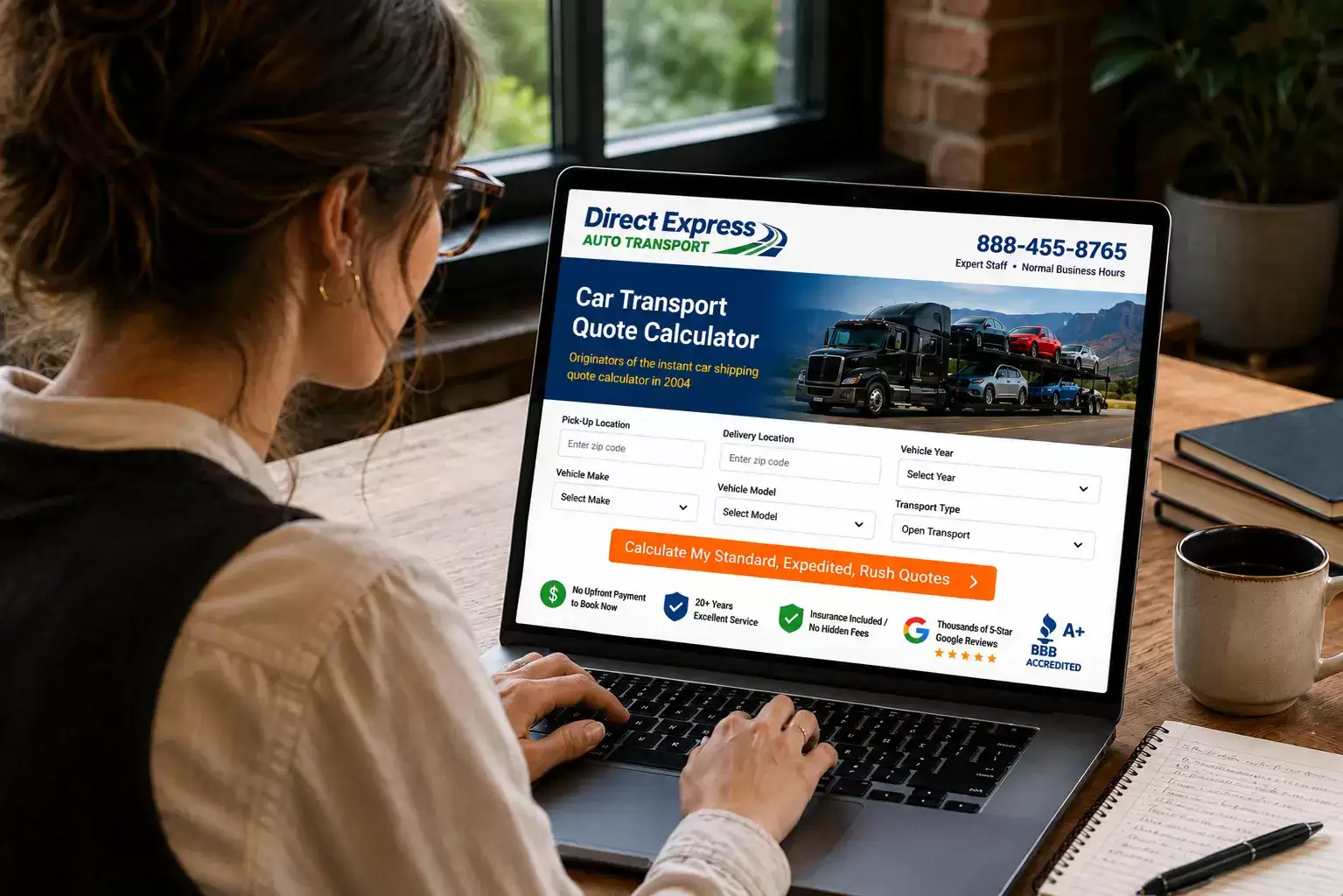
Direct Express Auto Transport pioneered online instant pricing for the auto transport industry in 2004. Before we built the first car shipping cost calculator, getting a quote from a broker meant phone calls, callbacks, and waiting — sometimes days. We changed that. Today you know your exact cost in 30 seconds, before committing to anything. No phone tag, no hassle. Just a real number, instantly.
Three Service Tiers for Every Michigan to California Shipment
Every shipment on this Michigan to California route is available at three service tiers so you can match your budget to your timeline. Standard delivers at the best available rate — ideal when your schedule has a few days of flexibility. Expedited moves your vehicle to the front of the dispatch queue for faster pickup. Rush gets your car picked up as fast as humanly possible — for moves where every day counts. All three tiers include full door-to-door service and carrier insurance.
What customers say about shipping a car from Michigan to California with Direct Express Auto Transport


Seasonal Pricing Guide: Michigan to California
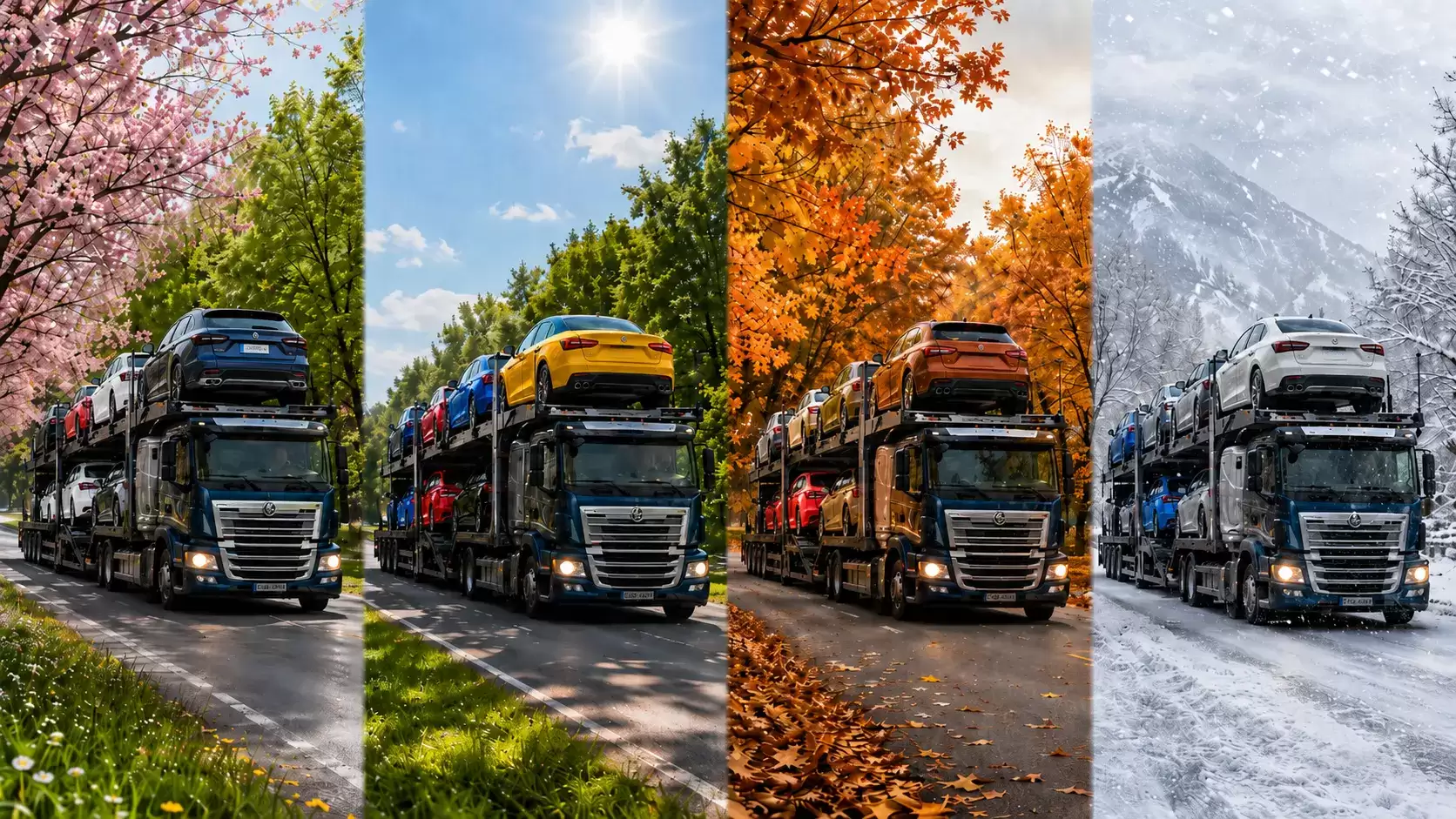
Michigan winters are among the most persistent in the Great Lakes region — and they are a primary motivator for this westbound corridor. The seasonal timing of Michigan-to-California shipments reflects both the national demand calendar and the very human impulse to get a vehicle out of the Great Lakes winter before the salt and snow arrive.
Who Ships a Car from Michigan to California — and Why
Michigan-to-California is one of the country’s most structurally consistent westbound shipping corridors. The motivations are durable — rooted in career opportunity, climate, the automotive industry’s unique bicoastal structure, and the timeless appeal of the California weather advantage.
Automotive Industry Personnel: Detroit Design and Engineering Roles in California
The auto industry’s California design and tech centers — Ford, GM, and Stellantis each maintain studios and advanced technology centers in the Los Angeles area and Silicon Valley — drive a constant bidirectional shipping cycle. Michigan engineers and designers rotating to California studios ship vehicles west; California-based auto professionals accepting Michigan assignments ship east. The Detroit → Los Angeles pairing at $1,150 Standard is the corridor’s primary city-pair.
Michigan Graduates Moving to California Technology and Entertainment Industries
Michigan graduates pursuing California careers represent the corridor’s most concentrated June demand. Michigan’s universities produce graduates recruited directly into California’s technology, entertainment, and healthcare sectors. A University of Michigan engineer accepting a Google or Apple offer ships a vehicle west in May or June — a single one-way shipment with a fixed start date tied to the job offer letter.
Michigan Residents Relocating Permanently to California for Climate and Career
Michigan winters are a permanent motivating force for permanent westbound relocations. Michigan residents with professional flexibility — remote workers, early retirees, self-employed professionals — choose California for its climate, outdoor access, and lifestyle. The Detroit → Los Angeles pairing at $1,150 and Grand Rapids → San Diego at $1,200 Standard cover the primary Michigan permanent-relocation routes to California.
What Makes the Michigan–California Auto Shipping Run Different
I-94 West to Chicago — The First Leg
Every Michigan-to-California shipment begins the same way: west on I-94 from the Detroit metro through Ann Arbor, Battle Creek, and Kalamazoo before crossing into Indiana and reaching Chicago. This 290-mile stretch from Detroit to Chicago is one of the most carrier-traveled segments in the Midwest — major load exchanges happen in the Chicago area, where westbound California-bound carriers consolidate loads before heading south on I-55 to St. Louis and then west on I-44/I-40 through the Southwest.
Grand Rapids and Western Michigan: US-131 South to I-94 Before the Chicago Run
Grand Rapids and western Michigan carriers enter I-94 at Kalamazoo or take US-131 south to I-94, adding roughly 30–45 minutes before the Chicago run. This minor approach difference is why western Michigan pickups are fully available but may add 1 transit day compared to Detroit metro departures.
Chicago to Los Angeles: The I-40 Desert Crossing
From the Chicago area, the dominant routing continues south on I-55 to St. Louis, connects to I-44 southwest toward Oklahoma City, then picks up I-40 west — the 1,400-mile all-weather desert highway through Albuquerque, Flagstaff, and the Mojave before descending into the Los Angeles basin. I-40 is the most weather-reliable major cross-country route in the country: the Southwest desert section is immune to winter closures that affect I-80 and I-90.
Bay Area Routing: I-80W Through Wyoming and Nevada for Northern California Delivery
I-40 is the most weather-reliable major cross-country route in the country — the Southwest desert is immune to winter closures that affect I-80 and I-90. Bay Area-bound loads (San Francisco, Oakland, San Jose) take I-80W from Chicago through Iowa, Nebraska, Wyoming, Utah, and Nevada instead, adding distance but serving Northern California more directly.
NorCal Delivery Premium — Applies from Any Michigan Origin
Southern California — Los Angeles, San Diego, Orange County, and the Inland Empire — is the natural western endpoint of the I-40 run. Carriers terminate loads in the SoCal basin, which is the country’s most active carrier delivery zone. Northern California delivery (San Francisco, Oakland, San Jose, Sacramento) requires the carrier to continue north from the LA area on I-5 or I-580 after crossing the desert, adding 400+ miles and typically 1–2 additional transit days. The $200–$250 NorCal delivery premium applies from any Michigan origin and is reflected in the pricing table above. If flexibility exists on the California end, delivering to SoCal and driving or ferrying north is occasionally a practical money-saving alternative for Bay Area destinations.
Pickup Zones: Metro Detroit vs. Western Michigan
Metro Detroit — Detroit, Warren, Sterling Heights, Dearborn, Livonia, Troy, Macomb, Pontiac, Farmington Hills — is Michigan’s most carrier-dense pickup zone. I-94 departs directly westbound from the Detroit metro, and carrier availability on this corridor is consistently strong throughout the year. Western Michigan (Grand Rapids, Kalamazoo, Muskegon) requires carriers to travel east to the I-94 trunk or head south on US-131, adding roughly 30–45 minutes before reaching the Chicago area.
Saginaw and Bay City: North-Central Michigan Adds 1–2 Transit Days
Western Michigan pickups are fully available but typically add 1 transit day and a slight pricing adjustment compared to equivalent metro Detroit shipments. Saginaw and Bay City (north-central Michigan) add 1–2 days compared to the southeast corner of the state — factor this into your delivery window if shipping from north of Flint.
Other Michigan to California Cities We Serve
Direct Express ships vehicles between hundreds of city pairs on this route. Below is a broader look at additional Michigan origins and California destinations we regularly serve.
Hub Cities Along the Michigan–California Car Shipping Corridor
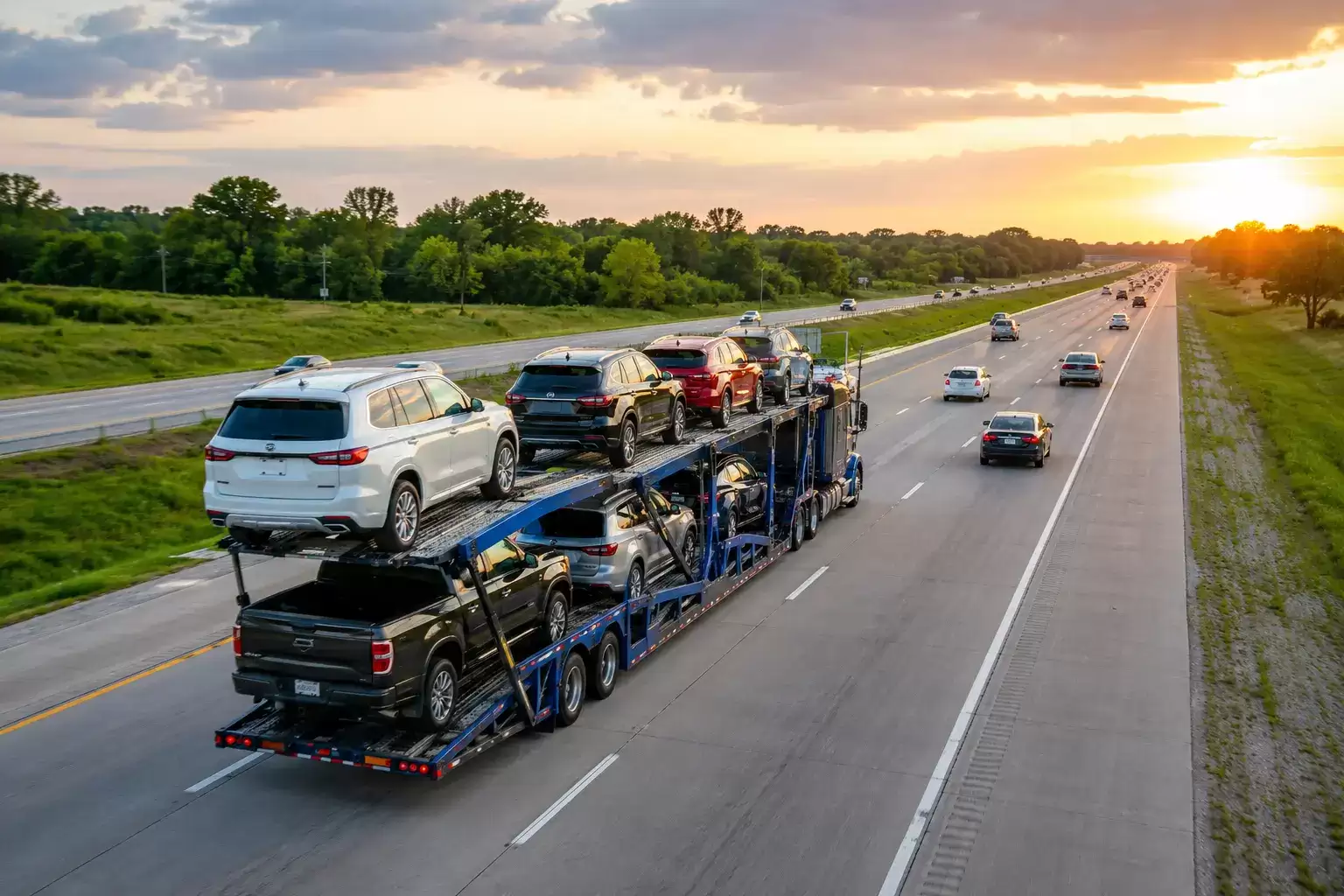
The Michigan-to-California run departs the country’s most car-aware city and drives west along a well-defined interstate corridor through Chicago and the Southwest. Detroit anchors the eastern end; Los Angeles anchors the western end. The route between them is one of the most carrier-traveled lanes in the country.
Major Origin Hubs in Michigan
Cross-Country Corridor Cities
Major California Delivery Points
Chicago: The Gateway Junction: Chicago is the pivotal routing hub for every Michigan-to-California shipment — it’s where the I-94 westbound run from Detroit meets I-55 south toward St. Louis and the I-40 Southwest corridor. Detroit to Chicago is 290 miles on I-94. Chicago to St. Louis is another 300 miles on I-55. St. Louis to Los Angeles via I-40 is approximately 1,835 miles. That’s the entire trip in three segments — and Chicago is where all three connect. Carriers often reload or cross-dock in the Chicago area, making it the most operationally significant midpoint city on this corridor.
Open vs. Enclosed Car Transport on the Michigan–California Route
The Michigan-to-California haul spans 2,300–2,500 miles, beginning in a Great Lakes winter climate and ending in year-round California sunshine. The pickup end — specifically Michigan’s road salt season — is the main variable that distinguishes this route’s open vs. enclosed decision from warmer-state routes.
Open Transport Recommended for Most
- Open-air trailer carrying 7–10 vehicles — the industry standard for virtually all everyday vehicle shipments
- Most cost-effective option by a significant margin
- Well-suited for daily drivers, commuter vehicles, SUVs, trucks, minivans, and any vehicle under approximately $60,000
- The I-94 to I-40 corridor is among the most carrier-traveled routes in the country, with strong westbound availability from the Detroit metro
- Your vehicle picks up road film during the 2,300+ mile haul — normal and expected; a wash on California delivery addresses it
Enclosed Transport
- Vehicle travels in a fully enclosed, weatherproof trailer from Michigan to California
- Typically 40–60% more expensive than open transport
- Recommended for luxury vehicles, exotics, collector cars, show-quality finishes, and low-clearance vehicles
- The strongest case on this corridor: Michigan winter pickup means road salt and brine contact during outdoor staging. Enclosed transport eliminates this entirely — your vehicle is loaded directly into the enclosed trailer without salt exposure
- Particularly relevant for shipping a Michigan vehicle to California’s collector car market, or for any vehicle where documented rust-free condition has monetary or sentimental value
- Book 2–3 weeks ahead — fewer enclosed carriers on this lane
Our honest recommendation: Open transport for the everyday vehicle — the route is well-served and cost-efficient from Detroit. For winter pickups, high-value vehicles, or any situation where salt exposure during Michigan staging is a genuine concern — enclosed is worth the premium on this specific route.

Door-to-Door Car Shipping: What to Expect in Michigan and California
Pickup in Michigan
Detroit Metro and Southeast Michigan
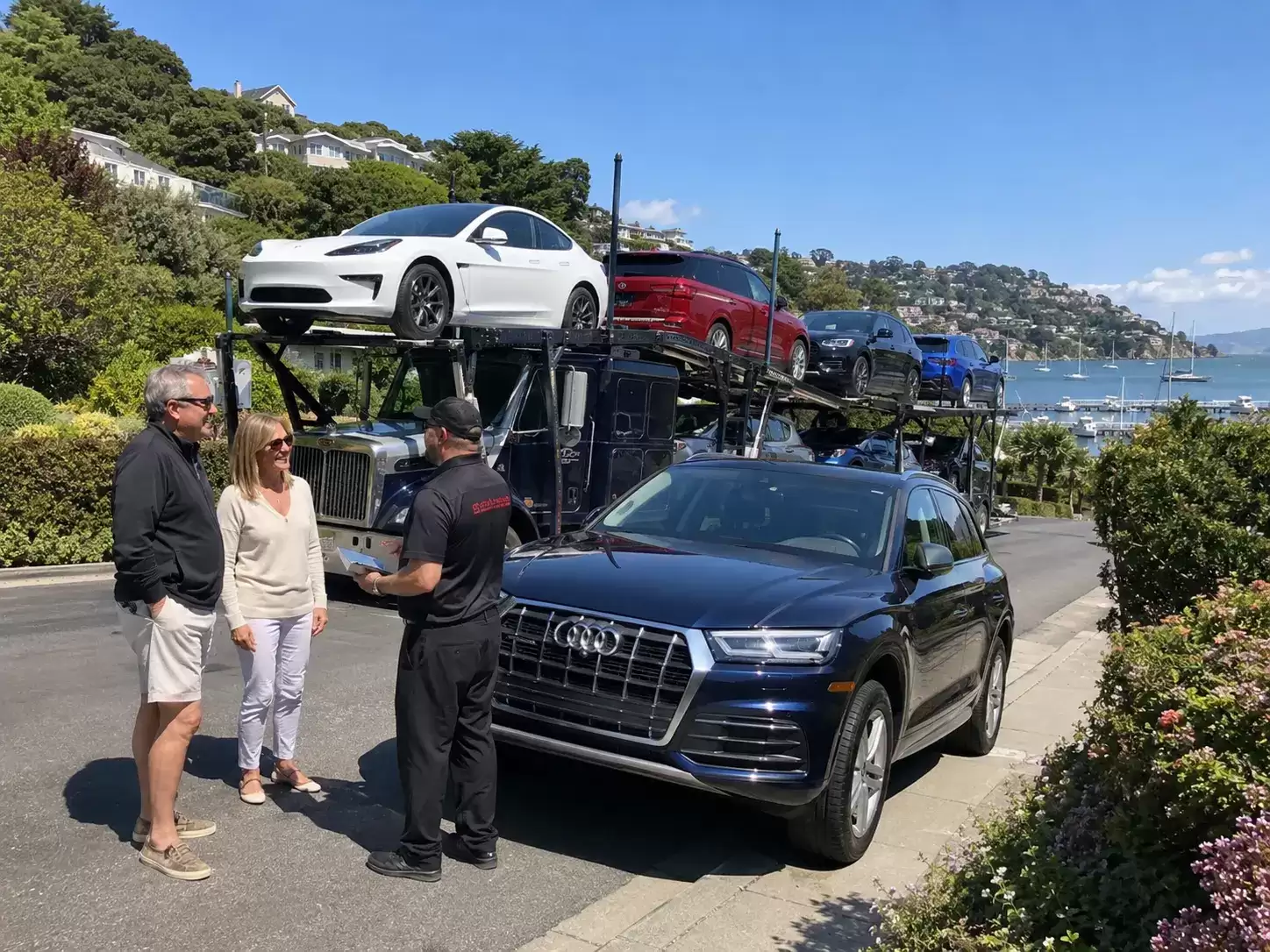
Metro Detroit — Detroit, Warren, Sterling Heights, Dearborn, Livonia, Troy, Macomb, Pontiac, Farmington Hills — is Michigan’s most carrier-accessible pickup zone. I-94 departs westbound directly from the metro area, and carrier availability from this corridor is consistently strong. Most residential and commercial addresses in metro Detroit and its suburbs are accessible to large car haulers without complication. Your carrier contacts you 24–48 hours before pickup to confirm a window.
West Michigan: Grand Rapids, Kalamazoo, Lansing, and Mid-Michigan
Standard door-to-door pickup throughout West Michigan and Mid-Michigan. Grand Rapids: standard residential throughout, I-96 and US-131 access. Kalamazoo: standard residential, I-94 corridor. Lansing and East Lansing (Michigan State University): standard residential; campus-area addresses — confirm at booking. Flint, Saginaw, and Bay City: standard residential, I-75 and I-69 access. Winter protocol: road salt and brine coat vehicles staged outdoors November through March. For collector cars, show vehicles, or exotic paint finishes, enclosed transport avoids salt exposure. Allow additional dispatch lead time for smaller mid-Michigan markets.
Delivery in California
Southern California and the Inland Empire
Southern California — the Los Angeles basin, San Diego, Orange County, and the Inland Empire — is the natural western terminus of this run and the most carrier-dense delivery zone in the country. Door-to-door delivery is straightforward at most residential and commercial addresses in SoCal. Your carrier contacts you 24–48 hours before delivery to confirm a window. California delivery is uncomplicated year-round — no weather, no salt, no seasonal complications on the destination end.
Bay Area and Northern California
Northern California delivery (San Francisco, Oakland, San Jose, Sacramento) requires the carrier to continue north from the LA area after crossing the desert, adding 400+ miles and 1–2 additional transit days. San Francisco’s denser neighborhoods may require meeting-point coordination for large haulers — your coordinator addresses this before departure from Michigan.
Preparing Your Vehicle
Before pickup: remove all personal items from the interior, leave no more than a quarter tank of fuel, disable your car alarm, and remove any exterior accessories. Photograph your vehicle thoroughly from all angles with date-stamped images before the carrier arrives. At delivery in California, inspect your vehicle carefully before signing the Bill of Lading — note any concerns before signing. Your signature without notation constitutes acceptance of the vehicle’s condition.
Michigan & California Auto Transport Resources
Michigan Helpful Government Links
- Michigan Secretary of State — Vehicle Registration — Michigan vehicle registration is handled by the Secretary of State (not a DMV). When moving your vehicle to California permanently, initiate the Michigan title release process through the SOS before re-registering in California.
- Michigan SOS — Title Transfer Overview — Guidance on releasing your Michigan title for out-of-state transfer. California requires the Michigan title to complete registration at the destination end.
- Michigan SOS — Office Locator — Find your nearest Michigan Secretary of State branch to obtain your title before your move. SOS branches handle all vehicle title and registration transactions in person.
California Helpful Government Links
- California Department of Motor Vehicles (CA DMV) — Primary agency for California vehicle titles and registration. New California residents must register their out-of-state vehicle within 20 days of establishing residency.
- CA DMV — Registering an Out-of-State Vehicle — Step-by-step guidance for transferring your Michigan title and obtaining California registration and plates. California requires a smog inspection before registration for most vehicles.
- CA DMV — Vehicle Registration Fees — California registration fees are calculated on vehicle value and are typically higher than Michigan fees. Estimate your cost before your vehicle arrives at your California address.
Federal Auto Transport Resources
- FMCSA — Verify a Carrier’s License (SAFER System) — Verify that any auto transport company you consider is federally licensed and insured before booking.
- FMCSA — Protect Your Move — Federal consumer guidance about hiring vehicle shippers, including red flags for broker scams and your rights as a shipper.