Texas to Illinois Car Shipping
The original instant car shipping calculator — trusted since 2004. Door-to-door Texas to Illinois transport with no surprises, no hidden fees, and three options to ship your vehicle on your schedule.
★ 4.6/5 Google Reviews | BBB Accredited A+ | FMCSA Licensed (MC #479342) | USDOT #1240502 | No upfront payment required | 20+ years shipping vehicles


Texas to Illinois Car Shipping Rates by City
Every Texas to Illinois vehicle shipment is available at three service levels:
Standard, Expedited, & Rush Options
Choose the one that fits your timeline and budget. All three include full door-to-door service and carrier insurance.
The Company That Invented Instant Auto Transport Pricing
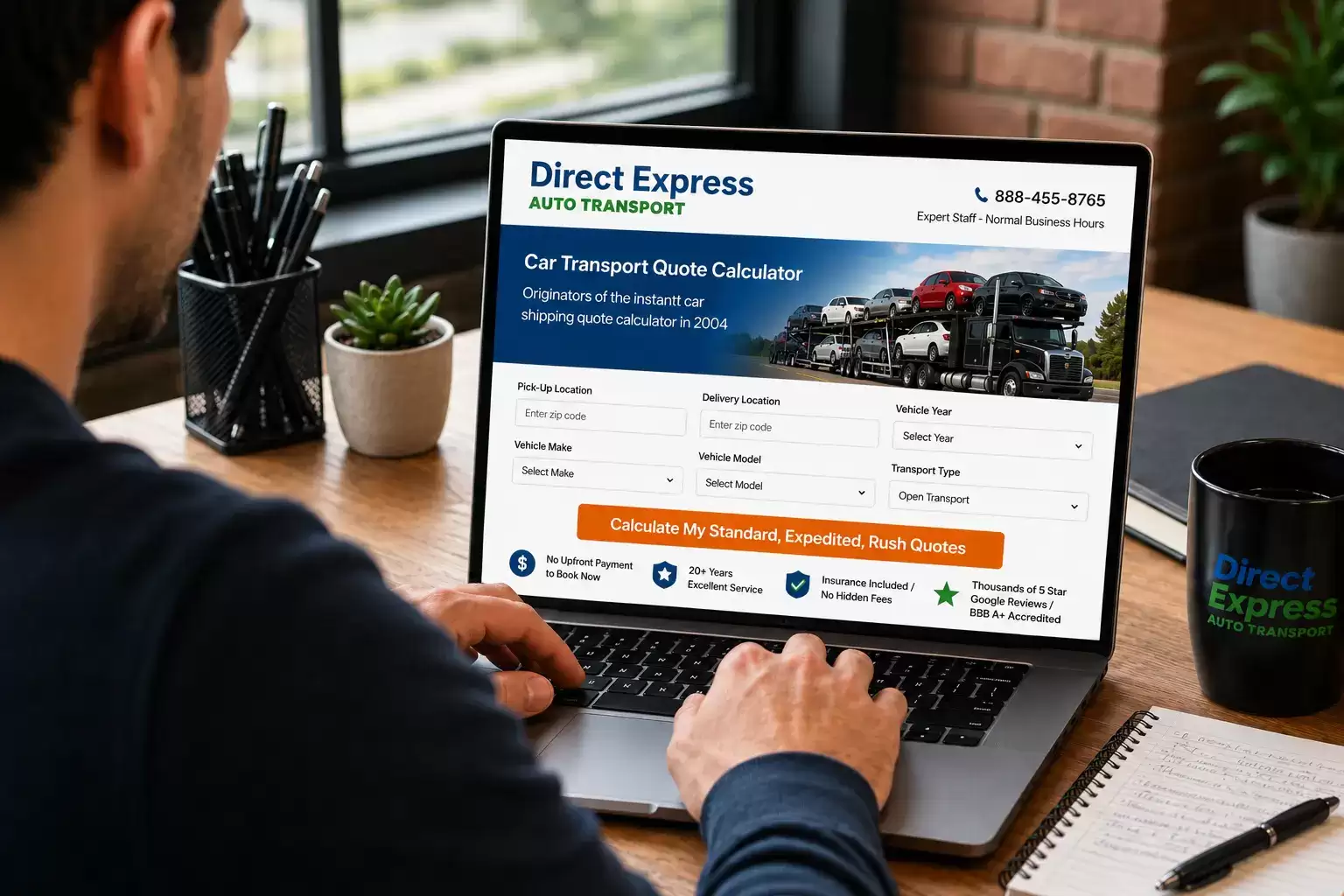
Direct Express Auto Transport pioneered online instant pricing for the auto transport industry in 2004. Before we built the first car shipping cost calculator, getting a quote from a broker meant phone calls, callbacks, and waiting — sometimes days. We changed that. Today you know your exact cost in 30 seconds, before committing to anything.
Three Service Tiers for Every Texas to Illinois Shipment
Every shipment on this Texas to Illinois route is available at three service tiers so you can match your budget to your timeline. Standard delivers at the best available rate — ideal when your schedule has a few days of flexibility. Expedited moves your vehicle to the front of the dispatch queue for faster pickup. Rush gets your car picked up as fast as humanly possible — for moves where every day counts.
All three tiers include full door-to-door service and carrier insurance. No phone tag, no hassle. Just a real number, instantly.
What customers say about shipping a car from Texas to Illinois with Direct Express Auto Transport


Seasonal Pricing Guide: Texas to Illinois
Texas to Illinois runs steady year-round, anchored by Chicago’s draw on Texas corporate talent and military PCS. January–March is the best value window; June–August is peak demand.

Who Ships a Car from Texas to Illinois — and Why
Military PCS: Fort Cavazos and JBSA → Scott AFB and Naval Station Great Lakes
Fort Cavazos — home to III Corps and one of the Army’s largest installations — generates officer and NCO PCS orders to Scott Air Force Base in Belleville, Illinois, the headquarters of Air Mobility Command. Joint Base San Antonio also sends Air Force logistics and medical personnel to Scott AFB and surrounding Illinois installations.
Naval Station Great Lakes: Texas Navy Personnel Reporting to Enlisted Training Command
Naval Station Great Lakes in North Chicago (Lake County) is the Navy’s sole enlisted training command and receives Navy personnel from across the country, including from Texas. Book immediately on receipt of PCS orders. Expedited or Rush is strongly recommended for any firm Illinois report date — particularly for summer moves when carrier capacity on this corridor is at maximum demand.
Texas University Graduates Moving to Chicago Finance and Consulting
CME Group — operator of the Chicago Mercantile Exchange, CBOT, NYMEX, and COMEX — and CBOE Global Markets employ thousands of professionals in Chicago’s financial district. Texas graduates from UT Austin McCombs, SMU Cox, and Rice Business entering energy trading or derivatives roles in Chicago use this corridor consistently.
Texas Graduates in Consulting: McKinsey, BCG, Bain, and Big Law at Kirkland and Sidley
Chicago’s major consulting practices — McKinsey, BCG, Bain, Accenture, and Deloitte — recruit heavily from Texas universities. Big Law firms including Kirkland & Ellis, Sidley Austin, and Mayer Brown recruit from UT Law and other Texas law schools. These are price-insensitive corporate movers with firm start dates; Expedited service is standard for this segment.
South Texas Residents Moving to Chicago’s Latino Neighborhoods
Chicago has the second-largest Mexican-American population of any US city. The neighborhoods of Pilsen, Little Village (La Villita), Logan Square, Back of the Yards, and Humboldt Park have deep roots in Mexican and Mexican-American communities going back generations. The Rio Grande Valley — McAllen, Brownsville, Harlingen, Edinburg, and Mission — has long-established community ties to Chicago’s South Side and West Side neighborhoods.
Pilsen, Little Village, and Logan Square: Year-Round Demand from South Texas Communities
This is the corridor’s most consistent year-round demand segment. It runs at volume in every month, is relatively price-sensitive (Standard is the most common service tier here), and often involves shipping from South Texas cities (Laredo, McAllen, Brownsville, Corpus Christi) that carry higher base rates due to their approach mileage to the I-35 mainline. The Laredo → Waukegan pairing at $1,175 is the table’s most expensive for exactly this reason.
Houston Energy Professionals Moving to Chicago Commodities Markets
Houston is the world’s energy capital — home to major oil companies, refining operations, LNG finance, and energy private equity. Chicago is the world’s commodities derivatives capital — CME Group and the CBOE handle energy futures and options volume that dwarfs all other exchanges combined. The professional pipeline between Houston’s energy sector and Chicago’s trading floors is active and consistent.
Houston Petrochemical Professionals Moving to Chicago
Petroleum engineers moving to energy trading desks, energy finance professionals moving to commodity hedge funds, and oil company employees transferring to Chicago regional offices all use this corridor. These are high-income, time-sensitive corporate moves — Expedited is standard, and many use enclosed transport for collector cars or high-value vehicles moving north from Texas garages to Chicago condos.
DFW Technology Sector and Corporate Relocations to Chicago
Dallas–Fort Worth is home to a growing technology sector anchored by AT&T, Texas Instruments, HCL Technologies, and a constellation of mid-market tech companies. Chicago’s tech ecosystem — including Salesforce’s Chicago hub, Zebra Technologies in Lincolnshire, Motorola Solutions in Schaumburg, and a dense Fulton Market startup cluster — draws DFW technology professionals at consistent volume. Irving and Plano origins appear in the table precisely because they are the DFW technology corridor’s most active shipping zones.
DFW Corporate and Technology Transfers: AT&T, Boeing, and United Airlines Chicago Operations
Corporate relocations from Texas to Chicago more broadly — including Boeing’s former Chicago headquarters, United Airlines, and major financial services firms with dual-market operations — generate cross-corridor vehicle shipments throughout the year. DFW-to-Chicago-suburb pairs are the corridor’s most competitive in pricing because the I-35 north routing is the cleanest, most direct, and most carrier-dense path on the entire table.
What Makes the Texas–Illinois Auto Shipping Run Different
The Main Corridor: I-35 North to Oklahoma City, Then I-44 and I-55 to Chicago
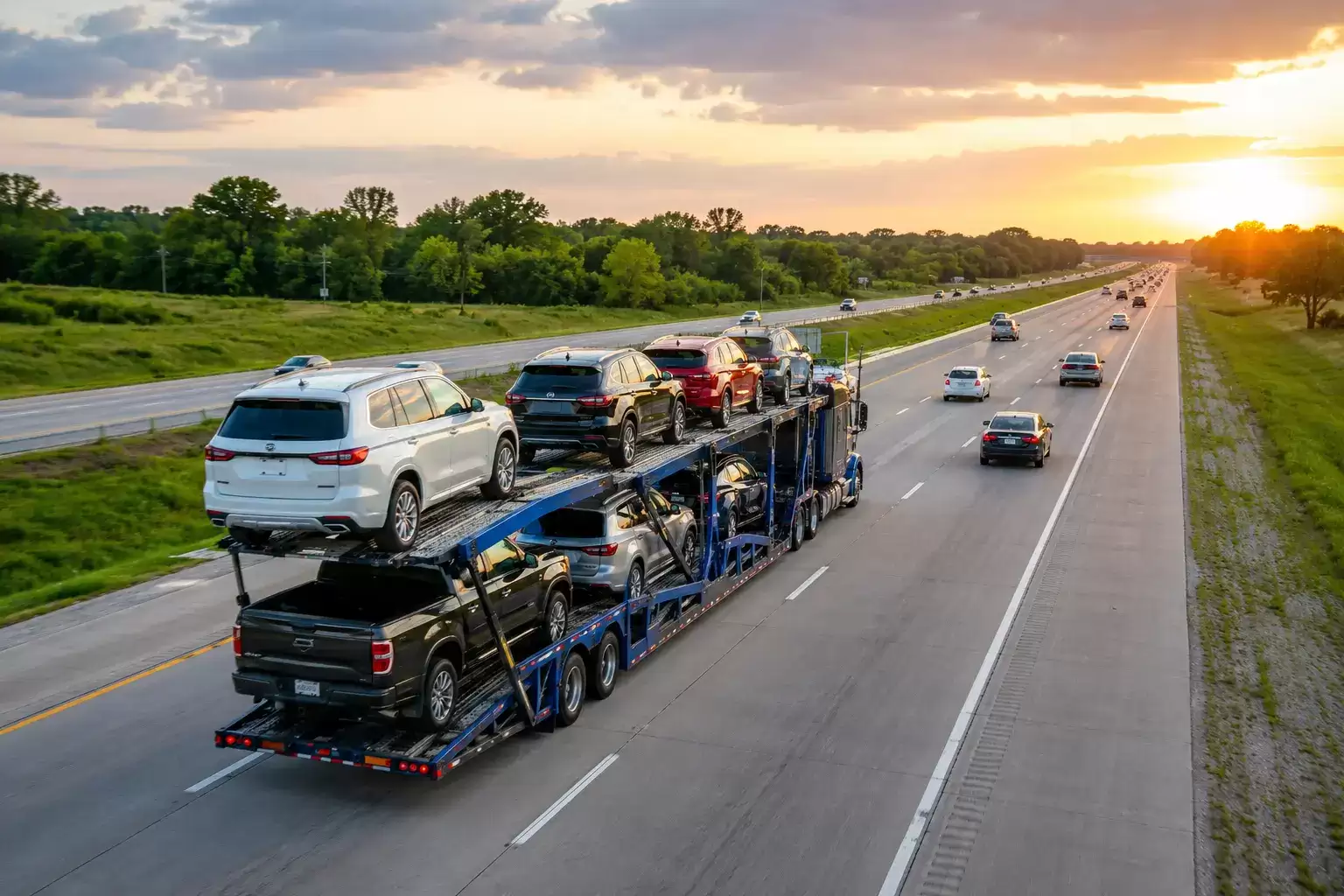
The primary Texas-to-Illinois routing follows a clean north-south corridor. From DFW origins, carriers take I-35 north through Gainesville and Ardmore to Oklahoma City — approximately 200 miles. From Oklahoma City, I-44 northeast through Tulsa and Joplin, Missouri leads to St. Louis, where I-55 north carries the run the remaining 300 miles to Chicago.
Oklahoma City and St. Louis: The Two Relay Hubs on the I-35/I-44/I-55 Corridor
This I-35 / I-44 / I-55 corridor is one of the most carrier-dense routes in the American interior. Every Texas-to-Midwest shipment passes through or near this routing. Oklahoma City and St. Louis function as natural relay hubs — high carrier density at both points means that vehicles originating in any Texas zone can connect efficiently with northbound Illinois-bound loads at either city.
Irving → Schaumburg: The Table’s Cheapest Pair
Irving to Schaumburg at 940 miles and $850 Standard is the table’s cheapest pair — and both ends earn it. Irving sits at the intersection of I-35E and I-635 (LBJ Freeway) in the DFW Metroplex’s western half, providing the most direct on-ramp to I-35 north of any major Texas city on this table. Schaumburg is a northwest Chicago suburb on I-90, about 25 miles from the Loop, and carriers approaching Chicago from I-55 north can exit west onto I-290 to reach Schaumburg without navigating downtown Chicago.
Why Irving–Schaumburg Cuts Both Cost Drivers: Approach Mileage and Urban Delivery
The pairing eliminates the two main cost drivers on this corridor: approach mileage from deep South Texas origins, and downtown Chicago delivery complexity. Motorola Solutions is headquartered in Schaumburg; it is one of the Chicago metro’s most active corporate relocation zones for technology professionals moving from Texas.
Laredo → Waukegan: The Most Expensive Pair
Laredo to Waukegan at 1,395 miles and $1,175 Standard is the table’s most expensive pair for reasons that are geographic on both ends. Laredo sits on the Texas-Mexico border, requiring approximately 150 miles of I-35 north approach before reaching San Antonio — before the main northbound run even begins. Every mile south of San Antonio adds pure approach mileage to the total haul.
Naval Station Great Lakes: Waukegan PCS Significance for South Texas Origins
Waukegan is on Lake Michigan north of Chicago, approximately 35 miles north of the Loop. Carriers delivering to Waukegan must travel through the Chicago metro from the south before continuing north on I-94 — adding city navigation time and mileage to a run that already starts at the far southern tip of Texas.
DFW vs. Houston Origins: Why DFW Ships for Less
DFW origins (Dallas, Fort Worth, Irving, Plano, Garland, Frisco, Arlington) consistently price below Houston on this table, even though Houston is the larger city and generates more corporate and energy-sector volume. The reason is routing geometry. DFW sits directly on I-35 — the main Texas-to-Chicago carrier corridor. A carrier loading in Irving at 8 a.m. is on I-35 north within minutes, heading straight toward Oklahoma City without detour.
Houston Origins: I-45 North Approach Adds $100–$125 Over Comparable DFW Pairs
Houston’s approach to the I-35 corridor requires I-45 north approximately 240 miles to Dallas before the main northbound run begins. Those 240 miles of approach mileage are reflected in the $100–$125 pricing premium Houston origins carry over comparable DFW pairs. This is not a judgment about Houston’s importance as a shipping origin — it is simply what the routing geometry costs on this specific corridor.
East Texas Origins and the I-55 Alternate Through Memphis
Beaumont, Tyler, Port Arthur, and Longview sit east of the main I-35 corridor. Carriers picking up from these origins have two routing options. The first is to proceed west to Houston or Dallas and join the I-35 mainline — most efficient for DFW and Chicago destinations. The second, for destinations in northern and eastern Illinois (Chicago, Waukegan, Champaign), is to take I-10 east from Beaumont to New Orleans, then I-55 north through Jackson, Memphis, and Champaign to Chicago.
I-55 Through Memphis: Why East Texas to Chicago Can Beat the Western Routing
The I-55 alternate through Memphis runs approximately 1,000 miles from Beaumont to Chicago and is genuinely competitive with the western routing for East Texas origins. Carriers make this routing decision based on load availability and backhaul opportunities — it is the reason Tyler → Cicero and Beaumont → Aurora can price lower than South Texas origins of similar theoretical distance.
Chicago Metro Delivery: The Midwest’s Most Active Auto Transport Market
Chicago is the second-largest auto transport market in the Midwest and one of the most active in the country. The metro area covers more than 9 million people across six Illinois collar counties — Cook, DuPage, Kane, Lake, McHenry, and Will — as well as the city of Chicago itself. Carrier density on inbound Chicago routes is high year-round, which supports competitive pricing for all Illinois destinations that are Chicago-adjacent.
Chicago City Delivery vs. Suburban and Downstate Illinois Access
Chicago city proper — particularly the Loop, River North, Lincoln Park, and the North Side — requires commercial staging for large multi-car haulers, identical to the staging process in Manhattan. Suburban Chicago addresses (Schaumburg, Naperville, Aurora, Joliet, Evanston, Waukegan) receive standard door-to-door delivery. Downstate Illinois destinations (Springfield, Peoria, Bloomington, Champaign, Decatur) are efficiently served via I-55 south from Chicago with clean delivery access and no complications.
Other Texas to Illinois Cities We Serve
Direct Express ships vehicles between hundreds of city pairs on this route. Below is a broader look at additional Texas origins and Illinois destinations we regularly serve.
Texas and Illinois Auto Shipping Zones Along the I-35 Corridor
Texas to Illinois runs through the heart of the American interior via I-35 north. Understanding the major origin zones, relay points, and Illinois delivery zones helps set accurate expectations for transit and delivery logistics.
Texas Origin Zones
Mid-Corridor Relay Points
Illinois Delivery Zones
Open vs. Enclosed Car Transport on the Texas–Illinois Route
Open Transport: The Right Choice for Most TX→IL Moves
Open transport handles the overwhelming majority of Texas to Illinois shipments. Military PCS moves from Fort Cavazos and JBSA, corporate relocations from DFW and Houston to Chicago, and university moves from Texas A&M or UT Austin to Northwestern and UChicago all ship open. Open carrier is the correct choice for virtually every daily driver, pickup truck, SUV, minivan, and standard vehicle on this corridor from every Texas origin to every Illinois destination.
When to Consider Enclosed
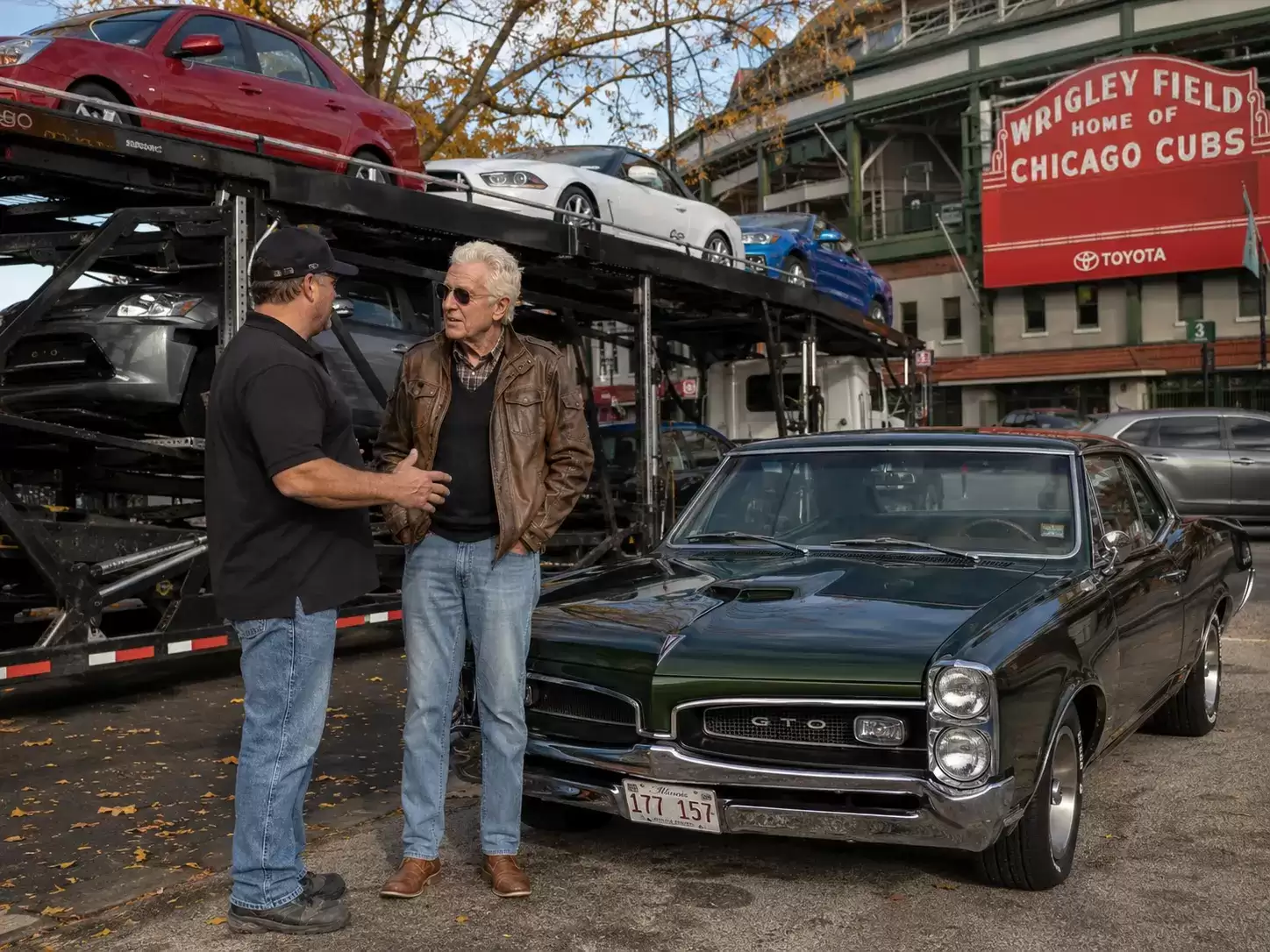
Enclosed transport is the right choice for collector cars, exotic vehicles, and high-value specialty vehicles moving from Texas to Illinois. Chicago is a significant collector car market — Mecum Auction holds events at the Schaumburg Convention Center and the city draws collector activity throughout the year. Texas collectors purchasing auction vehicles in Houston or Dallas and shipping north to Chicago enclosed is a consistent market on this corridor.
Illinois road salt is a serious consideration for enclosed decisions. Chicago and the collar counties begin salting roads with the first significant winter storm — typically mid-November — and roads remain treated with salt and brine through March or April. For collector cars, exotics, or any vehicle arriving in Illinois between November and March, enclosed transport eliminates all road salt spray exposure at the delivery stage. This is a genuine and meaningful benefit for vehicles that will not be washed immediately on arrival.
Open Transport Recommended for Most
- Military PCS from Fort Cavazos and JBSA to Scott AFB and Naval Station Great Lakes — all ship open
- Corporate relocations, DFW tech sector, and Houston energy professionals shipping daily drivers — open
- Texas university students (UT, A&M, Rice, SMU, TCU) shipping vehicles to Chicago for first jobs — open
- All DFW, Houston, San Antonio, and Austin origins to Chicago metro — excellent open carrier availability year-round
- South Texas border city residents moving to Chicago — open; Standard is the standard service tier for this segment
Enclosed Transport
- Collector cars, exotics, and pristine low-mileage vehicles requiring white-glove service
- Auction-purchased vehicles shipping from Texas to Chicago-area collections
- High-value vehicles arriving in Chicago November through March — enclosed eliminates road salt exposure at delivery
- Texas garage vehicles moving north to Chicago condos where daily-driver condition matters
- Typically 40–60% more expensive than open transport
Our honest recommendation: Open for all military PCS, corporate relocations, university moves, and standard vehicles. Enclosed for collector cars, exotics, and any high-value vehicle arriving in Illinois between November and March where road salt exposure at delivery is a concern.

Door-to-Door Car Shipping: What to Expect in Texas and Illinois
Pickup in Texas
Greater Houston Metro and Southeast Texas
Houston metro pickup is standard door-to-door for virtually all addresses. Houston’s I-10, I-45, and I-69 corridors provide excellent carrier access throughout the metro — from Sugar Land and League City in the southwest to Conroe and The Woodlands in the north, and to Pasadena in the east. Beaumont and Port Arthur access I-10 directly and are straightforward pickups with no approach complications. Summer heat in the Houston metro is extreme June through September — leave no more than a quarter tank of fuel and remove all personal items before your pickup date.
East Texas and Dallas–Fort Worth
The DFW Metroplex has the highest carrier density of any Texas origin zone and the cleanest pickup logistics on this corridor. From Dallas, Irving, Plano, Garland, Arlington, Frisco, and Fort Worth, standard door-to-door pickup is the norm at virtually every residential and commercial address. Tyler and Longview in East Texas access I-20 directly; Texarkana sits on I-30 at the Texas-Arkansas border and is among the most efficiently reached Texas pickups on this entire table — carriers heading northeast to Chicago pass directly through the I-30 corridor.
Central Texas
Austin, Waco, Killeen, Temple, and College Station are all standard pickup zones with good highway access and no complications. Killeen and Temple serve the Fort Cavazos corridor — if you are an active duty recipient receiving a vehicle at Fort Cavazos, confirm on-base delivery protocols at booking; pickup from civilian Killeen addresses is standard door-to-door. Austin’s pickup access via I-35 is excellent, and Round Rock, Cedar Park, and Georgetown addresses are all served without issue.
South Texas and Border Cities
Corpus Christi, Laredo, McAllen, Brownsville, Harlingen, and Mission are all serviceable pickup zones with standard door-to-door access. The additional approach mileage from South Texas origins to the I-35 mainline — approximately 150 miles from Laredo to San Antonio, and similar distances from the Rio Grande Valley — is reflected in the higher Standard rates for these pairings. Summer heat in South Texas is the most extreme of any Texas zone; pickups in July and August in Laredo and the Rio Grande Valley require extra care regarding fuel levels and personal items in the vehicle.
Delivery in Illinois
Chicago City Proper
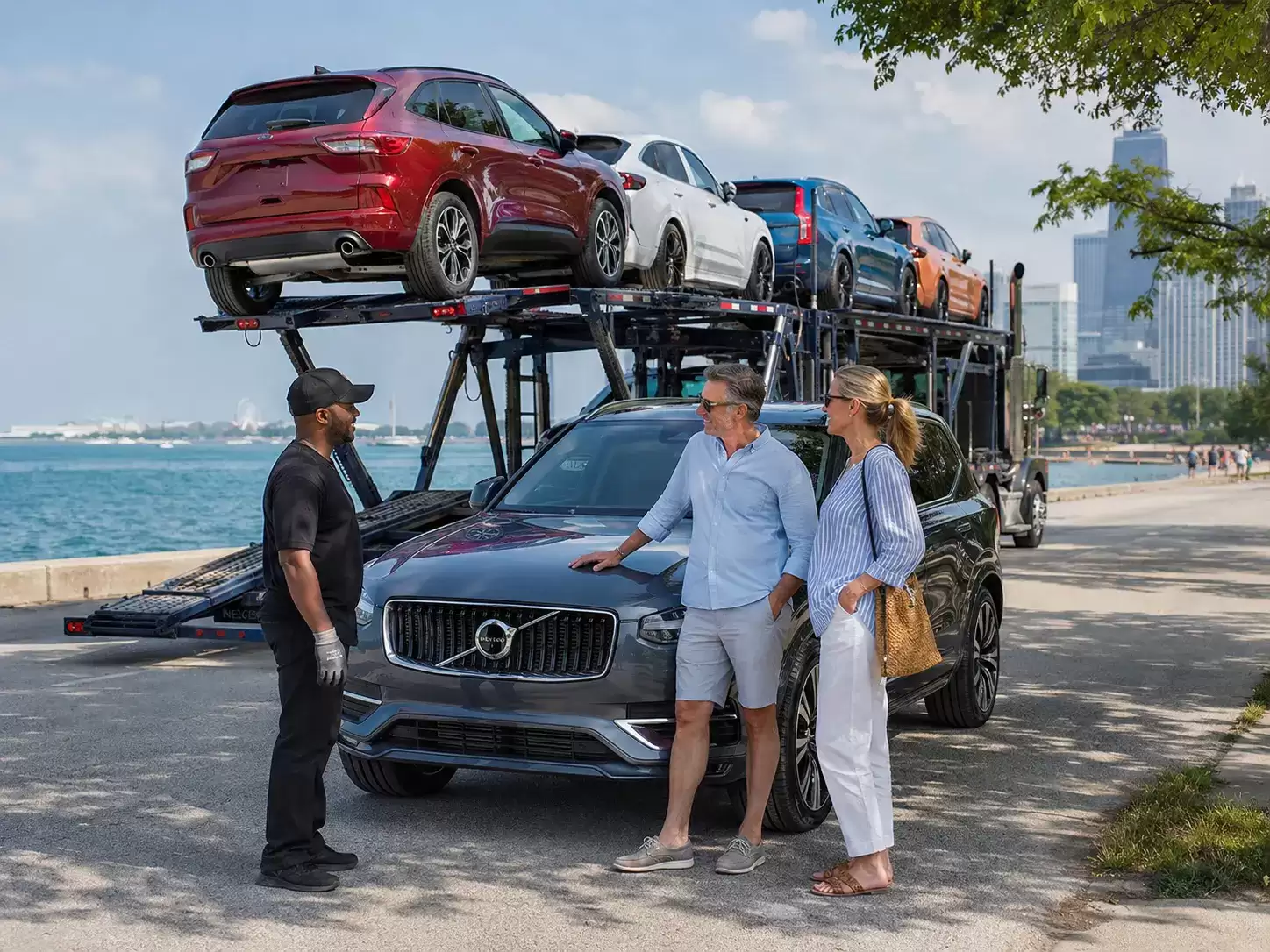
Chicago city delivery requires commercial staging for large multi-car haulers, identical to the process in Manhattan or downtown Los Angeles. The Chicago street grid, restricted-height underpasses on Lake Shore Drive, and tight residential streets in neighborhoods like Lincoln Park, Wicker Park, Bucktown, and Logan Square are inaccessible to 75-foot multi-car haulers. Your carrier coordinator establishes a staging point at the nearest accessible interchange — typically near I-55, I-290, or I-94 approach routes. Plan your Chicago delivery staging protocol at booking and confirm the staging location with your carrier before departure from Texas.
Chicago Metro and Collar Counties
Suburban Chicago delivery is standard door-to-door for virtually all addresses in the collar counties. Schaumburg, Naperville, Aurora, Joliet, Elgin, Waukegan, Evanston, Bolingbrook, and all other Chicago suburb addresses are served on I-290, I-355, I-90, I-94, and I-80 approach routes. Gated community and high-rise deliveries in the suburbs use nearby commercial staging as needed — your coordinator handles this routinely. Illinois road salt treatment in the collar counties begins mid-November; plan vehicle washing on arrival for November through March deliveries.
Downstate Illinois
Downstate Illinois delivery — Springfield, Peoria, Bloomington, Champaign, Decatur, Normal, Belleville, Galesburg, and Kankakee — is straightforward and efficient. I-55 south from Chicago reaches Springfield, Bloomington, and Champaign directly; I-74 west from Champaign reaches Peoria; I-64 east from St. Louis reaches Belleville. There are no staging complications at downstate Illinois destinations, and carrier access is standard door-to-door throughout. Deliveries to University of Illinois at Urbana-Champaign, Illinois State University in Normal, and Bradley University in Peoria follow standard door-to-door protocols — coordinate delivery timing with university move-in schedules in late August.
Illinois Vehicle Registration for Texas Arrivals
Illinois requires registration within 30 days of establishing residency. Visit an Illinois Secretary of State facility with your out-of-state title, proof of Illinois insurance, and proof of Illinois address; an emissions test is required in the Chicago metro area. Cancel your Texas registration once your Illinois plates arrive.
Preparing Your Vehicle
Before Texas pickup: remove all personal items from the passenger compartment, disable car alarms, remove TxTag toll transponders, and leave no more than a quarter tank of fuel. Photograph your vehicle from all angles with date-stamped images before the carrier arrives. For summer Texas pickups (June–September): avoid leaving any heat-sensitive items — electronics, medications, valuables — inside the vehicle. Texas summer temperatures inside a closed vehicle can exceed 150°F.
Illinois delivery: inspect your vehicle carefully before signing the Bill of Lading. For November through March deliveries, wash the vehicle promptly on arrival to remove any road film from the Illinois delivery stage. Remove remaining personal items and electronics immediately after delivery. If you are receiving your vehicle at a Fort Cavazos or Joint Base San Antonio PCS destination in Illinois, confirm on-post delivery arrangements at booking and review the Bill of Lading thoroughly before signing.
Texas & Illinois Auto Transport Resources
Texas Helpful Government Links
- Texas Department of Motor Vehicles (TxDMV) — Texas vehicle title and registration agency. Cancel your Texas registration and obtain title documentation when establishing Illinois residency.
- TxDMV — Title Transfer and Registration — Title release procedures for Texas vehicles transferring title to Illinois.
- TxDMV — Military Provisions — Provisions for active duty military departing Fort Cavazos and Joint Base San Antonio on PCS orders to Illinois installations.
- Texas DPS — Driver License — Surrender your Texas driver’s license when obtaining an Illinois license after establishing Illinois residency.
Illinois Helpful Government Links
- Illinois Secretary of State (ilsos.gov) — Illinois vehicle title, registration, and driver’s license agency. New residents from Texas must register within 30 days of establishing Illinois residency. Illinois does not have a state-level DMV; the Secretary of State handles all vehicle matters.
- Illinois SOS — Vehicle Registration and Title — Registration procedures for out-of-state vehicles arriving from Texas. Documents needed: Texas title, proof of Illinois automobile insurance, and completed application.
- Illinois SOS — Driver’s License — Obtain your Illinois driver’s license within 90 days of establishing residency. Your Texas license must be surrendered.
- Illinois EPA — Vehicle Emissions Testing — Which Illinois counties require emissions testing. Cook, DuPage, Kane, Lake, McHenry, and Will counties (Chicago metro) and Madison, Monroe, and St. Clair counties (Metro East) require testing. All other Illinois counties are exempt.
- Illinois SOS — Military Provisions — Registration and license provisions for active duty military arriving at Scott AFB, Naval Station Great Lakes, and other Illinois installations on PCS orders from Texas.
Federal Auto Transport Resources
- FMCSA — Verify a Carrier’s License (SAFER System) — Verify that any auto transport company is federally licensed and insured before booking.
- FMCSA — Protect Your Move — Federal consumer guidance on hiring vehicle shippers and your rights on a cross-country move.