Car Shipping To or From Pennsylvania
Need to ship a car to or from Pennsylvania? Direct Express Auto Transport has been the Keystone State’s most trusted auto transport broker since 2004 — with a 4.6-star average across thousands of verified Google reviews, no upfront payment required, and a real-time quote available in 30 seconds.
★ 4.6/5 Google Reviews | BBB Accredited A+ | FMCSA Licensed (MC #479342) | USDOT #1240502 | No upfront payment required | 20+ years shipping vehicles


Pennsylvania car shipping costs range from $285 on very short hauls to neighboring New Jersey, New York, and Delaware up to $1,540+ on transcontinental routes to Washington State. The PA Turnpike’s position as the primary east-west carrier artery in the northern United States means Pennsylvania has outstanding carrier frequency and competitive pricing on virtually every route — short regional hauls and full cross-country vehicle transport alike. Use our calculator above for a real-time quote based on your specific route, vehicle, and timeline. We offer Standard, Expedited, and Rush tiers to match any schedule, from flexible to last-minute.
What customers say about shipping a car to or from Pennsylvania with Direct Express Auto Transport


The interstate corridors that define Pennsylvania auto transport
I-95 / I-476 (The Northeast Corridor through Philadelphia): I-95 enters Pennsylvania from Delaware at the Wilmington crossing, runs north through the Philadelphia metro — passing through Chester, Marcus Hook, the Philadelphia airport area, and into Center City — then continues northeast into New Jersey via the Tacony-Palmyra Bridge and the Walt Whitman and Ben Franklin Bridges. The I-476 Blue Route connects I-95 in the south to the PA Turnpike (I-76) in the northwest, completing the Philadelphia metro carrier loop. This is the most carrier-dense corridor in Pennsylvania and the primary route for all Florida Snowbird traffic moving through the state on the way to and from New England and New York.
I-76 / Pennsylvania Turnpike (The Keystone Corridor): The dominant east-west carrier highway in the northern United States. Enters Pennsylvania from New Jersey at the Delaware River Toll Bridge near Bristol, runs west through the Philadelphia suburbs, through the Valley Forge and King of Prussia interchange (where it meets I-476), west through Harrisburg and the Cumberland Valley, climbs the Allegheny Mountain crossing at the Somerset plateau, and enters Pittsburgh from the east, continuing west to the Ohio border at the Beaver Valley. Nearly every auto carrier moving vehicles between the NY/NJ metro and the Midwest runs I-76. This single highway accounts for more vehicle transport volume than any other road in Pennsylvania.
I-78 (The Lehigh Valley Corridor): Enters Pennsylvania from New Jersey near Easton-Phillipsburg and runs west through the Lehigh Valley — Bethlehem, Allentown — before merging into I-76 near Harrisburg. I-78 is the primary carrier route connecting the NJ pharmaceutical corridor and the New York metro to the Lehigh Valley’s industrial and distribution centers. It is the fastest routing between New York City and Harrisburg for carriers who want to avoid NJ Turnpike/Delaware River crossing congestion.
I-80 (The Northern Tier Corridor): Crosses Pennsylvania’s northern counties from the New Jersey border near Delaware Water Gap west through Stroudsburg, Bloomsburg, Lock Haven, and the Clarion area before entering Ohio. I-80 is the primary carrier route for vehicles moving between the New York/New Jersey metro and the northern Midwest (Cleveland, Detroit, Chicago via northern Ohio). The Pennsylvania section crosses the Pocono plateau and the Allegheny Plateau — elevation and winter weather on this corridor can affect routing decisions from November through March.
I-81 (The Appalachian Corridor): Enters Pennsylvania from Maryland near Hagerstown and runs northeast through the Cumberland Valley (Chambersburg, Carlisle, Harrisburg) before continuing northeast through Hazleton, Wilkes-Barre, and Scranton into New York near Binghamton. I-81 is the primary carrier route for vehicles moving between the Carolinas, Virginia, and the Mid-Atlantic, and northeastern Pennsylvania and upstate New York. It is also the primary routing for vehicles between Carlisle Barracks military PCS moves and Southeast installations.
I-83 (The Baltimore-Harrisburg Connector): A relatively short but strategically important corridor connecting Baltimore (via I-695) north through York to Harrisburg. I-83 is the primary artery for vehicles moving between the Baltimore/DC metro and central Pennsylvania. Standard transit Baltimore to Harrisburg is typically same-day or one day on this corridor.
Vehicles shipping to or from Philadelphia, the I-76 PA Turnpike corridor, and Pittsburgh benefit from the highest carrier frequency in the state. Central PA (State College, Williamsport) and the northern tier (I-80) have solid coverage. Remote rural areas in north-central PA (Potter, McKean, Cameron Counties) may require Expedited tier for reliable scheduling due to limited carrier traffic off the main interstate spine.

Pennsylvania’s carrier geography: the Keystone through-state and what it means for your shipment
Pennsylvania is neither a terminus like California or Florida nor a peripheral market — it is the pivot point of the entire East Coast auto transport network. The Pennsylvania Turnpike is the bridge between the Northeast’s densest auto transport market (the NJ/NY metro) and the Midwest’s largest market (Chicago and Ohio). Every carrier running that route passes through Pennsylvania in both directions, every day of the year. This creates a structural advantage for Pennsylvania shippers: even routes that originate or terminate in less-trafficked parts of the state tend to benefit from the sheer volume of car hauling traffic moving through on I-76. Vehicle relocation to or from Pennsylvania is, in many corridors, as easy to arrange as shipping to or from New Jersey itself.
Philadelphia’s position at the junction of I-95 and the PA Turnpike makes it the de facto northeastern hub of the entire East Coast vehicle shipping network. Carriers staging in the Philadelphia metro have access to I-95 northbound (toward NY/NJ/New England), I-95 southbound (toward Maryland/Virginia/Carolinas/Florida), I-76 westbound (PA Turnpike to Pittsburgh and Ohio), and I-78 northeast (to the NJ pharma corridor and NYC). No other city east of Chicago has this range of routing options for auto carriers. The result is that Philadelphia pickup windows for car transport are among the shortest on the East Coast outside of New York and New Jersey.
Pittsburgh occupies a complementary role as Pennsylvania’s western gateway. The I-76 Turnpike, I-79 (to West Virginia and the South), I-376 (Pittsburgh metro), and I-80 (northern tier) all converge in the Pittsburgh metro area, giving carriers arriving from the east a full menu of outbound options — south toward WV and the Carolinas via I-79, north toward Cleveland and Detroit via I-80, or further west toward Chicago and Indianapolis via I-76 into Ohio. Pittsburgh’s carrier frequency approaches Cleveland’s, making it a faster-than-expected market for vehicle transport that consistently surprises shippers unfamiliar with western PA’s logistics infrastructure.
Central and rural Pennsylvania presents the expected challenges of a lower-population through-state: carrier frequency drops quickly once you move off the I-76/I-78/I-81 spine. State College (Penn State), Williamsport, and the Susquehanna Valley have reasonable coverage via connecting routes, but the north-central counties (Tioga, Potter, McKean, Cameron) are among the lowest-frequency markets in the Mid-Atlantic region. Expedited tier is the reliable choice for any vehicle shipping to or from an address more than 30 miles from a major interstate in Pennsylvania. The carrier network reaches these areas, but Standard tier pickup windows can be unpredictably long without the priority pricing signal.
Shipping a car through Philadelphia’s dense urban core: what you need to know
Philadelphia’s inner-city neighborhoods — Center City, South Philadelphia, Fishtown, Kensington, and the row-house blocks of North Philadelphia — share the same narrow-street challenge found in New York’s boroughs and Hudson County, NJ. Standard 75-foot multi-car transporters cannot navigate the 19th-century grid of South Philly and the neighborhoods west of Broad Street. Carriers serving these areas stage at a nearby accessible meet-point — typically along a commercial arterial, an open parking structure, or a surface lot within reasonable driving distance of your address. Common meet-points include the Columbus Boulevard waterfront corridor, the parking areas near Citizens Bank Park and Lincoln Financial Field in South Philly, and the broad commercial streets of North Broad Street.
The Philadelphia suburbs and the I-76/I-476 corridor are a completely different vehicle shipping experience. Main Line communities (Wayne, Ardmore, Villanova, Bryn Mawr, Wynnewood, Narberth), Delaware County suburbs (Media, Swarthmore, Springfield), and Montgomery County communities (Plymouth Meeting, Blue Bell, Lansdale) are almost entirely door-to-door capable with standard carrier trucks. The same applies to the western suburbs along the PA Turnpike through Exton, Downingtown, Coatesville, and the Chester County communities. Standard door-to-door auto transport service is the norm throughout suburban Philadelphia, and carrier frequency in these communities is high enough that Standard-tier pickup windows are typically very short.
Pittsburgh presents its own version of this challenge. Pittsburgh’s hillside neighborhoods — Mount Washington, Squirrel Hill, Shadyside, the North Shore, and the Strip District — combine steep grades, narrow streets, and parking restrictions that complicate carrier access for large multi-car transporters. The South Hills and North Hills suburbs, the communities along Route 30 west toward the airport, and the I-376 corridor (Monroeville, Greensburg, Carnegie) are fully accessible and door-to-door capable. Urban Oakland and the Carnegie Mellon/Pitt area may require a nearby staging point on Fifth Avenue or Forbes Avenue, where commercial access allows large transporters to load and unload safely.
Pennsylvania auto transport hubs: carrier frequency by market
Tier 1 — Daily Carrier Access (Philadelphia metro and PA Turnpike corridor): Philadelphia, King of Prussia/Valley Forge, Conshohocken, Wayne and the Main Line, Chester County (Exton, Downingtown), Berks County (Reading), Lancaster, Harrisburg, York, Chambersburg, Allentown/Bethlehem/Easton. The King of Prussia interchange (I-76/I-476) is the single busiest carrier staging point in the state outside of Philadelphia itself. Shippers in this corridor can reliably expect Standard-tier pickup windows of 1–3 business days for most routes.
Tier 2 — Frequent Carrier Access (Pittsburgh metro and I-81 corridor): Pittsburgh, Monroeville, Bethel Park, Cranberry Township, Greensburg, New Castle, Carlisle, Mechanicsburg, Shippensburg, Scranton, Wilkes-Barre. These markets benefit from strong bidirectional carrier access via the PA Turnpike, I-81, and the Pittsburgh metro interstates. Standard tier is generally reliable; Expedited is recommended for tight timelines.
Tier 3 — Regular but Limited Carrier Access (I-80 corridor and secondary markets): Erie, State College, Williamsport, Stroudsburg/Pocono area, Hazleton, Johnstown, Indiana (PA), DuBois. These markets have solid service but lower carrier frequency than the main PA Turnpike corridor. Expedited tier is the practical choice for any vehicle shipping with a firm pickup deadline.
Tier 4 — Remote, Requires Coordination: North-central Pennsylvania counties (Tioga, Potter, Cameron, Clinton), the upper Susquehanna Valley, rural Elk and Forest Counties. Expedited tier is strongly recommended for all vehicle transport to and from these locations. Carrier access exists but Standard-tier windows are unpredictable.
The PA Turnpike corridor, Snowbird transit season, and Pennsylvania vehicle shipping timing
Pennsylvania’s vehicle shipping calendar is shaped by three overlapping cycles: the Snowbird transit season (every Florida-bound and Florida-returning carrier on the East Coast passes through PA on I-95 and I-76, creating a predictable autumn-southbound and spring-northbound carrier surge); the military PCS cycle (Carlisle Barracks, Tobyhanna, Letterkenny, and NSA Philadelphia all peak June–August); and the university cycle (Penn State, Pitt, CMU, Temple, Drexel, and eight other major campuses all have simultaneous August move-in and May move-out peaks). Understanding which of these cycles is dominant at the time of your shipment is the single most useful tool for managing auto transport timing and cost in Pennsylvania.
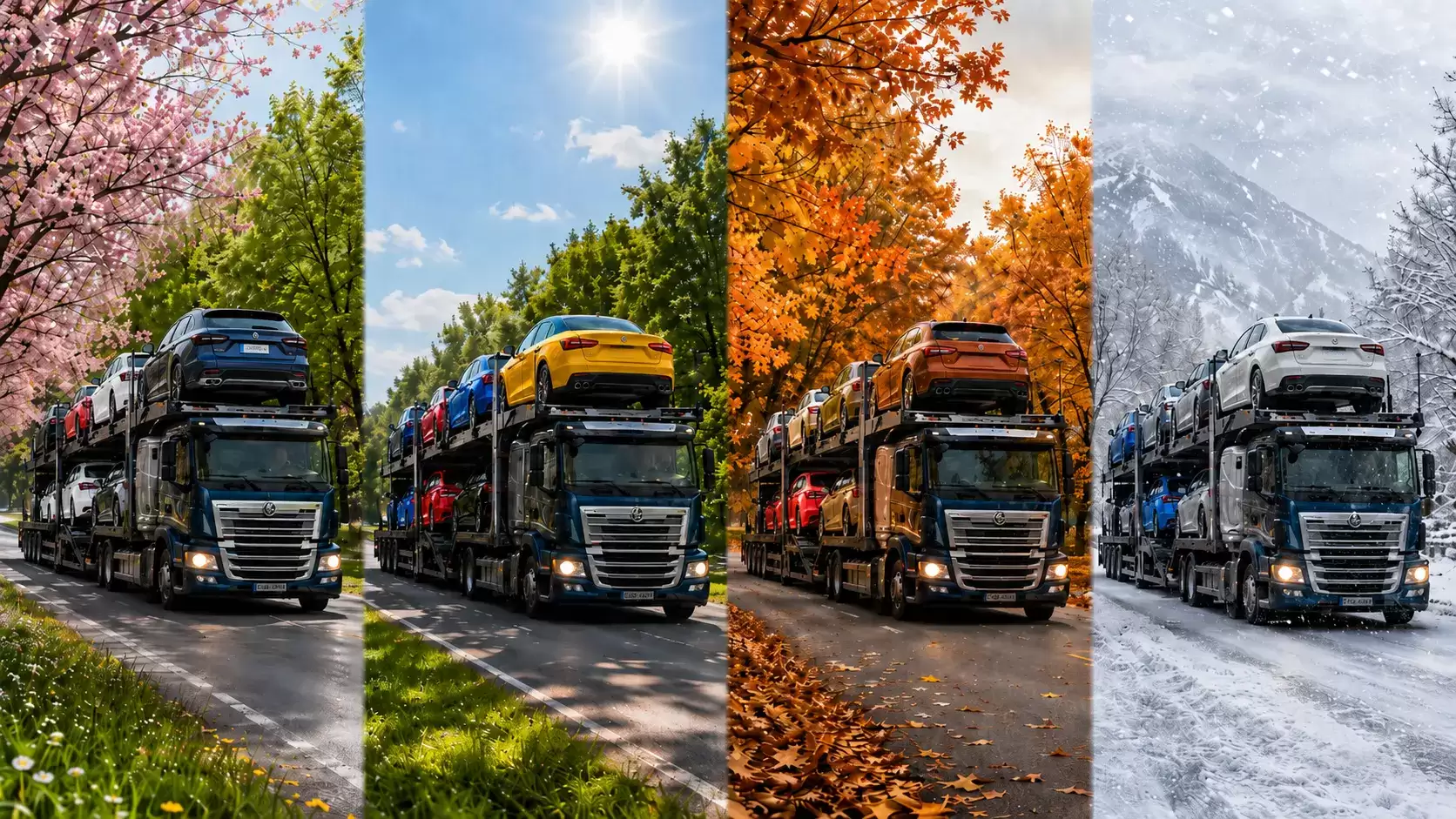
Summer (June–August) is the peak demand period in Pennsylvania — military PCS moves, university arrivals, and corporate relocations all compete for carrier capacity simultaneously. Car shipping rates are highest in July and August statewide. If your timeline is flexible, spring (March–May) and fall (September–November) offer the best combination of carrier availability and competitive pricing for vehicle relocation. The autumn window is particularly favorable for southbound routes (PA to FL, GA, NC) as Snowbird carriers heading south through I-76 and I-95 fill quickly and outbound PA vehicles benefit from excellent carrier frequency and competitive rates.
Winter (December–February) in Pennsylvania requires one additional consideration: the Allegheny Mountain crossing on I-76 (between the Somerset and Bedford interchanges) and the Pocono plateau on I-80 are subject to significant winter weather events. Carriers crossing these sections in January and February may experience delays during major snow events. For vehicles auto shipping from western PA to the east, or from eastern PA to Ohio and the Midwest, add a 1–2 day buffer to winter transit estimates. For I-95 corridor shipments (PA to FL or to NY/NJ), winter weather impact is minimal since I-95 through the Delaware Valley rarely closes for extended periods.

Pennsylvania vehicle transport cost estimates: major routes
Prices shown below are representative ranges for a standard operable sedan shipped via open carrier. SUVs, trucks, oversized vehicles, and non-running vehicles will be higher. Use our calculator for a real-time quote based on your specific zip codes, vehicle type, and preferred service tier. Prices vary by vehicle size, exact pickup and delivery locations, and seasonal demand.
Shipping a Car TO Pennsylvania
Swipe to view full table →
| From | To | Distance (mi) | Estimated Days | Standard | Expedited | Rush |
|---|---|---|---|---|---|---|
| New York | Pennsylvania | 95 | 1–2 days | $285 | $340 | $400 |
| New Jersey | Pennsylvania | 85 | 1–2 days | $285 | $340 | $400 |
| Delaware | Pennsylvania | 60 | 1–2 days | $285 | $340 | $400 |
| Maryland | Pennsylvania | 100 | 1–2 days | $325 | $390 | $455 |
| North Carolina | Pennsylvania | 460 | 2–4 days | $680 | $815 | $950 |
| Georgia | Pennsylvania | 850 | 3–5 days | $855 | $1,025 | $1,200 |
| Florida | Pennsylvania | 1,100 | 3–5 days | $895 | $1,075 | $1,255 |
| Ohio | Pennsylvania | 310 | 2–3 days | $445 | $535 | $625 |
| Michigan | Pennsylvania | 580 | 2–4 days | $700 | $840 | $980 |
| Illinois | Pennsylvania | 800 | 3–5 days | $840 | $1,010 | $1,175 |
| Texas | Pennsylvania | 1,570 | 4–7 days | $1,220 | $1,465 | $1,710 |
| Colorado | Pennsylvania | 1,740 | 4–6 days | $1,310 | $1,570 | $1,835 |
| California | Pennsylvania | 2,790 | 6–9 days | $1,485 | $1,780 | $2,080 |
| Washington State | Pennsylvania | 2,840 | 7–10 days | $1,540 | $1,850 | $2,155 |
Shipping a Car FROM Pennsylvania
Swipe to view full table →
| From | To | Distance (mi) | Estimated Days | Standard | Expedited | Rush |
|---|---|---|---|---|---|---|
| Pennsylvania | New York | 95 | 1–2 days | $285 | $340 | $400 |
| Pennsylvania | New Jersey | 85 | 1–2 days | $285 | $340 | $400 |
| Pennsylvania | Delaware | 60 | 1–2 days | $285 | $340 | $400 |
| Pennsylvania | Maryland | 100 | 1–2 days | $325 | $390 | $455 |
| Pennsylvania | North Carolina | 460 | 2–4 days | $680 | $815 | $950 |
| Pennsylvania | Georgia | 850 | 3–5 days | $855 | $1,025 | $1,200 |
| Pennsylvania | Florida | 1,100 | 3–5 days | $895 | $1,075 | $1,255 |
| Pennsylvania | Ohio | 310 | 2–3 days | $445 | $535 | $625 |
| Pennsylvania | Michigan | 580 | 2–4 days | $700 | $840 | $980 |
| Pennsylvania | Illinois | 800 | 3–5 days | $840 | $1,010 | $1,175 |
| Pennsylvania | Texas | 1,570 | 4–7 days | $1,220 | $1,465 | $1,710 |
| Pennsylvania | Colorado | 1,740 | 4–6 days | $1,310 | $1,570 | $1,835 |
| Pennsylvania | California | 2,790 | 6–9 days | $1,485 | $1,780 | $2,080 |
| Pennsylvania | Washington State | 2,840 | 7–10 days | $1,540 | $1,850 | $2,155 |

Pennsylvania seasonal auto shipping guide
Pennsylvania vehicle shipping service tiers
Swipe to view full table →
| Tier | Best for Pennsylvania when… | What to expect |
|---|---|---|
| Standard | Flexible timeline; Philadelphia suburbs or PA Turnpike corridor address; not near a military PCS deadline; shipping in fall or spring when carrier availability is highest statewide | Pickup 1–5 business days; carrier assigned as trucks route through your area on the I-76/I-95 corridor. No upfront payment — pay at delivery. |
| Expedited | Corporate relocation with a move-in deadline; central PA or off-interstate address; summer peak season; military PCS with a report date; Pocono or rural area address year-round | Pickup 1–3 days; listed above market rate to attract carriers faster; recommended for rural central PA and Pocono-area addresses year-round and any shipment with a firm deadline. |
| Rush | Emergency move; last-minute PCS orders; estate or auction vehicle; any winter shipment in mountain corridor areas; any address requiring guaranteed pickup speed | Highest priority carrier assignment; often same-day or next-day pickup; premium applies but guarantees fastest possible vehicle transport service. |
The tier system matters more in Pennsylvania than in purely urban states because the state’s geography creates a wide range of carrier frequency — from the near-daily departures of the Philadelphia metro and PA Turnpike corridor to the once-or-twice-weekly auto carrier traffic in rural northcentral Pennsylvania. Standard tier works well in most of the I-76/I-95 corridor; Expedited tier is the practical choice for central PA, the northern tier, and any vehicle shipment with a firm deadline regardless of location.


How to ship a car to or from Pennsylvania in 4 steps
Step 1 — Get an instant quote. Use our online calculator for a real-time price based on your exact pickup and delivery locations, vehicle type, and preferred service tier. No registration required. No phone call required. Results in 30 seconds.
Step 2 — Book and we assign a carrier. Once you book, our dispatch team lists your shipment to our vetted auto carrier network. Standard orders are typically picked up within 1–5 business days; Expedited and Rush orders move faster. We confirm carrier assignment and provide the driver’s contact information before pickup so you can coordinate directly.
Step 3 — Pickup and inspection. The carrier arrives at your agreed location, inspects your vehicle, and documents its condition on the Bill of Lading. You sign the pickup report. Dense Center City Philadelphia and hillside Pittsburgh neighborhoods may require a nearby meet-point on a commercial arterial. PA Turnpike suburban and Philadelphia Main Line pickups are typically door-to-door. Carlisle Barracks, Tobyhanna, and other military base pickups coordinate with the installation transportation office for gate access.
Step 4 — Delivery and final inspection. Your vehicle arrives at the destination. Do a thorough inspection against the pickup Bill of Lading before signing the delivery report. If any new damage is noted, document it on the delivery report before signing. Payment is due at delivery to the carrier — no upfront payment is charged by Direct Express Auto Transport.
Pennsylvania university and college auto transport
Penn State’s University Park campus and its 24 satellite campuses generate the largest single-institution vehicle shipping volume in the state. Philadelphia’s university cluster (Penn, Temple, Drexel, Villanova, St. Joseph’s, La Salle) and Pittsburgh’s (Pitt, Carnegie Mellon, Duquesne, Robert Morris) create geographic concentrations of student and faculty auto shipping demand that peak in late August and May. The Lehigh Valley’s Lehigh University and Moravian College add to the I-78 corridor university market. Book at least two weeks ahead for the late-August academic arrival window across all Pennsylvania campuses.
Swipe to view full table →
| University | Location | Enrollment | Notes |
|---|---|---|---|
| Penn State University | University Park | ~46,000 | PA’s flagship; central PA location near I-80/US-322; carriers detour from I-80 for State College; Expedited recommended for tight move-in windows |
| Temple University | Philadelphia | ~37,000 | North Philadelphia urban campus; meet-point protocol may apply for residential streets near campus; strong carrier access via I-76 and I-95 |
| University of Pittsburgh | Pittsburgh | ~33,000 | Oakland neighborhood; Pittsburgh’s urban campus challenge — Forbes/Fifth Avenue staging common; strong overall carrier frequency in Pittsburgh metro |
| Drexel University | Philadelphia | ~24,000 | University City campus in West Philadelphia; similar carrier access to Penn via I-76; meet-point at commercial corridors near campus |
| University of Pennsylvania | Philadelphia | ~22,000 | Ivy League; University City, West Philadelphia; same carrier access as Drexel; excellent I-76 and I-95 proximity |
| Carnegie Mellon University | Pittsburgh | ~15,000 | Oakland neighborhood adjacent to Pitt; tech-heavy enrollment drives strong inbound California and Seattle-to-Pittsburgh vehicle shipping flows |
| Villanova University | Villanova | ~12,000 | Main Line suburban campus; excellent carrier access via US-30 and I-476; one of the easiest PA university areas for door-to-door vehicle transport |
| Lehigh University | Bethlehem | ~7,500 | Lehigh Valley; excellent I-78 access; near Allentown-Bethlehem-Easton metro; straightforward carrier access for most auto transport routes |
| Bucknell University | Lewisburg | ~3,800 | Susquehanna Valley; US-15 corridor; rural location — Expedited recommended for tight arrival windows and move-in/move-out periods |
| Penn State Harrisburg | Harrisburg | ~5,200 | Middletown, Dauphin County; excellent I-76/I-83 access; near major carrier trunk routes; door-to-door service standard |

Pennsylvania military base vehicle shipping
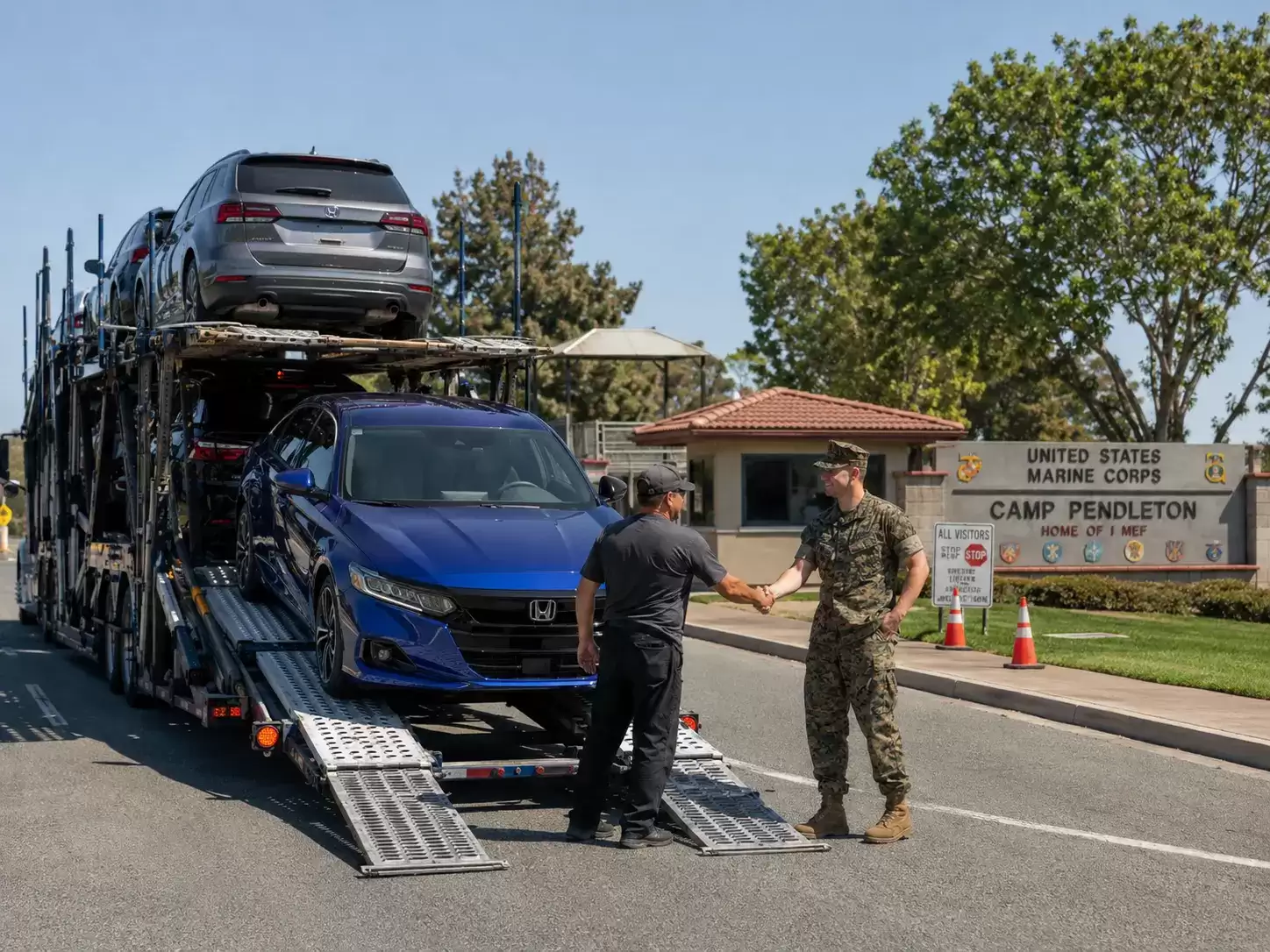
Pennsylvania hosts six significant federal military and defense installations, anchored by the Army War College at Carlisle Barracks and two major Army depots. PCS vehicle shipping to and from Pennsylvania installations runs primarily to Southeast installations (Fort Liberty, Fort Campbell, Langley AFB, Fort Stewart) and the broader East Coast network. The I-81/I-76 interchange near Carlisle and the I-95 corridor near Philadelphia give most PA installations solid auto carrier access; Tobyhanna in the Poconos is the notable exception requiring Expedited tier for reliable scheduling.
Carlisle Barracks — Carlisle (Cumberland County): Home of the U.S. Army War College, the Army Heritage and Education Center, and U.S. Army Reserve Command headquarters. As the service’s senior professional military education institution, Carlisle Barracks hosts a continuous rotation of senior officers, many arriving with late-model vehicles from assignments worldwide. PCS vehicle shipping to Carlisle from Army installations across the country is steady year-round. The I-81/I-76 interchange near Carlisle gives excellent carrier access in all directions. Standard tier is reliable for most Carlisle PCS moves; Expedited is recommended for those with a firm report date.
Tobyhanna Army Depot — Tobyhanna (Monroe County): The Army’s primary electronics maintenance and manufacturing depot, located in the Pocono Mountains of northeastern Pennsylvania. The Pocono location places Tobyhanna away from major carrier trunk routes; Expedited tier is recommended for all vehicle shipping to this installation. I-380 and PA Route 191 connect to I-80, providing the primary carrier routing access point. Allow extra lead time for scheduling, particularly in winter when I-80 Pocono plateau weather events can affect carrier routing.
Letterkenny Army Depot — Chambersburg (Franklin County): The Army’s primary depot for tactical wheeled vehicle and missile system maintenance, located in the Cumberland Valley. The Franklin County location has good I-81 access, making southbound routes to Fort Liberty (NC), Fort Bragg installations, and Southeast Army posts efficient for carrier routing. Standard carrier access is solid via I-81 for most vehicle shipping routes.
Naval Support Activity Philadelphia — Philadelphia (Philadelphia County): A joint military installation in South Philadelphia hosting several Navy, Marine Corps, and Defense Logistics Agency commands. The urban Philadelphia location provides excellent carrier access via I-95 and I-76, though meet-point coordination may apply for vehicles destined to housing within the historic Navy Yard complex. The broader Philadelphia metro carrier network makes this one of the most accessible military installations for vehicle transport on the East Coast.
Defense Distribution Center Susquehanna — New Cumberland (Cumberland County): One of the Defense Logistics Agency’s largest distribution depots, located on the west bank of the Susquehanna River near Harrisburg. The New Cumberland/Mechanicsburg location has outstanding carrier access at the I-76/I-83 interchange — one of the most strategically positioned logistics locations in the Mid-Atlantic. Vehicle shipping to and from this installation benefits from the same high-frequency carrier network that serves the Harrisburg metro.
Fort Indiantown Gap — Annville (Lebanon County): Pennsylvania’s primary Army National Guard training center, located in the Lebanon Valley between Harrisburg and Allentown. The I-78/I-81 corridor provides solid carrier access for Guard unit activations and individual soldier PCS vehicle relocations. The Lebanon Valley location sits between the Harrisburg and Allentown carrier markets, giving it reasonable access to both I-76 and I-78 carrier corridors.
Pennsylvania cities we serve
Philadelphia: Pennsylvania’s largest city and the anchor of a 6.2-million-person metro area. Dense urban neighborhoods in Center City and South Philly require a nearby meet-point; the Philadelphia suburbs — Main Line, Delaware County, Montgomery County, Chester County — are fully door-to-door capable. I-95 and I-76 give Philadelphia among the highest auto carrier frequency on the entire East Coast, making it one of the fastest auto transport markets in the country outside of New York and New Jersey.
Pittsburgh: Pennsylvania’s western gateway, where I-76, I-79, I-376, and I-80 converge. Pittsburgh’s urban hillside neighborhoods may require a nearby meet-point; the sprawling southern, northern, and eastern suburbs are door-to-door capable. Strong bidirectional car carrier frequency from the Midwest makes Pittsburgh a faster vehicle transport market than its population alone would suggest.
Allentown, Bethlehem, and the Lehigh Valley: The third-largest metro area in Pennsylvania and the center of one of the fastest-growing manufacturing and distribution corridors on the East Coast. Excellent I-78 and I-476 carrier access makes the Lehigh Valley one of the best secondary markets for vehicle shipping in the state, with Standard-tier pickup windows typically matching those of the Philadelphia suburbs.
Harrisburg: Pennsylvania’s capital sits at the crossroads of I-76, I-81, and I-83 — making it one of the most naturally accessible auto transport markets in the Mid-Atlantic. Government relocation demand and the large distribution and logistics sector in the Cumberland Valley generate steady vehicle shipping activity year-round. Standard tier is reliable for virtually all Harrisburg-area routes.
Erie: Pennsylvania’s only Lake Erie port city. Located in the far northwest corner of the state on I-90 (US-20), Erie is served primarily by carriers running the I-90 Great Lakes corridor between Cleveland and Buffalo. Slightly longer pickup windows than the PA Turnpike corridor; Expedited tier is recommended for firm timelines on vehicle shipping to and from Erie.
Scranton and Wilkes-Barre: Northeastern Pennsylvania’s dual urban center, served by I-81 and the PA Turnpike’s northeastern extension. Strong carrier access via I-81 to the NJ metro and I-81 south to the Carolinas. The area’s growing healthcare and distribution sectors drive professional vehicle transport demand at volumes that support solid Standard-tier windows for most routes.
Lancaster: The heart of Pennsylvania Dutch Country and one of Pennsylvania’s fastest-growing metros. Excellent I-76 (PA Turnpike) and US-30 carrier access. Lancaster County’s suburban growth and tourism economy generate consistent auto shipping activity throughout the year, and the King of Prussia/I-76 carrier corridor places Lancaster well within daily vehicle transport reach.
Reading: Berks County seat at the convergence of PA Route 222 and US-422. Strong carrier access connecting the Allentown-Lehigh Valley corridor and the PA Turnpike via I-76. Reading’s growing Hispanic-American community and manufacturing sector generate steady vehicle transport demand, and the city’s central position between the Philadelphia metro and the Lehigh Valley keeps carrier frequency competitive.
State College (Penn State area): Home to Penn State’s main campus and approximately 46,000 students. US-322 connects to I-80 (east-west) and US-220 connects south to I-99 and I-76. Expect Standard 2–4 day pickup windows for most car shipping routes; Expedited tier is strongly recommended for move-in and move-out periods in August and May when demand surges statewide.
York: York County sits along I-83, the primary artery between Baltimore and Harrisburg. Strong southbound carrier access to MD/VA/DC. York’s manufacturing base and proximity to the Mason-Dixon Line generate steady vehicle shipping activity throughout the year, with I-83 providing direct carrier access to the Baltimore/DC auto transport network.
Pennsylvania vehicle registration and helpful government links
If you are moving to Pennsylvania, you are required to register your vehicle and obtain a Pennsylvania driver’s license within 60 days of establishing residency. The Pennsylvania Department of Transportation (PennDOT) manages all vehicle registrations and title transfers statewide.
- Pennsylvania Department of Transportation (PennDOT) — The primary resource for vehicle registration, title transfers, driver’s license applications, and tag renewals in Pennsylvania. New residents must register their vehicle within 60 days of establishing PA residency.
- PennDOT — Vehicle Title & Registration — Step-by-step guide for transferring an out-of-state title and obtaining Pennsylvania plates, including required documentation, fee schedules, and driver’s license center locations statewide.
- PennDOT — Emissions Inspections — Pennsylvania requires annual safety and emissions inspections for most registered vehicles. Vehicles newly registered in PA must complete their first inspection within the registration period. Emissions requirements vary by county — verify your county’s specific requirements before completing registration.
- Pennsylvania Turnpike Commission — The PA Turnpike (I-76) uses all-electronic tolling (E-ZPass and Toll By Plate). If your vehicle has an E-ZPass transponder, remove it before shipping to prevent unintended toll charges while the carrier transports your vehicle across the state.
- FMCSA SAFER System — Verify a Carrier’s License — The Federal Motor Carrier Safety Administration’s carrier lookup tool. Verify that any auto transport company or vehicle hauling broker you consider is federally licensed and insured before booking. Direct Express Auto Transport is FMCSA Licensed (MC #479342).

Popular long-distance Pennsylvania car transport routes
Pennsylvania to Florida Car Shipping
The Pennsylvania-to-Florida Snowbird corridor is one of the most heavily traveled auto transport lanes in the country. Philadelphia-area, Lehigh Valley, and Harrisburg retirees shipping vehicles south to Palm Beach, Naples, Sarasota, Fort Lauderdale, and the Space Coast have made this one of the most predictably carrier-dense vehicle hauling routes on the East Coast. The route follows I-95 south the entire way — through Delaware, Maryland, Virginia, the Carolinas, and Georgia before entering Florida. Standard transit is 3–5 days from most Pennsylvania origin points. Southbound fall departures (September–November) and northbound spring returns (February–April) are the peak demand windows; book early for October and November southbound departures.
Pennsylvania to Georgia Auto Transport
Pennsylvania professionals and retirees migrating to Atlanta’s growing healthcare, technology, and film economy drive the PA-to-Georgia vehicle shipping corridor. The route follows I-95 south to I-85, or I-81 south through the Shenandoah Valley into Georgia. Philadelphia’s healthcare and pharmaceutical sectors have strong ties to Atlanta’s growing biotech and life sciences market, generating professional vehicle relocation in both directions. Standard transit is 3–5 days.
Pennsylvania to North Carolina Vehicle Shipping
The Pennsylvania-to-North Carolina migration corridor is driven by two powerful currents: the ongoing movement of PA and NJ metro residents to the Research Triangle (Raleigh-Durham-Chapel Hill) and Charlotte, and the strong military PCS connection between Carlisle Barracks (PA) and Fort Liberty (Fayetteville, NC). The I-95 south to I-85 routing and the I-81 south to I-40 routing serve both corridors efficiently. Standard transit is 2–4 days, making this one of the most straightforward mid-range auto transport lanes on the East Coast.
Pennsylvania to Ohio Vehicle Transport
Pennsylvania-to-Ohio is the most natural PA cross-border auto transport route. The PA Turnpike (I-76) runs directly west into Ohio at Beaver Valley, making Pittsburgh to Cleveland one of the shortest and most carrier-dense inter-state routes in the northeastern United States. Automotive industry connections between Pittsburgh’s steel and tech economy and Cleveland’s manufacturing sector drive consistent bidirectional car shipping demand. Standard transit is 2–3 days, and carrier frequency on this corridor is strong enough that Standard tier is reliable year-round.
Pennsylvania to Michigan Auto Shipping
The PA Turnpike west to I-80 or I-90 into Michigan is the primary carrier routing. Automotive and technology vehicle relocations between Pittsburgh and Detroit drive the most concentrated demand on this corridor, supplemented by university connections between Pennsylvania’s major campuses and Michigan’s Big Ten institutions. Standard transit is 2–4 days. Carrier frequency is strong given that this corridor follows the same I-76/I-80 spine that handles the bulk of Pennsylvania’s through-state vehicle hauling traffic.
Pennsylvania to Illinois Car Hauling
The Pennsylvania-to-Chicago auto transport corridor connects Philadelphia’s financial, healthcare, and university sectors to Chicago’s financial and tech economy. The route runs the PA Turnpike west to I-80 west into Illinois. Chicago’s status as the Midwest’s largest financial center creates consistent executive vehicle relocation demand from the Philadelphia metro and the Lehigh Valley corridor. Standard transit is 3–5 days, and carrier frequency on the PA Turnpike–I-80 routing ensures competitive pricing year-round.
Pennsylvania to Texas Vehicle Relocation
The PA-to-Texas car shipping corridor has expanded significantly as remote work and corporate relocations have directed Pennsylvania talent to Austin, Dallas-Fort Worth, and Houston. The route typically follows the PA Turnpike to I-70 south or I-81 south to I-40 west into Texas. Philadelphia’s growing tech and biotech sectors have strengthened the tie to Austin’s tech economy, generating professional vehicle transport demand in both directions. Standard transit is 4–7 days depending on origin and destination zip codes.
Pennsylvania to Colorado Vehicle Hauling
The Pennsylvania-to-Colorado corridor serves outdoor enthusiasts, remote workers, and technology professionals relocating from Philadelphia, Pittsburgh, and the Lehigh Valley to Denver, Boulder, Colorado Springs, and Fort Collins. The Front Range has attracted significant migration from the Northeast over the past decade. The route follows the PA Turnpike west to I-76 across the Plains to Denver. Standard transit is 4–6 days, and the I-76 carrier spine through Pennsylvania makes this route well-served by the same auto carriers that handle the broader Midwest corridors.
Pennsylvania to California Car Transport
The Pennsylvania-to-California auto transport move is the classic coast-to-coast vehicle relocation. The route follows the PA Turnpike to I-76/I-70 west to I-15 or I-40 into California. Tech workers relocating between Philadelphia and Pittsburgh and Silicon Valley, Los Angeles, and San Diego make this one of the most active transcontinental car transport lanes in the Mid-Atlantic region. Standard transit is 6–9 days. This is a high-volume lane — carrier frequency is excellent in both directions, keeping pricing competitive.
Pennsylvania to Washington State Auto Shipping
The Pennsylvania-to-Washington State corridor is the longest transcontinental auto transport route in Pennsylvania’s portfolio, spanning approximately 2,840 miles. Amazon and Microsoft relocation demand from Pennsylvania’s tech corridor drives professional vehicle shipping to the Seattle-Bellevue-Redmond campus cluster. The route runs the PA Turnpike west to I-80, then I-84 or I-90 into Washington. Standard transit is 7–10 days. Carnegie Mellon and University of Pittsburgh alumni relocating to Amazon and Microsoft tech jobs generate a consistent annual flow of vehicle transport on this corridor.
Pennsylvania to New York Auto Transport
The Pennsylvania-to-New York auto transport route is one of the most naturally short and frequently served in the entire Mid-Atlantic region. I-95 north or I-78 northeast into New Jersey then New York gives carriers daily routing options in both directions. Philadelphia’s proximity to the New York metro means this is essentially an extension of the same carrier market. Standard transit is 1–2 days — often same-day dispatch. Daily carrier frequency makes this the fastest and most predictable short-haul vehicle shipping route in Pennsylvania.
Pennsylvania to New Jersey Vehicle Shipping
The Pennsylvania-to-New Jersey auto transport corridor is one of the most carrier-dense short routes on the East Coast. The Easton-Phillipsburg bridge and the multiple Delaware River crossings (Walt Whitman, Ben Franklin, Tacony-Palmyra) connect both states’ carrier networks seamlessly. I-95 north and I-78 northeast are the primary carrier routings. Standard transit is 1–2 days, and carrier frequency is strong enough that this route fills quickly in both directions every day of the year.

Nearby states we also serve from Pennsylvania
New Jersey
New Jersey is Pennsylvania’s most active neighboring state for vehicle transport. I-78, I-76, and the Delaware River crossings make this a seamless carrier market with daily frequency in both directions. The Philadelphia-to-NJ corridor functions as a single auto transport market; carriers routinely load vehicles in both states on the same run, keeping pricing and availability highly competitive.
New York
I-95 northeast and I-78 connect Pennsylvania to New Jersey then New York; I-81 north connects directly to upstate New York near Binghamton. Daily carrier frequency serves downstate New York from Philadelphia-area origins. Regular vehicle shipping service to Buffalo, Rochester, and Syracuse is available via the I-90 Great Lakes corridor accessible through I-81 and I-90 north of the PA border.
Delaware
Delaware is the most natural short-haul Pennsylvania auto transport route. I-95 south through Wilmington connects to Dover and the Delaware beaches with same-day or next-day transit. The Delaware Memorial Bridge connects Pennsylvania’s Turnpike carrier network to the DelMarVa peninsula, and carrier frequency on the PA-to-DE corridor is among the highest for any short-haul route in the Mid-Atlantic.
Maryland
I-95 south and I-83 south connect Pennsylvania to Baltimore and the Washington, DC metro seamlessly, creating one of the most carrier-dense short corridors on the East Coast. Standard transit from Philadelphia or Harrisburg to Baltimore is typically same-day or one day. Vehicle shipping to the Maryland suburbs of DC (Bethesda, Silver Spring, Rockville) follows the same I-95/I-270 carrier routing.
Ohio
Ohio is Pennsylvania’s most important interstate connection after New Jersey. The PA Turnpike runs directly into Ohio, and Pittsburgh to Cleveland is one of the shortest and most carrier-dense inter-state auto transport routes in the country. Vehicle shipping to Columbus, Cincinnati, and Dayton extends this corridor further west with strong carrier availability driven by the PA Turnpike’s continuous through-traffic.
West Virginia
I-79 south from Pittsburgh connects Pennsylvania to the West Virginia market efficiently. Morgantown and Charleston are the primary WV destinations from Pennsylvania origin points, with Pittsburgh’s carrier network providing the bridge between the two states. Standard-tier vehicle transport is reliable for most WV routes from Pittsburgh; Expedited tier is recommended for more rural WV destinations.
Pennsylvania auto transport by region
The Philadelphia Metro and I-95/I-76 Gateway
The Philadelphia metro is Pennsylvania’s carrier anchor and one of the most active vehicle shipping hubs on the entire East Coast. I-95 and I-76 converge here, giving auto carriers access to every major East Coast corridor from a single staging area. The Philadelphia suburbs — Main Line communities, Delaware County, Montgomery County, Chester County, and the Bucks County townships — are overwhelmingly door-to-door capable with standard multi-car transporters. Dense inner-city neighborhoods require meet-point coordination as described above. Philadelphia-area pickup windows rival those of the New Jersey Turnpike corridor for Standard tier. Key auto transport cities in this region: Philadelphia, King of Prussia, Conshohocken, Wayne, Ardmore, Media, Springfield, Norristown, Lansdale, Bensalem, Chester.
The Lehigh Valley and I-78 Corridor
The Lehigh Valley — anchored by Allentown, Bethlehem, and Easton — is Pennsylvania’s third-largest metro and one of the fastest-growing vehicle shipping markets in the state. I-78 provides direct carrier access to the NJ pharmaceutical corridor and New York metro, while I-476 connects south to the PA Turnpike and Philadelphia. The valley’s booming distribution and logistics sector has generated a carrier infrastructure that approaches Turnpike-corridor frequency for most routes. Standard tier is reliable year-round for Lehigh Valley vehicle transport. Key cities: Allentown, Bethlehem, Easton, Emmaus, Macungie, Whitehall, Northampton, Palmer Township.
The PA Turnpike Central Corridor: Harrisburg, Lancaster, and York
The central Pennsylvania corridor running along I-76 and I-81 from York through Harrisburg to Lancaster is one of the most carrier-accessible inland stretches in the Mid-Atlantic. Harrisburg’s position at the I-76/I-81/I-83 interchange makes it a natural staging point for car carriers serving central PA from multiple directions. Lancaster and York both benefit from direct I-76 and I-83 carrier access, respectively. Door-to-door vehicle transport is the standard for virtually all addresses in this corridor. Key cities: Harrisburg, Lancaster, York, Carlisle, Chambersburg, Mechanicsburg, Hershey, Lebanon, Gettysburg.
Pittsburgh and Western Pennsylvania
Pittsburgh’s role as Pennsylvania’s western gateway gives it carrier frequency approaching that of a major Midwest hub. The I-76 Turnpike, I-79, I-376, and I-80 corridors converge in the Pittsburgh metro, creating the same multi-directional routing advantage that Philadelphia enjoys on the east side of the state. Western PA suburbs — South Hills, North Hills, the Monroeville corridor, the Route 30 west communities, and Cranberry Township — are fully accessible for door-to-door vehicle shipping. The urban core’s hillside neighborhoods require meet-point staging as noted above. Key cities: Pittsburgh, Monroeville, Bethel Park, Mt. Lebanon, Carnegie, Cranberry Township, Greensburg, New Castle, Butler.
Northeastern Pennsylvania: Scranton, Wilkes-Barre, and the Poconos
Northeastern Pennsylvania is served primarily by I-81 (Scranton/Wilkes-Barre corridor) and I-80 (Stroudsburg/Pocono area). Scranton and Wilkes-Barre have reasonable Standard-tier carrier access via I-81, which connects them directly to both the NJ metro and the Carolinas corridor. The Pocono area (Stroudsburg, Tannersville, Mount Pocono) benefits from I-80 but sees slightly lower carrier frequency than the I-81 spine; Expedited tier is recommended for time-sensitive auto transport from Pocono addresses. Key cities: Scranton, Wilkes-Barre, Stroudsburg, Hazleton, Pittston, Carbondale, Tobyhanna.
North-Central and Northwestern Pennsylvania: State College, Williamsport, and Erie
North-central and northwestern Pennsylvania represents the state’s lower-frequency carrier zone. State College (Penn State) is the most accessible market in this region via US-322 connecting to I-80; Expedited tier is recommended for the August move-in and May move-out windows when demand spikes dramatically. Williamsport connects via US-220 and I-180. Erie sits on I-90 (Great Lakes corridor) and has reasonable access to carriers running between Buffalo and Cleveland, but pickup windows are longer than the Turnpike corridor. For north-central rural counties (Tioga, Potter, McKean, Clinton, Cameron), Expedited or Rush tier is the only reliable choice for consistent vehicle hauling service. Key cities: State College, Williamsport, Erie, Lock Haven, Clarion, DuBois, Bradford, Corry.