
Car Shipping To or From Kentucky
Need to ship a car to or from Kentucky? Direct Express Auto Transport has been the Bluegrass State’s most trusted auto transport broker since 2004 — with a 4.6-star average across thousands of verified Google reviews, no upfront payment required, and a real-time quote available in 30 seconds.
★ 4.6/5 Google Reviews | BBB Accredited A+ | FMCSA Licensed (MC #479342) | USDOT #1240502 | No upfront payment required | 20+ years shipping vehicles


Kentucky car shipping costs vary based on your route, the time of year, vehicle size, and the service tier you choose. Use our instant calculator above for a real-time quote — or see the route-by-route pricing tables below for a fast ballpark. Most standard sedan shipments range from $350 for short-haul routes to neighboring Tennessee or Indiana to $1,400 or more on transcontinental routes to California. Our Expedited and Rush pricing tiers hasten the process to create an even more satisfying experience.

The interstate corridors that move Kentucky vehicles
I-65 (North-South backbone): Kentucky’s primary carrier artery, running from the Tennessee state line at Bowling Green north through Louisville to the Indiana state line. I-65 is the main connector between the Southeast and the Midwest, and Louisville sits at the junction where I-65 meets I-64 east-west and I-71 northeast toward Cincinnati and Cleveland. Through-carrier traffic on I-65 between Nashville and Chicago passes through Kentucky continuously, making the Louisville-to-Bowling Green corridor one of the most carrier-active segments in the central United States.
I-64 (East-West through Louisville and Lexington): Runs from the Indiana state line at Louisville east through Frankfort, Lexington, and on to the West Virginia state line at Huntington. I-64 is Kentucky’s primary east-west corridor, connecting Louisville and Lexington to the Mid-Atlantic via West Virginia and Virginia. Lexington sits at the I-64/I-75 intersection, which is the state’s second most important carrier hub after Louisville.
I-75 (North-South through Lexington): Runs from the Ohio state line south of Cincinnati through Northern Kentucky (Covington, Florence) and Lexington, then south to the Tennessee state line near Corbin. I-75 is the primary carrier corridor for moves between Lexington and Cincinnati and between Kentucky and Atlanta and Florida via the I-75 southeastern spine. Northern Kentucky cities of Covington, Florence, and Newport function as suburbs of Cincinnati and benefit from the Cincinnati metro’s enormous carrier infrastructure on I-75.
I-71 (Louisville northeast toward Cincinnati): Connects Louisville northeast to Cincinnati and on to Cleveland and Columbus. I-71 is Kentucky’s gateway to the Ohio Valley and the Northeast and is essential for Louisville-to-Cincinnati and Louisville-to-Columbus carrier routing. Combined with I-65 and I-64, I-71 makes Louisville one of the most multi-directional carrier hubs in the country.
I-24 (Western Kentucky toward Nashville and Chicago): Runs from Paducah in western Kentucky southeast toward Nashville, providing Paducah access to the Nashville carrier hub and connecting west Kentucky to the I-65 north-south corridor. Paducah sits at the I-24/US-60 junction and is western Kentucky’s most carrier-accessible city.
I-275 (Cincinnati metro loop through Northern Kentucky): The Cincinnati metro beltway that passes through Florence, Erlanger, and Covington in Northern Kentucky. I-275 gives Northern Kentucky cities direct access to Cincinnati’s interstate ring without routing through downtown Cincinnati, making them among the most efficiently served smaller cities in Kentucky for carrier access.

Kentucky carrier dynamics: Louisville’s logistics hub advantage
Louisville’s status as a global logistics hub — anchored by UPS Worldport, Amazon’s regional distribution network, and dozens of major 3PL operators at Louisville Muhammad Ali International Airport — produces a carrier infrastructure for auto transport that is substantially deeper than the city’s population would suggest. The logistics ecosystem that supports freight movement through Louisville also creates carrier staging opportunities and equipment availability that benefit vehicle shippers. Carriers positioned in Louisville for freight pickup are often available for vehicle transport loads heading in the same direction, and the competitive multi-carrier environment keeps Louisville’s vehicle shipping rates among the most competitive in the Midwest.
The automotive manufacturing plants add a commercial vehicle transport layer on top of this logistics foundation. Toyota Georgetown’s dealer delivery runs position carriers on US-62, I-75 north, I-64 east, and I-65 south from the Georgetown-Lexington area. Ford’s two Louisville plants generate dealer delivery runs on I-65 north toward Chicago, I-64 east toward the Mid-Atlantic, and I-65 south toward Nashville and Alabama. Return-freight loads from these dealer delivery runs compete for residential pickup slots on the same corridors, improving Standard tier pickup windows throughout the Louisville and Lexington markets.
The Fort Campbell PCS market creates a distinct carrier dynamic in the Hopkinsville and southwest Kentucky area. PCS vehicle shipping demand at Fort Campbell is among the highest of any single Army installation in the United States, but the base’s location on US-41A between Clarksville, Tennessee, and Hopkinsville, Kentucky, places it well off the I-65 mainline. Carriers serving Fort Campbell PCS moves must exit I-65 at Clarksville and drive approximately 15 miles to the main gate. This is a short detour compared to truly remote installations, but it is enough to require Expedited tier for reliable pickup scheduling — Standard tier at Fort Campbell carries 5–10 day pickup windows, which is incompatible with most PCS reporting schedules.
Kentucky vehicle shipping hub rankings
Louisville / I-65 / I-64 / I-71 — Tier 1 hub: Kentucky’s largest city and the state’s dominant carrier hub. The convergence of three major interstates and Louisville’s global logistics infrastructure produce carrier access that ranks among the best in the Midwest. Standard tier is appropriate for virtually all Louisville metro zip codes; pickup windows average 1–3 business days. Jefferson County suburbs — St. Matthews, Shively, Jeffersontown, and Middletown — all benefit from Louisville’s exceptional multi-interstate access.
Lexington / I-75 / I-64 — Tier 1 hub: Kentucky’s second-largest city and the heart of the Bluegrass Region, Lexington sits at the I-64/I-75 convergence with access to both the east-west and north-south carrier corridors. The University of Kentucky’s 31,000-student enrollment and the Toyota Georgetown plant’s dealer delivery runs generate year-round carrier demand. Standard tier is appropriate; pickup windows average 2–4 business days. Georgetown (Toyota plant) and Richmond (Eastern Kentucky University) are both within the Lexington carrier zone.
Northern Kentucky / Covington / Florence / I-75 / I-71 / I-275 — Tier 1 hub: The Cincinnati metro spills across the Ohio River into Boone, Kenton, and Campbell Counties, and Northern Kentucky cities function as suburbs of one of the most carrier-dense markets in the Midwest. Florence, Covington, Newport, and Erlanger all benefit from Cincinnati’s I-75 and I-71 carrier infrastructure. Standard tier produces 1–3 business day pickup windows for most Northern Kentucky zip codes.
Bowling Green / I-65 — Tier 1 hub: South-central Kentucky’s largest city and home to Western Kentucky University, Bowling Green sits directly on I-65 between Louisville (110 miles north) and Nashville (65 miles south). This position on one of the most carrier-active north-south corridors in the country gives Bowling Green exceptional carrier access for its size. The Corvette Assembly Plant in Bowling Green adds commercial carrier volume to the I-65 corridor. Standard tier appropriate; pickup windows average 2–4 business days.
Owensboro / US-60 / US-431 — Tier 2 hub: Western Kentucky’s largest city, Owensboro sits on the Ohio River without direct interstate access. US-60 and US-231 connect Owensboro to I-65 and I-64, but the absence of an interstate means carriers must detour from primary routes. Expedited is recommended for Owensboro; Standard pickup windows average 4–7 business days.
Paducah / I-24 — Tier 2 hub: Western Kentucky’s gateway city at the confluence of the Ohio and Tennessee Rivers, Paducah sits on I-24 and connects to the Nashville carrier hub to the southeast and to I-57 and the Chicago market to the northwest. Standard tier usually works for Paducah; pickup windows average 3–5 business days. Expedited recommended for time-sensitive moves.
Hopkinsville / Fort Campbell / US-41A — Tier 3 hub: Serving Fort Campbell’s 101st Airborne community, Hopkinsville sits well off the I-65 mainline on US-41A. Expedited is mandatory for all Fort Campbell and Hopkinsville shipments. Standard pickup windows routinely extend to 7–12 business days in this corridor.
Kentucky car shipping rates: popular routes and estimated costs
The tables below reflect current market averages for open-carrier transport of a standard sedan in good weather conditions. Prices vary based on fuel costs, carrier availability, season, and vehicle size. Use the calculator above for a real-time quote specific to your route and vehicle.
Popular routes from Kentucky
| From | To | Distance (mi) | Estimated Days | Standard | Expedited | Rush |
|---|---|---|---|---|---|---|
| Kentucky | Tennessee | 175 | 1–2 | $350 | $420 | $490 |
| Kentucky | Indiana | 175 | 1–2 | $350 | $420 | $490 |
| Kentucky | Ohio | 300 | 2–3 | $425 | $510 | $595 |
| Kentucky | Illinois | 350 | 2–3 | $450 | $540 | $630 |
| Kentucky | Georgia | 550 | 3–4 | $650 | $780 | $910 |
| Kentucky | North Carolina | 550 | 3–4 | $650 | $780 | $910 |
| Kentucky | New York | 850 | 3–5 | $875 | $1,050 | $1,225 |
| Kentucky | Florida | 900 | 4–6 | $900 | $1,080 | $1,260 |
| Kentucky | Texas | 1,050 | 4–6 | $975 | $1,170 | $1,365 |
| Kentucky | California | 2,400 | 7–10 | $1,400 | $1,680 | $1,960 |
Popular routes to Kentucky
| From | To | Distance (mi) | Estimated Days | Standard | Expedited | Rush |
|---|---|---|---|---|---|---|
| California | Kentucky | 2,400 | 7–10 | $1,400 | $1,680 | $1,960 |
| Florida | Kentucky | 900 | 4–6 | $900 | $1,080 | $1,260 |
| New York | Kentucky | 850 | 3–5 | $875 | $1,050 | $1,225 |
| Texas | Kentucky | 1,050 | 4–6 | $975 | $1,170 | $1,365 |
| Georgia | Kentucky | 550 | 3–4 | $650 | $780 | $910 |
| Ohio | Kentucky | 300 | 2–3 | $425 | $510 | $595 |
| Tennessee | Kentucky | 175 | 1–2 | $350 | $420 | $490 |
| Indiana | Kentucky | 175 | 1–2 | $350 | $420 | $490 |
| Illinois | Kentucky | 350 | 2–3 | $450 | $540 | $630 |
| North Carolina | Kentucky | 550 | 3–4 | $650 | $780 | $910 |
Why cross-country car transport to or from Kentucky costs what it does
Kentucky’s central location in the eastern United States produces competitive pricing on most directions. Louisville is approximately 1,100 miles from New York, 1,900 miles from Los Angeles, 900 miles from Miami, and 700 miles from Atlanta. Short-haul routes to Tennessee, Indiana, and Ohio benefit from dense I-65 and I-75 carrier competition and are among the most affordable routes in the region. Transcontinental routes to California at approximately 2,400 miles are slightly longer than from more centrally located states, reflecting Kentucky’s eastern position. All rates represent open-carrier transport averages and vary based on fuel costs and carrier market conditions at booking.

Best time to ship a car to or from Kentucky — the complete seasonal guide

Which service tier is right for your Kentucky shipment?
| Feature | Standard | Expedited (most popular) |
Rush |
|---|---|---|---|
| Pickup window | 3–7 business days | 1–3 business days | Within 24–48 hours |
| Best for | Flexible schedules on I-65 / I-75 / I-64 corridors | Most Kentucky moves; Fort Campbell PCS; off-corridor cities | Last-minute moves; PCS with <48 hours; closings with firm dates |
| Price vs. Standard | Base rate | +20% | +40% |
| Secondary market use | Not recommended for Fort Campbell, Owensboro, eastern KY | Mandatory for Fort Campbell; recommended for Owensboro and eastern KY | Guaranteed fastest available carrier |
For Louisville, Lexington, Northern Kentucky, and Bowling Green on the I-65/I-75/I-64 corridors, Standard tier delivers reliably with the 3–7 business day pickup window. Expedited is the correct default for Fort Campbell and Hopkinsville (mandatory), Owensboro (recommended), Paducah (recommended for time-sensitive moves), and any eastern Kentucky destination east of Lexington. Fort Campbell PCS families should never book Standard without explicit budget constraints; Expedited is the cost of reliable scheduling at this installation.


How Kentucky car shipping works: 4 steps
Step 1: Get your instant quote. Use the calculator above to enter your origin zip code, destination zip code, vehicle year/make/model, and transport type. You’ll receive a real-time price based on current Kentucky carrier market conditions. No personal information required to see your quote.
Step 2: Book your shipment. Select your service tier — Standard, Expedited, or Rush — and provide your contact details and pickup/delivery addresses. No upfront payment is required to book. You pay the carrier directly at or after delivery, not before.
Step 3: Carrier assignment and pickup. We broadcast your load to our vetted Kentucky carrier network. Once a carrier accepts your load, you receive their name, DOT number, and contact information. Your carrier will call you 24 hours before pickup to confirm the appointment window. Photograph your vehicle before the carrier arrives and note any pre-existing condition on the Bill of Lading.
Step 4: Delivery and inspection. Your carrier delivers your vehicle to the destination address. Inspect your vehicle before signing the delivery receipt. Note any new damage on the Bill of Lading before the carrier departs. All carriers in our network carry full cargo insurance; if damage occurs in transit, the carrier’s insurance covers it, and your documentation is your evidence.
University and college auto transport in Kentucky
Kentucky’s universities produce a significant and predictable vehicle shipping market each August and May. The University of Kentucky and Western Kentucky University alone enroll more than 52,000 students between them, and the University of Louisville adds another 22,000 to the Louisville carrier market. The UK-UofL basketball rivalry is one of college sports’ most intense, and both programs attract out-of-state students in numbers that sustain an above-average inbound vehicle shipping market each fall.
| University | Location | Approx. Enrollment |
|---|---|---|
| University of Kentucky | Lexington | 31,000 |
| University of Louisville | Louisville | 22,000 |
| Western Kentucky University | Bowling Green | 21,000 |
| Northern Kentucky University | Highland Heights | 15,000 |
| Eastern Kentucky University | Richmond | 14,000 |
| Murray State University | Murray | 10,000 |
| Morehead State University | Morehead | 9,500 |
| Bellarmine University | Louisville | 4,000 |
| Georgetown College | Georgetown | 2,500 |
| Transylvania University | Lexington | 1,200 |
Bowling Green is particularly well-served for university vehicle shipping: Western Kentucky University’s enrollment of 21,000 students coincides with Bowling Green’s position directly on I-65 between Louisville and Nashville, giving WKU student shippers the same Standard tier pickup windows as Louisville. Lexington is excellent for UK and Transylvania moves with I-64/I-75 carrier access. Northern Kentucky University students in Highland Heights benefit from the Cincinnati carrier market via I-275 and I-75 North. Eastern Kentucky University in Richmond sits on I-75 south of Lexington; Standard tier works for EKU moves. Murray State and Morehead State are the two universities most likely to require Expedited tier given their secondary highway positions.

Military auto transport in Kentucky
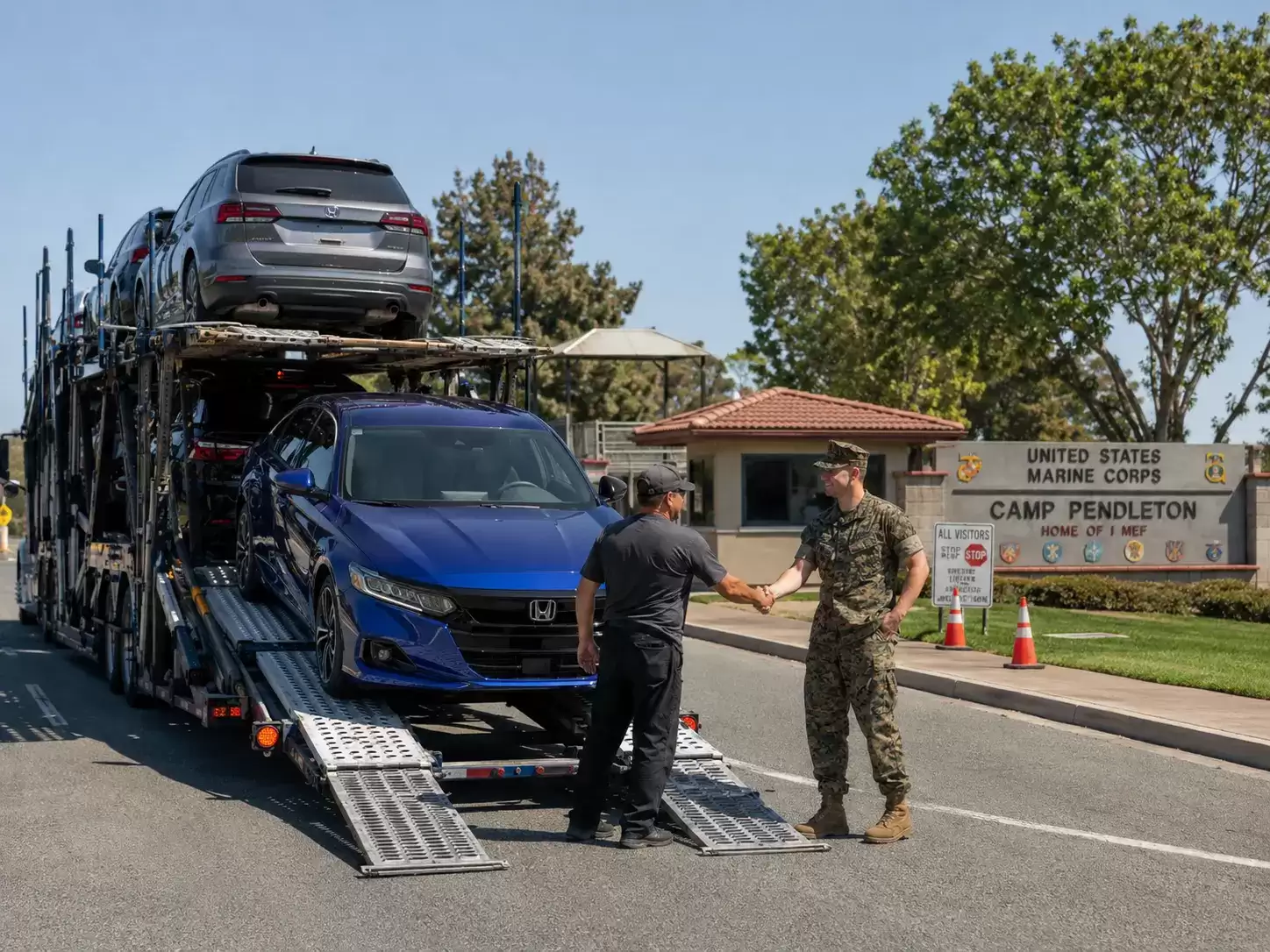
Fort Campbell (Hopkinsville / Clarksville, TN): Home of the 101st Airborne Division (Air Assault) and the Army Aviation Center of Excellence for Air Assault, Fort Campbell straddles the Kentucky-Tennessee state line with most facilities in Tennessee but the mailing address in Fort Campbell, Kentucky. Fort Campbell is one of the most active PCS installations in the United States Army, and the volume of PCS vehicle shipping demand at this installation is among the highest of any single base. Access is via US-41A from Clarksville, Tennessee — approximately 15 miles from I-24. Expedited tier is mandatory for all Fort Campbell PCS moves. Standard pickup windows at Fort Campbell extend to 10–14 business days, which is incompatible with military reporting schedules. Provide at least 7 days of lead time on Expedited; use Rush if your reporting date is within 5 days of your booking date.
Fort Knox (Radcliff / Elizabethtown): Home of the Army Armor School and the United States Bullion Depository, Fort Knox is located on I-31W approximately 35 miles south of Louisville on the I-65 corridor. The proximity to I-65 gives Fort Knox significantly better carrier access than Fort Campbell. Standard tier is appropriate for most Fort Knox PCS moves with 5–7 days of lead time; Expedited is recommended for moves with firm reporting dates. Elizabethtown and Radcliff are both within the Fort Knox carrier zone and benefit from the base’s I-65 proximity.
Blue Grass Army Depot (Richmond): An Army ammunition storage and demilitarization installation near Richmond on the I-75 south corridor. The depot is within the Lexington carrier zone; Standard tier works for Richmond area moves. Not a major PCS generator but relevant for depot employees and contractors relocating to the Richmond area.
Louisville Metro / I-65 / I-64 / I-71 Convergence Hub
Louisville is Kentucky’s largest city and its dominant auto transport hub. The I-65/I-64/I-71 convergence and Louisville’s global logistics infrastructure produce carrier availability that ranks among the best in the Midwest. Standard tier produces 1–3 business day pickup windows for all Louisville metro zip codes. The Watterson Expressway (I-264) and the Gene Snyder Freeway (I-265) give carrier trucks efficient access to all Louisville suburban communities without entering downtown Louisville traffic.
Jeffersontown, St. Matthews, Middletown, and Shively are Louisville east and west suburban communities within the I-264/I-265 beltway and benefit from Louisville’s carrier coverage. Standard tier appropriate; same pickup windows as Louisville proper.
New Albany and Clarksville, Indiana are across the Ohio River from Louisville and functionally part of the same metro carrier market. Standard tier works; carriers cross the bridge routinely on Louisville area loads.
Elizabethtown sits on I-65 approximately 45 miles south of Louisville near Fort Knox. I-65 direct access makes Elizabethtown well-served; Standard tier appropriate with 2–4 business day pickup windows.
Lexington / I-75 / I-64 / Bluegrass Region Toyota Corridor
Lexington is Kentucky’s second-largest city and the heart of the Bluegrass horse country, sitting at the I-64/I-75 convergence. The University of Kentucky and the Toyota Georgetown plant (10 miles north on I-75) generate sustained carrier demand year-round. Standard tier is appropriate with 2–4 business day pickup windows. The New Circle Road (KY-4) beltway gives carrier trucks efficient access to all Lexington zip codes.
Georgetown is home to Toyota Motor Manufacturing Kentucky and sits directly on I-75 north of Lexington. Toyota dealer delivery traffic on I-75 north gives Georgetown above-average carrier access for its size. Standard tier appropriate.
Richmond is home to Eastern Kentucky University on I-75 south of Lexington. I-75 access; Standard tier works with 3–5 business day pickup windows.
Frankfort, the state capital, sits between Louisville and Lexington on US-60 and US-127 with I-64 access nearby. Standard tier works; allow 3–5 business days.
Northern Kentucky / Cincinnati Metro / I-75 / I-71 / I-275
Covington, Newport, Florence, and Erlanger are Northern Kentucky cities that function as Cincinnati suburbs on the south side of the Ohio River. I-75, I-71, and I-275 pass through this area, and Northern Kentucky shippers access Cincinnati’s massive carrier infrastructure directly. Standard tier produces 1–3 business day pickup windows — some of the best in Kentucky — because Cincinnati is a major carrier distribution hub. Carriers staging in Cincinnati for Ohio Valley loads are readily available for Northern Kentucky pickups.
Bowling Green / I-65 / South-Central Kentucky
Bowling Green sits on I-65 between Louisville (110 miles north) and Nashville (65 miles south), giving it access to both directions of the most active north-south carrier corridor in the central United States. Western Kentucky University’s enrollment and the National Corvette Museum (which attracts a small but consistent vehicle enthusiast shipping market) contribute to year-round carrier activity. Standard tier appropriate; pickup windows average 2–3 business days — faster than most comparably sized cities given I-65 positioning.
Glasgow and Franklin are small south-central Kentucky communities near the Tennessee state line on US-31E and I-65, respectively. Standard tier works for I-65-adjacent Franklin; Expedited recommended for Glasgow and off-corridor south-central Kentucky communities.
Paducah / Owensboro / Western Kentucky
Paducah is at the confluence of the Ohio and Tennessee Rivers in western Kentucky, accessible via I-24 from Nashville and the Midwest. I-24 gives Paducah reasonable carrier access for its size; Standard tier usually works with 3–5 business day pickup windows. Expedited for time-sensitive moves.
Owensboro is western Kentucky’s largest city on the Ohio River, accessible via US-60 and US-431. Without direct interstate access, Owensboro requires carriers to detour from I-64 (approximately 35 miles south) or I-65 (approximately 60 miles east). Expedited is recommended for Owensboro; Standard pickup windows average 5–8 business days.
Hopkinsville and the Fort Campbell corridor are discussed above in the Military section. Expedited mandatory for all Fort Campbell area shipments regardless of whether the address is on-post or in Hopkinsville proper.
Eastern Kentucky / Appalachian Region
Pikeville, Hazard, Paintsville, and other eastern Kentucky communities in the Appalachian coalfields are accessible via US-23, US-119, and the Mountain Parkway (KY-9002), which connects to I-64 near Owingsville. There is no interstate serving most of eastern Kentucky, and carriers must navigate mountain highways to reach these communities. Expedited tier is mandatory for all eastern Kentucky shipments, and pickup windows of 7–14 business days even on Expedited are common. Budget 2 weeks of lead time for eastern Kentucky moves and consider staging your vehicle in Lexington if your schedule allows — the pickup window from Lexington will be dramatically shorter than from Pikeville or Hazard directly.

Kentucky government resources for auto transport consumers
- Kentucky Transportation Cabinet — Vehicle Licensing — Vehicle title transfers, registration, and license plate information for vehicles shipped to Kentucky.
- Kentucky Office of the Attorney General — Consumer Protection — File a complaint or check the status of an auto transport company operating in Kentucky.
- FMCSA SAFER System — Verify any auto transport carrier’s USDOT number, operating authority, and safety rating before booking.
- FMCSA Protect Your Move — Federal consumer protection resources and guidance for vehicle shipping, including how to identify and avoid broker fraud.
- Kentucky 511 — Road Conditions and Travel Information — Real-time traffic, road conditions, and incident information for I-65, I-64, I-75, and all major Kentucky carrier routes.

Popular long-distance car shipping routes from Kentucky
Kentucky to Florida auto transport
The Kentucky-to-Florida corridor covers approximately 900 miles via I-65 south from Louisville through Nashville, Birmingham, and Montgomery to Florida. This is Kentucky’s most active long-distance route, driven by the I-65 snowbird corridor and the steady stream of Kentucky retirees relocating to Florida’s Gulf Coast and Atlantic coast. Transit time is 4–6 days. October through December is the most competitive season for southbound moves on this corridor, when carrier supply is amplified by the Midwest snowbird wave passing through Kentucky on I-65.
Kentucky to California car shipping
The Kentucky-to-California corridor covers approximately 2,400 miles via I-65 south and I-10 west through Texas, New Mexico, and Arizona, or via I-64 west and I-70 through St. Louis and Kansas City. Transit time is 7–10 days. Expedited tier is recommended for Kentucky-to-California moves given the distance and the number of carrier handoffs on a transcontinental route.
Kentucky to Ohio vehicle transport
The Kentucky-to-Ohio corridor covers approximately 300 miles via I-75 north through Cincinnati to Columbus and Cleveland, or via I-71 north from Louisville to Cincinnati and Columbus. Cincinnati is a major carrier hub and the effective gateway between Kentucky and Ohio, and the I-75/I-71 corridor north of Cincinnati is one of the most carrier-dense routes in the Midwest. Transit time is 2–3 days; Standard tier works well for most Kentucky-to-Ohio moves.
Kentucky to Tennessee auto shipping
The Kentucky-to-Tennessee corridor runs approximately 175 miles via I-65 south from Louisville to Nashville or via I-75 south from Lexington through Knoxville. Nashville is a major carrier hub with exceptional connectivity, and the Louisville-to-Nashville segment on I-65 is one of the most carrier-active short-haul routes in the South. Transit time is 1–2 days; Standard tier almost always delivers within 2–3 business days pickup in Louisville and Bowling Green.
Kentucky to Georgia car hauling
The Kentucky-to-Georgia corridor covers approximately 550 miles via I-75 south from Lexington through Knoxville to Atlanta, or via I-65 south to Nashville and I-24 to Chattanooga. Atlanta is the largest carrier hub in the Southeast, and the I-75 south corridor from Lexington to Atlanta is well-traveled. Transit time is 3–4 days; Standard or Expedited depending on your destination and schedule.
Kentucky to North Carolina vehicle shipping
The Kentucky-to-North Carolina corridor covers approximately 550 miles via I-75 south to Knoxville and I-81 northeast to Virginia and I-77/I-85 south into the Carolinas, or via I-64 east through Virginia. The Charlotte and Raleigh-Durham markets are strong carrier destinations. Transit time is 3–4 days; Expedited recommended for North Carolina moves with firm delivery dates.
Kentucky to New York auto carrier
The Kentucky-to-New York corridor covers approximately 850 miles via I-64 east to I-81 north through Virginia and the Shenandoah Valley to I-78 east to New York City, or via I-71 north to Cleveland and I-90 east. New York is the largest carrier destination in the northeastern United States. Transit time is 3–5 days; Expedited recommended for New York metro area moves.
Kentucky to Illinois car transport
The Kentucky-to-Illinois corridor covers approximately 350 miles via I-65 north from Louisville to Indianapolis and US-41 northwest, or via I-24 northwest from Paducah toward St. Louis and Chicago. Chicago is a major carrier hub with excellent connections throughout the Midwest. Transit time is 2–3 days; Standard tier works for Chicago and northern Illinois destinations.
Kentucky to Indiana vehicle relocation
The Kentucky-to-Indiana corridor runs approximately 175 miles via I-65 north from Louisville to Indianapolis. Louisville and Indianapolis are both Tier 1 carrier markets on I-65, and the corridor between them is one of the most carrier-dense short-haul routes in the Midwest. Transit time is 1–2 days; Standard tier delivers quickly with competitive rates year-round on this corridor.
Kentucky to Texas auto shipping
The Kentucky-to-Texas corridor covers approximately 1,050 miles via I-65 south to Nashville and I-40 west to Little Rock and Dallas, or via I-65 south to Birmingham and I-20 west. Texas is the second-largest single-state carrier market in the United States after California. Transit time is 4–6 days; Expedited is recommended for Texas moves from Kentucky.
Kentucky to Virginia vehicle hauling
The Kentucky-to-Virginia corridor covers approximately 450–600 miles via I-64 east through Lexington to Richmond and Northern Virginia. I-64 is the primary carrier route for Kentucky-to-Virginia moves, and Richmond and Northern Virginia are significant carrier destinations on the East Coast. Transit time is 3–4 days; Standard or Expedited depending on your Virginia destination and schedule.
Kentucky to Michigan car carrier
The Kentucky-to-Michigan corridor covers approximately 500 miles via I-75 north through Cincinnati to Detroit, or via I-65 north to Indianapolis and I-69 north to Michigan. Detroit is the American automotive capital and one of the most carrier-active markets in the Midwest. Transit time is 3–4 days; Standard tier works well for Detroit-area moves from Louisville and Lexington.

Nearby states for Kentucky auto transport
Tennessee auto transport
Tennessee borders Kentucky to the south and is the most active carrier partner for the Louisville and Bowling Green markets on I-65. Nashville is a major carrier hub with connections throughout the South, and the Louisville-to-Nashville segment is one of the most competitively priced short-haul corridors in the country. Fort Campbell straddles the Kentucky-Tennessee line and generates significant PCS carrier activity in Clarksville. Standard tier delivers quickly for Tennessee moves from I-65 corridor Kentucky cities; Lexington-to-Knoxville on I-75 is also a well-served route.
Ohio car shipping
Ohio borders Kentucky to the north, and Northern Kentucky functions as part of the greater Cincinnati-Columbus carrier market. I-75 north from Lexington through Cincinnati to Columbus and Cleveland, and I-71 north from Louisville through Cincinnati, give Kentucky shippers excellent access to Ohio’s carrier network. Columbus, Cleveland, and Cincinnati are all major carrier hubs; Standard tier produces fast pickup for Ohio moves from Louisville and Northern Kentucky. Expedited is recommended for Ohio moves from Lexington and southeast Kentucky destinations.
Indiana vehicle shipping
Indiana borders Kentucky to the north and northwest, with Louisville directly across the Ohio River from Jeffersonville and New Albany, Indiana. I-65 north from Louisville reaches Indianapolis in approximately two hours, and I-64 west from Louisville reaches Evansville. The Louisville-Indianapolis corridor on I-65 is one of the most carrier-active short-haul routes in the Midwest, with pickup windows that often match or beat standard urban expectations. Standard tier appropriate for most Kentucky-to-Indiana moves.
Illinois car hauling
Illinois borders Kentucky to the northwest, accessible via I-24 northwest from Paducah toward St. Louis and Chicago. Chicago is the largest carrier hub in the Midwest, and while Kentucky’s I-24 connection to Illinois is not as direct as Indiana’s I-65 corridor, the route is still well-traveled. Standard tier works for Chicago moves from western Kentucky on I-24; Expedited for Louisville-to-Chicago moves that must route through Indianapolis. Transit time is 3–5 hours of driving and typically 2–4 transit days.
Virginia auto shipping
Virginia borders Kentucky to the east, accessible via I-64 east from Louisville through Lexington, Frankfort, and across the West Virginia mountains into Richmond and Northern Virginia. I-64 east through the Appalachian highlands involves mountain passes that can see weather delays in winter but is a direct and well-traveled carrier route. Northern Virginia and the Washington DC metro area are high-demand carrier destinations year-round. Expedited is recommended for Virginia moves from Kentucky; Standard works with adequate lead time for Louisville and Lexington origins.
West Virginia vehicle transport
West Virginia borders Kentucky to the east and northeast, accessible via I-64 east and US-119/US-23 from eastern Kentucky. West Virginia is a secondary carrier market with limited interstate coverage, and most Kentucky-to-West Virginia moves require carriers to navigate Appalachian mountain highways. Expedited is strongly recommended for all West Virginia destinations; Charleston on I-64 and I-77 is the most carrier-accessible West Virginia city from Kentucky. Budget extra lead time for western West Virginia destinations that require mountain highway routing.

Ready to ship your car to or from Kentucky?
Join hundreds of thousands of customers — Snowbirds, military families, tech relocators, students, and families moving across the country — who have trusted Direct Express Auto Transport with their Kentucky vehicle shipments since 2004. Get your instant, no-obligation quote now. It takes 30 seconds, requires no personal information, and there is no upfront payment required to hold your spot.
Instant quote — real-time pricing in under 5 seconds
No upfront payment — your card is charged only when a carrier is assigned
No risk to get a quote and book your order
BBB Accredited A+ since 2004
FMCSA licensed and fully bonded
4.6 stars across thousands of verified Google reviews